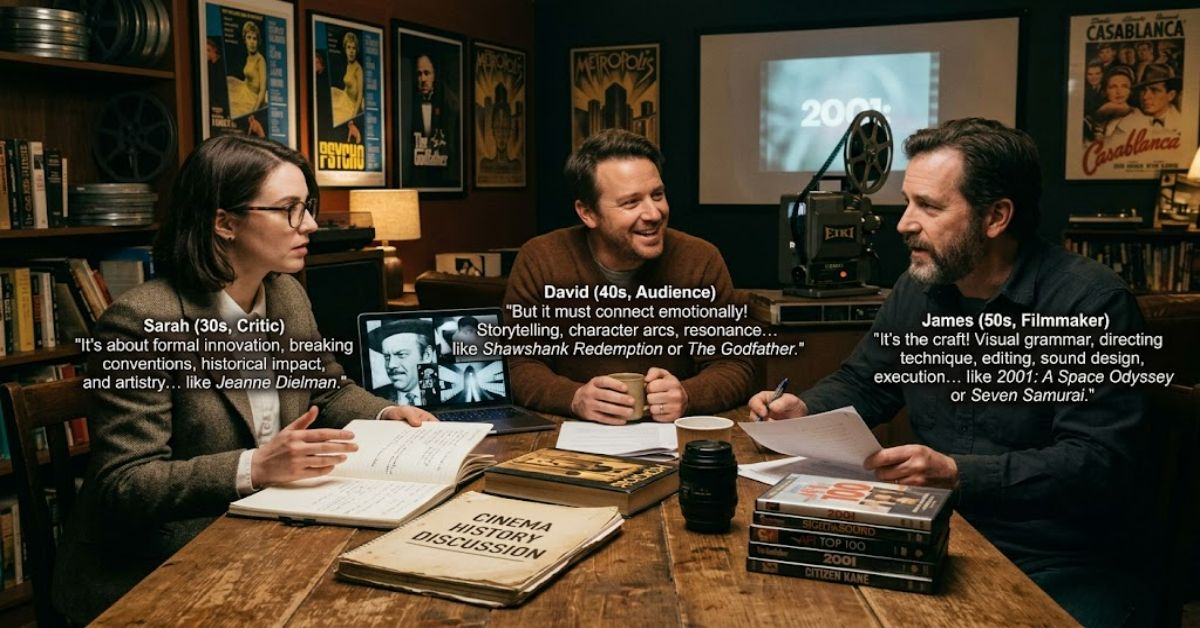
The best movies of all time are not necessarily the films with the highest audience ratings, the biggest box-office figures or the most awards. “Greatness” in cinema can mean technical innovation, cultural influence, emotional power, historical importance, critical acclaim or simply the ability to remain compelling decades after release.
That is why three major sources can produce very different pictures of cinematic achievement. The British Film Institute’s Sight and Sound poll is based on votes from critics and filmmakers, while IMDb’s Top 250 reflects ratings from regular users. Rotten Tomatoes uses a formula combining critics’ reviews, audience votes, the number of reviews and other factors.
The difference is more than statistical. It reveals that cinema has several overlapping canons.
In the 2022 Sight and Sound critics’ poll, Chantal Akerman’s Jeanne Dielman, 23 quai du Commerce, 1080 Bruxelles took first place, followed by Alfred Hitchcock’s Vertigo, Orson Welles’s Citizen Kane and Yasujiro Ozu’s Tokyo Story. The filmmakers’ poll produced another result, with Stanley Kubrick’s 2001: A Space Odyssey at the top.
By contrast, IMDb’s current Top 250 is led by The Shawshank Redemption, The Godfather and The Dark Knight. Rotten Tomatoes’ current all-time list places The Godfather first, followed by Seven Samurai and Casablanca.
The useful question, therefore, is not simply which film is number one. It is why particular films continue to matter.
What Makes a Film an All-Time Great?
A lasting film usually succeeds on more than one level. It may introduce a new visual language, influence generations of filmmakers, capture a historical moment or remain emotionally accessible long after its original audience has disappeared.
Consider Citizen Kane. Released in 1941, Orson Welles’s film remains important partly because of its formal experimentation, including its use of deep focus, unconventional narrative structure and ambitious sound design. The BFI continues to identify it as a major work in cinematic history, while the 2022 Sight and Sound critics’ poll placed it third.
The Godfather demonstrates a different kind of durability. Francis Ford Coppola’s 1972 crime drama appears near the top of both critic-oriented and audience-oriented measurements. Rotten Tomatoes currently places it first in its all-time list, while IMDb users place it second.
That overlap is significant. It suggests that some films bridge the gap between academic film culture and mass audience appreciation.
Three Different Measures of Greatness
| Measure | What it tends to value | Example source |
| Critical canon | Innovation, influence, formal achievement and historical importance | BFI Sight and Sound |
| Audience popularity | Overall viewer satisfaction and sustained popularity | IMDb |
| Combined critical and audience response | Critics, audience approval and review volume | Rotten Tomatoes |
No method is neutral. Each is designed around a particular definition of value.
Films That Consistently Cross the Divide
Some films appear repeatedly because they satisfy several definitions of cinematic achievement at once.
The Godfather — 1972
Coppola’s The Godfather is one of the clearest examples. It is highly regarded for its direction, performances, cinematography, editing and treatment of power and family. Its presence near the top of IMDb and Rotten Tomatoes demonstrates its enduring audience appeal as well as critical status.
Its influence is also unusually broad. The film changed expectations around the gangster genre, turning organised crime into the setting for an extended family drama about succession, loyalty and moral transformation.
Citizen Kane — 1941
Citizen Kane has a different profile. Its position is particularly strong within film scholarship and critical history. The 2022 Sight and Sound critics’ poll placed it third, while the directors’ poll placed it second.
Its reputation demonstrates an important distinction: a film can remain historically influential even when contemporary audiences may not rank it first in entertainment value.
Seven Samurai — 1954
Akira Kurosawa’s Seven Samurai also demonstrates cinema’s international reach. Rotten Tomatoes currently places it second on its all-time list, while Sight and Sound ranked it 20th in the 2022 critics’ poll.
Its influence extends far beyond Japan. Its ensemble structure, character archetypes and action staging helped establish techniques later adapted by filmmakers working in Hollywood and elsewhere.
The Shawshank Redemption — 1994
The Shawshank Redemption illustrates the strength of audience consensus. IMDb currently places it first in the Top 250, with a 9.3 rating from roughly 3.2 million ratings.
Its position is particularly revealing because it is not the sort of film usually associated with experimental cinema or formal modernism. Its enduring strength comes largely from narrative construction, performances, character relationships and themes of hope, institutional power and perseverance.
What the Major Rankings Actually Tell Us
The most useful comparison is not a single combined ranking but the pattern of overlap and disagreement.
| Film | IMDb Top 250 | Sight and Sound 2022 Critics | Rotten Tomatoes All-Time List |
| The Godfather | 2 | 12 | 1 |
| Citizen Kane | High-ranking title | 3 | Not top 10 |
| Seven Samurai | High-ranking title | 20 | 2 |
| The Shawshank Redemption | 1 | Not top 20 | Not top 10 |
| 2001: A Space Odyssey | High-ranking title | 6 | Outside top group |
| Singin’ in the Rain | High-ranking title | 10 | 14 |
Ranking positions reflect the published lists available at the time of research and can change on user-driven platforms.
This table exposes a useful limitation in the phrase “best movie”. There is no universal measurement. A film can dominate one constituency while occupying a much lower position in another.
The BFI itself has acknowledged that its poll represents a particular cinematic canon rather than an objective mathematical truth. Its 2022 analysis highlighted how the expanded electorate changed the diversity of the list, including more films directed by women and Black filmmakers.
Why the BFI Poll Matters
The Sight and Sound poll has been conducted once every decade since 1952. Its historical record shows that the idea of cinematic greatness changes.
Citizen Kane dominated the critics’ poll for decades before Vertigo displaced it in 2012. Ten years later, Jeanne Dielman moved into first place.
That progression matters because it demonstrates that a canon is not fixed.
The 2022 poll included more than 1,600 voters and nearly 4,000 nominated films. The result was also more internationally and stylistically diverse than earlier editions.
This is one of the most important findings for anyone researching great cinema: historical reputation can change as audiences, critics and institutions reconsider whose work deserves attention.
The Audience Canon Is Different
IMDb provides a useful counterpoint because its rankings emerge from regular users rather than a selected critical electorate. Its current Top 250 places The Shawshank Redemption, The Godfather, The Dark Knight, The Godfather Part II and The Lord of the Rings: The Return of the King among the leading films.
That list favours films with strong narrative appeal, accessible genres and large international audiences.
It does not make the list less meaningful. It measures something different.
Audience rankings can reveal which films have developed unusually strong popular followings. Critical polls, meanwhile, can reward formal experimentation and historical influence even when a film has a smaller general audience.
The two systems should therefore be read alongside each other rather than treated as competing authorities.
Three Insights About Cinematic Greatness
| Insight | Evidence and implication |
| Greatness changes over time | Citizen Kane, Vertigo and Jeanne Dielman successively occupied the top of the Sight and Sound critics’ canon across different periods. |
| Audience and critic canons overlap selectively | The Godfather performs strongly in both IMDb and Rotten Tomatoes while also ranking in the Sight and Sound top 20. |
| International cinema has become more visible | The 2022 Sight and Sound top 20 includes films from Japan, Iran, France, Belgium, Italy, Russia and Hong Kong alongside major American works. |
These patterns provide more useful information than simply copying a “top 100” list.
The Future of Best Movies of All Time in 2027
By 2027, the conversation around great cinema is likely to remain shaped by streaming access, repertory cinema, restoration and changing critical perspectives.
The BFI’s 2025 retrospective on the Sight and Sound poll described its role in international film culture and highlighted how rankings can influence screenings, releases, publishing and film discussion.
Digital access also changes which films can realistically enter the cultural conversation. A film that was previously difficult to see can become widely available through restoration, specialist streaming services or home-video releases.
The more interesting shift, however, is likely to be canonical rather than technological. The 2022 poll already showed greater representation of women filmmakers and Black filmmakers, alongside a broader international range of cinema.
That does not mean older films disappear from the canon. Instead, the definition of essential cinema can expand.
The result may be less agreement around one definitive “greatest film” and more recognition that different cinematic traditions produce different forms of excellence.
Key Takeaways
- A single all-time ranking cannot capture every definition of cinematic greatness.
- The Godfather is an unusually strong example of overlap between critical and audience recognition.
- Citizen Kane demonstrates how historical influence can outlast changes in audience taste.
- The Shawshank Redemption shows the power of sustained audience approval.
- The BFI’s decade-by-decade poll demonstrates that the cinematic canon changes as its electorate changes.
- International and previously underrepresented filmmakers have become more visible in major critical surveys.
- Comparing methodologies is more informative than treating any single list as definitive.
Conclusion
The best movies of all time are better understood as a conversation than a fixed ranking. Critics may prioritise formal innovation and historical influence, audiences may value emotional connection and storytelling, while filmmakers may focus on craft, visual language and the possibilities of the medium.
The major lists demonstrate this difference clearly. The Shawshank Redemption leads IMDb’s current audience-driven chart, The Godfather leads Rotten Tomatoes’ combined list, and Jeanne Dielman occupies the top position in the 2022 Sight and Sound critics’ poll.
None of these results cancels out the others. They answer different questions.
What makes the strongest films endure is often their ability to remain relevant after their original cultural moment has passed. Some transform filmmaking technique. Others reshape genres. Some become deeply personal audience favourites. A small number manage several of these achievements simultaneously.
That is why cinema’s greatest works continue to be debated. The disagreement is not a weakness of the canon. It is evidence that film remains an art form whose value cannot be reduced to one number.
FAQ
What are considered the best movies of all time?
Frequently cited films include The Godfather, Citizen Kane, Vertigo, Seven Samurai, 2001: A Space Odyssey, The Shawshank Redemption, Tokyo Story and Singin’ in the Rain. Different lists produce different selections because they use different audiences and methodologies.
What is the number one movie of all time on IMDb?
At the time of research, IMDb’s Top 250 lists The Shawshank Redemption as number one, followed by The Godfather and The Dark Knight. IMDb’s ranking is based on ratings from regular users and can change over time.
What is the greatest film according to Sight and Sound?
The 2022 Sight and Sound critics’ poll placed Chantal Akerman’s Jeanne Dielman, 23 quai du Commerce, 1080 Bruxelles first. The filmmakers’ poll instead placed Stanley Kubrick’s 2001: A Space Odyssey first.
Which classic films are still highly regarded today?
Citizen Kane, The Godfather, Seven Samurai, Vertigo, Tokyo Story and Singin’ in the Rain continue to appear prominently across major critical or audience-focused film lists.
Why do critics and audiences rank movies differently?
Critics may place greater emphasis on cinematic technique, historical importance and formal innovation. Audience rankings tend to reflect personal enjoyment and emotional response. Each method therefore measures a different form of appreciation.
Has the definition of a great movie changed?
Yes. The history of the Sight and Sound poll demonstrates significant changes in critical taste. Films directed by women and filmmakers from previously underrepresented groups have gained greater representation in recent editions.
Methodology
This article best movies of all time compares three major approaches to evaluating cinema: the BFI’s Sight and Sound critics’ and directors’ polls, IMDb’s user-driven Top 250 and Rotten Tomatoes’ combined critics-and-audience list. The rankings and methodologies were checked against the current or most recently published source pages available during research.
The analysis deliberately avoids presenting one ranking as an objective verdict. The sources measure different populations and use different methodologies, so direct numerical comparison has limitations.
The article best movies of all time also uses documented historical examples to examine how the cinematic canon has changed. Particular attention was given to the 2022 Sight and Sound poll because it provides a useful longitudinal perspective on changes in critical taste.
No personal film viewing, private screening test or firsthand audience survey was conducted for this article. The named examples and ranking information should therefore be treated as source-based evidence rather than first-person experience.
This article best movies of all time was drafted with AI assistance and should be reviewed and verified by a human editor before publication. All dates, rankings and citations should be independently checked against the original sources.
References
British Film Institute. (2022, 1 December). Revealed: The results of the 2022 Sight and Sound Greatest Films of All Time poll. BFI.
British Film Institute. (2022, 1 December). the best movies of all time: Jeanne Dielman, 23 quai du Commerce, 1080 Bruxelles. Sight and Sound.
British Film Institute. (2025, 14 July). Sight and Sound presents the Greatest Films of All Time. BFI.
British Film Institute. (2021). The 100 Greatest Films of All Time 2012. Sight and Sound.
British Film Institute. (2021). How we made the Greatest Films of All Time poll. Sight and Sound.
IMDb. (2026). IMDb Top 250 movies. IMDb Charts. Accessed 29 September 2026.
Rotten Tomatoes. (2025, 15 December). 300 Best Movies of All Time. Fandango Media.