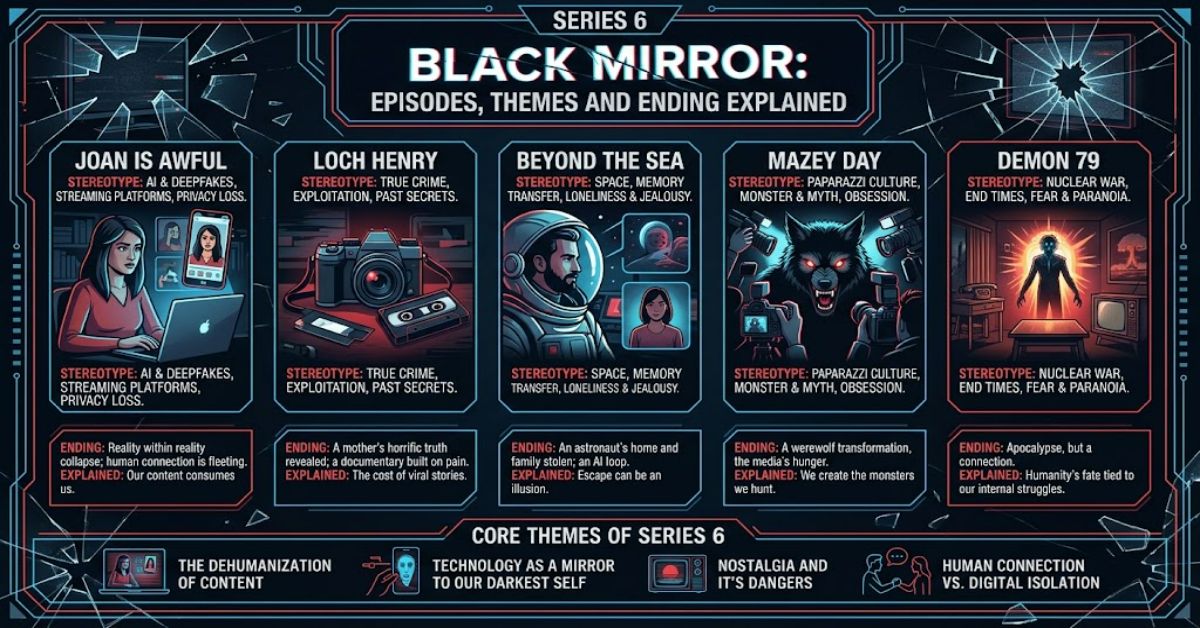
Series 6 of Black Mirror premiered on Netflix on 15 June 2023, marking a notable shift in Charlie Brooker’s acclaimed anthology series. Across five episodes, the season moves beyond its familiar focus on dystopian technology to explore celebrity culture, true-crime entertainment, historical horror and the darker sides of human ambition.
Unlike a conventional drama, Black Mirror does not follow one continuing cast or storyline. Each episode introduces new characters and a different setting, allowing the series to examine a particular social concern through a self-contained narrative. Technology remains important, but it is no longer the only source of fear. Sometimes the real threat comes from the people who build systems, the audiences who consume their output or the institutions that profit from human suffering.
The sixth season includes Joan Is Awful, Loch Henry, Beyond the Sea, Mazey Day and Demon 79. Their stories range from an ordinary woman’s discovery that a streaming service is dramatising her life to a remote Scottish town haunted by a disturbing past. Other episodes explore isolation in space, the pressures of celebrity photography and an apocalyptic supernatural bargain.
This change in tone makes Season 6 especially interesting. It asks whether society’s most unsettling inventions are always digital, or whether technology simply gives older human weaknesses greater reach. The result is a varied season that sometimes divides viewers but expands the creative boundaries of the franchise.
Black Mirror Season 6 Episode Guide
The season’s five episodes differ in setting, genre and storytelling style. Together, they explore the relationship between power and vulnerability, showing how ordinary people can become trapped by systems they cannot fully control.
| Episode | Main theme | Storytelling style |
| Joan Is Awful | Data privacy and streaming culture | Satirical science fiction |
| Loch Henry | True crime and exploitation | Psychological thriller |
| Beyond the Sea | Grief, isolation and identity | Science fiction drama |
| Mazey Day | Celebrity privacy and paparazzi | Supernatural horror |
| Demon 79 | Prejudice, morality and fate | Retro horror comedy |
1. Joan Is Awful
The opening episode follows Joan, played by Annie Murphy, who discovers that a streaming service called Streamberry is broadcasting a fictionalised version of her daily life. Salma Hayek plays the celebrity version of Joan in the programme.
The unsettling premise develops into a satire of personal data collection, consent and generative technology. Joan’s experiences are transformed into entertainment, while the distinction between real events and their digital representation becomes increasingly difficult to maintain.
The episode’s central insight is that accepting lengthy terms and conditions does not necessarily mean understanding the consequences. Its fictional technology exaggerates concerns about automated content generation and the commercial use of private information.
2. Loch Henry
Set in a Scottish town, Loch Henry follows aspiring documentary filmmakers Davis and Pia as they investigate a disturbing local murder case.
Their project begins as a historical documentary but becomes a commercially attractive true-crime story. The revelations force Davis to confront painful memories and the consequences of exposing his community’s past.
This episode is less concerned with futuristic inventions than with the ethics of entertainment. It asks whether a compelling documentary can justify reopening trauma, exploiting victims or turning real suffering into a marketable product.
3. Beyond the Sea
In an alternate version of 1969, astronauts David and Cliff use advanced replicas of their bodies to spend time with their families while working in space.
The technology offers emotional comfort during an isolated mission, but a violent tragedy transforms its benefits into a source of psychological conflict. David’s grief and Cliff’s complicated response to sharing access to his replica create a tense examination of intimacy, trust and control.
The episode’s strength lies in its contrast between technological progress and emotional fragility. Even a machine capable of reproducing human appearance and movement cannot guarantee safety, healthy relationships or emotional recovery.
4. Mazey Day
This episode follows paparazzo Bo, who becomes involved in the pursuit of a troubled actress named Mazey Day. The story initially examines the commercial pressures that encourage photographers to invade celebrities’ private lives.
However, the narrative takes a supernatural turn that changes its genre. Some viewers may find the shift refreshing, while others may feel that it interrupts the episode’s exploration of celebrity culture.
Its underlying question remains relevant: how far should people go for an exclusive image, particularly when someone is clearly vulnerable?
5. Demon 79
The final episode moves to northern England in 1979. Nida, a shop assistant played by Anjana Vasan, encounters a supernatural figure who tells her that she must commit three murders to prevent an apocalypse.
Blending dark comedy with period horror, the story explores prejudice, desperation and moral responsibility. Its historical setting also gives the narrative room to examine social tensions without relying on futuristic devices.
Demon 79 stands apart from traditional Black Mirror episodes, but its focus on power, fear and human judgement connects it to the wider series.
Why Season 6 Takes a Different Direction
Earlier seasons often presented technology as the main mechanism behind social collapse. Season 6 broadens this approach by treating entertainment industries, social expectations and human impulses as equally important sources of harm.
Three details make this shift particularly significant.
First, Joan Is Awful depicts data consent as a problem of power, not merely a technical setting. A person may agree to a service without having meaningful control over how their behaviour is transformed into entertainment.
Second, Loch Henry suggests that even older recording technologies can enable exploitation. Cameras, videotapes and documentary editing are enough to create ethical problems, demonstrating that harmful incentives do not require artificial intelligence.
Third, Beyond the Sea separates technical capability from emotional wellbeing. The astronauts’ replicas function as extraordinary tools, but their existence does not remove grief, jealousy or the need for trust.
These distinctions explain why the season feels broader than a conventional science-fiction anthology. Its central concern is not simply what technology might do in the future, but how existing human weaknesses can shape the use of powerful tools.
Cultural Impact and Critical Reception
The sixth season received mixed but engaged responses from critics. Some praised its willingness to experiment with genre, while others argued that the departure from technological dystopia weakened the show’s distinctive identity. Reviews in The Independent and Time highlighted this tension between creative reinvention and the expectations established by earlier seasons.
The trade-off is clear. Horror and period drama allow Black Mirror to explore different fears, but they can also make its social commentary less focused. Beyond the Sea preserves the emotional depth associated with the series, while Mazey Day takes a more abrupt creative turn.
The Future of Black Mirror in 2027
By 2027, the season’s questions about generative AI, personal data and streaming culture remain relevant. The European Union’s AI Act, adopted in 2024, also demonstrates that AI transparency and accountability have become concrete policy concerns rather than purely fictional themes.
However, it would be misleading to treat every fictional scenario as a prediction. Real-world AI systems have specific capabilities and limitations, while the technology in Joan Is Awful is deliberately exaggerated for dramatic effect.
The season’s longer-term importance may therefore lie in its approach to storytelling. By moving between science fiction, comedy and horror, Black Mirror can examine new social anxieties without relying on the same technological formula. Whether future instalments maintain this balance depends on the strength of their characters and ideas, not simply the novelty of their concepts.
Key Takeaways
- Genre experimentation: Season 6 combines science fiction, psychological suspense and supernatural horror.
- Privacy and consent: Joan Is Awful questions how personal information can be converted into profitable entertainment.
- Ethical storytelling: Loch Henry examines the cost of turning real suffering into a documentary product.
- Emotional vulnerability: Beyond the Sea shows that advanced technology cannot eliminate grief or interpersonal conflict.
- Celebrity culture: Mazey Day highlights the tension between public curiosity and personal privacy.
- Historical perspective: Demon 79 uses 1970s Britain to explore prejudice, morality and fear.
- Creative risk: The season’s varied approach expands the anthology’s possibilities but may not satisfy viewers seeking traditional technological dystopias.
Conclusion
Black Mirror Season 6 is an ambitious, uneven and often thought-provoking addition to Charlie Brooker’s anthology. Its five episodes explore different forms of power, from streaming platforms that monetise private lives to social environments that reward cruelty and systems that fail to protect vulnerable people.
The shift towards supernatural horror and period drama will not appeal to every viewer. Those expecting every episode to centre on futuristic technology may find some stories less recognisable than earlier instalments. Yet the change also reveals the flexibility of the series’ central idea: society’s darkest problems do not always begin with machines.
The strongest episodes connect imaginative storytelling with recognisable ethical dilemmas. Joan Is Awful questions digital consent, Loch Henry challenges the morality of true-crime entertainment, and Beyond the Sea explores the limits of technological solutions to human suffering.
Ultimately, Season 6 succeeds most when its unusual premises illuminate familiar weaknesses. Its value lies not in predicting the future with precision, but in encouraging viewers to question the systems, incentives and cultural habits they already accept.
Frequently Asked Questions
1. When did Black Mirror Season 6 come out?
Season 6 premiered on Netflix on 15 June 2023. It contains five standalone episodes created under Charlie Brooker’s direction as the series’ creator.
2. How many episodes are in Series 6 of Black Mirror?
There are five episodes: Joan Is Awful, Loch Henry, Beyond the Sea, Mazey Day and Demon 79.
3. What is the best episode of Black Mirror Season 6?
That depends on personal taste. Beyond the Sea appeals to viewers who enjoy emotional science fiction, while Loch Henry offers a disturbing psychological thriller. Demon 79 is a strong choice for those who prefer dark comedy and supernatural horror.
4. Is Series 6 Black Mirror based on real events?
The stories are fictional. However, their themes draw on real concerns about data privacy, celebrity intrusion, media ethics and the commercial exploitation of personal information.
5. Why is Series 6 Black Mirror different from earlier seasons?
It experiments more openly with horror, historical settings and supernatural storytelling. Technology remains important, but it is no longer the central focus of every episode.
6. Is Series 6 Black Mirror suitable for children?
The season is intended for mature audiences. It includes violence, disturbing themes, strong language and psychological horror. Parents should check Netflix’s current regional age ratings and episode information before deciding whether it is appropriate.
References
- Bentley, J. (2024, 29 April). Black Mirror Season 6 Reinvents Itself. Netflix Tudum.
- Loofbourow, L. (2023, 15 June). Black Mirror turns from the future to rewrite the past. The Washington Post.
- Netflix. (2023, 26 April). Black Mirror returns with sixth season. About Netflix.
- What Even Is Black Mirror Anymore? (2023, 15 June). Time.
Methodology
This article Series 6 Black Mirror draws on Netflix’s official season announcements and episode descriptions, alongside contemporary reviews published by established media outlets. Episode summaries and release information were compared with these sources. The critical analysis is interpretive rather than based on firsthand production research or audience surveys. Individual responses to the season may differ, and forward-looking comments about 2027 describe plausible cultural directions rather than confirmed production plans.
This article Series 6 Black Mirror was drafted with AI assistance and should be reviewed by a human editor before publication. All citations, factual claims and editorial disclosures should be independently verified.