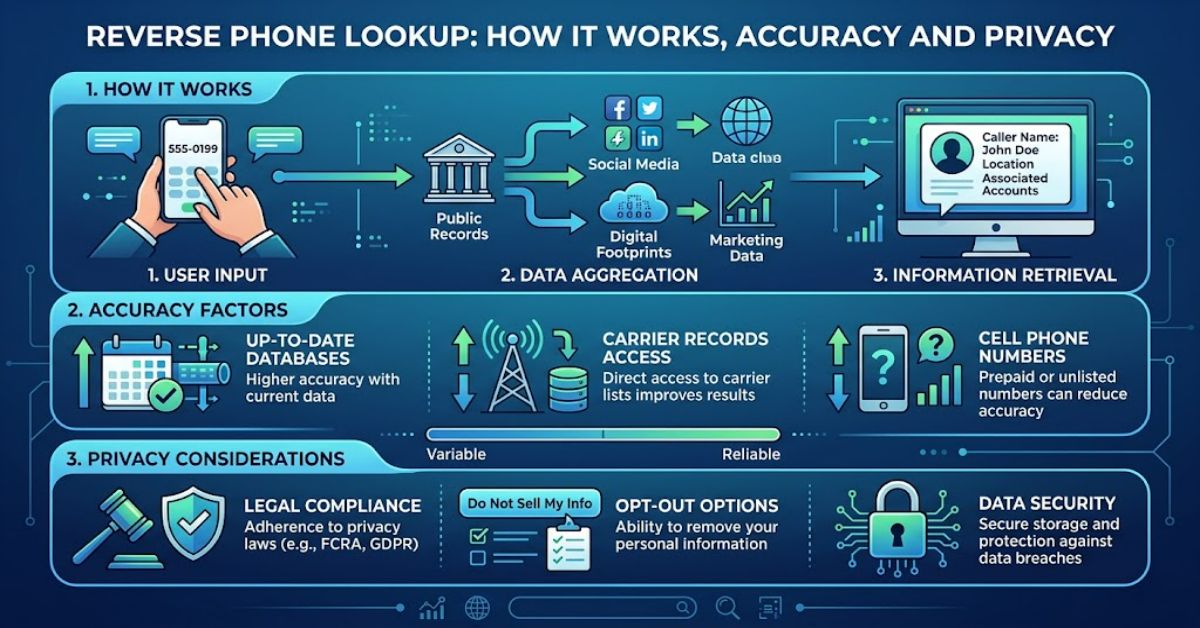
A reverse phone lookup is a service that lets someone enter a telephone number and search for information associated with it. Depending on the number and the service being used, the result might identify a business, a publicly listed subscriber, a geographic area, a carrier or reports from other users.
The important distinction is between identifying a number and identifying the person who actually called. Those are not always the same thing.
Telephone directories can contain subscriber information, while modern people-search services may combine public records, publicly available social-media information and information obtained from other data sources. The US Federal Trade Commission describes people-search sites as a type of data broker that can compile information from multiple sources into reports.
In the UK, the privacy implications are particularly important. The Information Commissioner’s Office says that telephone numbers can constitute personal data when they relate to an identifiable living individual. Its guidance on telephone directories also states that express opt-in consent is required for reverse searches that allow a person’s name and address to be found from their telephone number, subject to the scope and status of the applicable rules.
There is another complication: caller ID can be spoofed. Ofcom warns that the number displayed on a phone may not be the number actually used by the caller.
That makes a reverse search useful as an investigative lead, but not as definitive proof of identity.
How Reverse Phone Lookup Works
A reverse lookup generally works by matching a supplied number against one or more datasets.
The underlying information can come from several places:
- Public telephone directories
- Business listings
- Company websites
- Public records
- User-submitted spam reports
- Data-broker databases
- Public social-media information
- Historical directory records
- Telecommunications information
The amount of information available depends heavily on the number.
A publicly listed business number may produce a company name, address and business category. A private mobile number may return nothing useful. A landline number can sometimes provide geographic information, although number portability and modern telecommunications services make geographic assumptions less reliable than they once were.
The result can therefore range from a precise business identification to a simple message such as “no information found”.
Number Type Matters
| Number type | Potential result | Main limitation |
| Business landline | Business name and address | Information can become outdated |
| Public personal number | Subscriber information | Many individuals opt out of directories |
| Mobile number | Carrier or user reports | Subscriber identity is often unavailable |
| VoIP number | Provider or business information | Number may not indicate physical location |
| Unlisted number | Little or no information | Privacy restrictions |
| Spoofed number | Misleading identity | Displayed number may not belong to caller |
This is why the quality of a search depends more on the underlying data than on how sophisticated a lookup website appears.
What Information Can a Reverse Search Reveal?
A legitimate search may return relatively limited information. Depending on the source, that could include a name, business, approximate location, carrier, number type or reports concerning unwanted calls.
Some commercial people-search services offer considerably more information. The FTC notes that people-search businesses can combine information from data brokers, social-media profiles and public records.
That creates an important distinction between telephone-directory lookup and people-search profiling.
The first can be relatively narrow: “Who is associated with this number?”
The second can become much broader: “What other information can be assembled about this person?”
For UK users, the latter raises substantially greater privacy considerations. The ICO says that organisations obtaining personal data from other sources can have transparency obligations, including explaining the source of information and how it is being processed, subject to applicable exceptions.
Reverse Lookup Is Not the Same as Caller Verification
This is the most important limitation.
Suppose a search associates a number with a bank. That does not establish that the person calling from the displayed number works for that bank.
Ofcom specifically warns about number spoofing, in which callers manipulate the number displayed through caller ID. A spoofed number can imitate a legitimate organisation or even a real individual.
The problem has become important enough for Ofcom to introduce measures targeting spoofed UK numbers. On 29 January 2025, strengthened guidance required phone companies to block calls from abroad that falsely display UK landline numbers, with limited exceptions.
In July 2026, Ofcom further updated its approach to calls from abroad displaying UK mobile numbers.
The practical lesson is simple: a lookup result should be treated as supporting evidence, not authentication.
How Accurate Are Reverse Phone Searches?
Accuracy varies according to four main factors: data quality, data age, number type and privacy.
A business number published on an official company website is generally easier to associate with an organisation than an unlisted mobile number. A number that has changed ownership can also create historical inaccuracies.
Crowdsourced databases introduce another variable. They can be useful for identifying repeated nuisance calls because multiple users may report the same number. But a user report does not necessarily establish who owns the number.
There is also a difference between association and ownership.
A number might be associated with a company because it appeared in an old directory. It might later have been reassigned. Similarly, a personal number could appear in an online profile without proving that the current caller is the account holder.
A Practical Reliability Framework
| Result | What it can reasonably suggest | What it cannot prove |
| Official company listing | The number is publicly associated with the business | The caller is genuinely from that business |
| Multiple independent spam reports | The number has generated reported nuisance activity | Every call from the number is fraudulent |
| Directory name match | A subscriber was associated with the number | The current caller’s identity |
| Carrier information | Network or number-provider information | The person’s identity |
| Social-media match | A public profile uses or used the number | The profile owner made the call |
| No result | Little publicly available information was found | That the caller is safe or malicious |
This distinction is one of the most useful ways to avoid overinterpreting lookup results.
Privacy, Consent and UK Rules
Telephone numbers can be personal data under UK data-protection law when they relate to an identifiable individual. The ICO explicitly includes telephone numbers among information that can identify a person.
The ICO’s directory guidance is especially relevant to reverse searches. It states that organisations offering directories must tell individuals how the directory works, provide an opportunity to opt out and obtain express opt-in consent for reverse searches that allow a name and address to be obtained from a phone number. The ICO currently flags this guidance as under review following changes to UK data legislation, so organisations should check the latest regulatory position before relying on it.
This matters because “the information is publicly available” does not automatically mean “any use of the information is unrestricted”.
The purpose, source, processing activity and context can all matter.
Three Less Obvious Risks
1. A correct lookup can still produce the wrong conclusion
The database may correctly identify the person or organisation historically associated with a number while the incoming call has been spoofed.
Ofcom’s guidance provides documented evidence of this problem, including spoofing involving trusted organisations and government departments.
2. The absence of information says very little
People often interpret “no results” as suspicious. That is not justified.
A private mobile number, unlisted number or recently assigned number may simply have little publicly available information. Privacy choices can deliberately reduce discoverability.
3. More data does not automatically mean better identification
A service returning an extensive profile can appear more authoritative than one returning only a name. But additional data may come from multiple sources with different ages, accuracy levels and legal bases.
The FTC’s description of people-search sites illustrates how information can be aggregated from different sources.
A larger report therefore needs more scrutiny, not less.
Reverse Lookup and Scam Protection
The strongest use of a lookup tool is often preliminary screening.
For example, if an unfamiliar number repeatedly appears in public spam reports, that may justify caution. But if the search identifies the number as belonging to a bank, government agency or delivery company, that should not automatically make the caller trustworthy.
Ofcom’s current guidance says consumers should not provide personal or financial information to unexpected callers and should independently contact an organisation using a trusted number when verification is needed.
This is particularly important because scammers can manipulate caller ID.
A documented example is HM Courts & Tribunals Service, which warned in September 2026 that criminals were using spoofed HMCTS telephone numbers while attempting to obtain money and personal information.
That real-world case demonstrates why searching the displayed number is not enough.
What to Do With an Unknown Number
A sensible process is:
- Do not assume the displayed identity is genuine.
- Search the number using reputable, transparent sources.
- Look for independent matches rather than relying on one database.
- Check whether the number belongs to a published business contact.
- Look for repeated spam or scam reports.
- Do not disclose personal, banking or authentication information during an unexpected call.
- If the caller claims to represent an organisation, independently find that organisation’s official contact details.
- Block or report persistent nuisance numbers when appropriate.
Ofcom currently recommends forwarding suspicious texts to 7726 and reporting scam calls through the appropriate UK fraud-reporting channels.
The Future of Reverse Phone Lookup in 2027
The future of telephone identification is likely to involve more automated screening rather than simply larger searchable databases.
Ofcom’s work in 2025 and 2026 shows the direction of travel. Telecoms providers are being required to do more to detect and block spoofed UK numbers, while industry and regulators are developing approaches to share fraud-related data lawfully.
Ofcom also announced on 24 September 2026 that it had opened investigations into Vonage Business Limited and Voxbone SA over concerns about misuse of allocated telephone numbers, including their potential use in scams. The investigations illustrate increasing regulatory attention on how numbers are allocated, transferred and used.
For consumers, this could mean more effective network-level screening and less dependence on manually searching suspicious numbers.
Privacy will remain the counterweight. Better identification systems require access to data, while UK data-protection rules place obligations around transparency and the handling of information about identifiable people.
The likely direction is therefore not unlimited public access to subscriber identities. It is more controlled cooperation between telecommunications providers, fraud-prevention organisations and regulators.
Key Takeaways
- A reverse lookup can identify information associated with a telephone number, but association is not proof of caller identity.
- Mobile and unlisted numbers often provide less reliable results than publicly published business numbers.
- Caller ID spoofing can make a legitimate number appear on a fraudulent call.
- Public availability does not automatically remove privacy obligations surrounding personal information.
- Multiple independent sources are more useful than treating one database as authoritative.
- A lookup should support verification, not replace it.
- Network-level fraud detection is becoming increasingly important as telecoms regulators address spoofing.
Conclusion
A reverse phone lookup can be useful when an unfamiliar number appears on a phone, particularly when the number belongs to a publicly listed business or has accumulated credible reports from other users. It can provide context that helps someone decide whether further verification is necessary.
Its limitations, however, are just as important as its benefits. Databases can be incomplete or outdated, mobile numbers may have little public information, and a number displayed through caller ID may not belong to the person who actually placed the call.
UK privacy rules add another layer. Telephone numbers can constitute personal data, while the ICO has specific guidance concerning consent for reverse directory searches. At the same time, Ofcom continues to strengthen measures against spoofed numbers and telecoms-enabled fraud.
The most reliable approach is therefore to treat lookup results as clues. When a call involves money, passwords, account access or sensitive personal information, independent verification through an organisation’s official contact channel remains more dependable than any reverse-search result.
FAQ
What is a reverse phone lookup?
A reverse phone lookup allows a user to enter a telephone number and search for information associated with it, such as a public subscriber name, business, location, carrier or spam reports.
Can a reverse phone lookup identify an unknown caller?
Sometimes. It may identify the person or organisation associated with a publicly listed number, but it cannot reliably establish who actually made the call because numbers can be shared, reassigned or spoofed.
Are reverse phone searches legal in the UK?
The legal position depends on what information is being processed and how the service operates. ICO guidance states that express opt-in consent is required for certain reverse directory searches involving individual subscribers. The ICO currently says its directory guidance is under review.
Can a phone number be spoofed?
Yes. Ofcom explains that callers can manipulate caller ID so that a call appears to originate from another number. This can include numbers associated with legitimate businesses or government organisations.
Why does a reverse lookup show no information?
The number may be unlisted, private, recently assigned, mobile, associated with limited public records or simply absent from the database being searched. No result does not establish that the caller is suspicious.
Should I call an unknown number back after looking it up?
Not automatically. Ofcom advises caution with unrecognised numbers, particularly potentially premium-rate numbers. If a caller claims to represent an organisation, independently obtain the organisation’s official contact number instead of relying on the displayed number.
What should I do if an unknown caller asks for personal information?
Do not provide passwords, PINs, banking information or other sensitive details. End the call and independently contact the claimed organisation through a trusted channel. Suspicious calls can also be reported through the relevant UK reporting services.
Methodology
This article Reverse phone lookup was researched using current UK regulatory and government sources, with particular emphasis on Ofcom and the Information Commissioner’s Office. Additional context concerning people-search services was checked against US Federal Trade Commission consumer guidance.
The analysis distinguishes between directory information, data-broker information, crowdsourced reports and caller-ID data because these sources have different reliability and privacy characteristics.
Two documented real-world examples were used as evidence rather than fabricated firsthand testing: Ofcom’s measures against spoofed numbers and HM Courts & Tribunals Service’s documented warnings about spoofed HMCTS numbers.
No private database was accessed and no individual telephone number was searched for this article. Consequently, no claim is made that a particular person can be identified from a specific number.
The ICO notes that its directory guidance is under review following changes to UK data legislation. Readers and publishers should therefore verify the latest regulatory position before relying on legal guidance.
This article was drafted with AI assistance and should be reviewed and verified by a human editor before publication. All legal, regulatory and technical claims should be checked against the original sources.
References
Federal Trade Commission. (2022). What to know about people search sites that sell your information. FTC Consumer Advice.
Information Commissioner’s Office. (2026). Directories. ICO.
Information Commissioner’s Office. (2026). Right to be informed. ICO.
Information Commissioner’s Office. (2026). Data protection principles, definitions, and key terms. ICO.
Ofcom. (2026, 15 July). New rules to thwart text message scammers and protect consumers and businesses. Ofcom.
Ofcom. (2026, 15 July). What to do about a scam call, text or message. Ofcom.
Ofcom. (2026, 15 July). How to protect yourself from scam calls, texts and messages. Ofcom.
Ofcom. (2026, 15 July). Statement: Tackling scam calls from abroad. Ofcom.
Ofcom. (2026, 24 September). Ofcom launches investigations into whether two telecoms companies failed to prevent misuse of their phone numbers by scammers. Ofcom.
HM Courts & Tribunals Service. (2026, 17 September). Guidance on HMCTS related suspicious phone calls, emails, and text messages. GOV.UK.