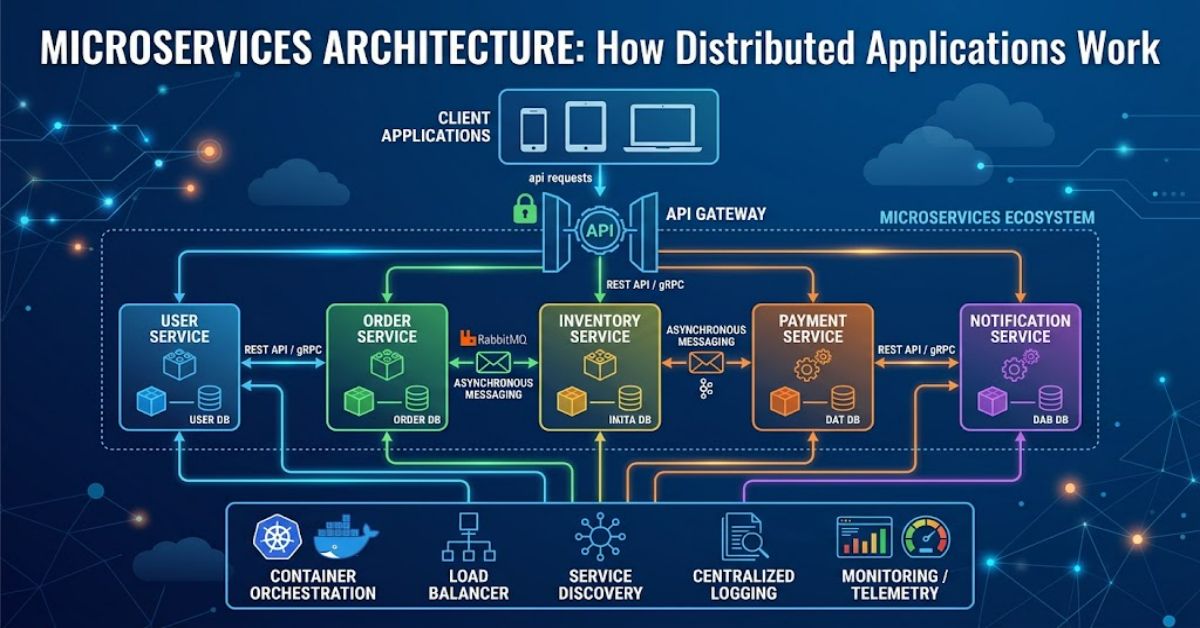
Microservices architecture is a design approach that structures an application as a collection of small, independent services that communicate over a network. Rather than building one large application where every component is released and scaled together, an organisation divides functionality into services responsible for defined business capabilities.
A retail platform, for example, might separate customer accounts, product catalogues, payments, orders and notifications. Each service can have its own codebase, deployment process and data store while communicating with other services through APIs or messaging.
The attraction is straightforward: teams can change and scale individual parts without necessarily redeploying the entire application. Microsoft describes microservices as autonomous services built around business capabilities and bounded contexts, with independent deployment and data ownership as important characteristics. Google and AWS similarly describe the model as a way of separating large applications into independently managed components.
But smaller services do not automatically create a simpler system. They replace some forms of application complexity with network, deployment, security, observability and data-consistency problems. That distinction is central to understanding when microservices make sense.
What Does Microservices Architecture Actually Change?
A traditional monolithic application may contain presentation, business logic and data-access components within one deployable unit. Even when internally modular, the application is normally released as a whole.
Microservices change the deployment boundary.
| Area | Monolithic approach | Microservices approach |
| Deployment | Usually one application | Services can deploy independently |
| Scaling | Often scales the whole application | Individual services can scale |
| Data | Common database is common | Services may own separate data |
| Communication | Mostly internal calls | APIs, events or messaging |
| Failure | Failures can affect larger areas | Failures can potentially be isolated |
| Technology | Often more standardised | Services can use different stacks |
| Operations | Comparatively centralised | Distributed monitoring and management |
The important point is that a microservice is not simply a small piece of code. A properly designed service normally has a clear responsibility, an explicit boundary and ownership within the development organisation.
Microsoft specifically recommends modelling services around business domains and warns that excessive granularity can increase complexity and reduce performance.
How the Architecture Works
A typical implementation places an API gateway or comparable entry point between external clients and internal services. Requests are routed to services such as accounts, orders or payments.
Services can communicate synchronously through REST or other APIs, or asynchronously through queues and event-driven messaging.
Data ownership is another major architectural decision. Rather than allowing every service to modify the same database tables, each service should generally control its own data. This improves autonomy but creates a harder problem: transactions that previously happened inside one database may now cross service boundaries.
Patterns such as the Saga pattern can coordinate distributed business transactions, while circuit breakers and bulkheads can reduce the effect of individual failures. Microsoft identifies these patterns as responses to common microservices problems involving data consistency, communication and failure isolation.
The Operational Layer Matters
The application code is only one part of a microservices environment.
A production platform may also require:
- Containerisation
- Continuous integration and deployment
- Service discovery
- API gateways
- Secrets management
- Centralised logging
- Distributed tracing
- Metrics and alerting
- Automated health checks
- Container orchestration
NIST’s work on secure microservices identifies authentication, authorisation, secure communication, service discovery, monitoring, load balancing and resilience as important parts of the environment rather than optional extras.
This produces one of the less obvious lessons of microservices: architectural decentralisation often requires operational standardisation.
Documented Real-World Evidence
Spotify provides a useful example of the organisational side of the model. In a 2023 engineering publication, Spotify described its use of many small components owned by teams that can independently develop and deploy them. The company said its production environment had grown to thousands of distinct components.
The UK Government provides another relevant example. A GOV.UK engineering publication has described the GOV.UK platform as consisting of Ruby on Rails microservices divided between publishing and rendering functions. Its architecture also relies heavily on caching at the content-delivery-network layer.
These examples show that microservices are not merely a cloud marketing term. They can support large organisations, but their benefits emerge alongside substantial engineering and operational requirements.
Three Less Obvious Trade-Offs
| Insight | Why it matters |
| Independent deployment does not mean independent operation | Services remain connected through networks, APIs, data and infrastructure |
| Smaller services can increase cognitive load | Developers may need to understand dependencies, logs, contracts and deployment pipelines across many components |
| Data ownership changes application design | Cross-service transactions require new consistency and coordination strategies |
The third issue is particularly important. Splitting a monolith can make organisational boundaries clearer, but it can also expose previously hidden dependencies. A transaction that once required one database commit may now involve several services, retries and eventual consistency.
Spotify has also publicly discussed the complexity created by large numbers of components and cloud tooling, highlighting the importance of developer portals and internal platforms for ownership, discovery and standardisation.
When Microservices Make Sense
Microservices are generally more appropriate when an organisation has a sufficiently complex domain, multiple development teams, independent scaling requirements or a strong need for frequent independent releases.
They are less compelling for a small application with a simple domain and limited engineering capacity.
A useful decision framework is:
- Identify the business boundaries. Find capabilities that genuinely have different responsibilities.
- Measure operational maturity. Check whether deployment, monitoring and incident response are already reliable.
- Establish ownership. Every service should have a clearly responsible team.
- Define communication contracts. APIs and events need versioning, authentication and failure handling.
- Protect data boundaries. Avoid recreating a distributed monolith through a shared database.
- Start incrementally. A carefully selected service can be extracted before attempting a wholesale migration.
The UK Ministry of Justice’s Technology Radar currently lists microservices architecture as an adopted architectural pattern, defining it around small autonomous services modelled around business domains.
Risks and Practical Implications
The largest risk is creating a distributed monolith: dozens of services that technically deploy separately but must all change together.
Warning signs include excessive synchronous calls, shared databases, tightly coupled release schedules and APIs that expose internal implementation details.
Network latency also becomes part of application performance. A function call inside one process is fundamentally different from a request travelling through a network, authentication layer, gateway and service before returning a response.
Security expands too. Instead of protecting one application boundary, teams must secure service-to-service communication, identities, credentials and APIs across a larger attack surface.
The result is a trade-off rather than a universal upgrade.
The Future of Microservices Architecture in 2027
By 2027, microservices are likely to remain an important pattern within cloud-native engineering, but the emphasis is shifting from simply creating more services towards controlling distributed complexity.
Internal developer platforms are one response. Spotify’s engineering work illustrates how platform tooling can help teams discover components, follow standards and manage ownership as systems grow.
Service meshes, distributed tracing, policy-as-code and automated security controls are also becoming increasingly relevant as organisations operate larger service fleets. NIST’s DevSecOps guidance already describes application, infrastructure, policy and observability code as distinct concerns in microservices environments.
The likely constraint is not whether organisations can create more services. Modern cloud platforms make that relatively straightforward. The harder question is whether teams can keep the resulting architecture understandable, observable, secure and economically sustainable.
Key Insights
- Service boundaries should follow business capabilities rather than arbitrary technical layers.
- Independent deployment only creates value when teams can genuinely own services end to end.
- Shared databases can undermine the independence that microservices are designed to provide.
- Observability is a core architectural requirement because failures cross network boundaries.
- API and event design become long-term governance concerns as the number of services increases.
- Internal developer platforms can reduce the cognitive burden created by large service estates.
- A modular monolith may be more appropriate than microservices for smaller or less complex systems.
Conclusion
Microservices architecture is best understood as an organisational and operational model as much as a software design technique. It divides applications into independently managed services, allowing teams to develop, deploy and scale business capabilities with greater autonomy.
The benefits can be substantial, particularly for complex platforms where different parts of an application have different scaling, release or ownership requirements. Yet the architecture also introduces distributed transactions, network latency, observability demands, security challenges and greater operational overhead.
The evidence from organisations such as Spotify, GOV.UK and large cloud platforms demonstrates that the model can operate at significant scale. It also shows why service count alone is a poor measure of architectural maturity.
The strongest implementation is therefore not necessarily the one with the most services. It is the one where boundaries are meaningful, ownership is clear, dependencies are visible and the operational platform can support the resulting complexity.
FAQ
What is microservices architecture?
It is an application design approach in which functionality is divided into small, autonomous services. Each service normally represents a defined business capability and communicates with other services through APIs or messaging.
How is microservices architecture different from a monolith?
A monolith is generally deployed as one application unit, while microservices can be developed, deployed and scaled independently. Microservices therefore provide greater organisational and deployment flexibility but introduce distributed-system complexity.
What are the main benefits of microservices?
Key benefits include independent deployment, selective scaling, clearer service ownership, fault isolation and the ability for teams to work on different business capabilities without changing the entire application.
What are the disadvantages of microservices architecture?
Common disadvantages include network latency, distributed transactions, complex monitoring, service discovery, security management and increased infrastructure and operational costs.
Does every microservice need its own database?
Not necessarily, but strong microservices designs generally give each service ownership of its data. Sharing database schemas can create tight coupling and make supposedly independent services dependent on one another.
Is Kubernetes required for microservices?
No. Kubernetes is a popular orchestration platform, but microservices can also run on other container platforms, serverless infrastructure or managed application services. The appropriate platform depends on operational requirements.
Methodology
This article was researched using current technical documentation from Microsoft Azure Architecture Center, Google Cloud, AWS, NIST, GOV.UK and engineering publications from Spotify. The analysis prioritises documented architectural principles, security considerations and real-world examples rather than unsupported performance claims.
The main limitation is that microservices outcomes vary substantially according to application complexity, team structure, traffic patterns, cloud platform and operational maturity. A microservices design that works for a large technology organisation may be unnecessary for a small application.
The article was drafted with AI assistance and should be reviewed by a human editor before publication. Technical claims, dates and references should be independently checked against their original sources.
References
Amazon Web Services. (2026). What is microservices architecture? AWS.
Chandramouli, R. (2022). Implementation of DevSecOps for a microservices-based application with service mesh (NIST Special Publication 800-204C). National Institute of Standards and Technology.
Google Cloud. (2026). What is microservices architecture? Google Cloud.
Ministry of Justice. (2026). Technology Radar: Microservices architecture. UK Government.
Microsoft. (2026). Microservices architecture style. Microsoft Learn.
Microsoft. (2026). Design a microservices architecture. Microsoft Learn.
National Institute of Standards and Technology. (2020). Building secure microservices-based applications using service-mesh architecture (NIST Special Publication 800-204A).
Spotify Engineering. (2023). Fleet Management at Spotify: Spotify’s shift to a fleet-first mindset. Spotify.
Spotify Engineering. (2024). Supercharged developer portals. Spotify.
UK Government Digital Service. (2021). Develop your data and APIs using a reference architecture. GOV.UK.