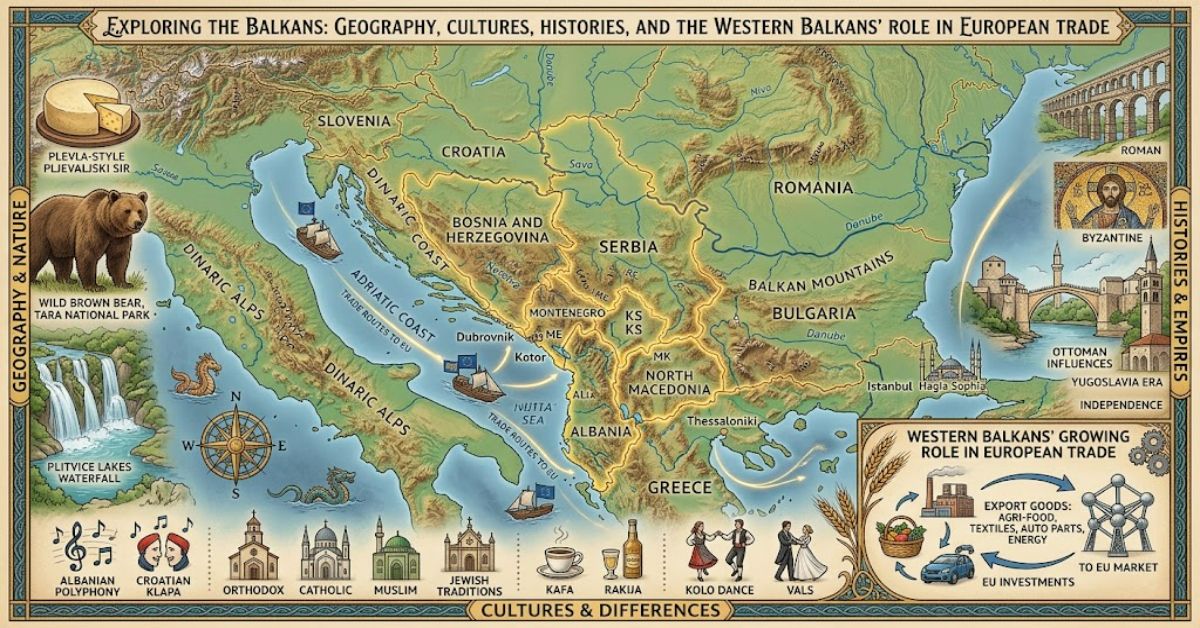
Balkan countries are the nations located in or historically associated with the Balkan Peninsula in southeastern Europe. The term describes a geographical region, but its exact boundaries are debated. Geography, history, culture and politics all influence which countries are considered part of the Balkans.
The most commonly associated states include Albania, Bosnia and Herzegovina, Bulgaria, Croatia, Kosovo, Montenegro, North Macedonia, Romania, Serbia, Slovenia and Greece. Türkiye is also sometimes included because a small part of the country, East Thrace, lies in southeastern Europe.
This lack of a universally agreed list is important. The Balkans are not a political organisation or a single economic bloc. Instead, the term describes a region with overlapping identities and a complicated historical development.
The European Union uses a narrower political term, Western Balkans, for Albania, Bosnia and Herzegovina, Kosovo, Montenegro, North Macedonia and Serbia.
Which Countries Are Considered Part of the Balkans?
The following table provides a practical overview rather than claiming that every geographical authority uses exactly the same definition.
| Country | Common Balkan association | EU membership |
| Albania | Strong | No |
| Bosnia and Herzegovina | Strong | No |
| Bulgaria | Strong | Yes |
| Croatia | Strong | Yes |
| Kosovo | Strong | No |
| Montenegro | Strong | No |
| North Macedonia | Strong | No |
| Romania | Often included | Yes |
| Serbia | Strong | No |
| Slovenia | Often included | Yes |
| Greece | Strong | Yes |
| Türkiye | Partial association | No |
The distinction between geographical and political definitions matters. For example, Bulgaria and Greece are EU members, while Serbia and Albania are not. The phrase “Western Balkans” therefore does not simply mean the western half of the peninsula.
Why Is the Region So Diverse?
One of the defining characteristics of the Balkan countries is diversity.
The region contains numerous languages, religious traditions and ethnic communities. Orthodox Christianity, Roman Catholicism and Islam have all played important historical roles. Ottoman, Byzantine, Roman, Habsburg and Slavic influences have also shaped different parts of the region.
This mixture is visible in architecture, food, music, literature and everyday customs. A visitor travelling from Slovenia through Croatia, Bosnia and Herzegovina, Montenegro and Albania can encounter noticeably different cultural environments within relatively short distances.
Geography adds another layer. The region contains mountain ranges, river valleys, Mediterranean coastlines, forests and fertile plains. This has influenced settlement patterns, agriculture, trade routes and tourism.
The Western Balkans and the European Union
The political importance of the Balkan countries is particularly visible through the European Union’s enlargement policy.
The Western Balkans consists of Albania, Bosnia and Herzegovina, Kosovo, Montenegro, North Macedonia and Serbia. The EU has developed a long-term integration framework for these countries, linking economic support with institutional and structural reforms.
The process has practical consequences. It affects infrastructure, trade, digitalisation, transport, governance and investment.
In 2025, the European Commission continued its enlargement assessments for the Western Balkan partners, focusing on reforms involving areas such as democracy, rule of law and fundamental rights.
This makes the Balkans more than a tourism destination. The region is also part of a major European political and economic project.
Balkan Countries Compared by Geography and Culture
| Region or country | Distinctive geographical feature | Important cultural influences |
| Albania | Adriatic and Ionian coastlines, mountains | Balkan, Mediterranean and Ottoman |
| Bosnia and Herzegovina | Mountainous interior and river valleys | Slavic, Ottoman and Austro-Hungarian |
| Bulgaria | Mountains, plains and Black Sea coast | Slavic, Byzantine and Ottoman |
| Croatia | Adriatic coastline and islands | Central European and Mediterranean |
| Greece | Mountainous mainland and extensive coastline | Ancient Greek, Byzantine and Mediterranean |
| Montenegro | Rugged mountains and Adriatic coast | Adriatic, Slavic and Balkan |
| Serbia | Danube basin and inland plains | Slavic, Byzantine and Austro-Hungarian |
| North Macedonia | Mountainous terrain and Lake Ohrid | Balkan, Byzantine and Ottoman |
The table shows why treating the region as culturally uniform can be misleading. Shared historical experiences exist, but individual national identities remain strong.
What Makes the Balkans Important Today?
The modern significance of the Balkan countries extends across several areas.
Trade and investment: The EU is a major economic partner for the Western Balkans. EU-Western Balkans goods trade exceeded €87.7 billion in 2025, according to the European Commission.
Infrastructure: Roads, railways, energy networks and digital infrastructure are important to regional connectivity. Better connections can reduce transport costs and make cross-border trade easier.
Digital development: In 2025, European Digital Innovation Hubs were established across several Western Balkan states to support digital transformation. Serbia and North Macedonia also hosted AI Factory Antennas connected with European artificial intelligence infrastructure.
Tourism: Coastal Croatia, Montenegro, Albania and Greece attract international visitors, while cities such as Sarajevo, Belgrade and Skopje offer different forms of cultural and urban tourism.
One important insight is that the region should not be viewed only through its past. Its present-day importance increasingly comes from connectivity, investment and integration with wider European markets.
Challenges Facing the Balkan Region
The region also faces significant challenges.
Political disagreements remain influential, particularly where borders, constitutional arrangements or national identities are contested. Economic development varies considerably between countries and between urban and rural areas.
Population movement is another important issue. Young people have often sought education and employment opportunities elsewhere in Europe, creating concerns about skills shortages and demographic pressure at home.
The EU accession process also creates a difficult balance. Closer integration can bring investment and market access, but candidate countries must undertake demanding reforms before membership.
The European Commission’s 2025 assessments continued to emphasise the need for structural reforms and stronger institutions across enlargement countries.
The Western Balkans Growth Plan
A significant recent development has been the EU Growth Plan for the Western Balkans.
The plan is backed by a €6 billion Reform and Growth Facility and is designed to accelerate reforms while bringing some benefits of closer EU integration before full membership. By November 2025, all six Western Balkan partners had adopted Reform Agendas, according to the European Commission.
This creates an important distinction between traditional enlargement and gradual economic integration. Countries do not have to wait until full membership before receiving every possible benefit of closer European cooperation.
The approach also highlights a broader trend: economic integration is increasingly being used alongside political reform as a way of strengthening regional stability.
The Future of Balkan Countries in 2027
By 2027, the most significant development for the Western Balkans is likely to remain the relationship between national reform and European integration.
The EU’s current approach places increasing emphasis on practical integration, including payments, transport, digital infrastructure, trade and regulatory alignment. In 2025, several Western Balkan countries moved closer to participation in European payment systems, while digital innovation initiatives expanded across the region.
However, accession timelines remain uncertain. Political reforms, rule-of-law requirements, bilateral disputes and institutional capacity can all affect progress.
Public opinion will also matter. A European Commission survey published in June 2026 found strong support for EU accession in several Western Balkan countries, although support varied substantially between states. Albania recorded 92% support and Kosovo 83%, while Serbia recorded 31%.
The likely direction, therefore, is deeper practical integration rather than a simple prediction of immediate EU membership for every country.
Key Insights About the Balkan Countries
- The Balkans are a geographical and cultural concept rather than a single political entity.
- The Western Balkans is a specific EU policy term covering six countries.
- Cultural diversity is one of the region’s defining characteristics.
- EU integration increasingly involves practical areas such as digital services, payments and infrastructure.
- Tourism is important, but the region’s economic role extends into manufacturing, trade, technology and transport.
- Population movement remains a major long-term economic and demographic consideration.
- The region’s political future will continue to influence Europe’s wider security and economic environment.
Frequently Asked Questions
How many Balkan countries are there?
There is no universally agreed number because the geographical boundaries of the Balkan Peninsula are disputed. Depending on the definition used, the list can include around 10 to 12 countries, with Türkiye sometimes included because part of its territory lies in southeastern Europe.
Which are the Western Balkan countries?
The European Union defines the Western Balkans as Albania, Bosnia and Herzegovina, Kosovo, Montenegro, North Macedonia and Serbia.
Are Balkan countries in the EU?
Some are. Bulgaria, Croatia, Greece, Romania and Slovenia are EU members. Albania, Bosnia and Herzegovina, Kosovo, Montenegro, North Macedonia and Serbia are outside the EU but have varying relationships with the accession process.
What is the largest Balkan country?
The answer depends on whether the definition is based on the entire territory of a country or only the portion geographically located within the Balkan Peninsula. This is one reason rankings of Balkan countries can vary.
Are the Balkans good for tourism?
Yes. The region offers Adriatic and Mediterranean coastlines, mountains, historic cities, archaeological sites, national parks and diverse culinary traditions. Different countries provide very different travel experiences.
Why are the Balkans important to Europe?
Their location connects Central Europe, the Mediterranean and southeastern Europe. The region is also important for trade, transport, energy, security and EU enlargement.
Methodology
This article treats “Balkan countries” as a geographical and cultural term rather than a fixed political classification. Country groupings were cross-checked against European Union terminology, particularly its definition of the Western Balkans. Current claims concerning EU integration, trade, digital development and public opinion were based on European Commission material published in 2025 and 2026.
The principal limitation is that the geographical boundaries of the Balkans are not universally agreed. Consequently, the article distinguishes between countries commonly associated with the wider Balkan region and the narrower Western Balkans political grouping.
References
European Commission. (2025). EU trade relations with the Western Balkans. Directorate-General for Trade.
European Commission. (2025). Commission reports on the progress of aspiring EU members. Directorate-General for Communication.
European Commission. (2025). Western Balkans Leaders’ meeting in Tirana takes stock of EU Growth Plan progress two years after its adoption. Directorate-General for Enlargement and Eastern Neighbourhood.
European Commission. (2025). 2025 Economic Reform Programmes of Albania, Bosnia and Herzegovina, Kosovo, Moldova, Montenegro, North Macedonia, Serbia and Türkiye. Directorate-General for Economic and Financial Affairs.
European Commission. (2026). Support for EU accession remains high across enlargement partners, latest surveys show. Directorate-General for Enlargement and Eastern Neighbourhood.