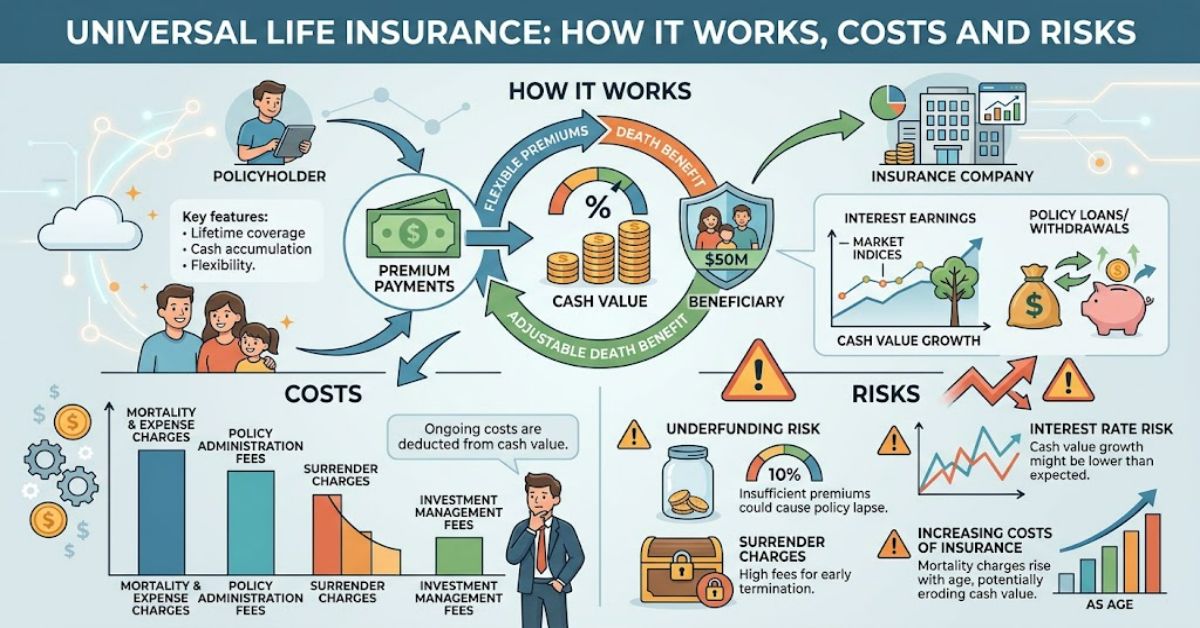
Universal life insurance is a form of permanent life insurance designed to provide cover for the insured person’s lifetime, provided the policy remains in force. Unlike straightforward term insurance, it combines a death benefit with a cash-value component that can accumulate over time.
The important feature is flexibility. Depending on the policy, the policyholder may have some control over premium payments, the level of cover and how the cash value is allocated. The trade-off is that the policy can require much more active management than a simple term policy.
The US National Association of Insurance Commissioners describes universal life as permanent coverage combined with a cash account, with premiums and death benefits potentially changing according to policyholder decisions. The Financial Industry Regulatory Authority similarly describes universal life as lifelong cover with flexible premiums and insurance costs deducted from the policy account.
For UK readers, an important qualification is necessary. “Universal life insurance” is not the standard consumer category used by UK comparison sites and protection bodies. UK consumers are more likely to encounter terms such as term assurance, whole-of-life insurance, unit-linked life assurance and investment bonds. The Financial Conduct Authority nevertheless regulates UK insurance-based investment products and unit-linked structures, which share some characteristics with the cash-value concept.
That distinction matters because tax treatment, regulation and product availability depend heavily on jurisdiction.
How Does Universal Life Insurance Work?
A universal life policy can be understood as having two connected functions: insurance protection and cash-value accumulation.
When premiums are paid, the insurer allocates part of the money towards the cost of providing life cover and other policy expenses. The remaining amount may contribute to the policy’s cash value, depending on the product’s terms.
The cash value can then earn interest or investment returns, depending on the type of policy.
This creates a moving relationship between the amount paid into the policy, the cost of insurance and the value accumulating inside it.
A simplified structure looks like this:
Premium paid → policy charges and insurance costs → remaining amount credited to cash value → interest or investment performance → changing policy value
That structure is one reason these policies require closer attention than ordinary term insurance.
The NAIC explains that universal life policies can remain active when sufficient cash value is available to cover insurance costs. This means that a policy can appear to have substantial value while still requiring careful monitoring.
Flexible Premiums Do Not Mean Unlimited Flexibility
The phrase “flexible premium” can be misleading if interpreted as “pay whatever you want”.
A policy normally has minimum funding requirements and contractual conditions. If insufficient money is paid into the policy, the cash value may gradually be consumed by insurance costs and other charges.
Eventually, the policy could lapse.
This is one of the most important practical differences between flexibility and certainty. A policyholder who reduces premiums may improve short-term cash flow but potentially weaken the policy’s long-term sustainability.
Universal Life Insurance Compared With Other Types of Life Cover
| Feature | Term life insurance | Whole-of-life insurance | Universal life insurance |
| Length of cover | Fixed term | Usually lifelong | Usually lifelong |
| Cash value | Generally no | Usually yes | Yes |
| Premium flexibility | Usually limited | Usually structured | Often flexible |
| Investment element | No | Depends on product | Often present |
| Complexity | Lower | Medium | Higher |
| Risk of policy lapse from inadequate funding | Lower | Depends on policy | Potentially significant |
| Typical purpose | Income or debt protection | Lifelong protection | Protection plus cash-value accumulation |
The comparison illustrates why universal life should not automatically be viewed as a superior form of life insurance. It offers additional features, but those features also introduce additional decisions and risks.
MoneyHelper explains that whole-of-life policies provide cover for life as long as premiums are maintained, but they can be more expensive than shorter-term policies.
The Cash Value: The Part Many Buyers Misunderstand
Cash value is often presented as the savings or investment side of a permanent life policy.
But cash value should not automatically be treated as equivalent to money held in an ordinary savings account.
Several deductions may affect it, including:
- Cost of insurance: The insurer charges for providing the death benefit.
- Policy expenses: Administrative and other charges can reduce accumulation.
- Investment or interest performance: Depending on the product, returns may be fixed, credited according to a formula or linked to investment performance.
- Withdrawals: Taking money from the policy can reduce its value and may affect the death benefit.
- Policy loans: Borrowing against cash value can create interest costs and reduce benefits if the loan is not managed properly.
- Surrender charges: Ending a policy early may result in a payout substantially below the headline cash value.
HMRC guidance on life policies illustrates a broader UK principle: the surrender value is the amount an insurer is prepared to pay if a policy is cancelled at a particular point, and it can be substantially different from the amount a consumer might assume the policy is worth.
That distinction is particularly important when comparing policy illustrations.
Fixed, Indexed and Variable Universal Life
Universal life is not one uniform product.
Different versions can expose the cash value to different forms of return and risk.
| Policy type | How cash value may grow | Main consideration |
| Fixed universal life | Interest credited by insurer under policy terms | Lower direct market exposure, but credited rates and guarantees must be examined |
| Indexed universal life | Interest linked to an external index using policy rules | Index participation does not necessarily mean direct ownership of the index |
| Variable universal life | Cash value linked to investment options | Greater investment risk and potentially greater return variability |
FINRA identifies indexed universal life as a form of universal life in which returns follow a specified stock index, while variable life products can expose cash value to portfolios of securities.
The terminology therefore matters. Two policies both marketed using “universal life” may have materially different risk profiles.
What Are the Main Benefits?
Universal life can make sense in specific circumstances.
Lifelong protection
Unlike term insurance, the policy is designed to remain in force for life, subject to its conditions.
This can be useful where the financial need does not have a defined end date.
Cash-value accumulation
The policy can build a cash-value reserve over time. This may provide another source of financial flexibility, subject to the policy’s terms, charges and tax rules.
Premium flexibility
The ability to adjust premiums can be useful when income varies. A policyholder may have more control over the timing and amount of funding than under a conventional fixed-premium arrangement.
Potential estate-planning role
Permanent life insurance can form part of wider estate planning. However, ownership, beneficiaries, trusts and local tax rules can materially affect the result.
HMRC states that life policy proceeds can form part of a deceased person’s estate in certain circumstances and that transfers of life policies can create inheritance-tax consequences.
This is an area where professional advice is particularly important.
What Are the Main Risks?
The flexibility that makes universal life attractive can also create its biggest weaknesses.
Policy lapse
A policy can become unsustainable if charges exceed the amount being paid into it and the cash value is gradually depleted.
This creates a risk that is less obvious than simply missing a monthly payment.
Investment risk
Where cash value is exposed to investment performance, poor returns can weaken the policy’s financial position.
The policyholder therefore has to understand both insurance risk and investment risk.
Charge complexity
Charges can include insurance costs, administration expenses, investment expenses, surrender charges and other deductions.
The FCA’s 2026 review of UK unit-linked pensions and savings found that some legacy products contained multiple layers of charges and that some customers were receiving poorer value than those in newer products. The regulator reviewed information from firms covering around 90% of the relevant market.
Although this review was about UK unit-linked pensions and savings rather than universal life specifically, it highlights an important lesson for insurance-based investment products: headline performance is not enough. Costs and customer outcomes must also be examined.
Complexity
A product can be technically sophisticated without being financially suitable.
A policyholder may understand the death benefit but misunderstand how premium changes, charges, cash value and investment performance interact.
That is a practical risk in its own right.
Universal Life Insurance and Tax
Tax is one of the areas where universal life becomes especially jurisdiction-specific.
The keyword detail describes the cash value as tax-deferred. That description reflects the way these products are commonly structured in the United States, but readers should not assume that the same tax treatment automatically applies in the UK.
UK taxation of life policies operates through specific chargeable-event rules. HMRC states that gains from many life policies can be subject to income tax treatment when relevant chargeable events occur, with the exact treatment depending on the policy and event.
HMRC also recognises specific rules around part surrenders and assignments. The traditional 5% allowance can defer taxation in certain circumstances, but it should not be interpreted as a blanket tax exemption.
This creates an important original insight for UK readers: the phrase “tax-deferred cash value” should never be treated as a universal statement about UK tax treatment.
The country where the policy was issued, the policy structure, residence, ownership and the nature of withdrawals can all matter.
A Practical Cost-and-Risk Checklist
| Question | Why it matters |
| What is the guaranteed cash value? | Separates guaranteed outcomes from illustrations |
| What are the annual policy charges? | Determines how much value is consumed |
| What is the cost of insurance? | Shows the ongoing price of protection |
| What happens if premiums are reduced? | Tests whether flexibility can create a lapse risk |
| What happens after a withdrawal? | May reduce cash value or death benefit |
| Are surrender charges applied? | Determines the cost of leaving early |
| What assumptions drive the illustration? | Helps distinguish projections from guarantees |
| What happens if investment returns are lower? | Tests downside resilience |
| What tax rules apply? | Prevents cross-border assumptions |
| Who owns the policy? | Can affect estate and tax treatment |
A useful way to evaluate a policy is to run three scenarios rather than focusing on one projected outcome:
Base case: The policy performs broadly according to its central assumptions.
Weak-return case: Interest or investment performance is materially lower.
Funding-reduction case: Premiums are reduced or paused during a period of financial pressure.
If the policy only remains attractive under optimistic assumptions, that should influence the decision.
Who Might Consider Universal Life Insurance?
Universal life can be relevant to someone with a genuine need for permanent protection and enough financial capacity to manage a more complicated product.
Potential users may include people with long-term estate-planning requirements, business interests, complex family arrangements or a need for lifelong financial protection.
However, the existence of a cash-value feature does not automatically make the product appropriate for wealth accumulation.
Someone whose primary objective is straightforward income protection may find a simpler term policy easier to understand and manage.
This is where product suitability matters more than product sophistication.
The FCA’s current work on unit-linked savings and insurance-based products also reinforces the importance of fair value, understandable charges and appropriate customer outcomes.
Who May Be Better Served by Simpler Life Insurance?
A simpler product may be preferable when the main objective is straightforward financial protection.
For example, someone may want to make sure that a mortgage, household costs or children’s financial needs are covered if they die during their working years. Term insurance can match that temporary need without adding a cash-value investment structure.
Whole-of-life insurance may be more appropriate when permanent cover is required, although it can still be more expensive and complex than term insurance.
The key question is not “Which policy has more features?”
It is:
“What financial problem am I actually trying to solve?”
That question can prevent consumers from paying for complexity they do not need.
Three Evidence-Based Insights Buyers Often Miss
Flexibility can shift risk to the policyholder
A flexible premium structure may sound consumer-friendly, but flexibility can transfer more responsibility to the policyholder.
With a fixed structure, the payment obligation is clearer. With flexible funding, the consumer may need to monitor the policy’s internal economics more closely.
Cash value is not the same as accessible savings
The headline cash-value figure may not equal the amount available after surrender charges, outstanding policy loans or other deductions.
HMRC’s distinction between surrender value and other measures of policy value demonstrates why valuation terminology matters.
Tax advantages depend on jurisdiction
A policy described using American tax terminology cannot automatically be evaluated using UK tax assumptions.
This is particularly important for international consumers, expatriates and people considering policies issued outside their country of residence.
What Should You Ask an Insurer or Adviser?
Before purchasing a policy, ask for the contractual details rather than relying solely on a sales illustration.
Questions should include:
- What parts of the policy are guaranteed?
- Which figures are assumptions?
- How much of each premium goes towards insurance costs?
- What are the current charges?
- Can charges change?
- What happens if premiums are reduced?
- When could the policy lapse?
- What happens to the death benefit after withdrawals?
- What are the surrender charges?
- How are policy loans treated?
- What happens under a low-return scenario?
- What tax treatment applies in my country?
- What happens if I move abroad?
The answers should be documented clearly enough for another adviser to review.
The UK Perspective: Why Terminology Matters
For a UK reader searching for universal life insurance, the first task should be identifying what product is actually being offered.
The UK market contains life assurance products with investment components, including unit-linked structures. The FCA describes insurance-based investment products as contracts offering a maturity or surrender value that is wholly or partly exposed to market fluctuations.
The regulator’s July 2026 review of unit-linked pensions and savings also found that legacy product complexity and multiple charge layers can make fair-value assessment difficult.
This means a UK consumer should not assume that an overseas universal-life product is simply another name for a standard British whole-of-life policy.
The underlying contract, insurer’s jurisdiction, regulatory regime and tax treatment all need to be checked.
The Future of Universal Life Insurance in 2027
The future of permanent insurance with cash-value and investment characteristics is likely to be shaped by greater scrutiny of charges, customer outcomes and product complexity.
In the UK, the FCA’s 2026 work on unit-linked pensions and savings has already placed emphasis on fair value, legacy products, charge structures and firms’ ability to demonstrate good customer outcomes.
That direction is relevant even where the exact product is not called universal life.
Technology is also likely to make policy monitoring easier. Better digital dashboards could allow customers to see cash value, charges, investment performance and projected policy sustainability more clearly.
However, better technology does not remove underlying financial risk. A clearer dashboard cannot guarantee investment performance or prevent a policy from becoming uneconomic.
The likely direction by 2027 is therefore not simply “more flexible insurance”. It is more transparent insurance, with greater pressure on providers to demonstrate value and communicate risks clearly.
Key Takeaways
- Universal life combines permanent life cover with a cash-value mechanism.
- Flexible premiums can be useful but require active policy management.
- Cash value can be affected by insurance costs, administration charges, investment performance and withdrawals.
- Indexed and variable versions can introduce additional investment risk.
- Tax treatment varies substantially between countries.
- UK consumers should distinguish universal life from unit-linked and whole-of-life products.
- A policy should be judged against its actual financial objective rather than the number of features it offers.
Conclusion
Universal life insurance sits between traditional protection and long-term financial accumulation. Its appeal comes from that combination: lifelong cover, cash value and a degree of premium flexibility. But those features also make it more complicated than straightforward term insurance.
The most important issue is sustainability. A policy can look attractive when illustrated using favourable assumptions but behave very differently if charges rise, investment returns disappoint or premiums are reduced.
For UK consumers, there is an additional layer of complexity because universal life is not the standard label for most domestic life-insurance products. Tax rules, regulation and product structures differ across jurisdictions.
A sound evaluation therefore starts with the purpose of the policy, followed by a careful examination of guarantees, charges, funding requirements, surrender terms, investment assumptions and tax treatment. The more complex the contract, the more important it is to understand what is guaranteed and what is merely projected.
Frequently Asked Questions
What is universal life insurance?
Universal life insurance is a form of permanent life insurance that combines a death benefit with a cash-value component. Depending on the policy, premiums and death benefits may have some flexibility, while policy charges and investment or interest performance affect the cash value.
How does the cash value in universal life insurance work?
Part of the premium may contribute to the policy’s cash value after insurance costs and other charges are deducted. The balance can earn interest or investment returns depending on the type of policy. Withdrawals and loans can reduce the value available later.
Is universal life insurance the same as whole-of-life insurance?
No. Both are generally permanent forms of insurance, but their structures differ. Whole-of-life policies usually have more structured premiums, while universal life generally offers greater premium flexibility and a separate cash-value mechanism.
Is universal life insurance tax-free in the UK?
Not automatically. UK taxation of life policies is governed by specific chargeable-event rules, and the outcome can depend on the policy structure, ownership, withdrawals, surrender and other circumstances. Overseas policies can introduce additional considerations.
Can universal life insurance lapse?
Yes. If the policy’s available value becomes insufficient to cover insurance costs and other charges, and required funding is not provided, the policy can potentially lapse. The exact rules depend on the contract.
Is universal life insurance a good investment?
It can have investment characteristics, but it should not automatically be treated as a conventional investment. Its primary structure combines insurance protection with cash-value accumulation, and charges and insurance costs can materially affect returns.
Who should consider universal life insurance?
It may be relevant to people with a genuine need for permanent life cover and the financial capacity to manage a complex policy. Anyone considering it should compare the product with simpler protection and investment options based on their specific objectives.
Methodology
This article was researched using regulatory and institutional sources, with particular attention to the distinction between North American universal-life terminology and UK insurance-based investment products.
The National Association of Insurance Commissioners and FINRA were used to establish the core structure and characteristics of universal life insurance.
UK tax and policy-value information was validated against HM Revenue & Customs guidance covering life-policy taxation, surrender values and chargeable events.
UK regulatory context was checked against Financial Conduct Authority material, including its July 2026 review of unit-linked pensions and savings and its definition of insurance-based investment products.
The main limitation is that universal life is not a single standardised product. Contract terms, guarantees, charges, investment structures and taxation can vary significantly by insurer and jurisdiction. Readers should therefore treat this article as general information rather than individual financial advice.
References
Financial Conduct Authority. (2026). Unit-linked pensions and savings: Multi-firm review of Consumer Duty price and value practices. Financial Conduct Authority.
Financial Conduct Authority. (2026). Insurance-based investment product. FCA Handbook.
Financial Industry Regulatory Authority. (2025). Insurance. FINRA.
HM Revenue & Customs. (2026). Insurance Policyholder Taxation Manual: Types of insurance policy used for investment. GOV.UK.
HM Revenue & Customs. (2026). Life Policies: definitions — surrender value and open market value. GOV.UK.
HM Revenue & Customs. (2026). Outline of the chargeable events regime: types of policy and contract chargeable. GOV.UK.
MoneyHelper. (2026). What is life insurance? Money and Pensions Service.
National Association of Insurance Commissioners. (2024). Life Insurance Buyer’s Guide. NAIC.
National Association of Insurance Commissioners. (2026). Life insurance. NAIC.