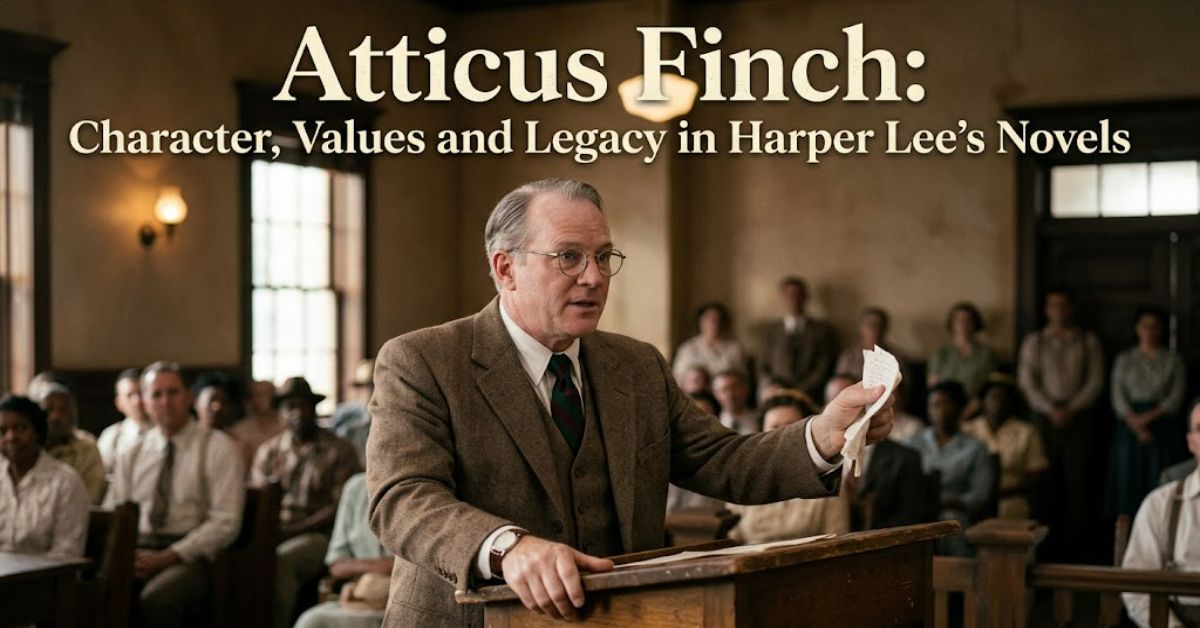
Atticus Finch is a fictional lawyer, widower and father in Harper Lee’s Pulitzer Prize-winning 1960 novel To Kill a Mockingbird. He lives in the fictional Alabama town of Maycomb with his children, Scout and Jem. Through Scout’s childhood perspective, readers see him as a calm, principled parent who believes that people should be understood before they are judged.
His most important role in the novel comes when he is appointed to defend Tom Robinson, a Black man accused of raping a white woman. Atticus knows that the case is unlikely to end in his client’s favour because of the racial attitudes surrounding the trial, yet he approaches his responsibility seriously.
The American Bar Association has highlighted the character as an example of unwavering professional integrity, particularly because the novel contrasts Atticus’s conduct with negative stereotypes associated with lawyers. (American Bar Association
Atticus Finch as a Symbol of Justice
Atticus’s importance is not simply that he is a lawyer. His significance comes from the tension between legal duty and social pressure.
In Maycomb, defending Tom Robinson exposes Atticus and his family to hostility. Nevertheless, he does not abandon the case. His courtroom conduct reflects his belief that legal representation should not depend on whether a defendant is popular or socially accepted.
A 2016 article in the American Bar Association’s Litigation Journal, written by litigation partner Chip Babcock, examined the character from a lawyer’s perspective and noted that the fictional Atticus was not primarily a criminal lawyer. His appointment to defend Robinson therefore becomes particularly significant within the story. (American Bar Association
| Character element | Significance |
| Lawyer | Represents legal responsibility |
| Father | Teaches Scout and Jem about empathy |
| Defender of Tom Robinson | Challenges racial prejudice |
| Maycomb resident | Must confront the values of his community |
| Literary symbol | Represents an idealised form of moral courage |
His Relationship With Scout and Jem
Atticus’s influence on his children is central to the novel. Rather than simply giving them rules, he encourages them to consider other people’s circumstances.
Scout’s understanding of her father develops throughout the story. As a child, she initially sees him as somewhat ordinary, especially compared with more dramatic figures around her. His actions gradually reveal qualities she has not fully recognised.
This father-daughter relationship gives the character much of his emotional power. Atticus is not presented solely through speeches about justice. Readers also encounter him through everyday parenting, family conversations and Scout’s gradual development of moral awareness.
That perspective matters because To Kill a Mockingbird is ultimately as much about learning how to see other people as it is about the trial itself.
Why Go Set a Watchman Changed His Reputation
The publication of Go Set a Watchman in 2015 transformed the public conversation surrounding Atticus Finch.
The novel was written before To Kill a Mockingbird but was published decades later. It takes place approximately 20 years after the events of Mockingbird and features an adult Jean Louise Finch returning to Maycomb. The older Atticus is portrayed very differently, including through racist and segregationist views. (The Guardian
The revelation shocked many readers because it conflicted sharply with the idealised image created by To Kill a Mockingbird. The Guardian reported that the publication produced widespread debate over whether readers had misunderstood Atticus or had placed too much faith in Scout’s childhood perception of him. (The Guardian
| Version | Atticus’s portrayal | Narrative effect |
| To Kill a Mockingbird (1960) | Principled, empathetic and committed to defending Tom Robinson | Creates an idealised moral figure |
| Go Set a Watchman (2015) | Older, politically conservative and openly segregationist | Challenges the earlier image |
Why the Character Remains Controversial
The difference between the two versions creates an important literary question: should readers treat the characters as two stages of one person’s life, or understand Watchman as an earlier manuscript that developed into the very different Mockingbird?
There is no simple answer.
Go Set a Watchman was actually completed before To Kill a Mockingbird. Lee’s publisher and editor recognised the potential in the childhood sections and encouraged her to develop that material into the novel that became Mockingbird. (The Guardian
That history suggests that Atticus’s two portrayals should be considered within the development of Lee’s writing rather than treated as a straightforward sequel designed to overturn everything established in the first novel.
The character’s complexity also reflects a broader problem with idealised heroes. A fictional figure can embody admirable principles in one context while holding deeply troubling beliefs in another.
Atticus Finch and Popular Culture
Gregory Peck’s performance in the 1962 film adaptation further strengthened Atticus’s public image. Peck won the Academy Award for Best Actor for his portrayal, helping establish a visual interpretation of Atticus that influenced generations of audiences.
The film made the character’s quiet manner, dignity and courtroom presence central to his cultural identity. As a result, many readers encounter Atticus through the combination of Lee’s writing and Peck’s performance rather than through the novel alone. (The Guardian
This creates another layer to his legacy: the literary character and the cinematic character are related but not identical cultural objects.
The Future of Atticus Finch in 2027
Atticus Finch is likely to remain relevant because discussions about the character have moved beyond whether he is simply a hero or a flawed man.
Modern literary analysis increasingly considers perspective, historical context and the limitations of idealised representations of racial justice. His character provides a useful way to discuss the difference between individual morality and broader social structures.
The continuing publication and teaching of Harper Lee’s novels means Atticus will probably remain part of conversations about literature, law, parenting and race. His lasting value may ultimately come from the questions he creates rather than from a single definitive interpretation.
Key Takeaways
- Atticus represents an ideal of professional responsibility in To Kill a Mockingbird.
- His relationship with Scout gives his moral lessons personal meaning.
- The Tom Robinson trial establishes the central test of his principles.
- Go Set a Watchman introduced a substantially more troubling portrayal.
- Gregory Peck’s 1962 performance helped cement the heroic public image.
- The character demonstrates how literary figures can become more complicated as their context changes.
Conclusion
Atticus Finch remains one of Harper Lee’s most influential fictional creations because his character sits at the intersection of family, law, morality and racial injustice. In To Kill a Mockingbird, he represents courage expressed through professional duty rather than physical confrontation. His defence of Tom Robinson and his lessons to Scout and Jem have made him an enduring literary reference point.
Yet the publication of Go Set a Watchman in 2015 made the character considerably more complicated. The older Atticus challenged the assumption that the man readers admired in Mockingbird could be understood without qualification.
That tension is precisely why Atticus continues to attract discussion. Rather than being remembered only as a flawless hero, he can also be examined as a literary construction shaped by perspective, historical context and the evolution of Harper Lee’s writing.
Frequently Asked Questions
Who is Atticus Finch?
Atticus Finch is the lawyer, widower and father at the centre of Harper Lee’s To Kill a Mockingbird. He is best known for defending Tom Robinson.
Why is Atticus Finch important?
He represents legal responsibility, empathy and moral courage within the novel, particularly through his decision to defend an unpopular client despite racial hostility.
Is Atticus Finch a real person?
No. He is a fictional character created by Harper Lee.
Is Atticus Finch in Go Set a Watchman?
Yes. The novel features an older Atticus and presents political and racial views that differ sharply from the familiar portrayal in To Kill a Mockingbird. (The Guardian
Who played Atticus Finch in the film?
Gregory Peck played Atticus in the 1962 film adaptation of To Kill a Mockingbird and won an Academy Award for the performance. (The Guardian
Methodology
This article draws on the supplied RubbleMagazine.co.uk editorial brief and published material concerning Harper Lee, To Kill a Mockingbird, Go Set a Watchman and Atticus Finch. The analysis distinguishes the fictional character from interpretations created by film, criticism and later publication history. No invented firsthand experience or testing has been presented. The supplied brief specifically requires firsthand signals to be genuine rather than fabricated.
References
American Bar Association. (2016). In search of Atticus Finch. Litigation Journal.
American Bar Association. (2024). 25 books for lawyers.
Flood, A. (2015, July 15). Go Set a Watchman’s UK sales top 100,000 in one day. The Guardian.
Lee, H. (1960). To Kill a Mockingbird. J. B. Lippincott & Co.
Lee, H. (2015). Go Set a Watchman. HarperCollins.