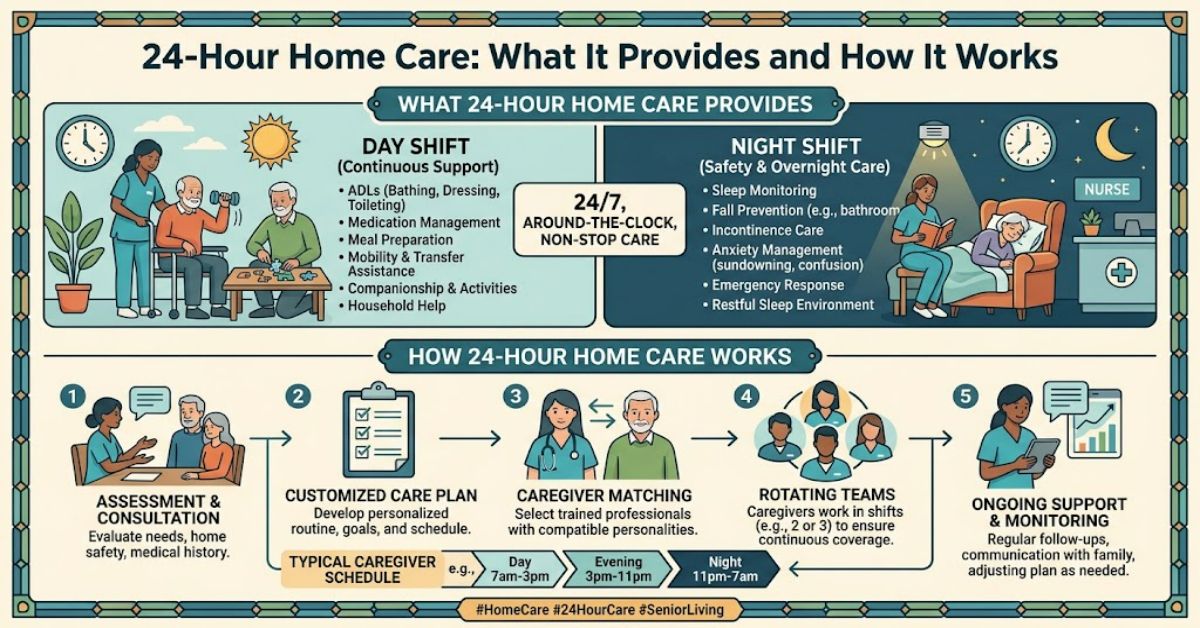
24-hour home care provides continuous, around-the-clock medical or personal assistance for elderly, bedridden or post-surgery patients directly in their homes. Unlike a conventional home-care visit, where a carer may arrive for a limited period, continuous care is designed around an ongoing need for supervision, personal assistance or clinical support.
The arrangement can involve help with washing, dressing, eating, mobility, continence, medication routines and household tasks. Where nursing care is required, appropriately qualified professionals may support clinical needs according to the individual’s care plan.
The important distinction is between continuous care and simply having a carer present for a long period. A safe 24-hour arrangement needs clear handovers, defined responsibilities, appropriate staffing and a plan for emergencies.
For families, the main attraction is often continuity without relocating a relative. Remaining at home can preserve familiar surroundings, relationships and routines. However, home care is not automatically the best option for everyone. The level of need, property layout, equipment, safeguarding risks and availability of suitable carers all have to be considered.
How Does Round-the-Clock Home Care Work?
A standard 24-hour shift framework generally uses two or three professional caregivers or nurses working 8-hour or 12-hour shifts. This prevents the unrealistic expectation that one individual can remain awake, alert and active throughout an entire day and night.
| Care arrangement | Typical purpose | Key consideration |
| 8-hour shifts | Three-shift continuous coverage | More frequent handovers |
| 12-hour shifts | Two-shift coverage | Longer individual shifts |
| Mixed staffing | Complex or changing needs | Requires detailed coordination |
| Live-in care | Continuous presence with agreed rest periods | Not automatically equivalent to waking night care |
The difference between live-in care and waking-night care is particularly important. A live-in carer normally has designated sleeping or rest periods. Someone who needs active overnight supervision may therefore require a different staffing model.
Good handovers are another practical requirement. Incoming staff should understand medication schedules, mobility changes, dietary requirements, recent incidents and any alterations to the person’s condition. Poor communication between shifts can undermine an otherwise well-designed care plan.
Who May Benefit From 24-Hour Home Care?
Continuous support can be appropriate for people whose needs cannot safely be managed through occasional visits. This may include individuals recovering after major surgery, people with significant mobility limitations, older adults requiring substantial personal assistance, or those living with conditions that require regular supervision.
The strongest case for continuous care is usually based on need rather than age. An older person who remains independent may need only occasional assistance, while a younger person with a serious physical disability may require extensive daily support.
A useful assessment should consider several areas:
| Assessment area | Questions to consider |
| Mobility | Is assistance needed for transfers or walking? |
| Personal care | Is help required with washing, dressing or continence? |
| Night-time needs | Are there frequent awakenings or safety concerns? |
| Medication | Is supervision or administration required? |
| Nutrition | Is help needed with meals, fluids or feeding? |
| Safety | Is there a risk of falls, wandering or emergencies? |
| Clinical needs | Is registered nursing support required? |
One often overlooked issue is the home itself. Narrow corridors, stairs, unsuitable bathrooms or inadequate sleeping arrangements can make an apparently straightforward care plan difficult to operate safely. An assessment should therefore consider the physical environment as well as the person’s medical and personal requirements.
Benefits, Risks and Trade-Offs
The principal benefit is continuity. A person can receive assistance in familiar surroundings while family members gain reassurance that support is available outside conventional visiting hours.
Home care can also make routines more individualised. Meals, sleep patterns and personal preferences can potentially be accommodated more easily than within a larger institutional setting.
There are trade-offs. Continuous care can be expensive, particularly when multiple skilled professionals are required. Families also need to consider staff compatibility, sickness cover, holiday arrangements and what happens when a person’s condition changes.
Another risk is assuming that home care removes clinical responsibility. It does not. Complex medical requirements may need appropriately qualified professionals and coordination with NHS services or other healthcare providers.
Safeguarding is equally important. Families should understand who employs the carers, how staff are checked, how concerns are reported and how care records are maintained. In England, regulated care providers may fall within the oversight framework of the Care Quality Commission, depending on the services being delivered.
Three Practical Insights Families Often Miss
Continuous presence is not the same as continuous clinical care. A person can have someone available at home around the clock without having a nurse physically present for every hour. The staffing model should therefore be based on actual tasks and risks.
The handover is part of the care system. Changing carers does not have to mean losing continuity if records, routines and escalation procedures are properly maintained. A weak handover, however, can create avoidable mistakes.
The home becomes part of the care environment. Equipment, access, bathroom facilities, heating, lighting and space for carers can affect whether a plan is sustainable. These practical details should be assessed before care begins rather than after problems emerge.
The Future of 24-Hour Home Care in 2027
By 2027, home-based care is likely to place greater emphasis on coordinated services, digital records and care delivered around individual needs. Technology may assist with medication reminders, remote monitoring, falls detection and communication between carers and clinical teams.
However, technology will not remove the need for human judgement. Devices can generate alerts, but someone still needs to interpret them and decide whether action is required. Cost pressures, workforce availability and the complexity of individual care will remain significant constraints.
The direction of travel is therefore more likely to be technology-supported human care than fully automated care. Providers that combine reliable staffing with better information-sharing should be better positioned to manage complex home-care arrangements.
Methodology
This article follows the supplied RubbleMagazine.co.uk production brief and uses established UK healthcare and social-care terminology. The discussion distinguishes personal care, live-in arrangements and waking-night support rather than treating them as interchangeable. Relevant institutional sources include NHS guidance, the Care Quality Commission and UK government social-care information.
The main limitation is that care requirements vary substantially between individuals. Staffing patterns, clinical responsibilities and costs cannot be determined safely from a generic article alone. Individual assessment and professional care planning remain essential.
Key Takeaways
- 24-hour home care should be designed around the person’s actual needs rather than a fixed staffing formula.
- Two or three carers may be needed to provide genuine continuous coverage through planned shifts.
- Live-in care should not automatically be described as waking-night care.
- Home suitability can be just as important as the individual’s clinical condition.
- Clear records and handovers reduce the risks associated with changing staff.
- Technology can support care coordination but does not replace qualified human judgement.
Conclusion
24-hour home care can provide a practical alternative for people who need extensive support but wish to remain in familiar surroundings. Its value depends less on the label and more on how carefully the service is designed.
A robust arrangement considers personal care, mobility, medication, night-time requirements, clinical needs, safeguarding and the physical suitability of the home. It also recognises that continuous coverage normally requires a team rather than one exhausted caregiver.
Families should therefore evaluate the staffing model, qualifications, handover process and contingency arrangements alongside the headline cost. Where needs are complex, professional assessment is particularly important. Done properly, round-the-clock home care can provide meaningful support while allowing an individual to retain greater familiarity, routine and dignity at home.
Frequently Asked Questions
What does 24-hour home care include?
It can include personal care, mobility assistance, meals, medication support, companionship, continence care and, where appropriately qualified staff are involved, certain nursing services.
How many carers are needed for 24-hour home care?
There is no universal number. A common continuous-shift model uses two or three carers working 8-hour or 12-hour shifts, depending on the care plan and staffing requirements.
Is 24-hour home care the same as live-in care?
No. Live-in care generally includes designated rest or sleeping periods for the carer. A person requiring active supervision throughout the night may need waking-night staffing.
Can elderly people receive 24-hour care at home?
Yes. Age alone does not determine eligibility or suitability. The decision should be based on care needs, safety, preferences and the practical ability to deliver appropriate support at home.
Is 24-hour home care suitable after surgery?
It can be appropriate during recovery when someone needs substantial assistance with mobility, personal care, medication routines or other daily activities. Clinical requirements should be assessed by the relevant healthcare professionals.
What should families check before arranging continuous home care?
Check the provider’s qualifications, safeguarding procedures, staffing arrangements, emergency cover, care planning, communication processes and how changes in a person’s condition will be handled.
References
Care Quality Commission. (2024). The state of health care and adult social care in England 2023/24. Care Quality Commission.
NHS. (2024). Social care and support guide. National Health Service.
NHS. (2024). Care and support you can get at home. National Health Service.
Department of Health and Social Care. (2024). Adult social care and support. UK Government.
RubbleMagazine.co.uk. (2026). Article Writing Prompt — Production Version.