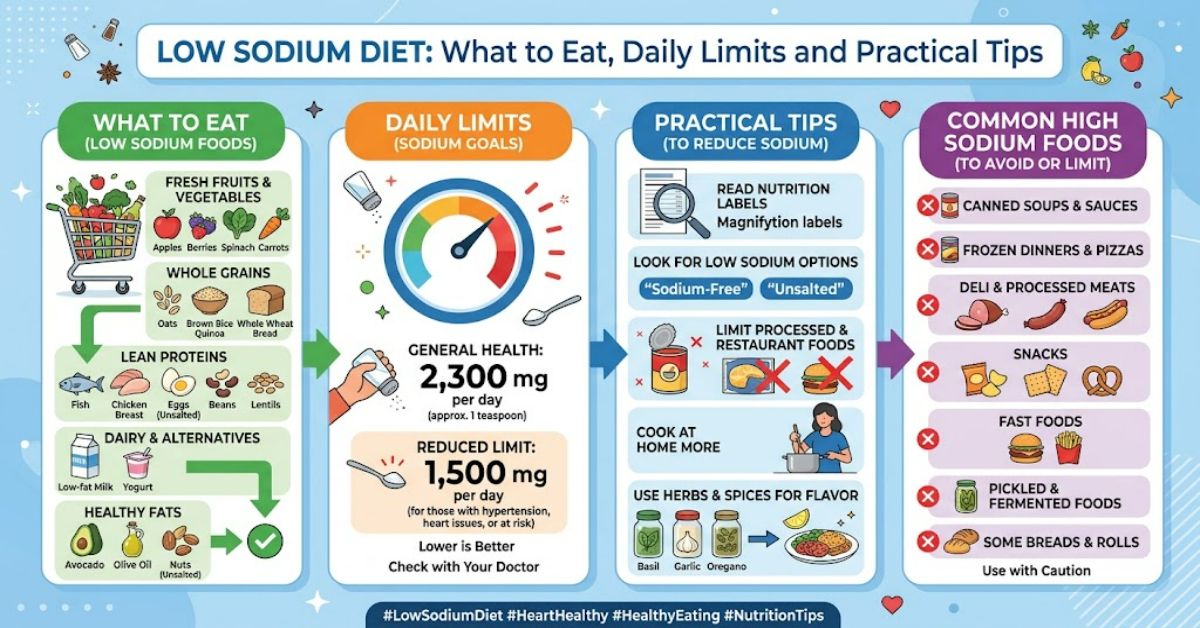
A low-sodium diet limits sodium intake by reducing salt and foods that contain substantial amounts of sodium. The term is often used in discussions about blood pressure, heart health, kidney disease and fluid retention. A low-sodium diet commonly targets around 1,500 to 2,300 milligrams (mg) of sodium daily, depending on the person’s health needs and clinical advice.
For UK adults, the general government recommendation is no more than 6g of salt per day, which is approximately 2.4g of sodium or around one level teaspoon of salt. Importantly, this figure includes salt already present in food, not simply the salt added during cooking.
That distinction matters because much of the sodium in a modern diet comes from manufactured and packaged foods. Bread, processed meats, ready meals, sauces, cheese, savoury snacks and some breakfast cereals can contribute significant amounts.
Reducing sodium therefore involves more than putting down the salt shaker. It means understanding labels, recognising high-sodium ingredients and building meals around foods that naturally contain less salt.
For some people, particularly those with specific medical conditions, a healthcare professional may recommend a stricter sodium target. A general dietary guideline should not replace individual medical advice.
How Much Sodium Do You Need?
Sodium is an essential mineral. The body uses it to help maintain fluid balance, support nerve function and enable normal muscle activity. The problem is excessive intake rather than sodium itself.
| Guideline | Approximate amount |
| UK adult salt maximum | 6g per day |
| Equivalent sodium | About 2.4g per day |
| Standard lower-sodium DASH target | Up to 2,300mg sodium |
| Lower DASH target | Up to 1,500mg sodium |
| Salt conversion | Sodium × 2.5 = salt |
The figures should not be treated as interchangeable prescriptions. A 1,500mg target may be recommended in some circumstances, while 2,300mg represents a commonly used upper target in dietary approaches such as DASH.
One useful practical insight is that reducing sodium does not necessarily mean eliminating salt completely. The objective is to reduce excess intake while maintaining a balanced diet.
Foods to Eat on a Low Sodium Diet
The easiest starting point is to build meals around minimally processed ingredients.
| Choose more often | Why it helps |
| Fresh fruit | Naturally low in sodium |
| Fresh vegetables | Provides fibre and micronutrients |
| Unsalted nuts | Nutritious alternative to salty snacks |
| Beans and pulses without added salt | Provides protein and fibre |
| Fresh meat and fish | Usually lower in sodium than processed versions |
| Plain rice and pasta | Useful low-sodium staples |
| Herbs, garlic, lemon and spices | Add flavour without relying on salt |
Fresh foods are not automatically superior in every nutritional respect, but they often make sodium easier to control because fewer salt-containing ingredients have been added during manufacturing.
Canned foods can still have a place. Choosing versions labelled no added salt or reduced salt, then draining and rinsing suitable products, can make them more useful in a lower-sodium eating pattern.
Foods to Limit
Processed and convenience foods deserve particular attention because sodium can accumulate across a meal.
Common examples include bacon, sausages, ham, cured meats, crisps, salted nuts, instant noodles, stock cubes, ready meals, pickles, some cheeses, sauces and takeaway foods.
Bread is another useful example. A single portion may not seem particularly salty, but eating bread several times a day can make its contribution meaningful. The same principle applies to sauces and condiments: a small quantity may seem insignificant, but repeated use can add up.
| Food category | Lower-sodium approach |
| Processed meat | Choose fresh meat or poultry |
| Stock cubes | Use reduced-salt versions |
| Soy sauce | Use sparingly or choose reduced-salt |
| Tinned vegetables | Choose no-added-salt options |
| Crisps | Choose unsalted alternatives |
| Cheese | Use smaller portions |
| Ready meals | Compare labels before buying |
The practical lesson is simple: look at the whole day’s intake rather than blaming one ingredient.
How to Read Food Labels
Food labels are one of the most effective tools for reducing sodium. In the UK, packaged foods commonly list salt rather than sodium.
If a label gives sodium instead of salt, multiplying the sodium figure by 2.5 provides an approximate salt equivalent.
Front-of-pack traffic-light labelling can also help. Foods with green salt indicators are generally easier choices when trying to reduce salt, while red indicators signal a higher level.
Portion size matters too. A product may appear moderate per 100g but contain considerably more salt when the actual portion is large.
This creates an important hidden risk: comparing products only by their marketing language. Terms such as “healthy”, “natural” or “light” do not automatically mean a product is low in sodium. The nutrition panel provides more useful evidence.
Making Low Sodium Food Taste Better
Removing salt suddenly can make familiar meals seem bland. A more sustainable approach is to replace some of the flavour function of salt.
Try garlic, black pepper, chilli, ginger, paprika, cumin, rosemary, thyme, parsley, coriander, vinegar and lemon juice. Toasting spices can also increase their aroma and complexity.
Acidity is particularly useful. Lemon juice or vinegar can make food taste brighter without adding sodium.
Another practical strategy is gradual reduction. If someone regularly adds salt before tasting food, stopping that habit can reduce unnecessary sodium without changing the entire diet.
Salt substitutes require more caution. Some contain potassium chloride rather than sodium chloride. They may not be suitable for people with certain kidney problems or those taking particular medicines, so medical advice is appropriate before using them regularly.
The Health Implications of Reducing Sodium
Excess salt intake is associated with raised blood pressure, which increases the risk of cardiovascular disease, including stroke and heart disease. The relationship is especially relevant for people who already have hypertension or other cardiovascular risk factors.
Lowering sodium can also matter in conditions where fluid balance is important. However, people with heart, kidney or other medical conditions should follow the dietary target provided by their healthcare team rather than adopting an aggressive restriction independently.
The evidence also highlights why individual meals should not be viewed in isolation. Sodium reduction is most effective when it becomes a pattern: fewer processed foods, more fresh ingredients and consistent label checking.
The Future of Low Sodium Diets in 2027
By 2027, sodium reduction is likely to remain partly dependent on food manufacturing as well as individual choices. Reformulation can reduce sodium across large populations without requiring every consumer to understand nutrition labels in detail.
Technology may also make tracking easier through food-scanning applications and personalised dietary tools. Yet these systems will only be useful when product databases and serving information are accurate.
A further challenge is taste. Manufacturers must reduce sodium without making products less appealing to consumers. This means reformulation, portion design and alternative flavouring will remain important.
The strongest approach is therefore likely to combine consumer education with changes in the wider food environment rather than placing the entire responsibility on individuals.
Key Takeaways
- Sodium is essential, but excessive intake can contribute to health risks.
- UK adults should generally stay below 6g of salt per day.
- Processed foods can contribute substantial sodium even when no salt is added at home.
- Food labels provide a more reliable guide than health-focused marketing claims.
- Herbs, spices and acidic ingredients can make lower-sodium meals more enjoyable.
- People with medical conditions may require an individually prescribed sodium target.
Conclusion
A low-sodium diet does not have to mean tasteless food or an extremely restrictive menu. The most useful approach is to understand where sodium comes from and make consistent substitutions.
Fresh vegetables, fruit, unsalted nuts, pulses, plain grains and less processed proteins can form the foundation of meals. Meanwhile, processed meats, salty snacks, sauces and heavily salted convenience foods can be reduced or replaced.
The UK guideline of no more than 6g of salt daily provides a practical benchmark for adults, while lower sodium targets may be appropriate for particular dietary approaches or medical circumstances. The important distinction is that sodium reduction should be purposeful rather than extreme.
For people managing hypertension, kidney disease, heart failure or another condition affected by sodium, personalised advice from a GP, nurse or dietitian is preferable to adopting a restrictive target alone.
Frequently Asked Questions
What is a low sodium diet?
It is an eating pattern that limits sodium, particularly from added salt and processed foods. The exact target varies according to health needs.
How much sodium is in a low sodium diet?
Common targets range from about 1,500 to 2,300mg of sodium daily. UK general guidance for adults is no more than 6g of salt, equivalent to approximately 2.4g of sodium.
What foods are naturally low in sodium?
Fresh fruit, most fresh vegetables, plain rice, plain pasta, unsalted nuts and many fresh meats and fish are naturally low in sodium.
Can I eat bread on a low sodium diet?
Yes. Bread can be part of a balanced diet, but compare labels because sodium and salt levels vary between products.
Is sea salt healthier than table salt?
Not in terms of sodium. Different types of salt generally contain similar amounts of sodium, so switching salt types does not remove the need to limit overall intake.
Can a low sodium diet lower blood pressure?
Reducing excessive salt intake can help lower blood pressure, although the effect varies between individuals and should be considered alongside other lifestyle and medical factors.
Methodology
This article was developed from the supplied RubbleMagazine.co.uk production brief and checked against UK dietary guidance from the NHS and British Heart Foundation. The distinction between salt and sodium, UK adult intake guidance, food-label interpretation and lower-sodium dietary approaches was cross-checked against established health information.
The main limitation is that sodium requirements are not identical for every person. Medical conditions, medicines and treatment plans can change the appropriate target. The article therefore uses general dietary guidance and does not present a restrictive sodium prescription for individuals.
References
British Heart Foundation. (2026). Salt. British Heart Foundation.
British Heart Foundation. (2026). Food labelling. British Heart Foundation.
British Heart Foundation. (2026). DASH diet: What to eat to lower high blood pressure. British Heart Foundation.
NHS. (2024). Salt in your diet. National Health Service.
NHS. (2024). Vitamins and minerals: Others. National Health Service.
NHS. (2024). Coronary heart disease: Prevention. National Health Service.