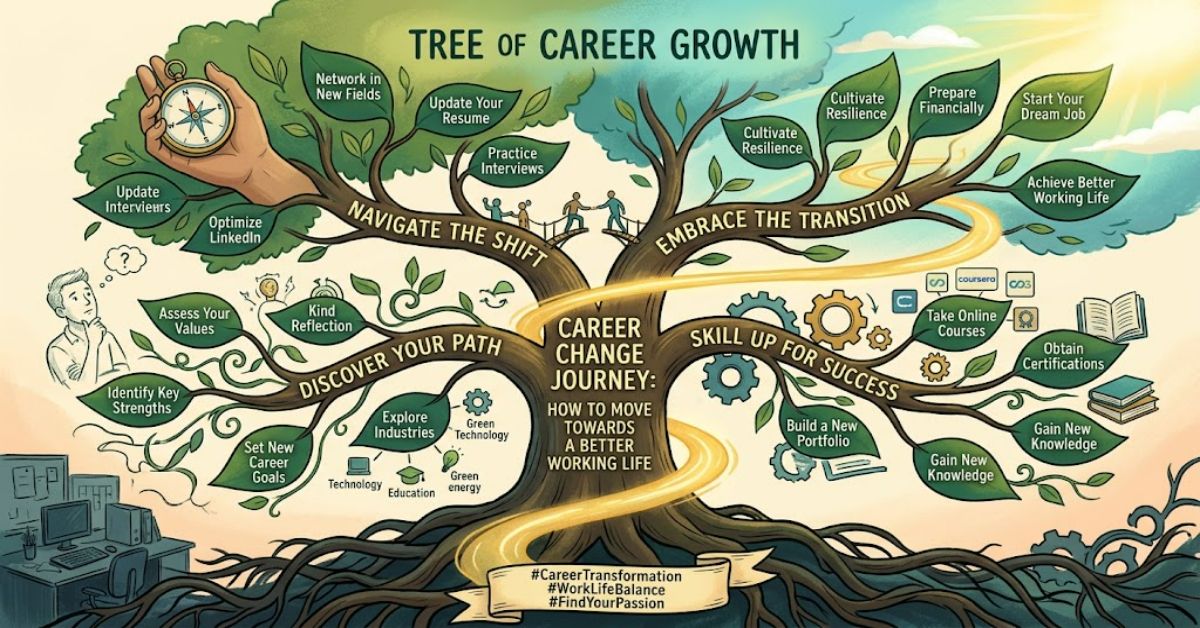
A career change can mean moving into a completely different profession, switching industries, returning to work after a break or gradually reshaping an existing role. Whatever the route, the strongest career change usually begins with a clear goal rather than simply running away from a bad job.
This distinction matters. Leaving an unhappy workplace may solve an immediate problem, but it does not automatically identify a better long-term direction. A more useful approach is to examine what you dislike about your current situation, identify what you want from your next role and then compare those requirements with your existing skills.
UK career guidance services recognise career change as a normal part of working life. The National Careers Service advises people considering a change to assess their skills, explore possible careers and make a plan before taking action.
There is also evidence that many adults are actively considering a change. The Learning and Work Institute’s 2025 Adult Participation in Learning Survey found that 32% of adults said they wanted to change career within the next one to two years, while a further 13% said they needed to change career. The leading motivations included earning more money, greater happiness or fulfilment and seeking a new challenge.
The challenge is turning that intention into a practical transition.
Start With the Destination, Not the Exit
Before updating your CV, define what you want your next career to provide.
| Question | What it reveals |
| What work gives me energy? | Preferred activities |
| What do I want to avoid? | Non-negotiable problems |
| Which skills do I enjoy using? | Transferable strengths |
| What income do I need? | Financial boundaries |
| What lifestyle suits me? | Hours, location and flexibility |
| What am I willing to learn? | Retraining requirements |
This exercise can expose an important distinction between dissatisfaction with a particular employer and dissatisfaction with an entire profession.
For example, someone who dislikes a manager may not need a new career. Someone who dislikes the fundamental tasks of their occupation probably needs a broader change.
The National Careers Service recommends considering your priorities, support system, wellbeing, skills and what you want from work when evaluating a career move.
Identify Your Transferable Skills
A career change does not necessarily mean starting from zero.
Communication, project management, sales, customer service, budgeting, analysis, administration, leadership and digital skills can transfer across sectors. The key is learning how employers in the target field describe and value those abilities.
A useful exercise is to create a three-column skills audit:
| Existing capability | Evidence | Potential new application |
| Project coordination | Managed deadlines and stakeholders | Operations |
| Customer communication | Resolved complex enquiries | Account management |
| Data analysis | Produced performance reports | Business analysis |
| Team leadership | Supervised colleagues | People management |
This can reveal that the distance between your current occupation and your target role is smaller than it first appears.
One of the less obvious barriers is that people often underestimate their existing capabilities because they associate a skill with their current job title. Employers, however, may care more about demonstrated competence than the label attached to previous employment.
Decide What Training You Actually Need
Retraining can be valuable, but unnecessary qualifications can consume time and money without materially improving your prospects.
Start with job advertisements for the roles you want. Look for recurring requirements. Separate them into three groups:
- Skills you already possess.
- Skills you can demonstrate through existing experience.
- Skills that genuinely require training or new experience.
This produces a more targeted learning plan.
The Learning and Work Institute’s 2025 research found that nearly three quarters of adults wanting to change career said they needed to develop their skills. However, access to learning is uneven, and cost remains a significant barrier.
That makes targeted upskilling particularly important. A short, relevant course combined with practical experience may be more useful than collecting several qualifications without applying them.
Test the New Direction Before Committing
One of the biggest risks in a career change is discovering that the new profession looks attractive from the outside but is frustrating in practice.
Where possible, test the career before making an irreversible move. Volunteering, freelance assignments, shadowing, professional networking, short courses and small personal projects can provide evidence about whether the work actually suits you.
The National Careers Service specifically identifies training, volunteering and changes to an existing role as possible routes when planning a career transition.
This creates a useful principle: experiment before investing heavily.
A small practical test can reveal problems that online research cannot. It can also give you evidence for your CV and future interviews.
Manage the Financial Risk
A career change can create a temporary income gap. Some people may need to accept a lower salary while gaining experience in a new field, although this is not inevitable.
Before resigning, calculate your minimum monthly requirements. Include housing, transport, food, debt payments, training costs and emergency expenses. Then compare that figure with realistic starting salaries in the target field.
| Financial consideration | Why it matters |
| Emergency savings | Provides transition flexibility |
| Training costs | Prevents unexpected expenditure |
| Expected starting salary | Tests financial feasibility |
| Possible pay reduction | Shows short-term trade-off |
| Time without income | Determines required reserve |
This is particularly important because financial pressure can cause people to abandon a carefully planned transition too early.
The Learning and Work Institute has identified the cost of retraining and the inability to afford a pay cut among significant barriers reported by adults considering career change.
Rebuild Your Professional Story
A career changer often faces a communication problem: employers may see the previous career but fail to understand its relevance.
Your CV and interview answers should therefore explain the connection.
Instead of presenting your previous experience as unrelated history, translate it into capabilities relevant to the new role. If you are moving from retail management into operations, for example, staff scheduling, performance monitoring, stock control and customer problem-solving may all become relevant evidence.
The same principle applies to LinkedIn profiles, applications and interviews. Your professional story should answer three questions:
- Why are you changing direction?
- What relevant experience do you already have?
- Why are you capable of succeeding in the new field?
The answer should be positive and forward-looking rather than centred on complaints about the previous career.
Three Practical Insights
A smaller career move may be more sustainable than a dramatic reinvention. Moving into an adjacent occupation can preserve more income, experience and professional credibility while still producing meaningful change.
Learning access is part of career strategy. The 2025 Adult Participation in Learning Survey found that participation in learning had declined, with only 21% of adults currently engaged in learning. This means candidates may need to be deliberate about finding accessible development opportunities.
Confidence is a practical barrier, not just an emotional one. Learning and Work Institute research identified self-confidence as the leading reported barrier to career change, followed by concerns about applications and interviews.
The Future of Career Change in 2027
Career mobility is likely to remain closely connected with lifelong learning. Learning and Work Institute research argues that longer working lives and economic change mean people will need to update skills and change careers more often. Its 2025 analysis also highlights the need for stronger support for adult learning and career transitions.
UK career support is also changing. From 1 October 2026, the Department for Work and Pensions’ Jobs and Careers Service is due to provide additional support, including digital tools, CV assistance and access to job-search services. The existing National Careers Service website will continue to provide career information and digital tools.
For individuals, the implication is straightforward: career change is becoming less about one permanent occupational identity and more about maintaining adaptable skills over a longer working life.
Key Takeaways
- Define the destination before leaving your current role.
- Audit transferable skills before assuming you need extensive retraining.
- Use real job descriptions to identify genuine skills gaps.
- Test a new career through practical experience where possible.
- Calculate financial requirements before accepting a lower income.
- Reframe previous experience around skills relevant to the target role.
- Treat career development as an ongoing process rather than a one-time decision.
Conclusion
A career change is rarely a single dramatic decision. More often, it is a sequence of smaller choices: identifying a better direction, understanding transferable skills, closing specific knowledge gaps, testing the new field and managing the financial consequences.
The strongest transitions are therefore strategic rather than reactive. Leaving a difficult job may provide immediate relief, but a sustainable move requires a destination that fits your abilities, priorities and circumstances.
The evidence also suggests that career change is becoming an increasingly relevant part of working life. Adults cite higher earnings, greater fulfilment and the desire for a new challenge among their main motivations, while confidence, training costs and uncertainty remain substantial barriers.
A thoughtful career change does not require throwing away everything you have built. In many cases, your previous experience is the foundation for the next stage. The objective is to understand its value, identify where it transfers and build deliberately towards the role you actually want.
FAQ
What is the best way to start a career change?
Start by identifying what you want from your next career and why your current situation is no longer suitable. Then assess your transferable skills, research realistic target roles and identify any genuine skills gaps.
How do I know whether I need a career change?
Consider whether your dissatisfaction comes from your employer, working conditions, particular responsibilities or the occupation itself. If changing employer would solve the problem, a complete career change may not be necessary.
Can I change career without going back to university?
Yes. The amount of formal education required depends on the target occupation. Some career changes can be achieved through short courses, workplace experience, volunteering, professional projects or transferable skills.
How long does a career change take?
There is no universal timeframe. An adjacent move may take only a few months, while a regulated profession requiring formal qualifications can take considerably longer.
Is changing career later in life realistic?
Yes. Career changes can happen at different stages of working life. The National Careers Service specifically provides guidance for people considering career changes later in life.
What is the biggest barrier to changing career?
Research from Learning and Work Institute identified self-confidence as the most commonly reported barrier, followed by concerns about applications and interviews, uncertainty about suitable careers and the cost of retraining or accepting a pay cut.
Methodology
This article combines the supplied RubbleMagazine.co.uk editorial requirements with current UK evidence on career change, adult learning and careers support. Primary emphasis was placed on UK Government career guidance and recent Learning and Work Institute research. The analysis does not assume that every career transition follows the same route, and recommendations vary according to occupation, qualifications, financial circumstances and existing experience.
The supplied article brief identifies the core keyword as “career change” and frames the central angle as moving towards a clear goal rather than simply leaving an unsatisfactory job.
References
Department for Work and Pensions. (2026). The National Careers Service is changing. UK Government.
Learning and Work Institute. (2024, 28 June). New Futures: Four nations policy recommendations.
Learning and Work Institute. (2025, 3 November). The workforce learning slowdown? Adult Participation in Learning Survey 2025.
Learning and Work Institute. (2025, 8 October). Ambition skills: Toward a lifelong learning century.
National Careers Service. (2026). Careers advice. UK Government.
National Careers Service. (2026). Managing your career later in life. UK Government.