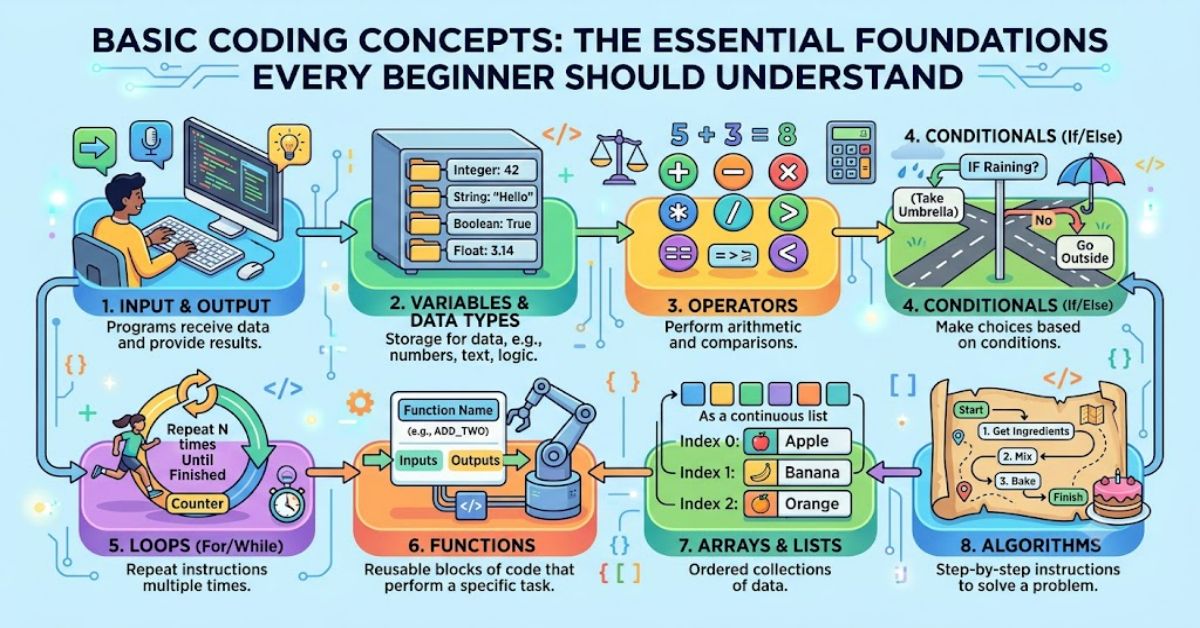
Basic coding concepts are the core rules used to write code and understand how computer programs work. These foundations include variables, data types, and control structures, which allow developers to store information, organise instructions, and create logical solutions to problems.
Whether someone is learning Python, JavaScript, Java, C++, or another programming language, these principles appear repeatedly. Programming languages may have different syntax, but the underlying ideas remain consistent.
A beginner who understands these foundations can move between languages more easily because they are learning problem-solving methods rather than memorising commands. Coding is not only about writing lines of text; it is about breaking complex tasks into smaller steps that computers can follow.
The importance of these concepts has increased as software development becomes part of many industries, including finance, healthcare, education, engineering, and business operations. Even professionals who do not become full-time developers often benefit from understanding computational thinking.
This guide examines the essential building blocks of programming, explains how they work together, and explores why these skills remain relevant in modern technology environments.
What Are Basic Coding Concepts?
Programming is based on communication between humans and computers. Developers write instructions using a programming language, and those instructions are converted into actions performed by a machine.
The most important foundations include:
- Variables for storing information
- Data types for defining different forms of information
- Control structures for managing decision-making and repetition
- Functions for organising reusable code
- Algorithms for creating step-by-step solutions
These elements work together to create applications, websites, games, automation systems, and digital services.
A useful way to understand programming is to compare it with following a recipe. Ingredients represent data, instructions represent code, and the final meal represents the completed program.
Variables: Storing and Managing Information
Variables are containers that store values used by a program. Instead of repeatedly writing the same information, developers assign data to a variable and reference it when needed.
For example, a banking application might store:
- Customer name
- Account balance
- Transaction history
A variable can change during program execution, which makes it useful for tracking information that develops over time.
Different programming languages handle variables differently. Some languages require developers to specify the type of data stored, while others automatically identify it.
Understanding variables helps beginners develop a mental model of how applications manage information.
Data Types and Information Structure
Data types define what kind of information a variable contains. Computers process different types of information differently, making classification essential.
Common data types include:
| Data Type | Purpose | Example |
| Integer | Stores whole numbers | 25 |
| Float | Stores decimal numbers | 19.95 |
| String | Stores text | “Technology” |
| Boolean | Stores true or false values | True |
| Array/List | Stores multiple values | [1,2,3] |
Choosing the correct data type improves accuracy and prevents programming errors.
For example, adding two numbers produces a mathematical result, while combining two text values creates a sentence. The computer needs to understand the difference between these operations.
Control Structures: Teaching Programs How to Think
Control structures allow software to make decisions and repeat actions. They are among the most important basic coding concepts because they introduce logic into programs.
The main types are:
Conditional Statements
Conditional statements allow programs to respond differently depending on circumstances.
Example:
- If a user enters the correct password, allow access.
- Otherwise, display an error message.
Loops
Loops repeat instructions until a condition changes.
Examples include:
- Processing thousands of customer records
- Displaying items in an online shop
- Running repeated calculations
Comparison of Programming Foundations
| Concept | Main Purpose | Real-World Example |
| Variables | Store information | Saving user preferences |
| Data types | Organise information | Separating numbers from text |
| Conditions | Make decisions | Login verification |
| Loops | Repeat actions | Processing large datasets |
| Functions | Reuse instructions | Payment calculations |
Why Programming Fundamentals Matter
Strong foundations improve problem-solving ability. Developers spend significant time analysing problems before writing code.
A person who understands programming logic can approach challenges systematically:
- Identify the problem.
- Break it into smaller tasks.
- Design a solution.
- Test the result.
- Improve the process.
This approach applies beyond software development. Many industries now value computational thinking because automation and digital tools influence daily operations.
Common Learning Challenges and Trade-Offs
Learning programming can be challenging because beginners often focus too heavily on syntax rather than understanding concepts.
Common difficulties include:
- Memorising commands without understanding logic
- Debugging errors caused by small mistakes
- Managing frustration during problem-solving
- Learning too many languages at once
Another challenge is balancing simplicity with complexity. Beginner-friendly languages such as Python make learning easier, but eventually developers must understand deeper concepts such as memory management, algorithms, and software architecture.
The most effective learning path usually focuses on principles first and specific programming languages second.
The Real-World Impact of Coding Knowledge
Programming knowledge influences modern society in many ways. Software controls financial systems, medical technologies, communication platforms, and transport networks.
Businesses increasingly use automation to improve efficiency, while governments and organisations rely on digital systems for public services.
Understanding coding concepts also helps people evaluate technology more effectively. A manager, designer, or entrepreneur with programming knowledge can communicate better with technical teams and make more informed decisions.
The Future of Basic Coding Concepts in 2027
By 2027, programming education is likely to become increasingly connected with artificial intelligence tools, automation platforms, and interactive learning environments.
AI-assisted coding tools may help beginners generate examples, identify errors, and understand programming patterns. However, fundamental concepts will remain important because developers still need to evaluate generated code, understand security risks, and design reliable systems.
The growth of low-code and no-code platforms may change how some applications are created, but these tools still rely on traditional programming principles behind the scenes.
Future developers will likely need both technical understanding and the ability to work alongside intelligent software systems.
Structured Insights: Why Foundations Remain Valuable
| Insight Area | Current Challenge | Long-Term Importance |
| Programming logic | Beginners struggle with problem-solving | Builds transferable thinking skills |
| Data management | Digital systems create more information | Supports accurate software development |
| Automation | Businesses require efficient workflows | Creates demand for technical literacy |
Key Takeaways
- Programming begins with understanding concepts rather than memorising syntax.
- Variables, data types, and control structures form the foundation of software development.
- Logical thinking is as important as technical knowledge.
- Coding skills support careers across many industries.
- AI tools may assist programmers but do not remove the need for fundamental understanding.
- Strong foundations make learning advanced technologies easier.
Conclusion
Basic coding concepts provide the foundation for understanding how software is designed, developed, and improved. Variables, data types, and control structures may appear simple, but they influence almost every digital system created today.
Learning these principles helps beginners move beyond copying code and develop genuine problem-solving skills. It creates a framework that applies across programming languages and technology fields.
As artificial intelligence and automation continue to influence software development, these fundamentals remain essential. Technology may change, but the need to understand logic, structure, and efficient problem-solving will continue.
A strong grasp of programming foundations gives learners the confidence to explore more advanced areas while building a clearer understanding of the digital world around them.
Frequently Asked Questions
What are the most important basic coding concepts?
The most important concepts include variables, data types, control structures, functions, and algorithms. These ideas appear across most programming languages.
Why should beginners learn programming fundamentals first?
Fundamentals help learners understand how software works instead of simply memorising commands. They create skills that transfer between different languages.
Are variables difficult to understand?
Variables are usually one of the easiest concepts for beginners. They work like labelled containers that store information a program needs.
Which programming language is best for learning coding concepts?
Python is often recommended for beginners because its syntax is simple and allows learners to focus on logic rather than complicated language rules.
Will AI replace the need to learn coding concepts?
AI tools may assist developers, but understanding programming cncepts remains necessary for checking accuracy, solving problems, and designing reliable systems.
How long does it take to learn basic coding concepts?
The timeline depends on practice and learning methods, but many beginners can understand fundamental ideas within several weeks of consistent study.
Methodology
This article was developed using established programming education resources, software engineering documentation, and recognised technology learning frameworks. The information focuses on widely accepted programming principles rather than specific software products.
No fabricated developer interviews, private testing results, or personal coding benchmarks were included. Examples are educational illustrations designed to explain technical concepts clearly.
This article was drafted with AI assistance and requires human editorial verification before publication. Editors should confirm technical details and update examples where programming practices change.
References (APA Style)
Python Software Foundation. (2024). Python documentation: The Python language reference. Python Software Foundation.
Mozilla Developer Network. (2024). JavaScript guide and programming fundamentals. Mozilla Foundation.
Microsoft. (2024). Programming concepts and developer documentation. Microsoft Learn.
University of Cambridge. (2023). Computer science education and computational thinking resources. University of Cambridge.