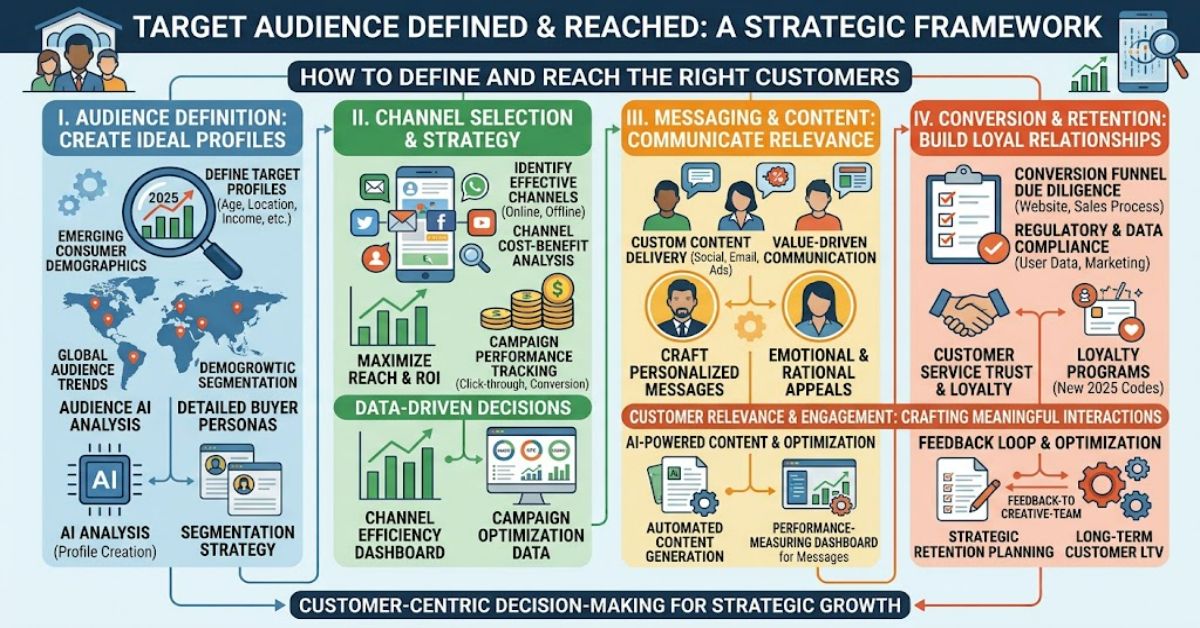
A target audience is the specific group of consumers most likely to want a product or service. Businesses define this group using shared traits such as age, location, interests, income, behaviour, needs and purchasing circumstances. The purpose is not to exclude everyone else, but to identify where marketing effort is most likely to produce meaningful results.
For example, a premium meal-delivery company may identify busy professionals in large cities as an initial audience. But that description is still broad. A stronger profile might focus on professionals aged 30–50 who work long hours, have limited time for cooking, value convenience and regularly purchase prepared food.
That distinction matters because modern marketing offers enormous reach. Ofcom reported in December 2025 that UK adults spent an average of four and a half hours online each day, with smartphones accounting for much of that activity. Businesses therefore have many opportunities to reach potential customers, but more channels do not automatically create better marketing.
The central challenge is relevance. A campaign can reach thousands of people and still perform poorly if the message, product or timing does not match their needs.
Good audience definition creates a practical bridge between customer research and marketing execution. It influences positioning, advertising, content, product development, pricing and customer retention.
What Makes a Target Audience?
A useful audience profile normally combines several dimensions rather than relying on one demographic characteristic.
| Audience dimension | What it examines | Example |
| Demographic | Age, income, occupation, household status | Professionals aged 30–45 |
| Geographic | Country, region, city or neighbourhood | Urban UK customers |
| Psychographic | Values, interests, attitudes and lifestyle | Sustainability-conscious shoppers |
| Behavioural | Purchases, usage and engagement | Frequent online buyers |
| Needs-based | Problems and desired outcomes | Customers seeking faster delivery |
| Intent | Readiness to purchase | People comparing providers |
Demographics are useful because they are easy to measure, but they rarely explain the complete buying decision.
Two people of the same age and income can have completely different motivations. One may prioritise convenience while another prioritises price. One may respond to technical detail while another wants reassurance and social proof.
That is why audience research becomes more useful when it moves from “Who are they?” to “Why would they choose this?”
Target Audience vs Target Market
The terms are related but not identical.
A target market is the broader group a company intends to serve. A target audience is usually narrower and more useful for a particular campaign, product or message.
| Concept | Main purpose | Typical scope |
| Target market | Defines the commercial opportunity | Broad |
| Target audience | Identifies likely campaign recipients | Narrower |
| Customer persona | Represents a researched customer type | Individualised |
| Audience segment | Groups customers with meaningful similarities | Variable |
A clothing retailer might serve a broad target market of adults interested in affordable fashion. A particular campaign could target university students looking for inexpensive autumn clothing.
The narrower audience gives the campaign a clearer proposition without suggesting that other customers are irrelevant.
How to Define Your Target Audience
Start with existing evidence rather than assumptions.
Customer records, sales data, website analytics, customer-service conversations, surveys and market research can reveal who actually buys and why.
Look for patterns in:
- purchase frequency;
- average order value;
- product preferences;
- geographic concentration;
- acquisition channels;
- repeat-purchase behaviour;
- customer questions and objections;
- reasons for abandoning purchases.
The next step is to identify the problem your product solves. An audience should not merely be described by appearance. It should have a meaningful connection to the product’s value proposition.
For example, “women aged 25–40” is weak positioning for a productivity application. “Professionals managing multiple projects who need a simpler way to organise deadlines” provides a stronger basis for messaging.
This is one of the most important analytical distinctions in audience research: shared demographics describe people, while shared problems explain purchasing relevance.
Segmentation Makes Targeting More Precise
Businesses rarely have one homogeneous customer group. Segmentation divides a wider market into smaller groups with different needs or behaviours.
A software company, for instance, could distinguish between:
- New users who need education.
- Active users who need advanced features.
- Inactive users who need re-engagement.
- High-value customers who may respond to premium services.
The product is unchanged, but the communication should differ.
This creates another important insight: segmentation is valuable only when the segments lead to different decisions. If two groups receive the same product, message, price and channel, separating them may add complexity without improving performance.
A practical segment should therefore answer a management question: What will we do differently for this group?
Audience Research and Personalisation
Digital marketing makes it possible to personalise campaigns using customer information and behavioural signals. But greater precision creates greater responsibility.
The Information Commissioner’s Office states that profiling for direct marketing can involve analysing interests, habits and behaviour to predict preferences. Organisations must ensure that such activity is fair, transparent and supported by an appropriate lawful basis.
The ICO also updated its direct-marketing guidance in April 2026 following changes associated with the Data (Use and Access) Act.
This means businesses should not treat audience data as an unrestricted marketing resource. Data collection, profiling and targeting need clear purposes and appropriate controls.
Contextual targeting can sometimes offer a less intrusive alternative. The ICO notes that contextual advertising can, in principle, make compliance with UK privacy requirements easier than approaches based heavily on behavioural profiling.
Common Targeting Mistakes
One common mistake is defining an audience too broadly. “Everyone who needs our product” is not an actionable audience.
Another is relying entirely on demographics. Age, gender and location can provide useful context, but they do not necessarily identify purchasing motivation.
A third mistake is confusing an existing customer base with the only possible audience. Current buyers reflect the company’s present proposition. They may not represent future growth opportunities.
A fourth is creating too many segments. Excessive segmentation can produce complicated campaigns that are difficult to manage and measure.
Finally, businesses sometimes confuse reach with relevance. A large audience does not guarantee strong commercial performance.
The Future of Target Audience Strategy in 2027
Audience strategy in 2027 is likely to become more dependent on first-party data, contextual signals and responsible personalisation.
Privacy requirements will remain important as businesses use customer information for advertising and profiling. The ICO states that direct marketing organisations should collect information fairly, explain how it will be used and respect individuals’ preferences, including objections to direct marketing.
Artificial intelligence may also make segmentation faster by identifying patterns across large datasets. However, automation does not remove the need for human judgement. A model can identify a correlation without explaining whether the resulting segment is commercially useful, ethically appropriate or statistically reliable.
The likely advantage will therefore come from combining better data with better interpretation rather than simply creating more detailed customer profiles.
Key Insights
- Problems can be stronger than demographics: Shared customer needs often provide a better basis for messaging than age or gender alone.
- Segments should change decisions: A segment is useful when it leads to different products, messages, channels or offers.
- Reach is not relevance: A smaller audience with strong purchase intent can outperform a much larger general audience.
- Customer evidence should lead assumptions: Existing sales and behavioural data can reveal gaps between intended and actual customers.
- Privacy is part of targeting: Data-driven segmentation must account for fairness, transparency and lawful processing.
- Context can reduce complexity: Not every campaign requires extensive individual profiling.
- Audience definitions should evolve: Markets, customer expectations and purchasing behaviour change over time.
Conclusion
A target audience is more than a demographic description. It is a practical definition of the people most likely to value a particular product or service, based on evidence about their characteristics, needs, behaviour and circumstances.
The strongest audience strategies combine market segmentation with customer research. They identify not only who potential buyers are, but also what problem they are trying to solve, how they make purchasing decisions and what information influences them.
For businesses, this creates a direct connection between research and execution. Audience insight can shape product positioning, content, advertising, pricing and customer experience.
There is also a growing responsibility attached to precise targeting. Profiling and personalisation can improve relevance, but organisations must handle personal information fairly and transparently.
Ultimately, effective targeting is not about reaching the maximum number of people. It is about understanding the right people well enough to communicate genuine value.
FAQ
What is a target audience?
A target audience is the group of consumers most likely to be interested in a company’s product or service. It can be defined using demographics, location, interests, behaviour, needs and purchasing intent.
How do you identify a target audience?
Start with customer and market data, then analyse demographics, purchasing behaviour, needs, problems, motivations and acquisition channels. Surveys and customer interviews can add qualitative insight.
What is the difference between a target audience and a target market?
A target market is the broader group a business aims to serve. A target audience is generally a narrower group selected for a particular campaign, product or communication strategy.
Why is audience segmentation important?
Segmentation allows businesses to identify meaningful customer differences and adapt messaging, offers or channels accordingly. It is most useful when different segments require different decisions.
Can a business have more than one target audience?
Yes. A business can serve several audiences, particularly when it offers different products or solves different problems. Each audience should have a clear commercial rationale.
Should target audiences be based on demographics?
Demographics can be useful, but they should rarely be the only basis. Behaviour, needs, purchasing intent and motivations often provide stronger information about why someone might buy.
Does audience targeting involve personal data?
It can. When organisations use personal information for direct marketing or profiling, UK data protection and electronic marketing rules may apply. The ICO recommends fair, lawful and transparent processing.
Methodology
This article uses the supplied RubbleMagazine.co.uk brief as its structural basis and draws on current UK regulatory and digital-behaviour sources. The Information Commissioner’s Office was used to validate claims concerning direct marketing, profiling, personal information and online advertising. Ofcom’s 2025 Online Nation reporting was used for the current UK online-behaviour context.
The article does not claim firsthand testing, interviews or original consumer research. Instead, documented regulatory guidance and named institutional research are used as the verifiable authority signals. The main limitation is that audience performance varies by sector, product, geography and campaign objective, so no universal demographic profile can guarantee conversion.
References
Information Commissioner’s Office. (2026). Direct marketing guidance.
Information Commissioner’s Office. (2026). Collect information and generate leads.
Information Commissioner’s Office. (2026). How do the rules apply to online advertising?
Information Commissioner’s Office. (2026). Direct marketing checklist.
Ofcom. (2025). From apps to AI search: How the UK goes online in 2025.