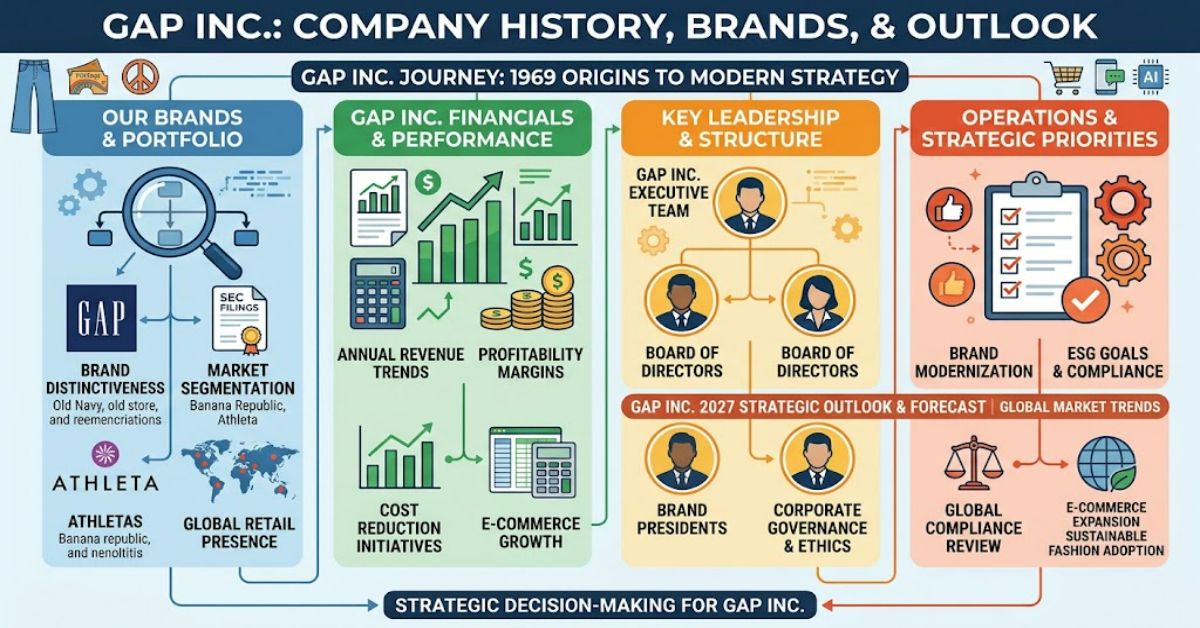
The story of Gap is closely tied to the development of modern American casualwear. Founded in San Francisco in 1969 by Donald and Doris Fisher, the company began with a simple retail concept centred on jeans before developing into one of the world’s best-known clothing groups. Gap Inc. now operates four major brands: Old Navy, Gap, Banana Republic and Athleta.
The original Gap brand remains particularly associated with denim, casual essentials and American style. Yet the modern company is much larger than the name on its flagship stores. Its business model combines company-operated shops, franchise locations, e-commerce and shared supply-chain capabilities across its brands.
Recent results suggest that Gap Inc. has entered a more constructive phase. For fiscal 2025, which ended on 31 January 2026, net sales rose 2% to $15.4 billion, while comparable sales increased 3%. The company also reported $1.1 billion in operating income and $1.3 billion in operating cash flow.
However, the headline improvement masks a more complicated picture. Old Navy remains a major sales engine, Gap has been strengthening, Banana Republic has shown signs of recovery, while Athleta has continued to struggle. Understanding that contrast is essential to understanding where the business goes next.
From a Denim Shop to a Global Retail Group
Gap’s origins date to 21 August 1969, when Don and Doris Fisher opened the first store on Ocean Avenue in San Francisco. The shop initially sold Levi’s jeans alongside records and tapes. Gap-branded products arrived later as the company developed its own identity.
The business expanded rapidly. Gap acquired Banana Republic in 1983, while Old Navy became an important growth vehicle during the 1990s. The company’s history demonstrates an important strategic pattern: rather than depending exclusively on one fashion proposition, Gap Inc. repeatedly used new brands and formats to reach different consumer segments.
That diversification remains central to the group today.
How Gap Inc.’s Brands Compare
| Brand | Core positioning | Recent performance | Strategic role |
| Old Navy | Accessible family apparel | Largest sales contributor | Scale and volume |
| Gap | Casual lifestyle and denim | Improving | Heritage and cultural relevance |
| Banana Republic | More premium lifestyle apparel | Showing recovery | Higher-end positioning |
| Athleta | Women’s performance lifestyle | Under pressure | Growth opportunity requiring rebuilding |
Gap Inc.’s fiscal 2025 results illustrate why the group should not be viewed as a single-brand retailer. Banana Republic generated $1.9 billion in full-year sales, down 1%, but comparable sales rose 3%. Athleta generated $1.2 billion, down 10%, with comparable sales falling 9%.
The contrast creates both diversification and complexity. A stronger brand can offset weakness elsewhere, but management must allocate investment carefully rather than applying the same strategy across every label.
The Numbers Behind the Business
Gap Inc.’s fiscal 2025 figures provide a useful snapshot of the company’s operating model.
| Measure | Fiscal 2025 |
| Net sales | $15.4 billion |
| Store and franchise sales | $9.4 billion |
| Online sales | $6.0 billion |
| Gross profit | $6.3 billion |
| Gross margin | 40.8% |
| Operating income | $1.1 billion |
| Operating cash flow | $1.3 billion |
| Company-operated stores | 2,474 |
| Franchise locations | Approximately 1,000 |
The figures show that digital commerce is no longer a secondary channel. Online sales reached almost $6 billion in fiscal 2025, while store and franchise sales remained the larger component. Gap Inc. also uses services such as buy-online-pick-up-in-store, order-in-store and ship-from-store to connect physical and digital retail.
That creates a useful operational advantage: stores can function as sales locations, customer-experience spaces and parts of the fulfilment network.
The Strategic Challenge
The central challenge for Gap is not simply selling more clothes. It is maintaining distinct brand identities while operating efficiently across a highly competitive apparel market.
Gap itself has a valuable heritage. Its denim history, recognisable branding and association with American casualwear give it cultural assets that newer retailers cannot easily reproduce. The difficulty is converting heritage into contemporary relevance.
The company’s recent results suggest progress. Gap Inc. reported eight consecutive quarters of positive comparable sales by March 2026, indicating that its turnaround efforts were beginning to produce more consistent results.
Yet Athleta demonstrates the limits of a broad recovery narrative. Its double-digit sales decline in fiscal 2025 shows that brand-level problems can persist even when the wider group improves.
One important insight is therefore that Gap Inc.’s future performance should be judged by dispersion between brands, not only by consolidated revenue. Group-level growth can conceal areas requiring substantial investment.
Risks and Trade-Offs
The company’s scale creates advantages but also introduces structural risks.
A large store network can provide visibility and convenience, but physical retail carries property, staffing and operating costs. Online expansion can reach consumers efficiently, yet digital retail creates intense competition around price, delivery, returns and customer acquisition.
Supply-chain complexity is another consideration. Gap Inc. states that most products sold under its brands are designed by the company and manufactured by independent suppliers globally. Shared investments in supply-chain and inventory management can improve efficiency, but global sourcing also creates exposure to freight costs, tariffs, geopolitical disruption and changing consumer demand.
There is also a brand-management trade-off. Promotional pricing can stimulate demand, but excessive discounting can weaken perceived value and margins. Premium positioning can protect margins but risks reducing accessibility.
The Future of Gap in 2027
Gap’s 2027 outlook is likely to depend on whether its recent operational improvement can become durable.
The strongest opportunity is the combination of brand heritage with sharper product relevance. Gap does not need to abandon its history; it needs to make that history useful to contemporary customers. Its own positioning continues to emphasise wardrobe essentials, individuality and culturally relevant experiences.
Old Navy’s scale should continue to provide an important financial foundation, while Gap’s improving performance could strengthen the group’s cultural profile. Banana Republic has demonstrated early signs of stabilisation, but Athleta remains a more difficult rebuilding project.
The wider retail environment will remain uncertain. Tariffs, consumer spending, inventory discipline and the cost of operating stores can all affect margins. Gap Inc.’s March 2026 outlook already acknowledged tariff assumptions as an important factor in its forecasts.
A credible 2027 strategy therefore looks less like rapid expansion and more like disciplined execution: strengthen individual brands, improve product consistency, use stores and digital channels together, and protect profitability while investing selectively.
Key Insights
- Heritage remains an asset: Gap’s 1969 origins provide a distinctive cultural foundation, particularly in denim and casualwear.
- The portfolio reduces concentration: Four major brands allow the group to serve different consumer segments.
- Old Navy provides scale: Its contribution gives Gap Inc. a significant volume-based foundation.
- Gap’s recovery matters strategically: Improvement in the namesake brand can influence the wider group’s cultural relevance.
- Athleta is the key weakness: Its fiscal 2025 decline shows that the turnaround remains incomplete.
- Digital and physical retail are increasingly integrated: Stores are becoming part of the fulfilment and customer-experience system rather than simply sales outlets.
Conclusion
Gap is no longer simply the denim retailer that opened on San Francisco’s Ocean Avenue in 1969. It has become a complex international apparel group whose fortunes depend on four distinct brands, multiple retail channels and a global sourcing network.
Its latest results provide evidence of meaningful progress. Fiscal 2025 produced higher sales, stronger operating income and positive comparable sales, while the company entered 2026 with a more constructive outlook.
But the recovery is not uniform. Old Navy provides scale, Ga’p is regaining momentum, Banana Republic is showing improvement and Athleta requires significant rebuilding. That uneven performance is likely to remain one of the most important issues to watch through 2027.
The company’s long-term strength will ultimately depend on whether it can turn heritage into relevance, scale into efficiency and brand diversity into consistent financial performance.
FAQ
What is Gap best known for?
Ga’p is best known for American casualwear, particularly denim, jeans and wardrobe essentials. The company was founded in San Francisco in 1969 and built its early identity around jeans and later Ga’p-branded clothing.
When was Gap founded?
Gap was founded in 1969 by Donald and Doris Fisher. The first store opened on Ocean Avenue in San Francisco on 21 August 1969.
What brands does Gap Inc. own?
Gap Inc.’s major brands are Old Navy, Gap, Banana Republic and Athleta. The group also operates through company-owned, franchise and digital channels.
Is Gap still growing?
Gap Inc. reported 2% net sales growth in fiscal 2025 and eight consecutive quarters of positive comparable sales by March 2026. However, growth varies considerably between individual brands.
What is Gap’s biggest business risk?
A major risk is uneven brand performance. Athleta’s decline shows that improvement at group level does not necessarily mean every brand has returned to sustainable growth.
How large is Gap Inc.?
Gap Inc. ended fiscal 2025 with 2,474 company-operated stores and approximately 1,000 franchise locations. Fiscal 2025 net sales were $15.4 billion.
Methodology
This article combines the supplied RubbleMagazine.co.uk editorial framework with current primary-source information from Gap Inc. and its SEC-filed annual report. Historical claims were checked against Gap Inc.’s corporate history and company materials, while fiscal performance and store figures were drawn from the company’s fiscal 2025 reporting. Current fiscal 2026 information was also considered where relevant.
The analysis does not claim firsthand testing, store visits or private interviews. Financial and strategic interpretations are analytical conclusions based on publicly reported information and should not be treated as investment advice.
References
Gap Inc. (2026). Gap Inc. reports fourth quarter and fiscal 2025 results; provides fiscal 2026 outlook. Gap Inc.
Gap Inc. (2026). Annual report for fiscal year ended 31 January 2026. U.S. Securities and Exchange Commission.
Gap Inc. (2026). History. Gap Inc.
Gap Inc. (2026). Gap. Gap Inc.
Gap Inc. (2026). Second quarter fiscal 2026 results. Gap Inc.