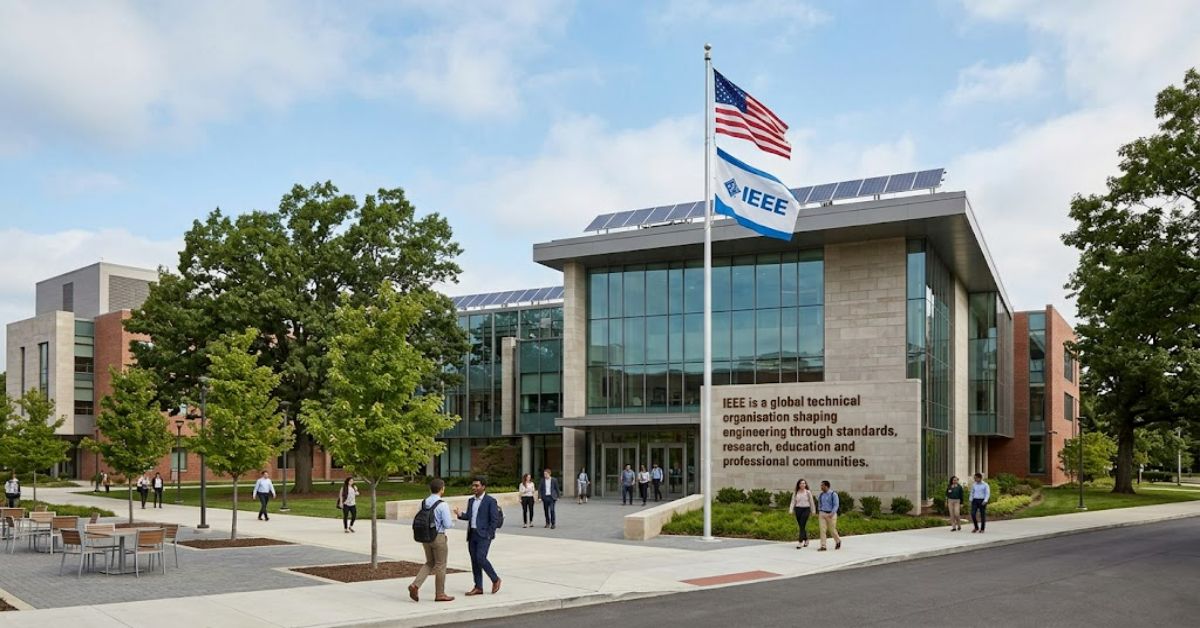
IEEE stands for the Institute of Electrical and Electronics Engineers. It is a global not-for-profit technical professional organisation whose members work across engineering, computing, electronics, communications, energy, artificial intelligence, biomedical technology and related disciplines.
IEEE describes itself as the world’s largest technical professional organisation. Current IEEE material places its network at more than 486,000 members across more than 190 countries, illustrating the scale of its international reach.
For many people, IEEE is most familiar through research papers, technical conferences or standards such as those associated with wireless networking. Yet reducing IEEE to a professional membership body misses its wider role. It operates simultaneously as a technical community, publisher, standards organisation, educational provider and professional network.
That combination explains why IEEE remains relevant well beyond traditional electrical engineering. Its activities increasingly cover software, data, artificial intelligence, robotics, telecommunications and other technologies that depend on shared technical knowledge.
How IEEE Began
The modern IEEE dates from 1 January 1963, when the American Institute of Electrical Engineers (AIEE) merged with the Institute of Radio Engineers (IRE).
The story goes further back. AIEE was founded in 1884, during the early expansion of electrical power and communications. IRE followed in 1912, focusing initially on radio and subsequently on the broader electronics field. As technologies converged, so did the professional interests of their members.
The merger created an organisation capable of representing a much broader technological profession. IEEE inherited the technical traditions, publications, conferences and standards work of both predecessors.
This history matters because IEEE’s structure was shaped by technological convergence long before today’s discussions about digital convergence. Its evolution from electrical engineering towards computing, communications and information technology demonstrates how professional institutions can adapt when technical boundaries change.
IEEE’s historical record also remains an active part of the organisation. Its History Committee supports the collection and dissemination of information about IEEE and its predecessor organisations, while IEEE History Week was introduced in 2024 around the organisation’s annual IEEE Day activities.
What Does IEEE Actually Do?
IEEE’s work can be understood through several connected functions.
| IEEE Function | What It Provides | Why It Matters |
| Standards | Technical specifications and consensus processes | Supports interoperability and consistent engineering practice |
| Publications | Journals, magazines, conference papers and digital research | Distributes technical knowledge |
| Conferences | Global technical meetings and presentations | Connects researchers, industry and practitioners |
| Professional development | Education, mentoring and career activities | Supports engineers throughout their careers |
| Membership | Technical societies, sections and communities | Creates professional and specialist networks |
| Ethics and public engagement | Professional principles and technology policy activity | Connects engineering decisions with public interests |
This combination is one of IEEE’s defining characteristics. A researcher can publish through IEEE, attend an IEEE conference, participate in a technical society, contribute to a standards working group and access professional education through the same broader organisation.
IEEE Standards
Standards are arguably one of IEEE’s most consequential contributions to everyday technology.
IEEE’s standards activity has roots stretching back to the AIEE and IRE. The AIEE established early work around electrical units and standards, while IRE developed technical specifications for radio and electronics. IEEE continued this work following the 1963 merger.
Today, IEEE Standards Association uses a formal development process intended to provide consensus, due process, openness and balance. Its Standards Board reviews and approves standards before publication.
The practical value is interoperability. When manufacturers, researchers and infrastructure providers use compatible technical specifications, devices and systems can work together without every organisation creating an isolated technical framework.
That makes standards particularly important in communications, networking, power systems, consumer electronics and emerging technologies.
IEEE Publications and IEEE Xplore
IEEE is also a major publisher of technical research.
The IEEE Xplore Digital Library provides access to more than six million full-text documents, including journals, magazines, conference proceedings, technical standards, books and educational material. IEEE states that approximately 20,000 new documents are added each month.
This creates a second layer of influence. IEEE does not simply help establish technical specifications; it also provides a large research infrastructure through which engineers and scientists communicate findings.
For students, researchers and professionals, the distinction between a standard and a research publication is important. A research paper primarily communicates knowledge or findings, while a technical standard establishes agreed requirements, methods or practices for a particular technological area.
IEEE Membership and Professional Communities
IEEE membership is organised around both technical interests and geography. Members can participate through technical societies and councils while also engaging with local sections, chapters and student branches.
This dual structure is significant because engineering careers operate at two levels. A specialist in power engineering may need access to a global technical community while also benefiting from local conferences, professional events and colleagues.
The UK and Ireland Section provides a useful example. Its activities include technical meetings, professional development, conferences, workshops, networking and career-related programmes.
Professional activities can also extend into mentoring, ethics, leadership, continuing education and public engagement. IEEE’s professional activities programmes explicitly address career development and the wider practice of engineering.
Why IEEE Matters Beyond Engineers
The influence of IEEE is not limited to people who hold engineering degrees.
Technical standards can affect businesses, manufacturers, software developers, researchers, governments and consumers. A standard can determine whether technologies communicate effectively, how equipment is tested or how an emerging system is specified.
IEEE’s standards activity therefore sits at the intersection of engineering and markets. Companies can participate in standards development to understand emerging technical directions and contribute expertise. IEEE Standards Association specifically provides membership routes for individuals and organisations seeking involvement in standards development.
There is also an ethical dimension. Engineering decisions increasingly affect privacy, safety, automated decision-making, energy consumption and access to digital infrastructure. IEEE’s professional activities include ethics and public engagement precisely because technical decisions can create consequences outside laboratories and engineering departments.
IEEE’s Strategic Challenges
IEEE’s scale is an advantage, but it also creates challenges.
| Challenge | Strategic Tension | Likely Consequence |
| Artificial intelligence | Fast innovation versus careful standards development | Greater demand for adaptable technical frameworks |
| Cybersecurity | Global interoperability versus security requirements | More emphasis on resilient standards |
| Emerging communications | Rapid commercial cycles versus consensus processes | Pressure to develop standards quickly without reducing rigour |
| Global participation | Different regulatory and economic environments | Need for broader international representation |
| Research volume | More publications versus limited attention | Greater importance of discoverability and research quality |
The central challenge is speed.
Standards traditionally require consultation, technical review and consensus. Emerging technologies can change substantially during that process. Moving too slowly can reduce relevance; moving too quickly can create immature or fragmented standards.
The more useful response is not simply to accelerate everything. IEEE’s standards governance exists partly to preserve procedural credibility. The strategic problem is finding where speed genuinely matters and where technical stability matters more.
Three Underappreciated Insights About IEEE
1. Standards are an economic mechanism, not merely technical paperwork.
IEEE standards can influence interoperability, procurement and market development. IEEE Standards Association explicitly connects standards participation with innovation, competitiveness and the development of emerging technologies.
2. IEEE’s greatest influence may occur without visible membership.
A consumer does not need to belong to IEEE to encounter technologies shaped by technical standards or research disseminated through IEEE publications. Its influence therefore extends far beyond its membership base.
3. IEEE’s organisational model mirrors technological convergence.
The institution combines geographic sections with discipline-focused societies. That structure is particularly useful as technology becomes less neatly divided into traditional engineering categories. Artificial intelligence, for example, increasingly intersects with communications, healthcare, robotics, energy and cybersecurity.
The Future of IEEE in 2027
IEEE enters 2027 with a technical environment increasingly shaped by artificial intelligence, autonomous systems, advanced communications, cybersecurity and interconnected infrastructure.
The organisation’s standards work will be especially important because emerging technologies require shared technical assumptions. IEEE Standards Association continues to maintain formal development processes while expanding work around technologies that affect markets, sustainability and consumer protection.
Another likely pressure point is participation. IEEE’s international scale creates opportunities for broader technical representation, but standards and professional activities must remain useful across different regulatory environments and levels of technological development.
Education will also become more important. Engineers increasingly need continuing professional development as tools and technical disciplines change. IEEE already provides professional education, credentials and training alongside its research and standards functions.
The uncertainty is speed. AI and related technologies can move faster than traditional professional institutions. IEEE’s long-term relevance will therefore depend not on predicting every technological development, but on maintaining credible mechanisms for engineers and organisations to respond to change.
Key Insights
- IEEE is both a professional organisation and a major technical infrastructure for knowledge, standards and collaboration.
- Its roots in AIEE and IRE explain its continuing emphasis on electrical, electronic and communications engineering.
- Standards are one of IEEE’s most consequential activities because interoperability affects entire technology markets.
- IEEE Xplore gives the organisation substantial influence over how technical research is discovered and communicated.
- Local sections and technical societies allow a global organisation to retain specialist and geographic communities.
- The growth of AI and connected technologies will increase demand for credible technical standards and professional guidance.
- IEEE’s biggest strategic test is balancing procedural rigour with the speed of technological change.
Conclusion
IEEE is much more than an abbreviation encountered on engineering papers or conference programmes. Since its formation in 1963, it has developed into a global technical organisation connecting research, professional development, standards, education and engineering communities.
Its historical significance comes from the merger of two organisations whose work reflected the technological priorities of their time. Its current significance comes from applying that institutional model to a much wider technology ecosystem.
The strongest case for IEEE remains its ability to connect people and technical knowledge. Researchers can publish and collaborate, engineers can develop professionally, companies can participate in standards work and technology communities can establish shared technical frameworks.
As artificial intelligence, cybersecurity, communications and connected infrastructure become increasingly interconnected, that coordinating role may become even more important. IEEE’s future influence will depend on whether it can preserve trust and technical quality while adapting quickly enough to remain relevant.
FAQ
What does IEEE stand for?
IEEE stands for the Institute of Electrical and Electronics Engineers. It is pronounced “eye-triple-E” and is a global technical professional organisation.
What is IEEE best known for?
IEEE is particularly well known for technical standards, research publications, conferences, professional communities and engineering education.
When was IEEE founded?
IEEE was formed on 1 January 1963 through the merger of the American Institute of Electrical Engineers and the Institute of Radio Engineers.
Is IEEE only for electrical engineers?
No. IEEE covers a broad range of disciplines, including computing, communications, artificial intelligence, biomedical engineering, power systems, electronics and related technologies.
What is IEEE Xplore?
IEEE Xplore is IEEE’s digital research library. It contains more than six million full-text documents spanning research papers, conference proceedings, standards, magazines, books and educational resources.
Why are IEEE standards important?
They establish technical specifications and consensus-based practices that can support interoperability, safety, compatibility and market development.
Is IEEE relevant to students?
Yes. IEE’E provides student membership, technical communities, conferences, professional development, educational resources and opportunities for networking and volunteering.
Methodology
This article was researched using IEE’E and IEE’E-affiliated primary material, including IEE’E organisational information, IEE’E Standards Association documentation, IEE’E History resources, IEE’E Xplore information and IEE’E regional publications.
Historical claims were cross-checked against IEEE’s published history. Current membership and organisational figures were compared across recent IEE’E materials. Standards-related claims were validated against IEE’E Standards Association documentation concerning standards development, membership and governance. UK context was checked against IEE’E UK and Ireland Section material.
A limitation is that IEEE’s organisational statistics can change as membership, publications and standards programmes develop. Figures presented here therefore reflect the most recent publicly available IEE’E material identified during research rather than a permanent count.
The article also distinguishes between IEE’E membership, IEE’E publications and IEE’E standards. These are related but separate functions, and treating them as interchangeable would oversimplify the organisation.
Editorial disclosure: This article was drafted with AI assistance and should be reviewed and independently verified by the RubbleMagazine.co.uk editorial team before publication.
References
IEEE. (2026). About IEEE Europe. IEEE Europe.
IEEE. (2026). IEE’E organisation. IEE’E Technology Navigator.
IEE’E. (2026). About the IEE’E Xplore Digital Library. IEE’E Author Center Journals.
IEE’E. (2026). Benefits of publishing with IEE’E. IEE’E Author Center Conferences.
IEE’E History Committee. (2026). IEE’E History Committee. IEE’E History.
IEE’E History. (2026). IEE’E History Activities. IEE’E History.
IEE’E Standards Association. (2026). About the IEE’E Standards Association.
IEE’E Standards Association. (2026). IEE’E SA Membership.
IEE’E Standards Association. (2026). About the IEE’E SA Standards Board.
IEE’E UK and Ireland Section. (2026). Professional and technical activities. IEE’E vTools.