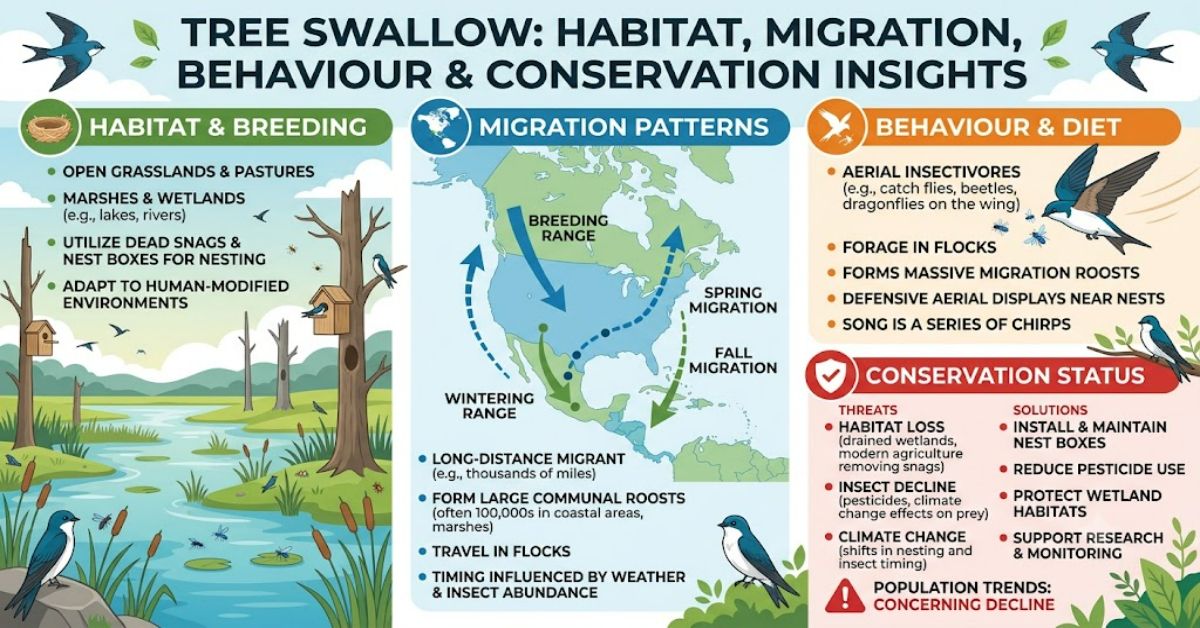
The tree swallow is a migratory bird of the family Hirundinidae found across much of North America. Known scientifically as Tachycineta bicolor, the species was first described in 1807 by French ornithologist Louis Vieillot as Hirundo bicolor before later classification placed it within the modern Tachycineta genus.
Recognised by its glossy blue-green upper feathers, white underside, and fast, agile flight, this bird has become a familiar sight around wetlands, open fields, forests, and rural landscapes. It is especially admired by birdwatchers because of its dramatic migration patterns and ability to perform complex aerial manoeuvres while catching insects.
The species provides valuable ecological insight because its population trends reflect wider environmental conditions. Changes in insect availability, climate patterns, and nesting habitats can influence breeding success and migration timing.
Understanding the tree swallow requires examining more than appearance. Its survival depends on a connected system involving food sources, nesting cavities, seasonal movement, and conservation management.
The Biology and Classification of the Tree Swallow
The tree swallow belongs to the swallow family Hirundinidae, a group of birds recognised for their specialised flying abilities and insect-eating behaviour.
Unlike some related swallow species that construct mud nests, this bird typically uses natural tree cavities or artificial nest boxes. Its scientific classification has changed over time as researchers studied evolutionary relationships within the genus Tachycineta.
Key characteristics include:
| Feature | Description |
| Scientific name | Tachycineta bicolor |
| Family | Hirundinidae |
| Original description | Louis Vieillot, 1807 |
| Main diet | Flying insects, berries during colder periods |
| Range | North and Central America |
| Migration type | Seasonal long-distance migration |
Its physical adaptations make it highly effective at aerial hunting. A streamlined body, pointed wings, and responsive flight control allow it to capture insects while moving rapidly through open air.
Habitat Preferences and Nesting Behaviour
The tree swallow typically selects habitats with open water, grasslands, wetlands, and forest edges. These environments provide both nesting opportunities and abundant insect populations.
Natural nesting sites are often found in abandoned woodpecker holes or tree cavities. However, human-provided nest boxes have become increasingly important in areas where natural cavities are limited.
This creates a unique relationship between conservation efforts and community involvement. Bird enthusiasts, landowners, and researchers often install nest boxes to support breeding populations.
| Habitat Factor | Importance |
| Tree cavities | Provide secure nesting locations |
| Wetlands | Support insect availability |
| Open landscapes | Allow efficient aerial hunting |
| Clean water systems | Maintain ecosystem health |
A practical challenge is that nesting success depends on more than providing a box. Placement, competition from other cavity-nesting birds, predators, and local climate conditions all affect outcomes.
Migration Patterns and Seasonal Movement
Migration is one of the most notable aspects of this species. Populations typically breed in northern parts of North America before moving south during colder months.
The journey requires significant energy because the birds depend heavily on insect availability, which changes with temperature and season.
Research into migratory birds has shown that climate change can affect timing by altering spring temperatures and food availability. When insects emerge earlier or later than expected, birds may experience challenges synchronising migration with peak feeding conditions.
This highlights an important ecological connection: a change in one part of the food chain can influence an entire migratory system.
Ecological Importance and Environmental Impact
The tree swallow contributes to ecosystem balance through insect control. By consuming large quantities of flying insects, it helps regulate populations of species that may affect agriculture, forests, and human environments.
Its presence also provides researchers with information about ecosystem health. Because birds respond quickly to environmental changes, monitoring populations can reveal broader ecological shifts.
Three important conservation insights include:
- Nesting availability matters: Loss of mature trees reduces natural cavity availability, making managed nesting programmes more valuable.
- Food timing influences survival: Climate-driven changes in insect cycles may create migration challenges.
- Local conservation has wider effects: Protecting wetlands and open habitats benefits multiple species beyond this bird alone.
Comparison: Tree Swallow and Related Swallow Species
| Species | Habitat Preference | Nesting Style | Migration Behaviour |
| Tree swallow | Wetlands, fields, woodland edges | Tree cavities and nest boxes | Long-distance migration |
| Barn swallow | Farms, open countryside | Mud nests on structures | Long-distance migration |
| Purple martin | Open areas near human settlements | Cavities and managed houses | Seasonal migration |
The main difference is the tree swallow’s reliance on cavity nesting. This makes availability of suitable nesting spaces a major conservation consideration.
Conservation Challenges and Risks
Although the species remains widespread, environmental pressures continue to influence populations.
Major concerns include:
- Reduction of natural nesting cavities
- Declining insect populations
- Habitat loss from land-use changes
- Extreme weather events affecting breeding seasons
Another challenge is balancing human intervention with natural ecological processes. Artificial nest boxes can help, but they cannot fully replace complex habitats.
Conservation strategies therefore focus on maintaining diverse landscapes rather than relying on a single solution.
The Future of Tree Swallow in 2027
By 2027, monitoring programmes and citizen science projects are expected to remain important tools for understanding population changes.
Advances in wildlife tracking technology may provide researchers with more detailed information about migration routes, survival rates, and environmental pressures.
Climate policy and habitat protection initiatives will also influence future outcomes. Organisations involved in biodiversity conservation increasingly emphasise protecting wetlands, restoring native habitats, and maintaining ecological connectivity.
However, predicting exact population changes remains difficult because migration depends on multiple interacting factors, including weather patterns, insect cycles, and regional habitat conditions.
The future of this species will depend on maintaining healthy ecosystems rather than focusing only on individual populations.
Key Takeaways
- The tree swallow is a highly adapted aerial insect-eating migratory bird.
- Its classification moved from Hirundo bicolor to Tachycineta bicolor as scientific understanding developed.
- Nesting cavities and insect availability are central to survival.
- Climate change may influence migration timing and breeding success.
- Conservation requires protecting complete ecosystems rather than isolated habitats.
- Community nest-box programmes can support local populations.
Conclusion
The tree swallow represents the close relationship between wildlife, habitat, and environmental change. Its elegant flight patterns and seasonal migrations make it a favourite among bird enthusiasts, while its ecological role makes it valuable to scientists studying ecosystem health.
Although the species remains adaptable, future pressures linked to habitat changes and shifting climate conditions require careful attention. Protecting wetlands, maintaining nesting opportunities, and supporting biodiversity-friendly landscapes will remain essential.
The story of this bird demonstrates how even a small migratory species can reveal larger environmental trends. By understanding its behaviour and needs, conservation efforts can support not only the tree swallow but the wider ecosystems connected to it.
Frequently Asked Questions
What is a tree swallow?
A tree swallow is a migratory North American bird from the Hirundinidae family, scientifically known as Tachycineta bicolor.
Where do tree swallows live?
They live across North America in habitats including wetlands, open fields, forests, and areas with suitable nesting cavities.
What do tree swallows eat?
They mainly eat flying insects caught during aerial feeding. During colder periods, they may also consume berries.
Are tree swallows endangered?
The species is not generally considered endangered, but habitat loss, insect declines, and climate changes may create conservation concerns.
How can people help tree swallows?
People can support them by protecting natural habitats and installing properly designed nest boxes where appropriate.
Why are tree swallows important?
They help control insect populations and serve as indicators of environmental changes affecting ecosystems.
Methodology
This article was developed using information from established ornithological references, conservation organisations, and scientific literature on migratory birds. Species classification, behaviour, and habitat information were reviewed against recognised biodiversity resources.
No personal field observations, unpublished tracking data, or fabricated expert interviews were included. The analysis focuses on documented characteristics of the species while acknowledging that regional populations may experience different environmental conditions.
This article was drafted with AI assistance and should receive human editorial review before publication. All scientific claims and references should be independently verified by editors.
References (APA Style)
Cornell Lab of Ornithology. (2024). Tree Swallow: Identification, life history, and conservation information. Cornell University.
National Audubon Society. (2024). Tree swallow species profile and conservation resources. Audubon.
BirdLife International. (2023). Species factsheet: Tachycineta bicolor. BirdLife International.
Vieillot, L. J. P. (1807). Histoire naturelle des oiseaux de l’Amérique septentrionale. Paris.