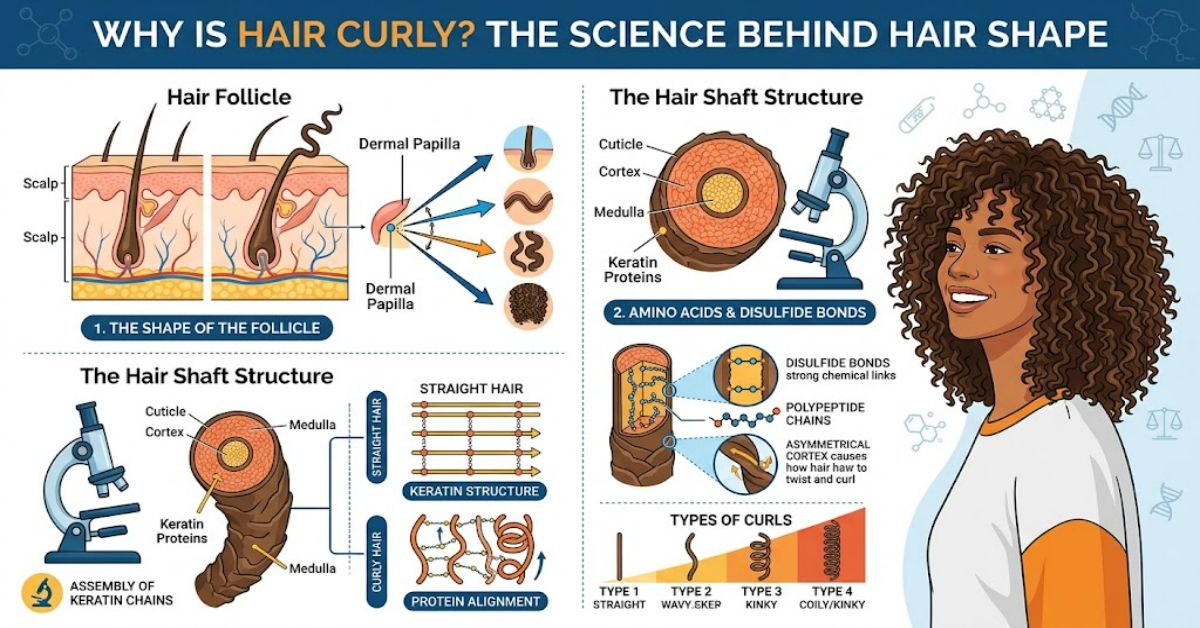
Why is hair curly when some hair grows almost perfectly straight? The answer begins beneath the scalp. Hair is produced inside a follicle, and the structure and behaviour of that follicle influence the shape of the fibre that eventually emerges. Research has linked curly hair with curved follicles, asymmetrical cell development and differences in the organisation of the hair cortex.
The simple explanation is that hair does not necessarily grow from a perfectly symmetrical biological structure. In curly hair, the follicle and its bulb can have a curved or asymmetrical configuration. Cells developing within that environment do not always differentiate evenly, creating physical differences across the emerging fibre. Those differences help establish curvature.
Genetics also play an important role. Studies have identified associations between hair shape and variations in genes involved in follicle development, keratin-related structures and cellular processes. However, there is no single “curly hair gene” that determines every curl pattern. Hair shape is a complex trait influenced by multiple biological mechanisms.
Understanding this distinction matters because the visible curl is only the final stage of a process that begins while the hair is still being formed.
The follicle is where curl begins
The hair follicle is a specialised structure embedded in the skin. It contains the bulb and matrix where new hair cells are produced, organised and eventually keratinised.
Research examining curly follicles has found distinctive curvature and asymmetry. A 2005 study published in the British Journal of Dermatology observed that curly follicles could have a curved implantation and a bent bulb, with asymmetrical structures around the follicle. Importantly, the curvature remained in hair shafts produced from these follicles in laboratory culture.
That observation provides a useful clue: curl is not simply created by environmental exposure after hair leaves the scalp. At least part of its shape is programmed during formation.
| Structural feature | Relationship with curl |
| Curved follicle | Encourages a curved growth path |
| Asymmetrical bulb | Creates uneven cellular development |
| Uneven cortex organisation | Contributes to bending |
| Elliptical or irregular fibre shape | Can influence mechanical behaviour |
| Genetic variation | Helps determine follicle and fibre characteristics |
The follicle therefore acts less like a neutral tube and more like a biological mould that helps determine the architecture of the growing fibre.
Why does hair bend instead of growing straight?
A growing hair fibre contains several structural components, including the cortex, which provides much of its strength and mechanical behaviour. In curly hair, cells within the developing cortex are not necessarily distributed symmetrically.
Research into curly follicles has found differences in the timing and distribution of cellular differentiation on different sides of the follicle. One side can develop differently from the other, producing an uneven structure that contributes to curvature.
This is more precise than the popular explanation that “oval hair follicles make hair curly”. Cross-sectional shape can influence the behaviour of a fibre, but modern research suggests that follicle geometry and asymmetric biological development are more fundamental to understanding curl formation.
A 2019 review and related research argue that the organisation of different cell populations within the hair cortex is a major driver of curl formation. An irregular cross-section can reinforce the effect, but it should not be treated as the sole cause.
Genetics influence the curl pattern
Hair shape is strongly influenced by inherited biology. However, curliness is a complex trait rather than a simple genetic switch.
Research has identified associations involving several genes and proteins connected with hair formation. A review of curly-hair biology highlighted links involving trichohyalin, CUTC and keratin 74, while broader genome-wide studies have identified additional genetic loci associated with variation in human hair shape.
This helps explain why members of the same family can have noticeably different hair patterns. Genetic inheritance influences the biological machinery involved in follicle construction and fibre formation, but combinations of many variants can produce different outcomes.
| Factor | What it influences |
| Genetics | Follicle development and fibre characteristics |
| Follicle geometry | Direction and degree of curvature |
| Cell differentiation | Asymmetry within the growing fibre |
| Keratin organisation | Mechanical properties of the fibre |
| Fibre cross-section | Bending and twisting behaviour |
| Environment and treatment | Appearance and condition of the finished hair |
Why humidity can change curly hair
The underlying curl pattern is established during hair formation, but the visible appearance of curls can change significantly afterwards.
Hair is a keratin-based fibre that responds to moisture and mechanical conditions. Humidity can alter interactions between components within the hair fibre, making curls appear tighter, looser or more frizzy. Heat, chemical processing, brushing and repeated wetting can also change the condition and mechanical behaviour of the fibre.
This creates an important distinction: environmental conditions can modify how existing curls look without being the original reason the follicle produced a curly fibre.
That distinction is one of the practical insights often missed in simplified explanations of hair texture. The biological origin of curl and the day-to-day appearance of curl are related but separate questions.
What makes some curls tighter than others?
Curl patterns vary because hair fibres differ in their geometry, curvature, diameter, internal organisation and growth behaviour. Recent micro-computed tomography research has demonstrated substantial variation in cross-sectional characteristics between hair fibres with different curl levels. It also found greater variability within some low- and medium-curl samples than highly curled fibres.
This means curl cannot always be reduced to a single measurement.
A tighter curl may involve stronger or more frequent curvature and twisting along the fibre. Differences in the cortex and cross-sectional shape can also affect how easily the fibre bends. The result is a spectrum rather than a strict division between straight and curly hair.
The Future of Hair Research in 2027
By 2027, hair research is likely to focus increasingly on three-dimensional follicle biology, genetics and quantitative measurement of curl. Improved imaging techniques can provide more detailed information about fibre geometry than visual classification alone.
Recent research using micro-CT illustrates this direction by measuring complete hair fibres and their internal and cross-sectional characteristics.
The practical value could extend beyond cosmetic classification. Better understanding of follicle biology may help researchers investigate hair disorders, fibre damage and how cosmetic treatments interact with different hair structures.
The limitation is that hair shape remains biologically complex. More detailed measurements do not automatically produce a single formula capable of predicting every person’s curl pattern.
Key Insights
- Curl formation begins while hair is developing inside the follicle.
- Follicle curvature and asymmetrical cellular development are central to the process.
- Genetics influence several biological pathways involved in hair shape.
- Cross-sectional geometry affects how a finished fibre bends and twists.
- Humidity and cosmetic treatments can alter appearance without creating the original curl pattern.
- Modern research increasingly measures curl as a three-dimensional structural property rather than a simple visual category.
Methodology
This article draws on peer-reviewed research concerning hair-fibre morphology, follicle structure, genetics and biomechanics. Particular attention was given to studies examining curly follicles directly, research reviews covering the biology of curly hair, genetic association studies and recent imaging research.
No original laboratory testing or firsthand hair-fibre measurements were conducted for this article. Observations attributed to researchers are based on their published experimental work. The principal limitation is that the biological mechanisms governing curl are complex and remain an active research area; therefore, simplified explanations should not be treated as complete models.
Conclusion
Curly hair is the visible result of a process that starts beneath the scalp. The shape and behaviour of the follicle, particularly around the bulb where hair is produced, influence how cells develop and organise into a growing fibre. In curly hair, asymmetry within this process can generate the curvature that becomes visible above the scalp.
Genetics provide much of the underlying biological instruction, while fibre structure determines how the finished hair bends, twists and responds to physical conditions. Environmental factors such as humidity can change the appearance of curls, but they are not the fundamental source of the pattern.
The science therefore goes beyond the familiar claim that an oval follicle simply produces curly hair. Current evidence points towards an interaction between follicle geometry, asymmetric cell differentiation, cortical organisation, genetics and fibre mechanics. That more complete explanation also helps clarify why human hair exists across such a broad and continuous range of textures.
FAQ
Why is hair curly?
Hair becomes curly because its formation inside the follicle involves curvature and asymmetrical cellular development. Genetics also influence the biological structures involved in producing the fibre.
Does an oval follicle cause curly hair?
Fibre cross-sectional shape can influence bending, but it is not the complete explanation. Research indicates that follicle curvature and asymmetric differentiation are important contributors to curl formation.
Is curly hair genetic?
Yes. Hair shape has a substantial genetic component, although multiple genes and biological processes contribute rather than one single gene determining curliness.
Can straight hair become curly naturally?
Hair appearance can change with age, hormones, damage and other factors, but permanent changes in the underlying growth pattern involve biological changes within the follicle rather than simply changing the hair’s surface.
Why does humidity affect curly hair?
Moisture can alter the physical and mechanical behaviour of the keratin fibre, changing the appearance, definition and amount of frizz in existing curls.
Why are some curls tighter than others?
Curl tightness depends on several structural characteristics, including curvature, twisting frequency, fibre geometry, cross-sectional properties and the organisation of the hair cortex.
References
Bernard, B. A. (2003). Hair shape of curly hair. Journal of the American Academy of Dermatology, 48(6 Suppl), S120–S126.
De La Mettrie, R., Saint-Léger, D., Loussouarn, G., Garcel, A. L., Porter, C., & Lévêque, J. L. (2007). Shape variability and classification of human hair: A worldwide approach. Human Biology, 79(3), 265–281.
Loussouarn, G., El Rawadi, C., & Genain, G. (2007). Diversity of hair types and their implications for hair care. International Journal of Cosmetic Science.
Thibaut, S., Barbarat, P., Leroy, F., & Bernard, B. A. (2007). Human hair keratin network and curvature. International Journal of Dermatology, 46(Suppl. 1), 7–10.
Wortmann, F. J., Wortmann, G., & Sripho, T. (2020). Why is hair curly? Deductions from the structure and the biomechanics of the mature hair shaft. Experimental Dermatology, 29(3), 366–372.