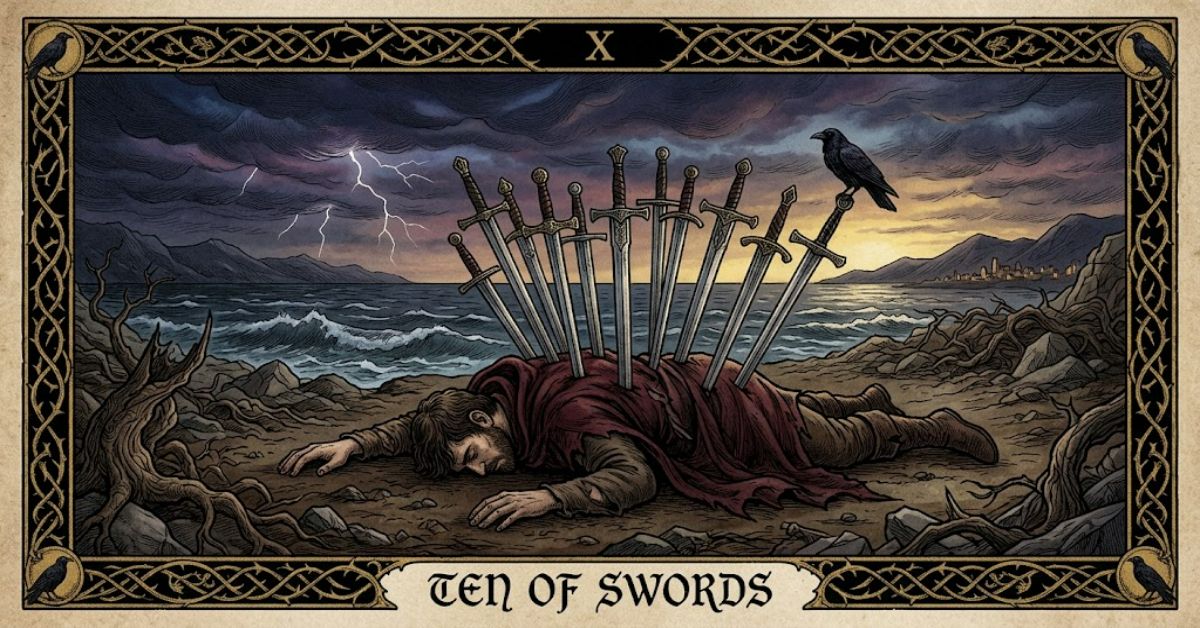
The Ten of Swords is one of the most visually striking cards in tarot. In the familiar Rider-Waite-Smith design, a figure lies face down with ten swords across his back while a dark sky stretches above a calm body of water. Yet the scene contains an important contrast: light is appearing on the horizon.
As a Minor Arcana card, the Ten of Swords deals with experiences that can feel immediate and personal. Its traditional associations include painful endings, loss, betrayal, collapse, exhaustion and the conclusion of a difficult period. Modern tarot interpretations commonly describe it as the point at which a situation has reached its natural or unavoidable endpoint.
The card is therefore less about predicting catastrophe than examining what happens when an existing chapter can no longer continue in its current form. A relationship may have ended, a professional situation may have collapsed, or a long period of emotional strain may finally have reached a breaking point.
That distinction matters. Tarot is an interpretive and symbolic practice, not a scientifically validated method for predicting future events. The Ten of Swords can be used as a prompt for reflection rather than as a fixed declaration of what must happen.
What the Ten of Swords Means
The central theme is finality. The number ten traditionally represents completion within the Minor Arcana, while the suit of Swords is commonly associated with thought, communication, conflict and the mental dimension of experience.
Together, these elements create a card concerned with the end of a difficult mental or situational cycle. The imagery is deliberately extreme, making the sense of finality difficult to miss.
| Element | Common interpretation |
| Ten swords | Completion, accumulation or finality |
| Fallen figure | Defeat, exhaustion or surrender |
| Dark sky | Crisis, grief or uncertainty |
| Rising light | Hope, renewal and another phase |
| Calm water | Emotional stillness after turmoil |
The sunrise is particularly significant. Although the figure appears to have reached the lowest point, the background suggests that darkness is not permanent. Biddy Tarot identifies the rising sun and calm water as visual elements that introduce hope and renewal into an otherwise bleak scene.
Symbolism and Historical Context
The modern image most readers associate with the card comes from the Rider-Waite-Smith tradition. The British Museum records Arthur Edward Waite as a key figure behind the standard modern tarot pack first published in 1909 by William Rider & Sons, alongside Pamela Colman Smith.
This historical context helps explain why the card’s detailed illustration is so influential. Earlier tarot traditions did not always present the Minor Arcana with the same narrative scenes. In the Tarot de Marseille tradition, for example, numbered Minor Arcana cards are much more dependent on suit symbolism and numerological interpretation than the illustrated Rider-Waite-Smith system.
The Ten of Swords therefore has to be interpreted within the particular tarot tradition being used. A reader working with a Marseille-style deck may approach the card differently from someone using the Rider-Waite-Smith visual language.
Ten of Swords in Love
In relationship readings, the Ten of Swords is commonly associated with separation, grief, betrayal or the end of a relationship dynamic.
It does not necessarily mean that every relationship involving the card must end. Instead, the symbolism can describe a relationship that has reached a painful turning point or a pattern that can no longer continue unchanged.
This distinction is useful when interpreting difficult cards. Rather than asking, “Does this mean my relationship will end?”, a more constructive question is, “What part of this relationship has reached its limit?”
The card can also represent the end of an unhealthy communication pattern, unresolved resentment or an outdated expectation. Its meaning depends heavily on the surrounding cards and the question asked.
Ten of Swords in Career and Money
Career readings often connect the card with redundancy, professional disappointment, burnout or the conclusion of a particular working arrangement. Labyrinthos similarly associates its upright meaning with job loss, office conflict and stress.
Financially, the card may symbolise a significant setback, a failed plan or the realisation that a particular approach is no longer sustainable.
The practical insight is not that failure is inevitable. Rather, the card can encourage an honest assessment of what has already stopped working. Continuing to invest energy in something that has effectively ended can create a different kind of cost.
Reversed Ten of Swords
The reversed Ten of Swords changes the emphasis from final collapse towards recovery and release.
Common interpretations include healing, regeneration, surviving a difficult period, resisting an inevitable ending and gradually moving beyond old wounds.
| Upright | Reversed |
| Painful ending | Recovery |
| Defeat | Survival |
| Betrayal | Release |
| Collapse | Rebuilding |
| Finality | Resistance or gradual renewal |
The reversed position can therefore be ambiguous. It may suggest that the worst has passed, but it can also indicate reluctance to accept an ending.
Three Deeper Insights
1. The card is about limits, not simply loss.
The strongest reading of the imagery is not necessarily “something terrible will happen”. It can instead identify a situation that has exhausted its available options. That makes the card useful for examining boundaries and endings.
2. The sunrise changes the emotional meaning.
The figure dominates the foreground, but the horizon prevents the image from becoming purely fatalistic. The composition places suffering and renewal in the same frame.
3. Reversal can reveal unfinished endings.
When reversed, the card may describe someone who has technically moved beyond an event but has not emotionally processed it. This interpretation shifts attention from what happened to how its consequences are being carried forward.
The Future of Ten of Swords in 2027
Tarot interpretation is increasingly presented online through educational websites, digital readings and visual comparisons between different decks. That trend is likely to continue through 2027, but the fundamental issue will remain interpretation rather than prediction.
Digital tarot content can make traditional symbolism more accessible, while also increasing the risk of treating simplified keywords as universal definitions. The Ten of Swords demonstrates why context matters: the same card can represent an ending, exhaustion, acceptance, recovery or resistance depending on its position and surrounding cards.
For readers, the more useful future-facing approach is likely to be contextual literacy rather than keyword memorisation.
Key Insights
- The Ten of Swords represents completion within a difficult narrative.
- Its imagery deliberately combines defeat with the possibility of renewal.
- Tarot traditions do not all interpret the card identically.
- In relationship readings, it can describe an ending or the end of a damaging pattern.
- In career readings, it may represent professional exhaustion or a concluded chapter.
- The reversed card commonly shifts attention towards recovery and unresolved pain.
- The card should be treated as symbolic guidance rather than a guaranteed prediction.
Conclusion
The Ten of Swords has earned its reputation as one of tarot’s most difficult-looking cards, but its meaning is more nuanced than its imagery initially suggests. It can represent painful endings, betrayal, defeat and the feeling of reaching rock bottom. At the same time, the card’s composition contains a quieter message: an ending can create the conditions for something different to begin.
Its most useful interpretation often comes from examining what has already reached its limit. Rather than treating the card as a prediction of unavoidable disaster, readers can use it to consider closure, acceptance, recovery and the consequences of continuing with an exhausted situation.
Whether upright or reversed, the Ten of Swords ultimately asks a question about transition. What needs to be acknowledged, released or understood before the next chapter can begin?
FAQ
What does the Ten of Swords mean in tarot?
It traditionally represents painful endings, defeat, betrayal, exhaustion and the completion of a difficult cycle. Its imagery can also suggest that a new phase follows an ending.
Is the Ten of Swords a bad card?
It is generally considered challenging because its symbolism centres on loss and finality. However, the rising light in the traditional imagery introduces themes of hope, recovery and renewal.
What does the Ten of Swords mean in love?
It may represent separation, heartbreak, betrayal or the ending of a relationship pattern. Context and surrounding cards are important.
What does the Ten of Swords reversed mean?
Common interpretations include recovery, regeneration, release from past pain or resistance to an ending. The exact emphasis depends on the reading.
Does the Ten of Swords predict death?
Not necessarily. In standard tarot interpretation, the card is primarily symbolic of endings, collapse and completion rather than a literal prediction of death.
What does the Ten of Swords mean for a career?
It can symbolise professional disappointment, job loss, burnout or the conclusion of a particular career situation.
References
Biddy Tarot. (2026). Ten of Swords tarot card meanings. Biddy Tarot.
British Museum. (n.d.). Arthur Edward Waite. British Museum Collections.
Gong, T. (2026). Ten of Swords meaning: Tarot card meanings. Labyrinthos.
Gong, T. (n.d.). The Minor Arcana of the Tarot de Marseille: Numerology of pip cards. Labyrinthos.
Methodology
This article was developed by comparing established interpretations of the Ten of Swords from Biddy Tarot and Labyrinthos with historical information from the British Museum concerning the Rider-Waite-Smith tarot tradition. The analysis distinguishes traditional symbolic interpretations from factual historical information and does not present tarot as a scientifically validated predictive system.
A key limitation is that tarot meanings are interpretive rather than universally standardised. Different decks, traditions and readers may assign different nuances to the same card. The article therefore focuses primarily on the widely used Rider-Waite-Smith visual tradition while acknowledging differences between tarot systems.
This article was drafted with AI assistance. A human editor should independently verify the cited sources, wording, historical details and editorial presentation before publication.