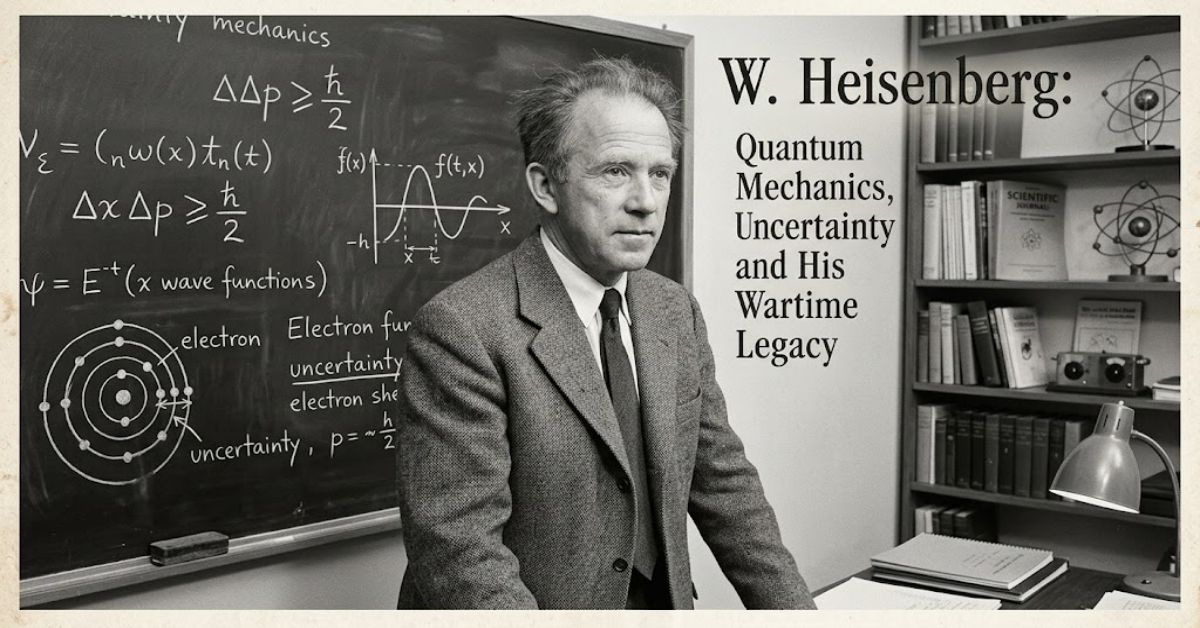
W. Heisenberg, formally Werner Karl Heisenberg, was a German theoretical physicist whose work helped establish quantum mechanics as one of the foundations of modern science. Born in Würzburg on 5 December 1901, he became one of the leading physicists of his generation and received the 1932 Nobel Prize in Physics, awarded in 1933, for the creation of quantum mechanics.
His importance rests primarily on two ideas. In 1925, Heisenberg developed a new mathematical description of atomic behaviour that became matrix mechanics. Two years later, he formulated the uncertainty relation, establishing that quantities such as position and momentum cannot both be known with unlimited precision.
Yet Heisenberg’s historical reputation extends beyond physics. His career continued through Nazi Germany and the Second World War, when he participated in German nuclear research. Understanding him therefore requires separating his scientific achievements from the complicated political and ethical circumstances surrounding his wartime work.
The 1925 Breakthrough
Quantum theory in the early 1920s was struggling to explain atomic spectra consistently. Classical physics could not fully account for what experiments showed, while existing quantum models relied on concepts that were increasingly difficult to defend.
In 1925, Heisenberg took a radical approach. Rather than trying to visualise electrons moving in precise classical orbits, he concentrated on quantities that could be connected with observations, including the frequencies and intensities of radiation emitted by atoms. His paper, published in Zeitschrift für Physik, became the starting point for matrix mechanics.
The mathematics was initially difficult to interpret. Max Born recognised that the quantities in Heisenberg’s formulation behaved like matrices, while Born and Pascual Jordan helped develop the mathematical framework further. The result represented a major change in how physicists thought about atomic systems.
| Development | Date | Importance |
| Heisenberg’s quantum-mechanics paper | 1925 | Established the basis of matrix mechanics |
| Uncertainty relation | 1927 | Limited simultaneous precision of certain quantities |
| Nobel Prize decision | 1932 | Recognised his creation of quantum mechanics |
| Nobel Prize awarded | 1933 | Formal presentation of the 1932 Physics Prize |
The significance of this work was not simply mathematical. It demonstrated that successful physics did not always require a familiar visual picture of microscopic reality. That shift helped open the way towards the modern quantum description of matter.
The Uncertainty Principle
Heisenberg’s second major contribution was the uncertainty principle, developed in 1927. It is often simplified into the claim that measuring a particle’s position disturbs its momentum. The deeper point is that quantum mechanics itself imposes a fundamental limit on the precision with which certain pairs of physical quantities can be simultaneously specified.
Position and momentum are the best-known example. The principle is not merely a statement about poor instruments. Even an ideal measurement cannot remove the mathematical uncertainty built into quantum mechanics.
This distinction matters because popular explanations sometimes turn the principle into a simple observer-effect story. Measurement can certainly affect quantum systems, but the uncertainty relation is more fundamental than the limitations of a particular measuring device.
That insight also challenged the classical expectation that a particle should possess a perfectly defined position and momentum at every moment. At atomic scales, nature cannot always be described using the categories that work comfortably for everyday objects.
Heisenberg and the Nobel Prize
Heisenberg received the Nobel Prize in Physics for 1932, with the award formally presented in 1933. The Nobel Committee credited him with creating quantum mechanics and noted its applications, including work that contributed to the discovery of allotropic forms of hydrogen.
His recognition reflected the rapid transformation of physics during the 1920s. Heisenberg’s matrix mechanics and Erwin Schrödinger’s wave mechanics initially looked like competing approaches, but Schrödinger demonstrated in 1926 that the two formulations were mathematically equivalent. Modern quantum mechanics incorporates the insights of both traditions.
Why Heisenberg Still Matters
Three aspects of Heisenberg’s work remain especially important.
Abstraction: He showed that physics could progress without relying on classical pictures of atomic motion.
Mathematical structure: Matrix mechanics became part of the formal language used to describe quantum systems.
Limits of prediction: The uncertainty principle demonstrated that quantum theory does not simply reproduce classical determinism at smaller scales.
Together, these ideas helped establish a framework that later became essential to atomic physics, chemistry and numerous technologies based on quantum phenomena.
Heisenberg and Germany’s Nuclear Programme
Heisenberg’s wartime history is more difficult to interpret. During the Second World War, he was among the scientists involved in Germany’s nuclear research effort. After the war, he and several other German scientists were detained at Farm Hall in Britain, where their conversations were secretly recorded.
The transcripts show that the scientists discussed the Hiroshima bombing and the limitations of Germany’s own nuclear programme. Heisenberg stated that he had believed a uranium reactor could be developed but had not expected Germany to build an atomic bomb during the war.
This evidence is important because it demonstrates the complexity of the historical debate. Heisenberg was neither simply outside Germany’s nuclear research nor straightforwardly equivalent to the leadership of the American Manhattan Project. His exact motivations, understanding and degree of commitment remain subjects of historical analysis.
| Historical question | Evidence-based assessment |
| Did Heisenberg pioneer quantum mechanics? | Yes |
| Did he formulate the uncertainty relation? | Yes, in 1927 |
| Did he receive a Nobel Prize? | Yes, Physics, 1932 |
| Was he involved in German nuclear research? | Yes |
| Did Germany produce an atomic bomb? | No |
| Is his wartime role historically debated? | Yes |
The Future of W. Heisenberg in 2027
In 2027, W. Heisenberg relevance is likely to remain strongest in education and the history of quantum science. The centenary of his 1927 uncertainty relation also provides an opportunity to distinguish the original physics from simplified popular interpretations.
The broader lesson is equally valuable. Heisenberg’s career demonstrates how scientific revolutions can involve both conceptual and mathematical changes. It also shows why scientific achievement cannot always be separated from the political institutions in which scientists work.
Modern quantum information science continues to rely on concepts descended from the mathematical framework developed during the 1920s, although contemporary theories and applications are far more sophisticated than the original formulations.
Key Takeaways
- W. Heisenberg 1925 work helped establish matrix mechanics.
- His 1927 uncertainty principle changed the meaning of physical measurement.
- His Nobel Prize recognised the creation of quantum mechanics.
- His scientific partnership with figures such as Born, Jordan, Bohr and Schrödinger was central to the development of quantum theory.
- His wartime nuclear research remains a subject of historical debate.
- His legacy combines major scientific achievement with difficult questions about responsibility.
Conclusion
W. Heisenberg occupies a distinctive position in twentieth-century science. His 1925 formulation of matrix mechanics helped replace classical assumptions about atomic motion with a new quantum framework, while his uncertainty principle showed that the microscopic world could not always be described through perfectly precise classical variables.
His Nobel recognition confirmed the importance of those achievements, but his historical significance extends beyond equations. His work during wartime Germany places his career within a difficult ethical and political context, requiring historians to distinguish documented evidence from later interpretations.
The strongest assessment of Heisenberg is therefore neither purely celebratory nor purely condemnatory. He was one of the architects of modern quantum mechanics, while also being a scientist whose career unfolded under extraordinary political circumstances.
FAQ
Who was W. Heisenberg?
W. Heisenberg was Werner Karl Heisenberg, a German theoretical physicist and one of the principal founders of quantum mechanics.
What did Heisenberg discover in 1925?
He developed a new formulation of quantum mechanics based on observable quantities. This work became known as matrix mechanics.
What is Heisenberg’s uncertainty principle?
It states that quantum mechanics places fundamental limits on the simultaneous precision with which certain pairs of physical quantities, such as position and momentum, can be specified.
When did Heisenberg win the Nobel Prize?
He was awarded the 1932 Nobel Prize in Physics, which was formally presented in 1933.
Was Heisenberg involved in Germany’s nuclear programme?
Yes. He participated in Germany’s wartime nuclear research programme, although the extent and nature of his intentions remain debated by historians.
Did W. Heisenberg build an atomic bomb?
No. Germany did not produce an atomic bomb during the Second World War.
Methodology
This article W. Heisenberg was based on established historical and scientific records, including Nobel Prize biographical material, Nobel educational resources, American Physical Society historical reporting, Heisenberg’s Nobel lecture and declassified Farm Hall transcripts. Claims about the 1925 and 1927 developments were cross-checked against these sources. The principal limitation is that interpretations of Heisenberg’s wartime intentions remain contested, so the article distinguishes documented participation from claims about motivation..
References
American Physical Society. (2025). June/July 1925: Werner Heisenberg pioneers quantum mechanics. APS News.
Nobel Prize Outreach. (2026). The Nobel Prize in Physics 1932: Werner Karl Heisenberg. NobelPrize.org.
Nobel Prize Outreach. (2026). Werner Heisenberg – Facts. NobelPrize.org.
Nobel Prize Outreach. Werner Heisenberg – Biographical. NobelPrize.org.
Heisenberg, W. (1933). Nobel Lecture: The development of quantum mechanics. Nobel Prize Outreach.
Atomic Archive. Excerpt from the declassified transcripts of secretly recorded conversations at Farm Hall.