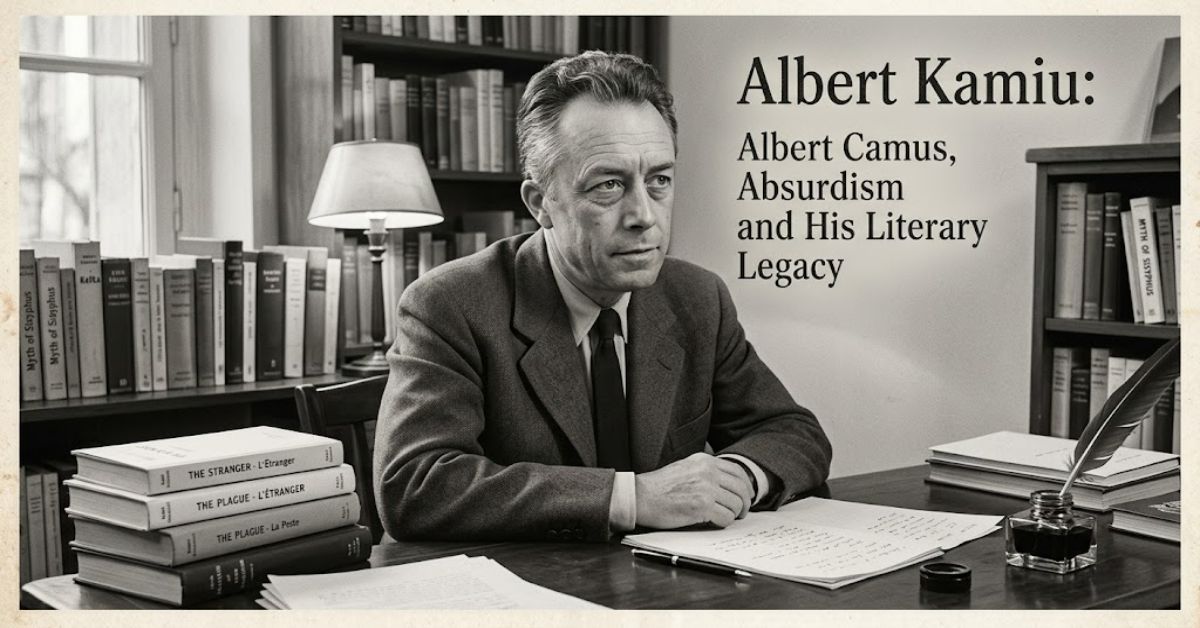
Albert Kamiu is commonly used online as a misspelling of Albert Camus, whose correct name was Albert Camus. Born on 7 November 1913 in Mondovi, French Algeria, Camus became one of the most influential French-language writers and thinkers of the twentieth century. He died in France on 4 January 1960, aged only 46.
Camus was a novelist, essayist, playwright, journalist and political activist. His writing repeatedly examined difficult questions: What gives life meaning? How should people respond to suffering? Can morality exist without religious certainty? And what responsibilities do individuals have when governments and societies become unjust?
His answer was rarely simple. Rather than offering a complete philosophical system, Camus used fiction and essays to explore the tension between human beings’ desire for meaning and a world that does not necessarily provide it.
That tension became known as the absurd.
Albert Camus and the Meaning of the Absurd
The absurd is central to Camus’s intellectual legacy. It does not simply mean that life is ridiculous or meaningless. Instead, Camus described a conflict between the human desire for order, purpose and explanation and a universe that does not guarantee those things.
His 1942 essay The Myth of Sisyphus developed this idea directly. The mythical Sisyphus is condemned to push a boulder up a mountain repeatedly, only for it to roll back down. For Camus, the story becomes a way of considering how people can live when existence offers no final answer to the question of meaning.
Importantly, Camus did not argue that recognising absurdity should lead automatically to despair. His philosophy emphasised conscious living, resistance and engagement with life.
This distinction separates Camus from the simplified idea that he merely believed “nothing matters”. His writing instead asks how people can act responsibly even when certainty is unavailable.
Major Works and Their Ideas
Camus expressed his ideas through several literary forms. His 1942 novel The Stranger introduced Meursault, a detached protagonist whose emotional response to death and social expectations challenges conventional ideas about morality and identity. The Nobel Foundation identifies the novel as a key expression of Camus’s treatment of absurdity.
His 1947 novel The Plague takes the discussion in another direction. Set in Oran, it follows people confronting an epidemic and examines solidarity, suffering and resistance. Dr Rieux’s persistent work for others provides a practical image of moral action in a world where suffering cannot always be explained or eliminated.
| Work | Year | Central concern |
| The Stranger | 1942 | Absurdity, alienation and social judgement |
| The Myth of Sisyphus | 1942 | Absurdity and the search for meaning |
| The Plague | 1947 | Solidarity, suffering and resistance |
| The Fall | 1956 | Guilt, judgement and moral responsibility |
| Exile and the Kingdom | 1957 | Isolation, belonging and ethical choice |
The progression matters. Camus moved beyond an abstract question about meaning towards a broader concern with how people should behave towards one another.
Camus, Politics and the French Resistance
Camus’s ideas developed alongside major political upheavals. His childhood and early adulthood in Algeria strongly influenced his perspective, while his journalism addressed the political and social realities of French Algeria. Later, after moving to France, he became involved with the Resistance during the German occupation. After liberation, he worked as a columnist for Combat.
His political position was often difficult to categorise. Camus had been associated with revolutionary circles when younger, but he became increasingly critical of political violence and ideological absolutism.
This creates one of the most useful ways to understand his philosophy: absurdity did not mean political indifference. Camus believed that recognising human limitations should encourage restraint, solidarity and opposition to unnecessary violence.
His disagreement with Jean-Paul Sartre and other intellectuals reflected these tensions. Although frequently grouped with existentialists, Camus resisted being defined by that label.
Why Camus Won the Nobel Prize
In 1957, Camus received the Nobel Prize in Literature. He was 44, making him one of the younger recipients at the time. The official citation praised his literary production for illuminating problems of human conscience in his era.
The award recognised more than individual novels. Camus had developed a distinctive literary method in which philosophical problems were expressed through characters, situations and moral conflicts.
His importance therefore sits between literature and philosophy. Readers can approach The Stranger as a novel, while also examining it as an exploration of alienation and moral judgement. The Plague can be read as a story about disease while also functioning as an examination of collective responsibility.
A Structured View of Camus’s Legacy
| Dimension | Camus’s contribution | Lasting significance |
| Literature | Novels, essays and plays | Influenced modern literary culture |
| Philosophy | Absurdity, revolt and responsibility | Continues to shape discussions of meaning |
| Politics | Resistance and criticism of ideological violence | Offers a model of political scepticism |
| Ethics | Emphasis on human solidarity | Connects philosophy with practical conduct |
| Culture | French-Algerian perspective | Adds complexity to twentieth-century French history |
One of Camus’s most enduring insights is that philosophical uncertainty does not remove the need for ethical decisions. People still have to choose how they treat others.
The Future of Albert Camus in 2027
Camus is likely to remain relevant in 2027 because the questions behind his work have not disappeared. Political polarisation, war, social alienation and uncertainty continue to raise questions about responsibility and collective action.
His work also fits contemporary debates about meaning in an age shaped by rapid technological and cultural change. Yet his value does not depend on making him a prophet of modern problems. His writing is strongest when read in its historical context and then considered against present concerns.
The enduring lesson is more modest: uncertainty about ultimate meaning does not prevent people from choosing solidarity, restraint and responsibility.
Key Takeaways
- The correct spelling is Albert Camus, although “Albert Kamiu” appears as a search variation.
- Camus was born in French Algeria in 1913.
- The Stranger and The Myth of Sisyphus were both published in 1942.
- The Plague developed themes of solidarity and resistance.
- Camus participated in the French Resistance and later worked for Combat.
- He received the Nobel Prize in Literature in 1957.
- His philosophy remains associated with the problem of absurdity and the ethical response to it.
Conclusion
Albert Kamiu, correctly known as Albert Camus, remains an important figure because his writing connects philosophical questions with ordinary human choices. His work does not provide easy answers about meaning. Instead, it examines what people can do when certainty is impossible and suffering cannot always be explained.
From The Stranger to The Plague, Camus repeatedly returned to alienation, mortality, responsibility and solidarity. His experience in Algeria, journalism, involvement in the French Resistance and later political disagreements gave those ideas a practical dimension.
His Nobel Prize in 1957 confirmed his status as a major literary figure, but his reputation has lasted because the problems he explored remain recognisable. Camus asks readers to face uncertainty without surrendering moral responsibility. That combination of intellectual honesty and human solidarity is the central reason his work continues to be read.
FAQ
Who is Albert Kamiu?
Albert Kamiu is a common misspelling or search variation of Albert Camus, the French-Algerian writer and Nobel Prize-winning author.
What is Albert Camus best known for?
He is best known for works such as The Stranger, The Myth of Sisyphus and The Plague, as well as his ideas about absurdity, freedom and moral responsibility.
What does Camus mean by absurdity?
Camus uses absurdity to describe the conflict between the human desire for meaning and a universe that does not provide guaranteed answers.
When did Albert Camus win the Nobel Prize?
Camus won the Nobel Prize in Literature in 1957. The award recognised his important literary production and its treatment of human conscience.
Was Camus an existentialist?
Camus was often associated with existentialism, but he rejected being tied to a particular ideology. His philosophical concerns overlap with existentialist themes without making the label definitive.
What is Camus’s most famous book?
The Stranger is among his most widely recognised works. Published in 1942, it presents themes of alienation, absurdity and social judgement.
Methodology
This article Albert Kamiu was prepared using the supplied RubbleMagazine editorial brief and verified biographical and bibliographical information from NobelPrize.org. Historical dates, major works, Nobel recognition and Camus’s involvement in journalism and the Resistance were cross-checked against Nobel Foundation material. Interpretive claims about his philosophy are presented as analysis rather than as firsthand reporting.
References
Nobel Prize Outreach. (2026). Albert Camus – Facts. NobelPrize.org.
Nobel Prize Outreach. (2026). Albert Camus – Biographical. NobelPrize.org.
Nobel Prize Outreach. (2026). The Nobel Prize in Literature 1957. NobelPrize.org.
Nobel Prize Outreach. (2026). All Nobel Prizes in Literature. NobelPrize.org.