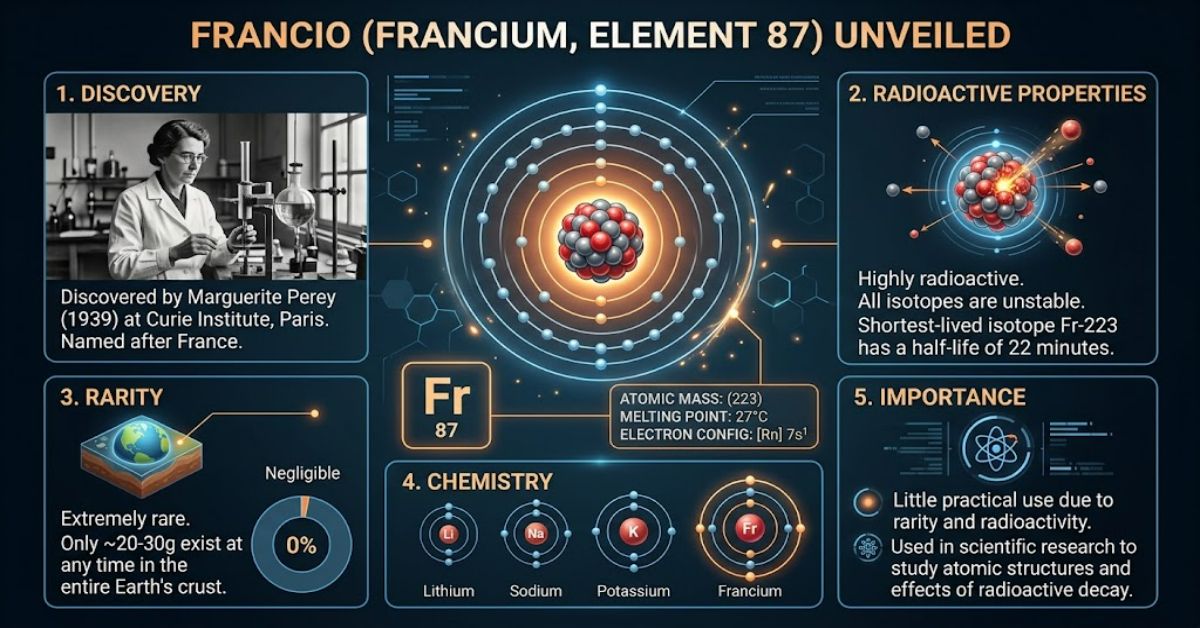
Francio is most commonly associated with francium, the chemical element represented by the symbol Fr and atomic number 87. The name appears particularly in Spanish and Italian contexts, where francio is used for the element known in English as francium. In chemistry, the underlying subject is therefore element 87, the heaviest member of the alkali-metal group.
Francium occupies Group 1 of the periodic table alongside lithium, sodium, potassium, rubidium and caesium. Its position suggests strong chemical reactivity, but studying the element directly is exceptionally difficult because every francium isotope is radioactive. The naturally occurring isotope francium-223 has a half-life of about 22 minutes, meaning a sample disappears rapidly through radioactive decay. The Royal Society of Chemistry lists francium as an intensely radioactive metal and states that it has no practical uses because of its short half-life. (Royal Society of Chemistry, 2026)
The story behind the element is almost as interesting as its chemistry. For decades, scientists searched for the missing Group 1 element predicted to sit beneath caesium. Earlier claims turned out to be incorrect. In 1939, French physicist Marguerite Perey identified the element while studying actinium decay at the Curie Institute in Paris.
Understanding francio therefore requires separating the word from the scientific substance. The term points to francium, while francium itself provides a remarkable case study in radioactive decay, periodic trends, nuclear chemistry and the limits of experimental observation.
What Is Francio?
In the context described by the supplied keyword brief, francio refers primarily to francium. The English chemical name is francium, while francio is used in Spanish and Italian.
| Property | Francium |
| Symbol | Fr |
| Atomic number | 87 |
| Period | 7 |
| Group | 1 |
| Block | s-block |
| Key natural isotope | Francium-223 |
| Half-life of Fr-223 | About 22 minutes |
| Oxidation state | +1 |
| Classification | Alkali metal |
Francium’s position in Group 1 gives it one valence electron, represented by the electron configuration [Rn] 7s¹. Like other alkali metals, it tends to lose this outer electron and form a +1 ion.
The difficulty is that the element does not remain around for long enough to behave like an ordinary laboratory material. The Royal Society of Chemistry reports no practical uses for francium and identifies its intense radioactivity as a defining characteristic.
Why Is Francium So Rare?
Francium is rare because it is continuously destroyed by radioactive decay. It occurs naturally only in extremely small quantities as an intermediate product in radioactive decay chains.
Francium-223 is associated with the decay of actinium-227. Its short half-life means that any francium atoms produced in nature rapidly transform into other elements. This creates a moving equilibrium in which tiny quantities can exist without accumulating into a visible stockpile.
| Factor | Effect on francium |
| Radioactive instability | Prevents long-term accumulation |
| Short half-life | Quickly reduces existing quantities |
| Natural production | Occurs through radioactive decay |
| Chemical family | Places it among highly reactive alkali metals |
| Practical availability | Makes bulk samples unrealistic |
The exact estimated quantity present in Earth’s crust varies between sources and calculation methods. The important point is the scale: francium exists in extraordinarily small amounts compared with common elements.
The Discovery of Francium
The discovery of francium is closely connected with Marguerite Perey, who worked at the Curie Institute in Paris. In 1939, she was studying purified actinium and detected evidence of an unexpected radioactive product.
The Royal Society of Chemistry records 1939 as the discovery year. Perey recognised that the unexplained radioactive species corresponded to the missing element 87. The element was eventually named francium in honour of France. (Royal Society of Chemistry, 2026)
The discovery also illustrates why radioactive elements can be difficult to identify. Scientists could not simply collect a large sample and analyse it using ordinary chemical techniques. The element was identified through its radioactive behaviour and position within a decay sequence.
Perey’s work was subsequently recognised more broadly. According to the CNRS, she later became a professor of nuclear chemistry at the University of Strasbourg and was elected a corresponding member of the French Academy of Sciences in 1962.
Francium and the Periodic Table
Francium is positioned below caesium in Group 1. This placement historically led scientists to expect that it would be an exceptionally reactive metal.
There is, however, an important qualification. Simple periodic trends suggest that reactivity should continue increasing down the alkali-metal group, but very heavy atoms are affected by relativistic effects. The electrons in heavy atoms move differently from the simplified model used for lighter elements.
The Royal Society of Chemistry notes that francium is not necessarily the most reactive metal despite its position. Caesium has a lower measured first ionisation energy than francium, meaning the simplistic claim that francium must be the most reactive element is misleading.
This is one of the most useful lessons from francium: periodic trends are powerful predictive tools, but they have limits when applied to very heavy atoms.
Three Important Insights About Francio
Language matters.
Searching for “francio” can produce different results depending on language. The term should generally be interpreted as francium when the surrounding context concerns chemistry.
Rarity changes the science.
Francium cannot be studied in the same practical way as stable metals. Researchers rely heavily on radioactive decay, generated isotopes and specialised nuclear experiments.
Theoretical chemistry becomes important.
Because direct experimentation is difficult, atomic structure and relativistic effects help explain why francium does not simply follow every expected Group 1 trend.
The Future of Francio in 2027
Francium is unlikely to become a commercially important material by 2027. Its extreme radioactivity and short-lived isotopes make large-scale applications impractical.
Its scientific value is different. Research involving francium can help physicists investigate atomic structure, parity violation and aspects of the weak interaction. The French CNRS-affiliated Institut UTINAM identifies francium as a useful subject for nuclear and atomic physics research because of its instability and large atomic size.
Future work is therefore more likely to involve producing tiny quantities for controlled experiments than developing conventional industrial applications. Advances in particle accelerators, radioactive-beam facilities and precision spectroscopy may improve the ability to study the element, but infrastructure and safety requirements remain substantial.
Key Insights
- Francio generally refers to francium in Spanish and Italian.
- Francium is element 87 and belongs to the alkali metals.
- Francium-223 has a half-life of roughly 22 minutes.
- Marguerite Perey discovered francium in 1939.
- Francium occurs naturally through radioactive decay processes.
- Its extreme scarcity prevents ordinary commercial use.
- Its greatest value remains in nuclear and atomic research.
Conclusion
Francio is best understood as the non-English name commonly used for francium, one of the most unusual elements in the periodic table. With atomic number 87, francium occupies the final position in the alkali-metal group and combines the expected chemistry of a Group 1 element with the unusual physics of an extremely heavy atom.
Its short-lived radioactive isotopes explain why francium is so difficult to obtain and study. Rather than existing as a useful industrial material, it appears fleetingly through radioactive decay and can be produced artificially for specialised research.
The history of its discovery also gives the subject wider scientific significance. Marguerite Perey’s 1939 identification completed a long search for the missing Group 1 element and demonstrated how careful radioactive measurements can reveal substances that cannot be collected in conventional quantities.
For readers encountering the word francio, the simplest interpretation is therefore francium: rare, radioactive, scientifically valuable and almost impossible to encounter outside specialised research.
FAQ
What does francio mean?
Francio most commonly refers to francium, the chemical element with the symbol Fr and atomic number 87. The term is used in languages including Spanish and Italian.
Is francio the same as francium?
Yes, when francio is being used as the Spanish or Italian name for the chemical element. In English, the element is called francium.
What is the atomic number of francio?
Francio, when referring to francium, has atomic number 87. Its chemical symbol is Fr.
Who discovered francium?
Marguerite Perey discovered francium in 1939 while working at the Curie Institute in Paris. She identified it while investigating radioactive products associated with actinium.
Why is francium so rare?
Francium is extremely rare because all its isotopes are radioactive. Its naturally occurring isotope francium-223 has a half-life of about 22 minutes.
Is francium the most reactive metal?
Not necessarily. Although francium is at the bottom of Group 1, measurements and relativistic effects complicate the simple periodic trend. Caesium has a lower first ionisation energy.
Methodology
This article was developed from the supplied keyword brief and checked against authoritative chemistry and scientific sources, particularly the Royal Society of Chemistry and CNRS-affiliated research information.
No laboratory testing or firsthand handling of francium was conducted. This limitation is significant because francium is not an element that can be evaluated through ordinary consumer or educational laboratory demonstrations. Claims about its properties have therefore been attributed to established scientific references.
Where estimates or theoretical interpretations vary, the article avoids presenting uncertain figures as absolute facts. The distinction between the word francio and the English name francium follows the terminology specified in the supplied brief.
References
Royal Society of Chemistry. (2026). Francium: Element information, properties and uses. Periodic Table.
Royal Society of Chemistry. (2011). Four Curie centennial elements: Francium, element 87. RSC Education.
Centre National de la Recherche Scientifique. (2022). Francium. Institut UTINAM, CNRS.