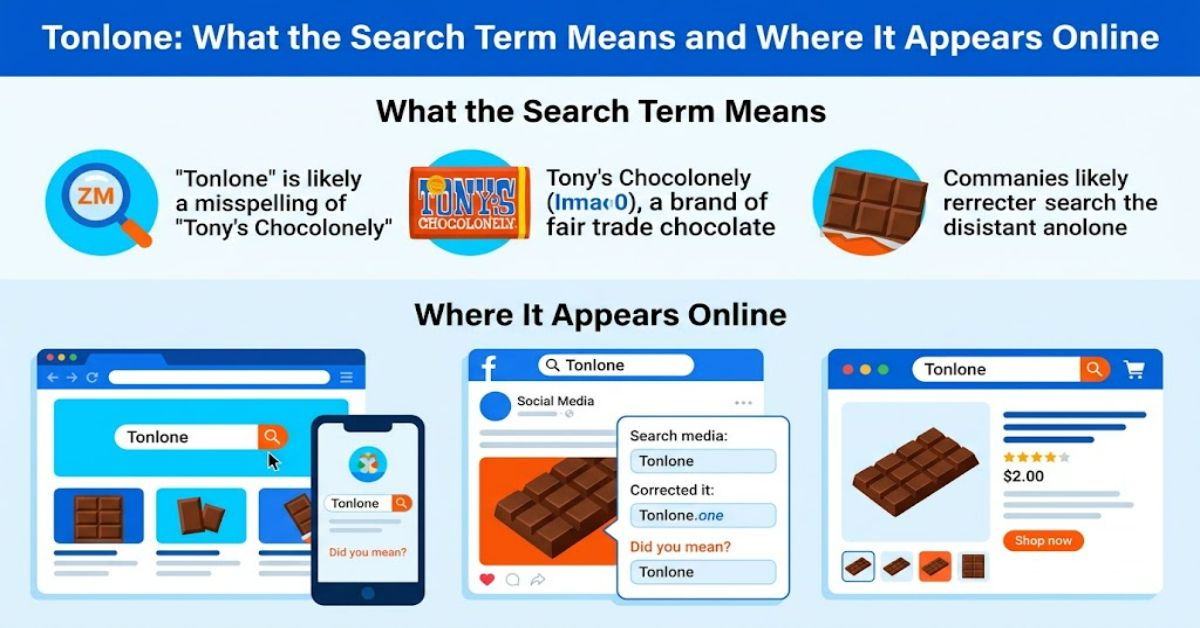
When people search for “tonlone”, they may expect a straightforward definition, but the available evidence does not support treating it as a standard English word or a clearly established brand. Instead, Tonlone appears in several online contexts, most notably as a username.
A Medium account using the name Tonlone has published and curated material relating to subjects such as LeetCode, hacking, stochastic trading, trading bots and PyTorch. The same name also appears in Geekbench results, where a user identified as tonlone submitted performance tests for a GMKtec NucBox M7 Pro computer.
That makes Tonlone an interesting example of how an apparently meaningless search term can develop an identifiable digital footprint. Rather than assuming it represents a company, technical standard or common expression, it is more accurate to examine how the term is actually being used online.
Is Tonlone a Word?
There is no strong evidence in the available sources that Tonlone is a commonly recognised modern English word.
One historical linguistic source contains a similar-looking form, “tonlòne”, but this is unrelated to the modern online uses of Tonlone and should not be treated as evidence for a contemporary definition.
Search results also show “tonlone” listed among possible misspellings of the surname Tinline. That demonstrates another possible interpretation, but it does not establish Tonlone as a conventional spelling of that surname.
The practical lesson is simple: context matters. A search for Tonlone without additional terms can produce unrelated results because the string itself is uncommon.
| Possible interpretation | Evidence available | Confidence |
| Online username | Medium and Geekbench profiles | Strong |
| Common English word | No clear contemporary evidence | Low |
| Surname or surname variation | Listed as a possible misspelling | Limited |
| Historical linguistic term | Similar historical spelling exists | Unrelated to modern usage |
| Brand or major company | No strong evidence found | Low |
Tonlone as an Online Username
The clearest modern use of Tonlone is as an online identity.
On Medium, an account named Tonlone has created collections covering programming and technology subjects. One collection focuses on LeetCode and includes articles about solving coding interview problems and software-development careers.
Other collections connect the same name with subjects including hacking, stochastic analysis, trading bots and PyTorch.
This creates a recognisable pattern. Tonlone appears less like a conventional dictionary term and more like a digital handle associated with technical interests.
That distinction is important for search intent. Someone searching for Tonlone may not be asking “What does this word mean?” They may instead be trying to identify a username, locate an online profile or understand why the term appears in technology-related search results.
Tonlone and Computer Benchmarking
Another documented use of the name appears on Geekbench.
A Geekbench 6 CPU result identifies the user as tonlone and records a GMKtec NucBox M7 Pro running Windows 11 Pro. The submitted system used an AMD Ryzen 9 PRO 6950H processor with eight cores and 16 threads. The published CPU result shows a single-core score of 1,997 and a multi-core score of 9,371.
A separate compute submission under the same username records an NVIDIA GeForce RTX 4070 SUPER and an OpenCL score of 183,184.
These records do not prove the real-world identity of the person behind the username. They do, however, show that the handle has been used to publish technical benchmark data.
| Platform | Username | Main context | Documented activity |
| Medium | Tonlone | Technology and programming | Curated technical articles |
| Geekbench | tonlone | Computer hardware | CPU and compute benchmarks |
| Search databases | tonlone | General web search | Uncommon keyword occurrence |
Why the Search Term Can Be Confusing
Tonlone illustrates a common problem in search optimisation: a keyword can have measurable search demand without having an obvious dictionary meaning.
One third-party search-analysis result lists Tonlone among the organic keywords associated with fastestknowntime.com, reporting substantial US search volume for the term. That result does not, however, establish why users searched the word or whether all searches shared the same intent.
This is an important distinction. Search volume is not the same as semantic clarity.
A keyword may receive searches because of:
- A username
- A typo
- A copied search query
- A niche community
- A website’s indexing behaviour
- An obscure historical reference
- An entity that is difficult to identify from the word alone
For publishers, this means a high-volume keyword should not automatically become a broad explanatory article. The underlying intent needs to be understood first.
What the Available Evidence Suggests
Three useful observations emerge from the available evidence.
First, Tonlone has a genuine digital footprint. It is not simply a fabricated string appearing nowhere online. Medium and Geekbench both contain records using the name.
Second, its strongest modern association appears to be technology. Programming, machine learning, trading-related content and computer benchmarking all appear in connection with the name.
Third, the evidence is insufficient to identify Tonlone as a particular person’s real-world identity. A username can be shared, reused or disconnected from a person’s legal name.
That final limitation matters. Digital traces can establish how a username is used without establishing who controls it.
Tonlone in 2027
By 2027, searches for unusual usernames such as Tonlone are likely to become increasingly shaped by fragmented digital identities.
People now maintain accounts across publishing platforms, developer communities, benchmark databases and social networks. A single handle can therefore appear in several unrelated databases without representing a formal organisation.
For search engines, entity disambiguation will remain important. Systems need to distinguish between a username, surname, company, product and ordinary word even when the spelling is identical or nearly identical.
Tonlone demonstrates why this matters. Treating every search term as a conventional word can produce misleading results. Treating every username as a confirmed identity can create an equally serious error.
The safest interpretation is therefore contextual: Tonlone is an uncommon online term with documented use as a username, particularly within technology-related environments.
Key Takeaways
- Tonlone has no clearly established mainstream English definition in the sources examined.
- Its clearest current use is as an online username.
- Medium connects the name with technology and programming-related content.
- Geekbench records technical hardware benchmarks submitted under the username.
- Similar spellings found in historical and surname sources should not automatically be treated as the same entity.
- Search volume alone cannot establish user intent.
- The available evidence does not establish the real-world identity behind the username.
Conclusion
Tonlone is a useful example of the complexity behind unusual search keywords. At first glance, the term looks like it could be a typo, obscure word or unfamiliar brand. Current evidence points more strongly towards its use as an online username.
Its digital footprint includes technology-related publishing activity on Medium and computer benchmark submissions on Geekbench. There are also unrelated historical and surname-related occurrences of similar spellings, which demonstrate why the term should not be assigned a single meaning without context.
The most responsible way to understand Tonlone is therefore to separate documented usage from assumptions. It can be identified as an uncommon digital handle with technology-related appearances, but the available evidence does not justify attaching a real-world identity or a definitive dictionary meaning to it.
For publishers and search researchers, the broader lesson is valuable: unusual keywords require intent analysis before content is created. A search term can have significant visibility while still having ambiguous meaning.
FAQ
What is Tonlone?
Tonlone is an uncommon search term that appears most clearly as an online username. Current evidence connects the name with technology-related publishing and computer benchmarking.
Is Tonlone a person?
Tonlone appears to be used as a username, but the available evidence does not establish the real-world identity of the person or people using it.
What does Tonlone mean?
There is no clearly established modern English definition supported by the sources examined. It is more accurately treated as an online handle unless additional context identifies another meaning.
Where does the name Tonlone appear online?
The name appears on Medium in technology-related collections and on Geekbench in computer performance submissions.
Is Tonlone related to technology?
Its documented modern digital footprint has several technology connections, including programming, machine learning, trading-related material and hardware benchmarking.
Could Tonlone be a spelling mistake?
Possibly. Search results contain unrelated similar spellings, including a historical linguistic form and a listing of Tonlone among possible misspellings of Tinline. These do not establish one definitive alternative meaning.
Methodology
This article treats the supplied keyword brief as the starting point and supplements its limited definition with current web research. The provided brief identifies Tonlone as an ambiguous term and specifically notes possible alternative interpretations, rather than establishing a definitive meaning.
Web research was then used to identify documented contemporary uses. Medium pages establish the Tonlone username’s association with technology-related collections, while Geekbench records establish the username’s appearance in computer benchmark submissions.
The main limitation is that a username does not necessarily identify a specific individual. Search-volume data also indicates interest in the term but does not independently establish the reason behind those searches.
References
Geekbench. (2024). GMKtec NucBox M7 Pro benchmark results. Geekbench Browser.
Medium. (2023). Tonlone profile and curated technology collections. Medium.
Semrush. (2026). Organic search traffic and keyword analysis for fastestknowntime.com. Semrush.
Names Directory. (n.d.). Tinline family name and possible misspellings. Names Directory.
Martius, C. F. P. von. (1863). Glossaria linguarum Brasiliensium. Vienna.