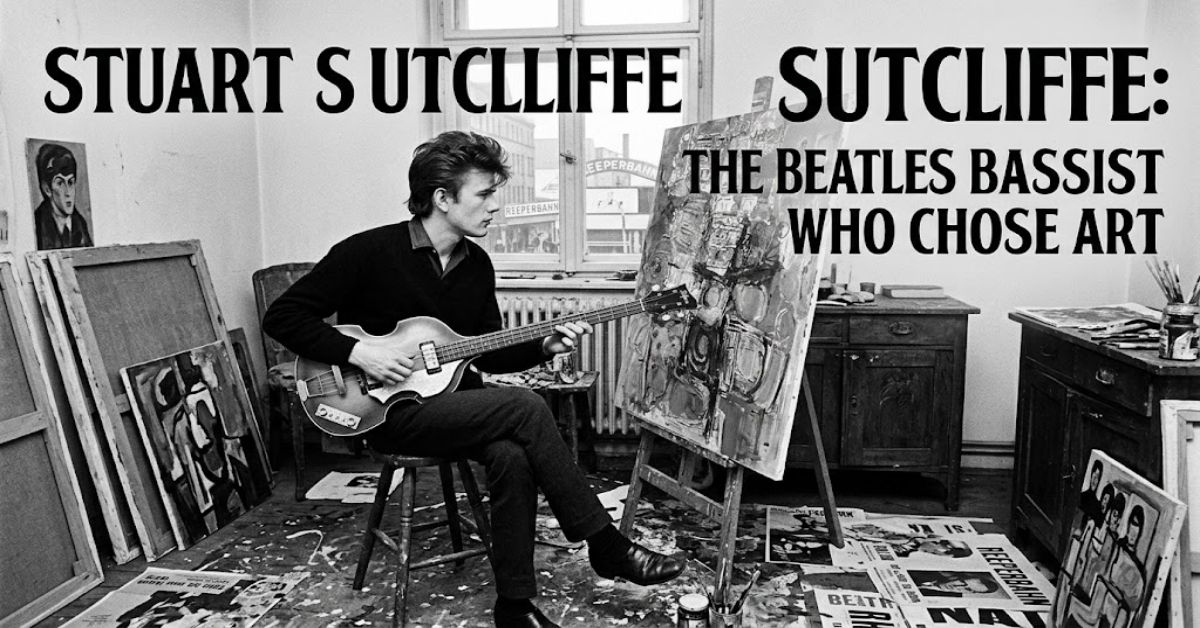
Stuart Sutcliffe is often remembered through the Beatles, but that description only captures part of his story. Born in Edinburgh on 23 June 1940, Sutcliffe became a central figure in the group’s earliest period after meeting John Lennon at Liverpool College of Art. He joined Lennon, Paul McCartney and George Harrison as their first bass guitarist in January 1960 and travelled with the group to Hamburg later that year.
Yet music was never the whole of Sutcliffe’s ambition. He was an art student before he became a Beatle, and painting remained his principal creative interest. His decision to leave the group in 1961 was closely connected to that priority. He continued his studies in Hamburg, where his work developed towards abstract expressionism under the influence of the European art scene and artist Eduardo Paolozzi.
His story is therefore not simply a footnote in Beatles history. It is also the story of a young British artist whose career was interrupted just as it was beginning to develop.
From Liverpool Art Student to Original Beatle
Sutcliffe met Lennon while studying at Liverpool College of Art. Their friendship became important to the formation of the early Beatles, and Lennon persuaded Sutcliffe to buy a bass guitar and join the group.
His musical ability was limited compared with the more experienced musicians around him, and accounts of his playing vary. What is less disputed is that his presence was significant during the band’s formative period. The National Portrait Gallery records that he became the group’s first bass guitarist and later left in June 1961 to continue painting.
The move to Hamburg was particularly important. The Beatles played demanding club engagements there in 1960 and 1961, developing their performance skills while becoming connected with a wider artistic and cultural community. Sutcliffe met photographer Astrid Kirchherr in Hamburg, and their relationship became one of the defining personal elements of his final years.
| Period | Sutcliffe’s main role | Significance |
| 1956 onward | Art student | Developed his interest in painting |
| 1960 | Beatles bassist | Joined the early five-piece group |
| 1960–61 | Musician and artist | Performed in Hamburg while developing his art |
| 1961 | Painter | Left the Beatles and pursued art in Hamburg |
| 1962 | Artist | Died in Hamburg aged 21 |
Stuart Sutcliffe and His Painting
The most important part of Sutcliffe’s legacy is arguably his art. A painting of his was selected for the prestigious John Moores Liverpool Exhibition at the Walker Art Gallery around the turn of 1960, and the work was subsequently purchased. Contemporary accounts of his development describe an artist increasingly interested in abstraction and expression rather than conventional representation.
His Hamburg period allowed that interest to develop further. After leaving the Beatles, Sutcliffe enrolled at the Hamburg College of Art on a postgraduate scholarship and studied under Eduardo Paolozzi. A retrospective published by the Victoria Gallery & Museum describes his Hamburg paintings as abstract expressionist canvases created in a studio associated with Kirchherr’s family home.
This creates an important distinction when discussing Sutcliffe. He was not simply a musician who later experimented with painting. Art had been part of his education and identity before his association with the Beatles became famous.
A useful way to understand his career is to see the Beatles period as one part of a much wider creative life rather than the destination of that life.
Why He Left the Beatles
Sutcliffe’s departure in 1961 was driven by his desire to concentrate on painting. The National Portrait Gallery records that he left the group to continue his art and subsequently enrolled at the Hamburg College of Art. Paul McCartney then became the Beatles’ bassist.
There were practical reasons for the change as well. Sutcliffe had stronger artistic ambitions than musical ones, while the Beatles were becoming increasingly serious about their professional future.
His departure also illustrates how fluid the group’s identity was before Beatlemania. The familiar four-member Beatles were not inevitable. In their earliest years, the line-up, roles and musical direction were still changing.
Sutcliffe’s importance lies partly in that transitional period. He belonged to the story before the world knew what the Beatles would become.
Hamburg, Astrid Kirchherr and Cultural Influence
Hamburg was more than a performance destination for Sutcliffe. It became the setting in which his musical and artistic lives overlapped.
His relationship with Astrid Kirchherr connected him to Hamburg’s creative community. Kirchherr and other German artists became associated with the Beatles during their early visits, while Sutcliffe’s visual interests developed alongside his musical experiences.
The National Portrait Gallery also records that the Beatles appeared periodically in Hamburg from 1960 to 1962, making the city a significant part of the group’s early development.
This cultural exchange is one of the less obvious aspects of Sutcliffe’s story. The Beatles were not developing in isolation. Their early Hamburg years exposed them to different audiences, artists, photographers and visual styles.
The Final Chapter
Sutcliffe’s career was tragically short. During his time in Hamburg, he experienced severe headaches and increasing sensitivity to light. On 10 April 1962, he collapsed and died in Hamburg aged 21. Contemporary and biographical sources identify the cause as a cerebral haemorrhage.
His death came less than a year after his departure from the Beatles. The timing adds to the sense of an unfinished artistic career, but it is important not to turn that uncertainty into speculation about what he might have achieved.
There is enough evidence to assess the work he actually produced. His art education, exhibition history and Hamburg studies show a young painter moving towards an increasingly individual style.
| Area | Documented legacy |
| Music | Original Beatles bassist |
| Art education | Liverpool College of Art and Hamburg College of Art |
| Painting | Abstract and expressionist work |
| Hamburg | Major setting for his artistic development |
| Personal legacy | Closely associated with Astrid Kirchherr and John Lennon |
| Death | Hamburg, 10 April 1962 |
The Future of Stuart Sutcliffe in 2027
Interest in Sutcliffe is likely to remain tied to two overlapping areas: Beatles history and post-war British art.
Digital archives, museum collections and renewed interest in Liverpool’s cultural history can make figures from the Beatles’ early years more accessible to new audiences. National Museums Liverpool continues to present Liverpool’s Beatles heritage as part of the city’s wider cultural identity.
For Sutcliffe specifically, the strongest future approach is likely to treat his paintings as primary cultural objects rather than viewing them only through his connection to the band. That distinction matters because his artistic reputation rests on work, education and documented relationships within the art world, not simply celebrity association.
Key Takeaways
- Sutcliffe was an art student before becoming a Beatles bassist.
- He met John Lennon at Liverpool College of Art.
- He travelled with the Beatles to Hamburg in 1960.
- His relationship with Astrid Kirchherr connected him to Hamburg’s creative community.
- He left the Beatles in 1961 to pursue painting.
- He studied under Eduardo Paolozzi in Hamburg.
- His life ended on 10 April 1962, when he was 21.
Conclusion
Stuart Sutcliffe occupies an unusual place in twentieth-century cultural history. He was part of the Beatles before they became a global phenomenon, yet his own ambitions pointed elsewhere. Music brought him into the group, but painting remained central to his identity.
His time with the Beatles helped place him inside one of popular music’s most important origin stories, while his education at Liverpool College of Art and later work in Hamburg reveal a serious commitment to visual art. The available record supports viewing him as more than an early bassist whose life ended prematurely.
Sutcliffe’s story is ultimately defined by creative transition. He moved from Liverpool’s art-school environment into the intensity of Hamburg’s music scene, then returned decisively to painting. His death in 1962 ended that development at only 21, leaving an artistic career that can be examined through the work he produced rather than imagined achievements that never had the opportunity to happen.
FAQ
Who was Stuart Sutcliffe?
Stuart Sutcliffe was a British painter and musician who became the original bass guitarist of the Beatles. He was born in Edinburgh in 1940 and studied art at Liverpool College of Art.
Why did Stuart Sutcliffe leave the Beatles?
He left the Beatles in 1961 to concentrate on painting. He subsequently studied at the Hamburg College of Art.
Did Stuart Sutcliffe attend art college?
Yes. He studied at Liverpool College of Art and later continued his education in Hamburg under artist Eduardo Paolozzi.
Who was Stuart Sutcliffe’s partner?
Sutcliffe was engaged to German photographer Astrid Kirchherr, whom he met in Hamburg.
When did Stuart Sutcliffe die?
He died in Hamburg on 10 April 1962, aged 21. His recorded cause of death was a cerebral haemorrhage.
Was Stuart Sutcliffe a painter?
Yes. Painting was central to his education and career, and his surviving work is associated with an abstract expressionist direction.
Methodology
This article uses documented biographical and institutional material concerning Sutcliffe’s education, Beatles membership, Hamburg period, artistic development and death. Key validation sources include the National Portrait Gallery, Christie’s and the Victoria Gallery & Museum retrospective record. National Museums Liverpool material was also consulted for Liverpool’s continuing Beatles cultural context.
No firsthand testing or personal observation was conducted, so no invented firsthand experience or fabricated metrics have been presented. Some details of Sutcliffe’s artistic development are necessarily interpreted through surviving records and retrospective scholarship.
References
Christie’s. (2005). Stuart Sutcliffe: Art school notes and sketchbook material. Christie’s auction archive.
Clough, M. H., & Fallows, C. (Eds.). (2008). Stuart Sutcliffe: A Retrospective. Victoria Gallery & Museum, University of Liverpool.
National Portrait Gallery. (n.d.). The Beatles: George Harrison, Stuart Sutcliffe, John Lennon. National Portrait Gallery.
National Museums Liverpool. (n.d.). The Beatles’ Liverpool. National Museums Liverpool.
The Washington Post. (1997). Rendered Mersey. Washington Post archive.