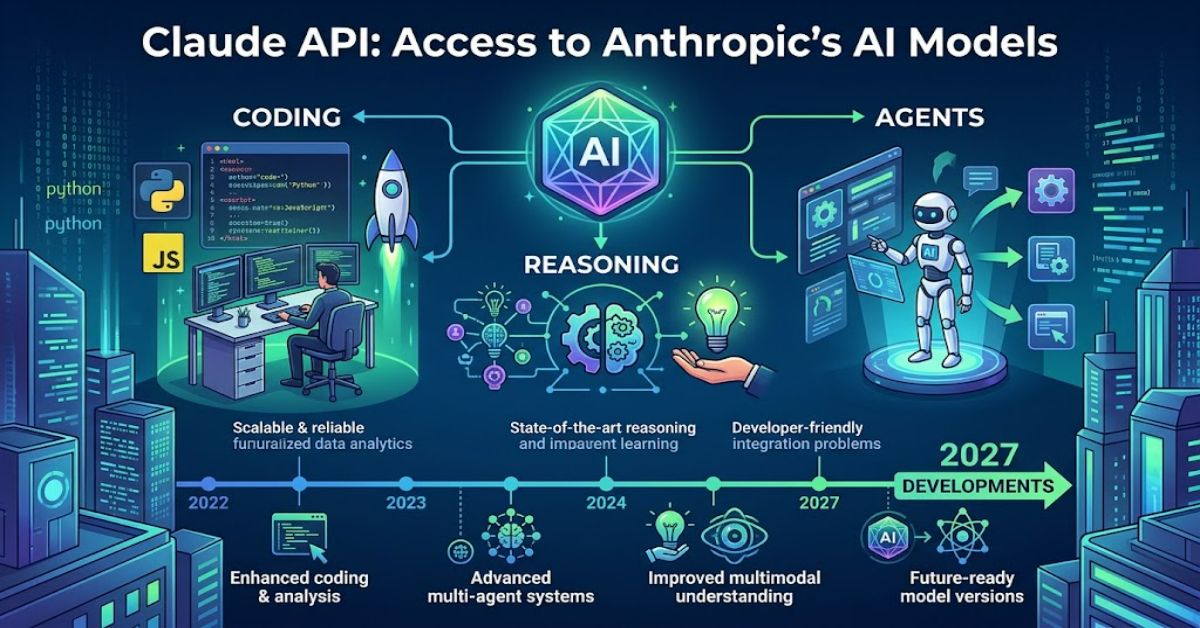
The Claude API is Anthropic’s developer interface for integrating Claude models into software applications, automated workflows and AI agents. Anthropic’s developer platform uses API access to let applications send instructions and context to Claude and receive generated responses programmatically. The supplied brief identifies the Anthropic Console as the starting point for generating keys, managing billing and integrating Claude models into applications.
That basic description, however, no longer captures the full scope of the platform. Claude API has developed from a conventional large-language-model interface into a broader foundation for applications involving coding, document processing, reasoning, tool use and autonomous task execution.
Anthropic introduced the Claude 3 family to its API in March 2024, establishing a model-selection approach based on different balances of capability, speed and cost. Since then, API capabilities have expanded considerably. In 2025, Anthropic added features including code execution, an MCP connector, the Files API and prompt caching, while Claude 4 introduced stronger support for agentic workloads and extended thinking.
For developers, the important question is therefore not simply whether Claude API can generate text. It is how its models and platform features fit a particular application.
What Claude API Does
At its simplest, an application sends a request containing instructions and relevant context to a Claude model. Claude processes that input and returns an output that the application can use.
This architecture supports familiar applications such as:
- Customer-support assistants
- Content analysis
- Document summarisation
- Software development tools
- Research assistants
- Data extraction
- Internal knowledge systems
- Automated business workflows
The more significant development is the move towards models that can participate in multi-step processes. Anthropic’s Claude 4 announcement introduced API capabilities designed for agents, including tool use and code execution.
This changes the engineering problem. Developers are no longer building only a prompt-and-response system. They may also need to manage tools, permissions, context, failure handling, monitoring and the boundaries within which an AI agent can operate.
Choosing a Claude Model
Claude API model selection should be based on workload rather than brand recognition. Different models can have different performance, latency and pricing characteristics.
Anthropic’s 2026 releases illustrate this trade-off. Claude Opus 4.6 introduced adaptive thinking, effort controls, context compaction and a 1-million-token context window in beta. Anthropic also reported support for outputs of up to 128,000 tokens.
Sonnet models occupy a different position. Claude Sonnet 5, announced on 30 June 2026, was positioned by Anthropic as a more capable agentic Sonnet model while retaining a lower price point than Opus-class models. Anthropic lists its API price at $2 per million input tokens and $10 per million output tokens.
| Requirement | Important consideration |
| High-volume generation | Token price and latency |
| Complex reasoning | Model capability and effort controls |
| Coding | Code performance and tool integration |
| Long-running agents | Context management and compaction |
| Large documents | Context-window requirements |
| Production applications | Rate limits, reliability and monitoring |
The practical insight is that the most powerful model is not automatically the most suitable. A simple classification or extraction workflow may not benefit enough from a premium reasoning model to justify its additional cost.
Claude API for Agents and Coding
Coding is one of the clearest areas in which Claude API has expanded beyond ordinary text generation.
Anthropic’s Claude 4 generation was designed around complex software engineering and agentic workflows. The company introduced API features allowing developers to combine models with tools and code execution.
Opus 4.6 subsequently added adaptive thinking and context compaction. Context compaction is particularly important for agents because long-running workflows can accumulate substantial amounts of conversation, tool output and intermediate information. Automatically managing older context can reduce the risk of an agent reaching its usable context boundary.
There is a trade-off. An agent with more autonomy can accomplish more, but it also creates more opportunities for incorrect actions. Developers therefore need explicit tool permissions, validation steps and appropriate human oversight.
Costs, Limits and Operational Trade-Offs
API economics depend heavily on how an application uses tokens. Input and output are generally treated separately, meaning a workflow that repeatedly sends large amounts of context can become considerably more expensive than a short request-and-response application.
Caching can help in appropriate workloads. Anthropic introduced prompt caching as part of its 2025 API improvements, alongside other features aimed at more sophisticated applications.
Rate limits are another operational consideration. Anthropic announced increased API rate limits for Opus models in May 2026 as its available computing capacity expanded.
| Operational issue | Why it matters |
| Token consumption | Directly affects usage costs |
| Rate limits | Can constrain request volume |
| Latency | Affects user experience |
| Context size | Determines how much information can be supplied |
| Tool errors | Can propagate incorrect results |
| Model changes | May affect application behaviour |
A production system should therefore monitor token consumption, latency, errors and model behaviour rather than treating the API as a fixed utility.
Risks and Practical Limitations
Greater capability also creates additional risks. Applications using tools can potentially take actions beyond generating text, so permissions need to be narrowly designed.
Prompt injection is another concern, particularly when models interact with external websites or untrusted content. Anthropic has specifically discussed prompt-injection risks in connection with computer-use systems and described improvements to model resistance.
Developers should also assume that model output requires validation. A fluent answer can still contain factual mistakes, flawed code or an inappropriate interpretation of instructions.
One useful design principle follows: the model should not automatically receive the same authority as the application using it. Sensitive operations should sit behind application-level controls.
The Future of Claude API in 2027
The direction of Claude API points towards increasingly capable AI agents rather than isolated chat completions.
Anthropic’s 2026 releases show several parts of that trajectory: stronger reasoning, adaptive effort, context compaction, tool use, coding capabilities and longer-running agent workflows.
The likely constraint will not simply be model intelligence. Infrastructure cost, latency, security, data governance and reliable tool execution will remain central engineering concerns.
For businesses, this suggests that API architecture will matter as much as model selection. The strongest applications may combine a capable model with carefully designed retrieval, tools, permissions, validation and human escalation.
Key Insights
- Claude API has evolved from basic text generation towards a platform for AI-enabled workflows.
- Model choice should reflect workload economics as well as capability.
- Context management is increasingly important for long-running agents.
- Tool access increases usefulness but also increases operational risk.
- Prompt injection remains relevant when models interact with external content.
- Token usage, rate limits and latency should be measured continuously in production.
- The application layer remains responsible for permissions and validation.
Methodology
This article combines the supplied editorial brief with current public information published by Anthropic. Model capabilities, API features and pricing references were checked against Anthropic announcements published through 2026. The analysis focuses on documented platform capabilities rather than independent performance claims.
A limitation is that API features, model availability and pricing can change quickly. Developers should verify current model documentation and commercial terms before deploying a production system.
Conclusion
Claude API has become more than a mechanism for sending prompts to an AI model. Its development reflects a broader shift towards software in which models can reason over large amounts of context, use tools, execute code and participate in multi-step workflows.
For developers, this creates both opportunity and responsibility. Choosing a model involves balancing capability, cost, speed and context requirements, while production architecture must account for errors, rate limits, security and permissions.
The strongest implementation is therefore unlikely to be the one that simply selects the newest model. It will be the one that gives the model an appropriate role inside a controlled software system, with clear boundaries around what it can access and what actions it can take.
Frequently Asked Questions
What is Claude API?
Claude API is Anthropic’s developer interface for integrating Claude models into software applications, automated workflows and AI agents.
How do developers get started with Claude API?
Developers can use the Anthropic Console to create API credentials, manage billing and configure access before integrating Claude into an application.
Can Claude API be used for coding?
Yes. Anthropic has developed Claude models and API features specifically for software engineering, code generation, code execution and agentic development workflows.
Is Claude API suitable for AI agents?
Yes. Recent Claude API capabilities include tools and features designed to support longer-running, multi-step agentic tasks.
How much does Claude API cost?
Pricing varies by model and can change. For example, Anthropic announced Claude Sonnet 5 at $2 per million input tokens and $10 per million output tokens in June 2026.
What are the main risks of Claude API?
Important risks include inaccurate outputs, excessive token consumption, tool misuse, prompt injection and insufficient application-level controls.
References
Anthropic. (2024, 4 March). Introducing the next generation of Claude.
Anthropic. (2025, 22 May). Introducing Claude 4.
Anthropic. (2026, 5 February). Introducing Claude Opus 4.6.
Anthropic. (2026, 17 February). Introducing Claude Sonnet 4.6.
Anthropic. (2026, 28 May). Introducing Claude Opus 4.8.
Anthropic. (2026, 30 June). Introducing Claude Sonnet 5.
Anthropic. (2026, 6 May). Higher usage limits and a SpaceX compute deal.