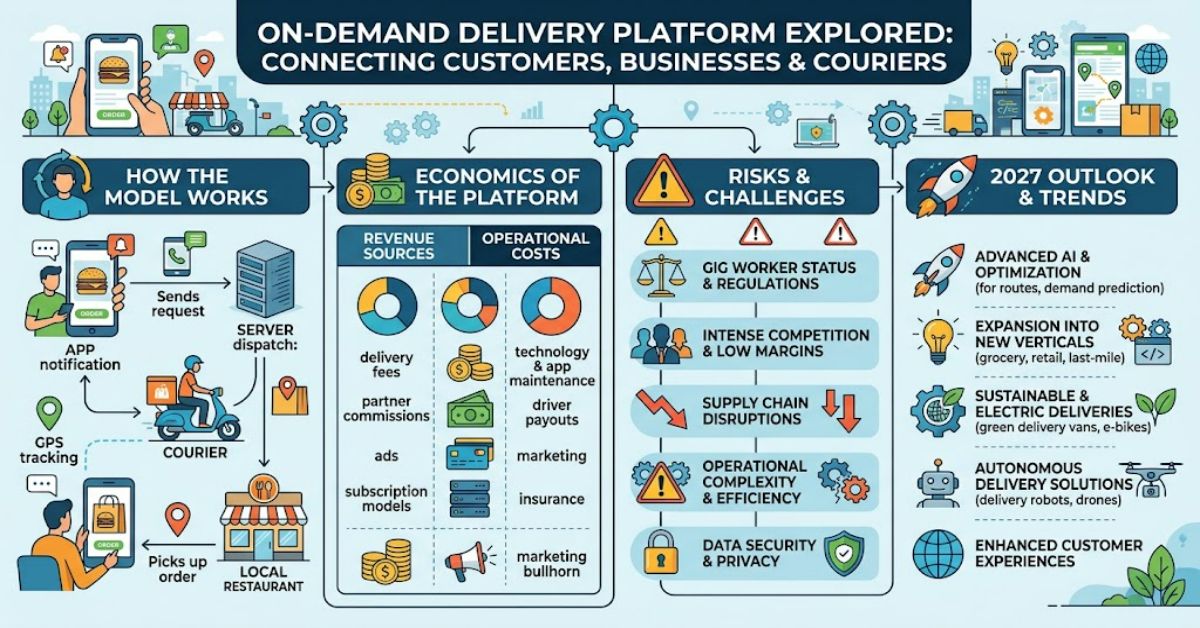
On-demand delivery platforms are digital systems that connect customers, local businesses and couriers to fulfil and transport orders almost immediately. The model is now familiar: a customer opens an app, selects a restaurant or shop, pays digitally and receives an estimated delivery time while software coordinates the order and courier.
Food delivery remains one of the clearest examples. The UK Food Standards Agency reported in May 2025 that 55% of respondents had ordered food or drink through an online ordering and delivery company such as Just Eat, Deliveroo or Uber Eats. Sixty per cent had ordered directly from a restaurant, takeaway or café website.
The important point is that the visible app is only one part of the system. Behind a simple “order now” button sits a network involving merchant onboarding, payment processing, location services, courier allocation, route optimisation, customer notifications, refunds and dispute handling.
That makes delivery platforms more than digital menus. They are operational marketplaces whose performance depends on matching supply and demand in real time.
For businesses, the attraction is reach. A local restaurant can potentially access customers beyond its existing walk-in trade. For consumers, the attraction is convenience. For couriers, the model can offer flexible access to paid work.
The trade-off is that each participant depends on the platform’s rules, pricing structure and technology.
How On-Demand Delivery Platforms Work
A typical platform has three primary participants: customer, merchant and courier.
The customer creates an order. The merchant accepts and prepares it. The platform then either dispatches a courier from its own network or passes fulfilment information to an integrated delivery service.
The underlying workflow usually includes:
- Order capture: Customer selects products and confirms payment.
- Merchant processing: Business receives the order and prepares it.
- Dispatch: Platform identifies an available courier.
- Route optimisation: Software considers location, estimated preparation time and courier availability.
- Collection: Courier receives the order.
- Tracking: Customer sees status updates through the application.
- Completion: Delivery is confirmed and payment is settled between participants.
This creates a feedback loop. Delivery times, cancellations, courier availability and customer behaviour generate data that can influence later dispatch decisions.
| Platform component | Main function | Main operational challenge |
| Customer app | Ordering and payment | Conversion and reliability |
| Merchant dashboard | Order acceptance | Preparation accuracy |
| Dispatch engine | Courier allocation | Supply-demand imbalance |
| Mapping system | Route calculation | Traffic and distance |
| Courier app | Collection and delivery | Availability and safety |
| Support system | Refunds and complaints | Cost and resolution speed |
The FSA describes online food platforms as technology businesses facilitating exchanges between food vendors and consumers, with established services also expanding into grocery delivery and other parts of the food sector.
Why Businesses Use Delivery Platforms
For smaller businesses, the platform can solve a customer-acquisition problem.
Instead of building a sophisticated ordering website, payment system, courier network and tracking infrastructure independently, a merchant can access an existing digital marketplace.
That convenience comes with a price. Businesses may pay commissions, service charges or other fees, while also becoming dependent on a platform’s ranking, promotions and customer-acquisition mechanisms.
The strategic question is therefore not simply whether delivery generates orders. It is whether those orders remain commercially worthwhile after fulfilment costs and platform fees.
A restaurant receiving additional sales through an app may still have weak margins if delivery-related costs consume too much of the order value.
This creates one of the sector’s less visible tensions: revenue growth and profit growth are not necessarily the same thing.
The Courier and Algorithm Problem
Couriers are another critical component of the model. Platform software determines which orders are offered, how deliveries are grouped and, in some systems, how incentives are structured.
This creates questions about algorithmic management. In January 2025, reporting by The Guardian highlighted calls for greater transparency around the algorithms used by major UK food-delivery platforms, particularly concerning pay and access to work. The report said the three largest platforms employed or provided work opportunities for more than 100,000 couriers in the UK.
Employment status is also significant. GOV.UK states that workers can be entitled to rights including National Minimum Wage protection, paid holiday and rest breaks, depending on their legal status and working arrangement.
The issue is not simply whether an app calls someone a “courier” or “partner”. Legal rights depend on the actual relationship and applicable employment law.
Regulation Is Becoming Part of the Platform Model
Regulation is no longer a peripheral issue for delivery technology.
On 30 June 2025, the UK Government announced that Deliveroo, Uber Eats and Just Eat would strengthen rider verification checks to prevent illegal working. The companies had already introduced voluntary right-to-work checks for account holders and registered substitutes.
The development illustrates a broader shift: platforms increasingly have responsibilities extending beyond software performance.
Food safety is another example. The FSA states that businesses selling food online, including food delivery businesses, must be registered as food businesses. Local authority food safety officers can inspect businesses to check compliance with food hygiene law.
The platform therefore sits within a chain of accountability involving merchants, couriers, regulators and consumers.
Risks and Trade-Offs
The model has several structural weaknesses.
High-density dependence: Platforms work most efficiently where many customers, merchants and couriers are concentrated. Rural areas can therefore present a more difficult economics problem.
Thin margins: Faster delivery requires sufficient courier availability, but maintaining excess courier capacity can be expensive.
Platform dependency: Merchants may gain customers but lose direct ownership of customer relationships.
Algorithmic opacity: Automated allocation can affect earnings and service quality while remaining difficult for participants to understand.
Regulatory exposure: Changes to employment, immigration, consumer protection or food-safety rules can increase compliance costs.
These risks suggest that delivery technology is partly a logistics business disguised as a consumer app.
Three Practical Insights
The first is that delivery speed is only one performance metric. Reliability, order accuracy and successful first-attempt delivery can matter more than shaving several minutes from an estimated arrival time.
Second, merchant density can be as important as customer density. A platform with many nearby restaurants or shops has more opportunities to bundle demand efficiently.
Third, verification infrastructure is becoming operational infrastructure. The UK Government’s 2025 rider-checking measures show that identity and right-to-work systems can directly affect platform capacity and courier onboarding.
The Future of On-Demand Delivery Platforms in 2027
By 2027, delivery platforms are likely to focus increasingly on efficiency rather than simply expanding delivery coverage.
Artificial intelligence and improved predictive analytics may help platforms estimate preparation times, anticipate demand and reduce inefficient courier movements. However, technical improvements will not remove fundamental constraints such as traffic, labour availability, merchant capacity and delivery geography.
The UK’s Digital Markets, Competition and Consumers Act also creates a stronger competition and consumer-protection environment for major digital businesses. The Competition and Markets Authority reported that its strengthened digital markets regime was operational during 2025–26, with work focused on competition, innovation and consumer outcomes in major digital markets.
The likely direction is therefore more sophisticated technology combined with greater scrutiny of how platforms operate.
Key Takeaways
- Delivery platforms are logistics systems as much as consumer applications.
- Merchant economics depend on contribution margin, not order volume alone.
- Courier allocation increasingly involves algorithmic management.
- Identity and right-to-work verification are becoming part of platform infrastructure.
- Food-delivery businesses remain subject to food-safety obligations.
- Competition and consumer regulation will increasingly shape platform design.
- Faster delivery does not automatically mean better delivery.
Conclusion
On-demand delivery platforms have changed how consumers interact with restaurants, shops and other local businesses. Their central innovation is not simply the delivery itself, but the digital coordination of customers, merchants, payments, couriers and location data in a single workflow.
That system creates genuine convenience and can lower the technical barrier for smaller businesses entering online commerce. At the same time, the economics are complicated. Platform commissions, courier costs, customer-acquisition spending, regulatory obligations and operational failures all affect whether the model produces sustainable value.
The UK’s experience also shows how the sector is moving beyond its early technology-first phase. Food safety, employment rights, identity verification, consumer protection and competition policy increasingly form part of the operating environment.
By 2027, successful delivery platforms will therefore need more than fast applications. Their resilience will depend on reliable logistics, transparent commercial relationships, responsible data use and the ability to operate within increasingly defined regulatory expectations.
Frequently Asked Questions
What are on-demand delivery platforms?
They are digital systems that connect customers with businesses and couriers to arrange relatively rapid fulfilment and delivery. Food, groceries, parcels and local retail goods can all use similar platform models.
How do on-demand delivery platforms work?
A customer places an order through an app or website. The merchant prepares it, while platform software coordinates payment, courier allocation, route planning, tracking and completion.
What are examples of on-demand delivery platforms?
In UK food delivery, prominent examples include Just Eat, Deliveroo and Uber Eats. Similar platform principles are also used in grocery, courier and local retail delivery.
Do delivery platforms employ couriers?
The legal relationship varies between platforms and individuals. Employment status depends on the actual contractual and working arrangement rather than simply the terminology used by an application.
Why do businesses use delivery platforms?
They provide access to an established ordering, payment and delivery infrastructure. This can reduce the need for a business to develop its own technology and courier network.
What are the main disadvantages of delivery platforms?
Businesses can face platform fees and customer dependency, while couriers may face uncertainty around work allocation. Platforms themselves must manage regulation, logistics, fraud, safety and service reliability.
Methodology
This article uses recent UK primary and institutional sources, including the Food Standards Agency, GOV.UK and the Competition and Markets Authority. The FSA’s research was used to establish consumer use of online food-delivery platforms and the regulatory context surrounding online food businesses. Government publications were used for courier verification and employment-status information, while CMA material was used for the digital competition outlook.
No original platform testing, courier interviews or merchant survey was conducted for this article. Accordingly, no invented firsthand performance figures are presented. Reported examples are attributed to their respective sources, and broader conclusions are framed as analysis rather than independently measured results.
Editorial disclosure: This article was drafted with AI assistance and should be reviewed by a human editor before publication. Statistics, legal claims and source details should be independently checked against the original documents.
References
Competition and Markets Authority. (2026). Annual report and accounts 2025 to 2026. GOV.UK.
Competition and Markets Authority. (2025). Annual plan 2025 to 2026. GOV.UK.
Food Standards Agency. (2025). F&Y2 Wave 9, Chapter 5: Online platforms. GOV.UK.
Food Standards Agency. (2021). Food in the digital platform economy – making sense of a dynamic ecosystem. GOV.UK.
Home Office, Department for Business and Trade. (2025, 30 June). Delivery firms to bolster rider security checks to stop illegal working. GOV.UK.
Home Office, Border Security Command. (2025, 22 July). New operational partnership with delivery giants to combat illegal working. GOV.UK.
Office of the Guardian. (2025, 20 January). Delivery apps urged to lift lid on ‘black-box algorithms’ affecting UK couriers. The Guardian.