Perry Office Plus is a Texas-based workplace products and furniture company serving businesses, schools, healthcare organisations and government agencies, particularly across Central Texas and the Brazos Valley. Although its modern proposition includes digital ordering and a wide catalogue of workplace products, the company’s roots are considerably older.
The business traces its origins to a printing operation established in Temple in 1920. Over subsequent decades, it moved increasingly into office products and eventually developed capabilities covering furniture, workplace planning, facility supplies and related business services.
That evolution is important when considering Perry’s position in the market. It is not simply an online office-supply retailer. Its model combines product distribution with local customer service, commercial furniture expertise, space planning, delivery and installation.
In 2025, the company announced a move towards the shorter Perry name as it marked its 105th anniversary. The rebrand was intended to better represent the breadth of its current services rather than signal a change in ownership or operating structure.
For organisations looking for a regional supplier, the Perry model is built around consolidating several workplace requirements through one business.
From Printing to Workplace Products
Perry’s history demonstrates how a traditional local company can adapt as customer requirements change.
The business began in Temple in 1920 as a printing company. In 1976, American Printing expanded into Belton with an office-products operation. By 1983, the office-products business had become a separate operation, establishing a clearer focus on workplace purchasing.
The company later operated under the Perry Office Products name before becoming Perry Office Plus. The addition of “Plus” reflected an expanding range of products and services rather than a narrow stationery business.
Commercial furniture became increasingly important. In 2018, Perry acquired Commercial Furniture Solutions in Temple, strengthening its workplace-design and furniture capabilities. The company subsequently expanded its regional presence through further acquisitions, including the office-supply division of Mackie’s in Waco in 2020.
Perry’s Development
| Period | Development | Importance |
| 1920 | Business established in Temple | Created the company’s local foundation |
| 1976 | Belton office-products operation launched | Expanded beyond printing |
| 1983 | Office-products business separated | Established a dedicated workplace focus |
| 2018 | Commercial Furniture Solutions acquired | Strengthened furniture and design |
| 2020 | Mackie’s Waco office-supply division acquired | Increased regional reach |
| 2025 | Rebrand to Perry | Broadened workplace positioning |
What Perry Provides
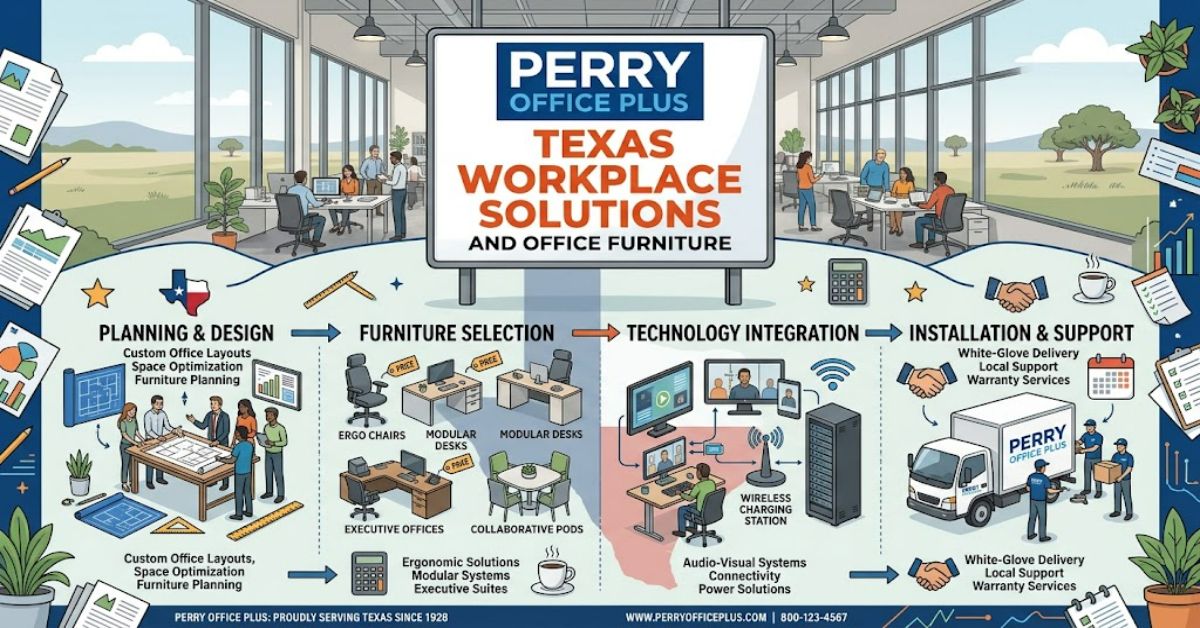
The company’s offering covers several workplace categories. Office supplies remain central, but customers can also obtain janitorial and facility products, breakroom supplies, commercial furniture, printing and promotional products.
Its furniture operation adds a professional-service component that distinguishes it from a conventional catalogue supplier. Workplace projects can involve space planning, furniture specification, delivery and installation rather than simply purchasing individual desks or chairs.
| Service | Customer requirement | Perry capability |
| Office supplies | Everyday workplace purchasing | Product sourcing and delivery |
| Facility products | Cleaning and operational supplies | Product distribution |
| Commercial furniture | Offices and institutional spaces | Furniture sourcing and planning |
| Space planning | Efficient workplace layouts | Design and planning support |
| Installation | Furniture project completion | Delivery and installation |
| Printing and promotional products | Business communications | Specialist production services |
This creates an opportunity for organisations to consolidate purchasing. A company opening a new office, for example, may require furniture, supplies, facility products and branded materials within the same project.
Why Local Service Matters
Perry’s regional focus is a significant part of its business proposition.
Large national retailers and online marketplaces compete heavily on catalogue size, automation and pricing. A local supplier needs to offer additional value through service, responsiveness and knowledge of the customer’s operating environment.
Perry has historically emphasised local delivery across Central Texas and the Brazos Valley. Its acquisition activity also demonstrates a strategy of expanding through established regional relationships rather than relying solely on digital customer acquisition.
There is evidence of institutional demand as well. Public records have documented purchases involving Perry Office Plus from Texas government organisations, demonstrating that the company has served customers beyond conventional private businesses.
The combination of local delivery and online purchasing is particularly relevant. Digital ordering can provide convenience, while account support and physical services address requirements that an automated marketplace may not handle as easily.
Three Strategic Insights
1. Procurement convenience is part of the product.
Perry’s value does not depend solely on individual product prices. Bringing office supplies, facility products, furniture and related services together can reduce the administrative burden of managing several suppliers.
2. Furniture creates a higher-value relationship.
Selling stationery is primarily transactional. Workplace design and commercial furniture involve consultation, specifications, planning, installation and follow-up. These services can create deeper relationships with organisations.
3. The rebrand reflects broader positioning.
Moving from Perry Office Plus to Perry makes strategic sense if the company increasingly wants to be associated with complete workplace environments rather than traditional office products alone.
Risks and Trade-Offs
The regional model also creates challenges.
National competitors benefit from purchasing scale, extensive technology infrastructure and enormous product catalogues. Perry must therefore demonstrate why local service is valuable enough to offset differences in scale or pricing.
Furniture projects introduce another layer of operational complexity. Measurements, specifications, delivery schedules and installation must align. A mistake in a large workplace project can have substantially greater consequences than an incorrect routine office-supply order.
There is also a strategic balance between maintaining local relationships and investing in digital procurement. Customers increasingly expect both personal support and frictionless online purchasing.
The Future of Perry in 2027
By 2027, Perry’s success is likely to depend on how effectively it combines these two sides of its business.
The 2025 rebrand indicates a clear ambition to operate within the wider workplace-solutions market. That creates opportunities across commercial offices, education, healthcare and government environments where furniture, facility management and procurement requirements overlap.
Digital tools will remain important. Online ordering, customised purchasing lists and approval processes can help organisations control routine spending, while local specialists can handle more complex projects.
The key competitive advantage will therefore not be simply having a large catalogue. It will be the ability to connect digital purchasing with local expertise, workplace design and physical service.
Key Takeaways
- Perry’s roots extend back to 1920.
- The company evolved from printing into office products and broader workplace services.
- Commercial furniture and space planning are important parts of its current proposition.
- Acquisitions have supported regional expansion.
- Public-sector purchasing records provide evidence of institutional customers.
- The 2025 rebrand reflects broader workplace positioning.
- Local service remains central to its competitive strategy.
Conclusion
Perry Office Plus illustrates how an established regional company can evolve without abandoning the local relationships that created its foundation. From its origins as a Temple printing business in 1920, the organisation has progressively expanded into office products, facility supplies, commercial furniture and workplace design.
The acquisition of furniture capabilities was particularly significant because it moved the company beyond straightforward product distribution. Space planning, furniture specification, delivery and installation require a different level of expertise and create opportunities for longer-term customer relationships.
The 2025 transition to the Perry name reinforces that development. The company is positioning itself around the wider workplace rather than a single office-products category.
Its future competitive position will depend on maintaining that balance. National online suppliers can offer scale and convenience, while a regional specialist can provide local knowledge and project support. Perry’s strongest proposition lies in combining those qualities rather than competing solely on catalogue size or price.
FAQ
What is Perry Office Plus?
Perry Office Plus is a Texas workplace-products supplier offering office supplies, facility products, commercial furniture, workplace planning, installation and related services.
Is Perry Office Plus now called Perry?
Yes. In 2025, the company announced a rebrand to Perry as part of its 105th anniversary. The change was intended to reflect its broader workplace-services offering.
Where does Perry operate?
Perry primarily serves Central Texas and the Brazos Valley, with roots in Temple and a regional customer base covering businesses and institutions.
Does Perry sell commercial office furniture?
Yes. Commercial furniture is a significant part of its offering, supported by workplace planning, design, delivery and installation services.
Does Perry serve government organisations?
Yes. Perry has supplied public-sector organisations, with Texas government purchasing records providing documented examples of its institutional business.
What makes Perry different from an online office retailer?
Its proposition combines product purchasing with local service, commercial furniture expertise, workplace planning, delivery and installation.
Methodology
This article uses publicly documented company history, service information, acquisition announcements and Texas public-sector purchasing records. The analysis distinguishes historical facts and documented transactions from strategic interpretation.
Private financial information, customer concentration, margins and internal performance data are not publicly available, so no unsupported financial conclusions have been made. Claims about services and company development should be checked against the latest company information before publication.
Human Editorial Disclosure: This article was drafted with AI assistance and should be reviewed and independently verified by a human editor before publication.
References
Perry. (n.d.). About us. Perry Office Plus.
Perry. (n.d.). Our history. Perry Office Plus.
Perry. (2020). Continued growth: Perry Office Plus acquires office supply division of Mackie’s in Waco, Texas. Perry Office Plus.
Perry. (2025). What’s new? We’re now Perry. Perry Office Plus.
Perry Contract Furniture. (n.d.). About us. Perry Contract Furniture.
City of Bryan. (2025). Behind the Gavel: September 9, 2025. City of Bryan, Texas.
Texas Animal Health Commission. (2022). Purchase Order No. 23-0061. State of Texas.