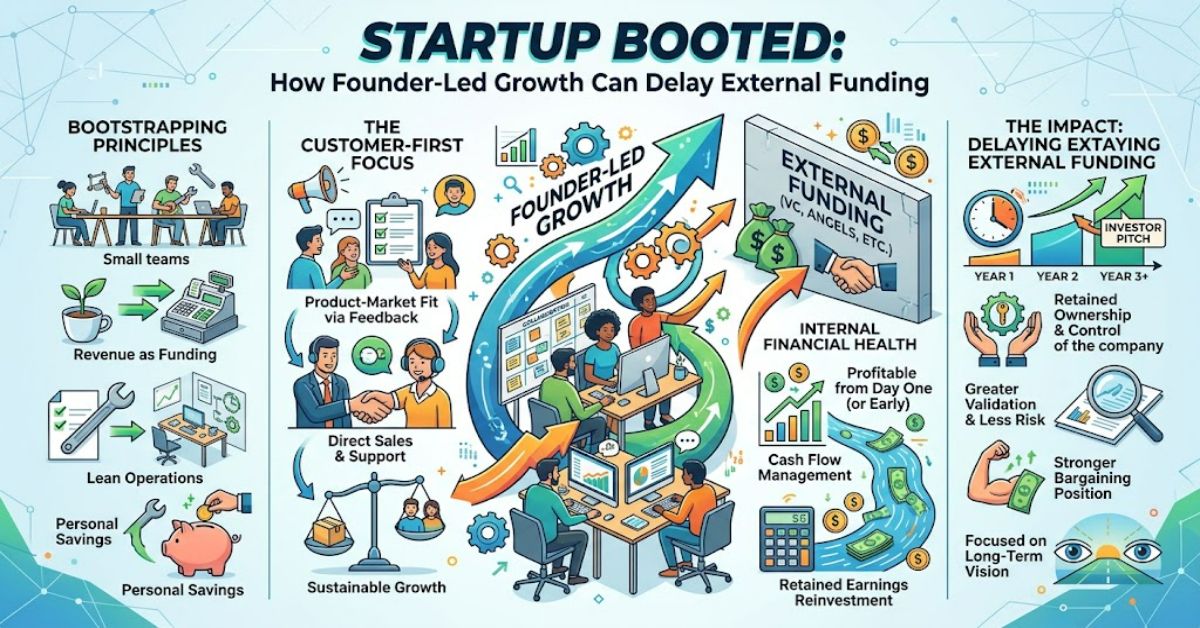
A startup booted strategy is a founder-led approach in which a business tries to generate customer revenue first and considers external funding later, primarily to accelerate growth rather than keep the company alive. It sits between traditional bootstrapping and the conventional venture-capital model, giving founders time to validate demand before taking on equity investors.
The distinction matters because fundraising is not automatically a sign of progress. Capital can provide hiring capacity, marketing budgets, product development resources and international expansion. However, it also introduces dilution, investor expectations and pressure to pursue particular growth targets.
The UK funding environment makes this distinction increasingly relevant. The British Business Bank reported in 2026 that equity investment in UK smaller businesses fell 4% in 2025 to £12.3 billion, while capital became increasingly concentrated in larger transactions. Its 2025 research had already identified a trend towards fewer and larger deals.
A booted model therefore starts with a straightforward question: can customers finance enough of the company’s early development to establish a commercially credible business?
How the Startup Booted Model Works
The basic sequence is different from a conventional venture-backed startup.
| Stage | Primary funding source | Main objective |
| Validation | Founder resources | Test the problem and customer demand |
| Early sales | Customer revenue | Prove willingness to pay |
| Early growth | Revenue and reinvested profit | Improve retention and unit economics |
| Expansion | Selective external capital | Accelerate a proven model |
| Scale | Equity, debt or retained earnings | Finance larger growth opportunities |
The important feature is timing. External capital is not necessarily rejected. Instead, it is delayed until the company has evidence that additional money can produce measurable results.
That evidence might include recurring revenue, strong customer retention, predictable acquisition costs, positive contribution margins or a repeatable sales process.
Why Customer Revenue Changes the Funding Equation
Customer revenue provides more than cash. It creates market evidence.
A founder selling a product to paying customers can measure average revenue per customer, gross margin, churn, customer acquisition cost and lifetime value. Those figures create a more concrete basis for financial planning than an early-stage pitch built mainly around future projections.
Documented businesses demonstrate what this can look like. Atlassian stated in July 2010 that it had been self-funded and profitable since its 2002 founding, receiving no outside financing until Accel invested US$60 million for a minority equity position.
Mailchimp provides another major case study. Founded in Atlanta in 2001, it grew for years before Intuit acquired it in November 2021 for approximately US$12 billion. Intuit’s acquisition materials reported around US$800 million in unaudited 2020 revenue and 95% recurring revenue.
These examples do not prove that every startup should follow the same route. They demonstrate instead that substantial technology businesses can reach significant scale before institutional funding becomes central to the story.
Strategic Benefits and Trade-Offs
A startup booted model can produce several advantages.
Greater founder control: Delaying equity investment can reduce early dilution and preserve decision-making authority.
Customer-led product development: Revenue forces the company to solve problems customers are willing to pay to have solved.
Financial discipline: Limited capital encourages founders to prioritise high-impact expenditure rather than expanding teams or features prematurely.
Stronger fundraising position: A company with measurable traction can approach investors with evidence rather than only a concept.
But these advantages have limits. A founder-funded company may grow more slowly than a heavily financed competitor. Cash-flow pressure can also encourage excessive caution, causing the business to underinvest in engineering, sales or infrastructure.
The central risk is therefore not simply running out of money. It is misallocating scarce money or delaying investment when speed genuinely matters.
Data and Decision Signals
| Signal | What it tells a founder | Possible funding implication |
| Recurring revenue | Demand is repeatable | Supports controlled expansion |
| Gross margin | Revenue quality | Shows how much growth can be funded internally |
| Customer retention | Product value over time | Strengthens investment case |
| CAC payback | Efficiency of acquisition | Helps determine marketing capacity |
| Cash runway | Financial resilience | Identifies when capital may become necessary |
| Revenue concentration | Customer dependency | Highlights commercial risk |
One useful insight is that revenue alone is not enough. £100,000 in annual sales with poor margins and high churn may provide weaker evidence than £60,000 in recurring revenue with strong retention.
Another is that the right fundraising point can be defined by a constraint. If customer demand is established but the company cannot hire developers quickly enough, external capital has a specific job. If the product still struggles to retain customers, more capital may simply increase the cost of an unresolved problem.
A third insight concerns bargaining power. Demonstrated revenue can change the purpose of fundraising from survival finance to acceleration finance. That distinction can affect how founders evaluate valuation, dilution and investor terms.
Risks and Market Context
The UK equity market illustrates why founders may consider timing carefully. The British Business Bank reported that smaller-business equity investment reached £12.3 billion in 2025, down 4% from 2024, while the top 10 fundraisings represented 23% of total investment. AI businesses alone accounted for 44% of investment.
This concentration means funding availability can vary considerably by sector, stage and investor appetite. A booted company may benefit from building commercial traction while waiting for a funding environment suited to its particular market.
However, businesses requiring substantial upfront expenditure are different. Deep technology, biotechnology, advanced manufacturing and infrastructure projects can require capital before meaningful customer revenue exists. The booted model is consequently more naturally suited to businesses with relatively low initial capital requirements.
The Future of Startup Booted in 2027
By 2027, the underlying logic of customer-funded growth is likely to remain relevant even as financing options expand.
The British Business Bank’s 2026 finance-market report found that around half of smaller businesses seek external finance, while equity finance remains particularly important for scale-up companies. It also reported that investment declined in 2025 to levels around those seen in 2019.
For founders, this suggests a more flexible financing stack rather than a simple bootstrapped-versus-VC divide. Revenue, retained profit, bank finance, specialist lending and equity can each have different roles.
The likely constraint will remain economics. A founder should raise capital when the expected commercial return from investment justifies its financial and ownership cost, not simply because fundraising is culturally associated with startup success.
Key Takeaways
- Customer revenue provides both funding and evidence of market demand.
- Delayed fundraising can preserve ownership during the most uncertain stage.
- Profitability and recurring revenue should be assessed alongside headline sales.
- External capital is most useful when it addresses a defined growth constraint.
- Sector capital intensity can make bootstrapping more or less practical.
- UK investment conditions have increasingly favoured fewer, larger transactions.
- A flexible financing strategy can combine bootstrapping with later debt or equity.
Conclusion
A startup booted strategy changes the order in which a founder answers two questions: does the market want this product, and how much capital is required to scale it? Instead of treating fundraising as the starting point, the founder first attempts to establish customer demand and build a revenue engine.
The model can protect ownership and encourage financial discipline, but it is not universally suitable. Businesses with heavy research, infrastructure or manufacturing requirements may need substantial external funding much earlier. Others can use customer revenue to validate their model before raising capital.
The strongest practical lesson is that funding should serve a business model rather than substitute for one. When external capital eventually arrives, the founder should be able to explain precisely what it will accelerate, which metrics will improve and why the timing makes commercial sense.
FAQ
What does startup booted mean?
It describes a founder-led growth strategy that prioritises customer revenue and internal resources before selectively using external capital to accelerate proven growth.
Is a startup booted the same as bootstrapping?
Not exactly. Traditional bootstrapping can mean operating without outside equity indefinitely. A booted strategy can involve raising external capital later once the company has demonstrated traction.
When should a booted startup raise funding?
Funding may become appropriate when a company has validated demand and a specific constraint, such as hiring, distribution or infrastructure, is limiting profitable growth.
Can a booted startup still raise venture capital?
Yes. The strategy does not prohibit venture capital. It changes the timing, with external investment considered after meaningful commercial evidence has been established.
What metrics matter before fundraising?
Useful measures include recurring revenue, gross margin, retention, customer acquisition cost, customer lifetime value, cash runway and revenue concentration.
Which businesses suit this strategy?
It is generally more practical for businesses that can reach paying customers without major upfront capital expenditure, including many software, agency and digital-service companies.
Methodology
This article uses publicly documented company records and recent UK funding research rather than fabricated firsthand testing. Key evidence was checked against British Business Bank publications, Atlassian’s corporate archive and Intuit’s investor disclosures concerning Mailchimp.
The analysis is limited because individual startup outcomes vary substantially by sector, capital intensity, market conditions and founder objectives. The documented Atlassian and Mailchimp examples demonstrate possible outcomes, not a universal formula. The UK funding figures reflect the periods specified by the British Business Bank and should not be interpreted as a forecast.
References
British Business Bank. (2026). Small Business Finance Markets Report 2026. British Business Bank.
British Business Bank. (2026, 2 July). AI dominates UK smaller business equity market with record investment share as overall funding falls. British Business Bank.
British Business Bank. (2025). Small Business Equity Tracker 2025. British Business Bank.
Atlassian. (2010, 14 July). Atlassian closes $60 million investment from Accel Partners. Atlassian.
Intuit Inc. (2021, 13 September). Intuit to acquire Mailchimp. Intuit Investor Relations.
Intuit Inc. (2022). Form 10-K: Annual report pursuant to Section 15(d). Intuit Investor Relations.