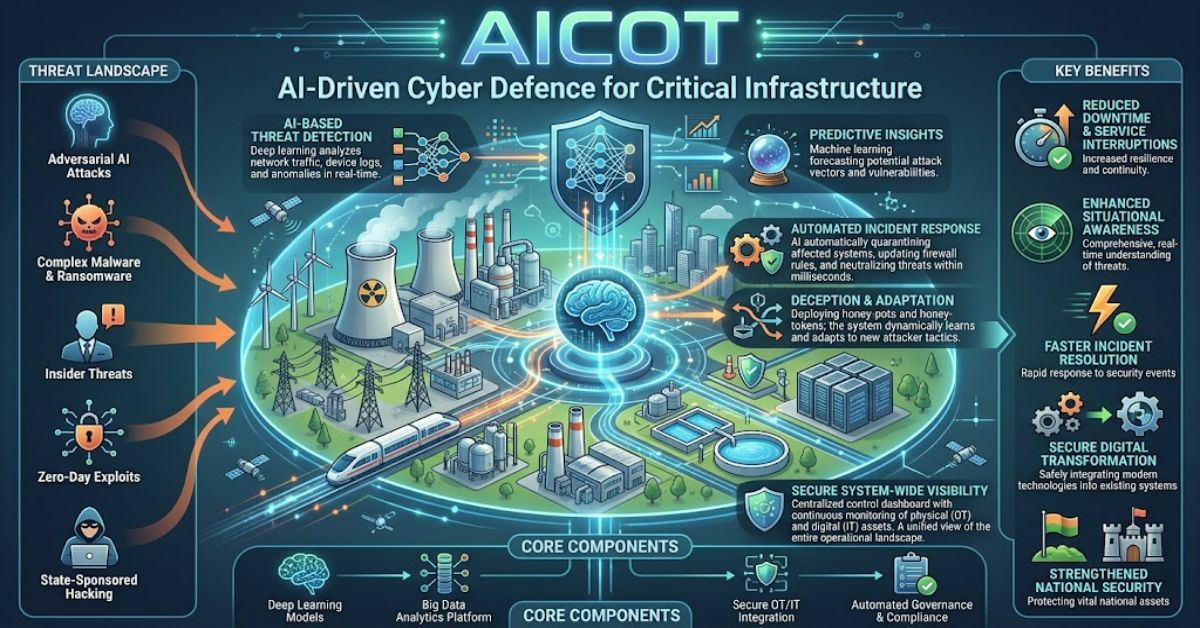
AICOT refers to the AI-Driven Cyber Defense Platform for Operational Technology Environments in Critical Infrastructure, a European cybersecurity project designed around a problem that conventional IT security tools do not always solve well: protecting industrial systems while they remain operational. The project describes OT environments across areas such as energy, transport, water and manufacturing as particularly challenging because many contain legacy equipment, specialised protocols and strict availability requirements.
The distinction between IT and OT is important. An office computer can often be disconnected, patched or restarted during an incident. A programmable logic controller, industrial control system or other operational component may be connected to a physical process where an inappropriate intervention can interrupt production or affect safety.
AICOT proposes an OT-focused approach built around artificial intelligence, machine learning, anomaly detection, protocol analysis and threat intelligence. The stated objective is not simply to collect more security logs but to provide greater understanding of what is happening inside industrial environments.
That makes AICOT relevant to a wider European debate about cybersecurity resilience, technological sovereignty and the safe use of AI. The European Commission’s July 2026 Action Plan on Cybersecurity and Artificial Intelligence similarly recognises that AI can strengthen cyber defence while creating new security risks of its own.
What AICOT Is Designed to Do
AICOT builds on Logstail’s existing SIEM and data-analytics capabilities. Its project description says the platform is intended to add advanced machine learning, anomaly detection, OT protocol analysis, threat intelligence, real-time monitoring and response capabilities.
| Area | AICOT approach | Practical purpose |
| Monitoring | OT-aware telemetry | Improve visibility |
| Detection | Machine learning and anomaly detection | Identify unusual behaviour |
| Protocol analysis | Industrial communication analysis | Understand OT-specific activity |
| Threat intelligence | Contextual security information | Support investigation |
| Response | Security-operation workflows | Assist incident handling |
| Validation | Realistic OT pilot environment | Test applicability |
The project also identifies secure cyber-threat-intelligence sharing as an important component. Its stated approach includes blockchain-backed sharing intended to support privacy, trust, auditability and interoperability.
This is significant because industrial threat intelligence can contain sensitive information about assets, network relationships, vulnerabilities and operational behaviour. Sharing useful information without unnecessarily exposing operational details is therefore a technical and governance problem, not simply a data-exchange problem.
Why OT Security Requires a Different Approach
AICOT’s underlying premise is that OT cannot simply be treated as conventional enterprise IT. Industrial systems often use protocols such as Modbus, DNP3, PROFINET and IEC 61850, while some environments contain equipment that was not designed for today’s connected threat environment.
The consequences of an incident can also differ. In an IT environment, confidentiality may be the immediate priority. In OT, availability, process integrity and safety can become equally important.
AICOT’s own technical material highlights another issue: security teams need context. An unusual command is not automatically malicious. Its significance may depend on which asset generated it, what process was running and whether the activity was authorised.
This creates a practical requirement for AI systems: detection must be sufficiently contextual to avoid producing alerts that industrial operators cannot safely interpret.
Risks, Trade-offs and Original Insights
AICOT’s proposed architecture also exposes several important challenges.
First, AI quality depends on industrial data. The project identifies the scarcity of labelled OT datasets as a challenge. Models trained primarily on conventional IT activity may struggle to understand legitimate industrial behaviour.
Second, detection does not automatically equal safe response. In an industrial environment, an automated action can have operational consequences. The more directly cybersecurity tooling interacts with OT systems, the more important human oversight and process context become.
Third, visibility depends on the quality of telemetry. AICOT’s discussion of OT time synchronisation illustrates a less obvious problem. If systems disagree about timestamps, investigators can struggle to reconstruct the order of events even when relevant logs exist.
These points suggest that successful OT AI will depend as much on data quality, integration and explainability as on model sophistication.
| Insight | Why it matters |
| Data quality is foundational | Poor or incomplete OT telemetry can weaken detection |
| Context reduces false alarms | Industrial activity must be interpreted against process conditions |
| Response needs operational safeguards | Cybersecurity actions can affect physical systems |
| Time integrity supports investigations | Inconsistent timestamps can distort incident timelines |
AICOT and European Cybersecurity Strategy
AICOT’s emphasis on European-native technology also reflects a broader policy concern. The project identifies dependence on non-EU vendors as a potential source of supply-chain and geopolitical risk and presents digital sovereignty as one of its objectives.
This does not mean European origin automatically guarantees security. A sovereign technology still needs strong engineering, independent validation, transparent governance and practical interoperability.
The project’s stated intention to validate its platform in realistic OT scenarios at Technology Readiness Levels 7–8 is therefore particularly important. Such validation can provide stronger evidence than a laboratory demonstration, although the project should not be treated as a mature commercial deployment merely because those targets exist.
The Future of AICOT in 2027
By 2027, the most important question for AICOT will be evidence of practical performance rather than the novelty of its AI components.
The project is positioned within a European environment where AI and cybersecurity policy are increasingly connected. The European Commission’s 2026 Action Plan explicitly addresses both the defensive potential of AI and the ways malicious actors can exploit it.
For AICOT, this creates several measurable priorities: successful OT pilot validation, reliable anomaly detection, manageable alert volumes, explainable decisions, secure threat-intelligence exchange and compatibility with existing security operations.
Uncertainty remains. Industrial environments differ substantially, and a model that performs well in one pilot cannot automatically be assumed to work across energy, manufacturing, transport and water systems.
Key Insights
- AICOT treats OT cybersecurity as a specialised discipline rather than an extension of ordinary IT security.
- AI-based detection is useful only when industrial context is available.
- Threat-intelligence sharing introduces privacy and governance considerations alongside technical requirements.
- Legacy equipment creates integration and monitoring constraints.
- Reliable timestamps and telemetry can be as important to investigations as advanced detection models.
- Pilot validation will be critical for establishing whether the proposed architecture works outside controlled environments.
Conclusion
AICOT represents a focused attempt to apply AI-driven cybersecurity to the particular requirements of Operational Technology and critical infrastructure. Its stated architecture combines machine learning, anomaly detection, OT protocol analysis, threat intelligence and monitoring rather than relying on a single detection technique.
The project’s strongest conceptual distinction is its recognition that industrial cybersecurity has consequences beyond data loss. Availability, physical processes, safety and operational continuity can all influence how a security event should be understood and managed.
Its future significance will depend on implementation evidence. Realistic pilot deployments, data quality, explainability, interoperability and safe response mechanisms will determine whether the approach can translate from project objectives into dependable industrial capability.
FAQ
What does AICOT stand for?
AICOT stands for AI-Driven Cyber Defense Platform for Operational Technology Environments in Critical Infrastructure.
What is AICOT designed to protect?
It is designed around cybersecurity for Operational Technology environments used in critical infrastructure.
Does AICOT use artificial intelligence?
Yes. Its stated architecture includes machine learning, anomaly detection and AI-based threat-detection capabilities.
Why is OT security different from IT security?
OT systems can control physical processes and often have strict availability and safety requirements, making conventional IT responses unsuitable in some situations.
What role does threat intelligence play in AICOT?
AICOT proposes secure, privacy-preserving threat-intelligence sharing to help organisations exchange useful security information without unnecessarily exposing sensitive operational data.
Is AICOT already a widely deployed commercial product?
The available project material describes AICOT as a research and development initiative with planned pilot validation. Its proposed capabilities should therefore be distinguished from independently verified widespread commercial deployment.
Methodology
This article was prepared from AICOT Project materials describing its objectives, technical approach and cybersecurity challenges, supplemented by European Commission material on AI and cybersecurity policy. The analysis distinguishes stated project objectives from independently established outcomes. No firsthand testing or personal field observation was claimed. The principal limitation is that project objectives and proposed capabilities should not be interpreted as proof of completed, large-scale deployment.
References
AICOT Project. (2026). AI-Driven Cyber Defense Platform for Operational Technology Environments in Critical Infrastructure.
AICOT Project. (2026). Why OT threat intelligence is so hard to share.
AICOT Project. (2026). Turning industrial telemetry into actionable OT security alerts.
AICOT Project. (2026). How OT security is different from IT security.
European Commission. (2026, 7 July). EU Action Plan on Cybersecurity and Artificial Intelligence.