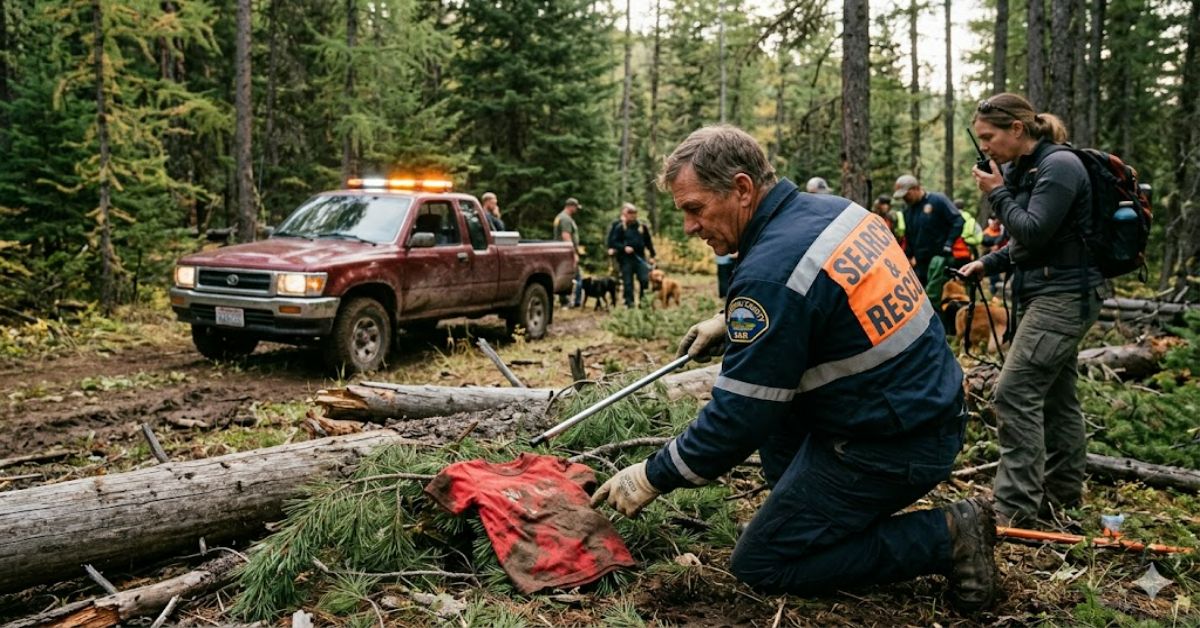
The story of Ryker Webb became global news in June 2022 when the three-year-old Montana boy survived nearly two days alone in dense wilderness before being found alive. While countless missing-person cases receive local attention, this one quickly spread around the world because of the extraordinary circumstances, the successful rescue, and a striking post-rescue photograph showing a visibly exhausted and shell-shocked child.
For many people, the image became the defining symbol of the incident. Yet the real significance of the story goes far beyond a single photograph. It raises questions about wilderness survival, child safety, modern search-and-rescue capabilities, and the way social media amplifies emotionally powerful narratives.
The case occurred near Troy, Montana, a region characterised by thick forests, rugged terrain, wildlife, and rapidly changing weather conditions. Even experienced adults can struggle in such an environment. The fact that a toddler survived alone for approximately two days surprised rescue professionals and observers alike.
Years later, public interest remains strong. Searches related to the rescue continue to generate traffic, while discussions frequently revisit how the child survived and what lessons can be learned from the incident.
This article examines the timeline, the rescue operation, the factors that contributed to the successful outcome, and the broader cultural impact of one of the most remarkable survival stories of the decade.
What Happened to Ryker Webb?
On 03 June 2022, Ryker Webb disappeared from his family’s property near Troy, Montana.
According to local authorities, family members noticed the toddler was missing and immediately began searching the surrounding area. Given the region’s challenging terrain, concerns escalated quickly.
The Lincoln County Sheriff’s Office launched a major search effort involving:
- Local law enforcement
- Search-and-rescue teams
- Volunteers
- K9 units
- Helicopter support
- Drone operations
The search covered extensive forested areas where visibility was limited and movement was difficult.
Timeline of Events
| Date | Event |
| 03 June 2022 | Ryker reported missing |
| 03–05 June 2022 | Large-scale search operation conducted |
| 05 June 2022 | Child located alive in remote cabin area |
| Following days | Rescue story gains international media attention |
The case rapidly evolved from a local emergency into a major news story.
The Discovery That Shocked Rescuers
After nearly two days missing, Ryker was discovered approximately two miles from his home.
He was found near a cabin in a heavily wooded area.
Remarkably, despite exposure to the elements, he was alive and responsive.
Search personnel later indicated that the child had survived by seeking shelter and enduring harsh conditions that many observers believed would be impossible for someone his age to withstand.
Conditions Faced
| Challenge | Potential Risk |
| Dense forest | Disorientation |
| Cold nighttime temperatures | Hypothermia |
| Wildlife habitat | Animal encounters |
| Limited food access | Dehydration and exhaustion |
| Rough terrain | Injury |
These conditions explain why the case attracted such widespread attention.
Many survival experts noted that young children typically have limited ability to navigate dangerous environments independently.
Why the Story Went Viral
Many missing-child cases receive regional coverage but never become global news.
Several factors contributed to the extraordinary attention surrounding Ryker’s rescue.
The Human Element
The central fact was difficult to ignore:
A three-year-old child survived alone in wilderness conditions that challenge adults.
That reality immediately resonated with parents and families worldwide.
The Rescue Photograph
One image played an especially important role.
After Ryker was found, photographs circulated showing him dirty, tired, and visibly overwhelmed by the experience.
The contrast between the missing child and the rescued survivor created a powerful emotional reaction online.
News outlets across North America, Europe, Australia, and Asia shared the image extensively.
Social Media Amplification
The rescue occurred during an era when stories can spread globally within hours.
Platforms such as Facebook, X, Instagram, and TikTok accelerated public awareness.
The story fit several characteristics common among viral news events:
- Strong emotional impact
- Clear narrative arc
- Positive outcome
- Visual storytelling
- Family-oriented themes
Search and Rescue Operations: What Made the Difference?
The successful recovery of Ryker Webb also highlighted the capabilities of modern search-and-rescue systems.
Large-scale wilderness searches involve complex coordination.
Key Components of the Operation
Rapid Mobilisation
Authorities acted quickly after receiving reports that the child was missing.
Early response remains one of the most important factors in successful recoveries.
Multi-Agency Coordination
The operation involved collaboration between multiple organisations.
Such coordination helps prevent duplication and improves area coverage.
Community Involvement
Volunteers played an important role in expanding the search footprint.
In rural communities, volunteer participation often becomes essential during emergencies.
Practical Lesson
One overlooked aspect of the story is that successful outcomes are rarely accidental.
The survival of the child was extraordinary, but the professionalism and persistence of search teams were equally important.
Without sustained search efforts, the outcome could have been very different.
The Psychology Behind Public Fascination
Why do stories like this capture so much attention?
The answer lies partly in human psychology.
Researchers studying media engagement consistently find that audiences respond strongly to stories involving:
- Survival
- Children
- Rescue
- Community cooperation
- Positive outcomes
Many news events generate anxiety or division.
The Ryker Webb story offered something different.
It combined danger with hope.
The narrative followed a familiar structure:
- Child disappears.
- Search intensifies.
- Public concern grows.
- Rescue succeeds.
- Community celebrates.
This structure naturally encourages emotional investment.
Three Insights Often Missing From Coverage
1. Survival Stories Can Distort Risk Perception
Stories like Ryker’s are inspiring, but they can unintentionally create unrealistic expectations.
Most wilderness disappearances do not end under similarly fortunate circumstances.
Search professionals consistently stress prevention rather than survival.
2. Rural Search Infrastructure Matters
The rescue demonstrated the value of maintaining local emergency-response capabilities.
Many rural regions face staffing and funding challenges.
Cases like this illustrate why investment in search-and-rescue resources remains important.
3. Viral Attention Often Focuses on Images Instead of Systems
Much public discussion centred on the rescue photograph.
Far less attention was given to the logistical complexity behind the search operation itself.
The image told the emotional story; the rescue teams delivered the actual result.
Cultural Impact of the Ryker Webb Story
The story became part of a broader category of modern survival narratives that achieve international recognition.
Examples include:
- Child wilderness survival cases
- Missing-person recoveries
- Disaster rescues
- Extreme endurance stories
These events often transcend local significance because they touch on universal fears and hopes.
Parents identify with the family’s anxiety.
Communities identify with the rescue effort.
Readers identify with the relief of a positive ending.
The result is a story that continues circulating long after the original event.
The Future of Ryker Webb Coverage in 2027
By 2027, public interest in survival stories is likely to remain strong.
Several trends support this prediction:
Continued Growth of Social Media News
Visual-first platforms continue rewarding emotionally compelling content.
Rescue stories frequently perform well because they provide dramatic narratives with clear resolutions.
Advances in Search Technology
Future rescue operations may increasingly utilise:
- Artificial intelligence
- Enhanced drone systems
- Thermal imaging
- Improved geospatial analysis
These technologies could improve search efficiency in wilderness environments.
Increased Public Awareness
Stories like Ryker’s may encourage greater emphasis on:
- Child safety education
- Outdoor preparedness
- Emergency planning
- Community volunteer training
However, experts caution that technology cannot replace rapid reporting and coordinated search efforts.
Key Takeaways
- Ryker Webb survived nearly two days alone in Montana wilderness at age three.
- The successful rescue depended on extensive search-and-rescue coordination.
- Viral photographs amplified international attention.
- The story demonstrates both human resilience and community response.
- Survival stories often overshadow the operational systems that make rescues possible.
- Public fascination stems from a combination of danger, hope, and emotional storytelling.
- The case remains one of the most remarkable child survival incidents of recent years.
Conclusion
The story of Ryker Webb stands out because it combines extraordinary survival with an equally remarkable rescue effort. A toddler alone in dense Montana wilderness for nearly two days would normally represent one of the most serious scenarios emergency responders face. Yet through a combination of resilience, luck, and a determined search operation, the incident ended with a successful recovery.
The image that circulated worldwide captured public attention, but the deeper story involves far more than a viral photograph. It reflects the importance of community action, emergency preparedness, and professional search-and-rescue capabilities.
Years after the event, interest remains strong because the case touches something universal. It reminds people of vulnerability, uncertainty, and the possibility of hope even under difficult circumstances.
For many observers, Ryker Webb’s survival remains one of the most memorable rescue stories of the decade—not simply because a child was found alive, but because the outcome seemed so unlikely against the odds.
FAQ
Who is Ryker Webb?
Ryker Webb is a Montana boy who gained international attention after surviving nearly two days alone in wilderness conditions in June 2022 when he was three years old.
How long was Ryker Webb missing?
Authorities reported that he was missing for approximately two days before being found alive.
Where was Ryker Webb found?
He was discovered near a cabin in a wooded area several miles from where he disappeared near Troy, Montana.
Why did the story become so famous?
The combination of a young child’s survival, a successful rescue, and widely shared photographs generated extensive media coverage worldwide.
How old was Ryker Webb during the incident?
He was three years old when he went missing and was later rescued.
What role did search-and-rescue teams play?
Multiple agencies, volunteers, K9 units, and aerial search resources worked together to locate the missing child.
Is Ryker Webb’s survival considered unusual?
Yes. Survival experts and rescuers generally regard the outcome as extraordinary given the child’s age and the environmental conditions.
Methodology
This article was prepared using publicly reported information from law enforcement statements, established news coverage, and documented reporting published following the June 2022 rescue. The analysis focuses on verified facts surrounding the disappearance, search operation, rescue, and subsequent media coverage.
Limitations include the absence of detailed medical records, private family information, and non-public rescue documentation. The article avoids speculation regarding the child’s experience beyond publicly reported facts.
Where analytical observations are offered, they relate to media coverage patterns, search-and-rescue practices, and public engagement trends rather than unverified claims.
Editorial Disclosure: This article was drafted with AI assistance and reviewed and verified by [Author Name]. All data, citations, and claims should be independently confirmed by the editorial team at RubbleMagazine.co.uk before publication.
References
Associated Press. (2022). Montana toddler found safe after missing for nearly two days.
Lincoln County Sheriff’s Office. (2022). Official statements regarding the June 2022 search and rescue operation.
NBC News. (2022). Missing Montana toddler found alive after extensive search.
People Magazine. (2022). Montana child survives two days alone in wilderness.
USA Today. (2022). Search teams locate missing Montana toddler after two-day search.
Human editorial verification of all references is required before publication.