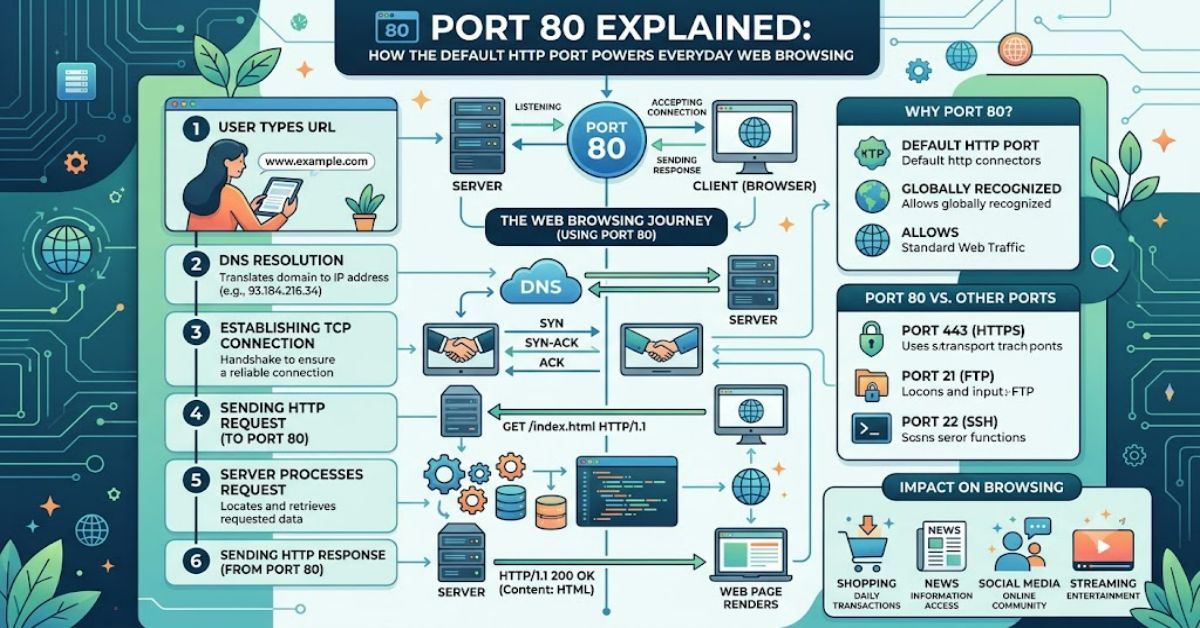
Port 80 is the standard networking port used for unencrypted HTTP web traffic. Whenever a user enters a website address beginning with “http://” rather than “https://”, the browser typically connects to the web server through this port to request and display website content.
First introduced alongside the growth of the World Wide Web in the early 1990s, Port 8’0 became the recognised gateway for browser-to-server communication. It supports the HTTP protocol, allowing websites to transfer HTML pages, images, scripts, and other resources.
However, the role of this port has changed significantly. Security concerns surrounding unencrypted communication have pushed businesses, governments, and technology providers towards HTTPS, which uses encryption and usually operates through port 443. Today, Port 8’0 is often used as a transition mechanism, mainly redirecting visitors to secure versions of websites.
Understanding how this networking standard works helps businesses, developers, and everyday users recognise how internet connections are established and why modern security practices have moved beyond traditional HTTP.
What Is Port 80 and How Does It Work?
In computer networking, ports act as numbered communication endpoints that allow different services to operate on the same device. A server may host email services, databases, applications, and websites simultaneously, with each service assigned a specific port number.
Port 8’0 is assigned to HTTP by the Internet Assigned Numbers Authority (IANA). When a browser requests a webpage through HTTP, it creates a connection to the web server’s IP address using this port.
The basic process works as follows:
- A user enters a website address.
- The browser identifies the server’s IP address through DNS.
- The browser connects to the server using Port 8’0.
- The server sends requested webpage files.
- The browser displays the content.
This process happens within seconds, but behind the scenes it involves multiple networking layers, including the Transmission Control Protocol (TCP), which ensures reliable data delivery.
Port 8’0 Compared With Port 443
The biggest distinction between Port 80 and Port 443 is security.
Port 8’0 handles HTTP traffic without encryption. Data transferred through this connection can potentially be intercepted because information travels in readable form.
Port 443 supports HTTPS, which uses Transport Layer Security (TLS) encryption to protect communication between users and websites.
| Feature | Port 80 | Port 443 |
| Protocol | HTTP | HTTPS |
| Encryption | None | TLS encryption |
| Default browser usage | Older HTTP websites | Modern secure websites |
| Security level | Low | High |
| Common purpose today | Redirects and legacy support | Main website communication |
Most professional websites now use HTTPS by default. Browsers such as Google Chrome and Mozilla Firefox also warn users when they visit websites that still rely only on HTTP.
Why Port 80 Still Matters
Although encrypted connections dominate modern browsing, Port 8’0 has not disappeared.
Many websites continue opening Port 8’0 because it provides compatibility and supports automatic redirection. For example, when someone types an old HTTP version of a website address, the server can respond by sending them to the secure HTTPS version.
Port 8’0 is also useful for:
- Initial website migration from HTTP to HTTPS
- Certificate verification processes
- Supporting older systems and devices
- Maintaining access to legacy applications
Large organisations often keep Port 8’0 available but configure it carefully to avoid unnecessary security exposure.
Security Risks Associated With Port 80
The biggest weakness of Port 8’0 is the absence of encryption. Information transferred through HTTP can be vulnerable to interception, especially on unsecured networks.
Potential risks include:
Data interception:
Attackers monitoring network traffic may view information exchanged between users and servers.
Man-in-the-middle attacks:
Cybercriminals can attempt to modify communication between a browser and a website.
Session theft:
Without encryption, authentication details and cookies may become easier targets.
For this reason, organisations typically follow security practices recommended by bodies such as the National Cyber Security Centre (NCSC) and encourage HTTPS adoption across all public websites.
Practical Management of Port 80 for Businesses
Businesses operating websites need a clear strategy for managing HTTP traffic.
A common approach is keeping Port 8’0 open only for redirection purposes. When visitors attempt to access an unsecured HTTP address, the server immediately forwards them to the HTTPS version.
This approach provides several advantages:
| Management Approach | Benefit | Possible Limitation |
| Disable Port 80 completely | Reduces exposure | Can break old links |
| Redirect HTTP to HTTPS | Maintains accessibility and improves security | Requires correct configuration |
| Continue using HTTP | Simple setup | Creates security risks |
Web administrators should also monitor server logs, apply security updates, and configure firewall rules appropriately.
Real-World Impact of Port 80
The shift away from unencrypted HTTP has affected almost every part of the digital economy.
E-commerce websites, banking platforms, government portals, and cloud services now depend heavily on encrypted communication. Search engines have also encouraged HTTPS adoption by considering secure connections as part of website quality evaluation.
The transition demonstrates a wider change in internet infrastructure: accessibility remains important, but security has become a fundamental expectation.
The Future of Port 80 in 2027
By 2027, Port 8’0 is expected to remain part of internet infrastructure, but its role will likely become more limited.
Future web environments will continue moving towards encrypted-by-default communication. Browser manufacturers, hosting providers, and cybersecurity organisations are expected to maintain pressure against unsecured HTTP usage.
However, completely removing Port 8’0 is unlikely in the short term because millions of websites, automated systems, and legacy applications still depend on HTTP compatibility.
The most realistic future is a supporting role: Port 8’0 will continue handling redirects, validation processes, and older connections while HTTPS becomes the universal standard for active web communication.
Key Takeaways
- Port 80 is the traditional gateway for HTTP website traffic.
- It enables browser and server communication without encryption.
- Modern websites mainly use HTTPS through Port 443 for security.
- Businesses commonly retain Port 80 for automatic redirects.
- Unencrypted HTTP creates privacy and cybersecurity concerns.
- Future internet standards will reduce reliance on unsecured connections.
Conclusion
Port 80 remains one of the most recognisable components of internet infrastructure. For decades, it provided the foundation for accessing websites and exchanging information across the World Wide Web.
Its importance has changed as cybersecurity expectations have evolved. While it is no longer the preferred route for sensitive online activity, it continues to serve practical purposes, particularly when redirecting users towards secure HTTPS connections.
Understanding Port 80 helps users and organisations appreciate how web communication works and why encryption has become essential. The future internet will not necessarily eliminate this traditional port, but its role will continue shifting from primary communication channel to supporting technology.
Frequently Asked Questions
What is Port 80 used for?
Port 80 is used for HTTP communication between web browsers and servers. It allows browsers to request and receive website content without encryption.
Is Port 80 safe to use?
Port 80 itself is not harmful, but HTTP traffic through it is unencrypted. Sensitive information should always be transferred through HTTPS connections.
Why do websites still keep Port 80 open?
Many websites keep Port 8’0 available to redirect visitors from HTTP addresses to secure HTTPS versions of their websites.
What is the difference between Port 80 and Port 443?
Port 8’0 supports HTTP without encryption, while Port 443 supports HTTPS with TLS encryption for secure communication.
Can hackers attack Port 80?
Attackers can target services running on Port 8’0, especially if servers are outdated or incorrectly configured. Regular security updates reduce these risks.
Will Port 80 disappear?
Port 8’0 will probably continue existing for compatibility and redirects, but HTTPS will remain the dominant method of website communication.
Methodology
This article was prepared using publicly available networking documentation, cybersecurity guidance, and technical standards information. Sources reviewed include IANA port assignments, web security guidance from recognised cybersecurity organisations, and HTTP protocol documentation.
The analysis focuses on explaining Port 80’s technical purpose, practical business implications, and changing role in modern web infrastructure. Limitations include the continuously evolving nature of browser security policies and internet standards.
References (APA Format)
Internet Assigned Numbers Authority. (2025). Service Name and Transport Protocol Port Number Registry. IANA.
National Cyber Security Centre. (2024). Web security guidance and HTTPS implementation recommendations. NCSC.
Fielding, R., & Reschke, J. (2022). HTTP Semantics (RFC 9110). Internet Engineering Task Force.
Mozilla. (2025). HTTPS and web security documentation. Mozilla Developer Network.