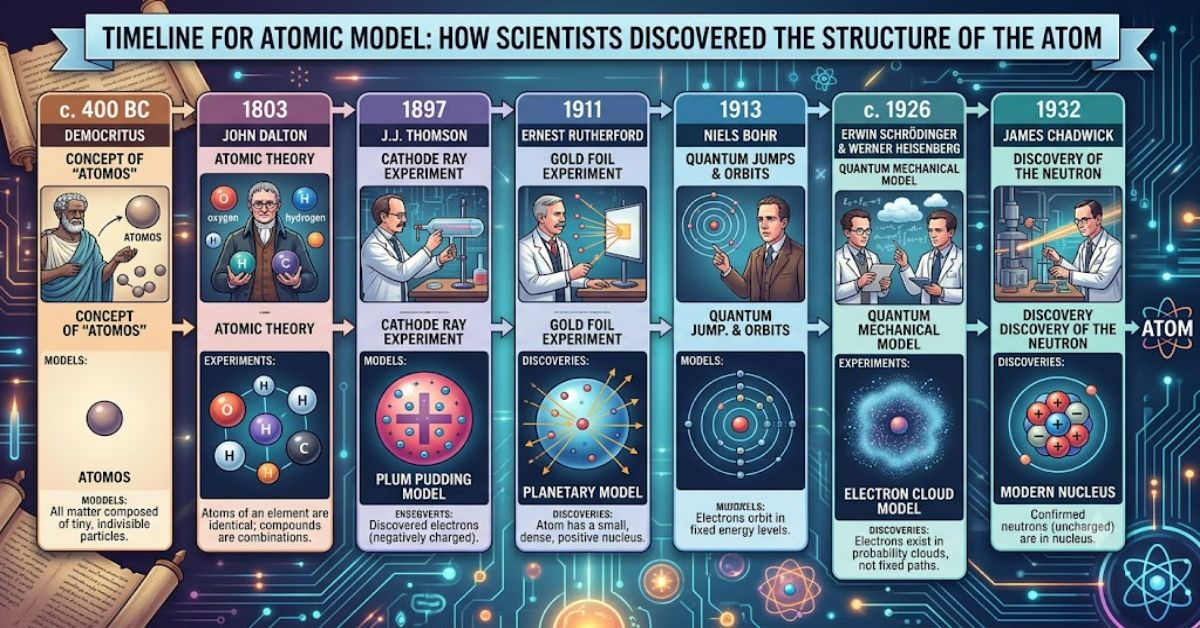
The timeline for atomic model development explains how scientists gradually uncovered the hidden structure of matter. The atomic model has evolved through five major stages, shifting from the idea of atoms as indivisible solid spheres to the modern understanding of electrons existing in probability-based regions around a nucleus.
For thousands of years, people questioned what matter was made of. Ancient philosophers proposed that everything consisted of tiny particles, but experimental science later transformed those ideas into measurable theories.
Each stage of atomic theory was influenced by a breakthrough experiment. John Dalton introduced the first scientific atomic theory in the early 1800s, J.J. Thomson discovered electrons in 1897, Ernest Rutherford identified the nucleus in 1911, and Niels Bohr improved atomic structure explanations in 1913. Later developments in quantum mechanics replaced fixed electron paths with a more accurate probability-based model.
Understanding this progression helps students and researchers see how scientific knowledge develops. Atomic theory was not replaced overnight; instead, each model improved upon earlier explanations when new evidence became available.
The Five Major Stages in the Timeline for Atomic Model Development
The atomic model changed as scientists gained better tools and performed more advanced experiments.
| Model Stage | Scientist | Year | Main Discovery |
| Solid Sphere Model | John Dalton | 1803 | Atoms are tiny indivisible particles |
| Plum Pudding Model | J.J. Thomson | 1897 | Discovery of electrons |
| Nuclear Model | Ernest Rutherford | 1911 | Small dense atomic nucleus |
| Planetary Model | Niels Bohr | 1913 | Fixed electron energy levels |
| Quantum Mechanical Model | Schrödinger, Heisenberg and others | 1920s | Electrons exist in probability regions |
Dalton’s Solid Sphere Model: The Beginning of Scientific Atomic Theory
Before Dalton’s work, atomic ideas were mainly philosophical. Ancient Greek thinkers such as Democritus suggested that matter consisted of tiny particles, but there was no experimental evidence.
In 1803, English chemist John Dalton proposed the first modern atomic theory. He argued that:
- All matter consists of atoms.
- Atoms of the same element have similar properties.
- Chemical reactions involve rearrangement of atoms.
- Atoms cannot be created or destroyed during chemical reactions.
Dalton’s model represented atoms as solid, indivisible spheres. Although later discoveries proved atoms contained smaller particles, his theory established a foundation for modern chemistry.
Thomson’s Discovery of Electrons and the Plum Pudding Model
The next major change occurred in 1897 when J.J. Thomson discovered the electron through experiments using cathode ray tubes.
His research showed that atoms were not indivisible. They contained negatively charged particles called electrons.
Thomson proposed the plum pudding model, where electrons were embedded within a positively charged sphere.
| Scientific Question | Dalton’s View | Thomson’s Improvement |
| Are atoms indivisible? | Yes | No |
| Do atoms contain smaller particles? | No evidence | Electrons discovered |
| Internal structure | Solid sphere | Positive charge with electrons |
This discovery changed scientific thinking because it proved atoms had internal components.
Rutherford’s Nuclear Model: Discovering the Atomic Centre
Ernest Rutherford’s gold foil experiment in 1909 transformed atomic science. Published conclusions in 1911 showed that most particles passed through gold foil, but some were deflected sharply.
Rutherford concluded that:
- Most of an atom is empty space.
- A tiny, dense nucleus exists at the centre.
- Positive charge is concentrated inside the nucleus.
This replaced Thomson’s model because the atom was no longer considered a uniform sphere.
The experiment became one of the most influential examples of evidence changing scientific understanding.
Bohr’s Model and Electron Energy Levels
In 1913, Danish physicist Niels Bohr introduced a new explanation for atomic behaviour.
Bohr suggested that electrons moved around the nucleus in specific energy levels. Electrons could jump between these levels by absorbing or releasing energy.
His model successfully explained hydrogen’s emission spectrum and improved understanding of atomic stability.
However, the model had limitations. It worked well for simple atoms but could not fully explain the behaviour of more complex elements.
The Modern Quantum Mechanical Model
The modern atomic model emerged during the 1920s through developments in quantum mechanics.
Scientists including Erwin Schrödinger and Werner Heisenberg showed that electrons do not move in fixed circular paths. Instead, they exist in regions called orbitals, where their location can be described through probability.
This model introduced important concepts:
- Electron clouds
- Quantum numbers
- Probability distributions
- Energy states
Today’s atomic theory combines quantum mechanics, experimental physics, and chemistry to explain atomic behaviour.
Why the Atomic Model Continues to Change
Scientific models are not permanent answers. They are explanations based on available evidence.
The atomic model changed because:
- New technology allowed deeper investigation.
- Experiments revealed unexpected results.
- Scientists improved previous theories.
This pattern appears throughout science. Models evolve when evidence shows that existing explanations are incomplete.
The Future of Atomic Models in 2027
By 2027, atomic research is expected to continue advancing through quantum computing, particle physics, and materials science.
Modern laboratories are exploring atomic behaviour at increasingly smaller scales. Organisations such as CERN continue investigating fundamental particles, while quantum technology companies are developing systems based on atomic-level principles.
However, the future of atomic theory is unlikely to involve replacing the quantum model completely. Instead, researchers will refine existing theories to explain unanswered questions involving dark matter, particle interactions, and quantum effects.
Key Takeaways
- Dalton created the first scientific atomic theory in 1803.
- Thomson proved atoms contained electrons in 1897.
- Rutherford discovered the nucleus through gold foil experiments.
- Bohr introduced electron energy levels in 1913.
- Quantum mechanics created the modern probability-based atomic model.
- Atomic theory continues developing through advanced research.
Conclusion
The timeline for atomic model development shows how scientific knowledge grows through evidence, experimentation, and revision. Each scientist contributed a new piece of understanding, transforming the atom from an imagined solid particle into a complex structure containing a nucleus and quantum electron regions.
Although earlier models became outdated, they played an important role in scientific progress. Dalton, Thomson, Rutherford, and Bohr each provided ideas that helped future researchers move closer to today’s explanation of atomic behaviour.
The modern quantum mechanical model remains the most accurate description available, but science continues investigating the fundamental nature of matter. Future discoveries may provide even deeper insights into the structure of the universe.
Frequently Asked Questions
What are the five timeline for atomic model in order?
The five major atomic models are Dalton’s solid sphere model, Thomson’s plum pudding model, Rutherford’s nuclear model, Bohr’s planetary model, and the quantum mechanical model.
Who created the first atomic model?
John Dalton created the first scientifically supported atomic model in 1803.
Why did the atomic model change over time?
The atomic model changed because new experiments revealed information that earlier theories could not explain.
What did Rutherford discover about atoms?
Rutherford discovered that atoms contain a small, dense nucleus surrounded by mostly empty space.
What is the modern atomic model?
The modern atomic model describes electrons as existing in probability-based orbitals rather than fixed paths.
Methodology
This article was prepared using established scientific references, including university-level chemistry resources, physics publications, and recognised scientific organisations. Information was checked against historical records of atomic theory development.
The article focuses on the progression of atomic models rather than advanced quantum mechanics calculations. Some scientific interpretations continue to develop as researchers investigate atomic and subatomic behaviour.
References (APA Format)
Dalton, J. (1808). A New System of Chemical Philosophy. London: Bickerstaff.
Rutherford, E. (1911). The scattering of α and β particles by matter and the structure of the atom. Philosophical Magazine, 21(125), 669–688.
Bohr, N. (1913). On the constitution of atoms and molecules. Philosophical Magazine, 26(151), 1–25.
Schrödinger, E. (1926). An undulatory theory of the mechanics of atoms and molecules. Physical Review, 28(6), 1049–1070.