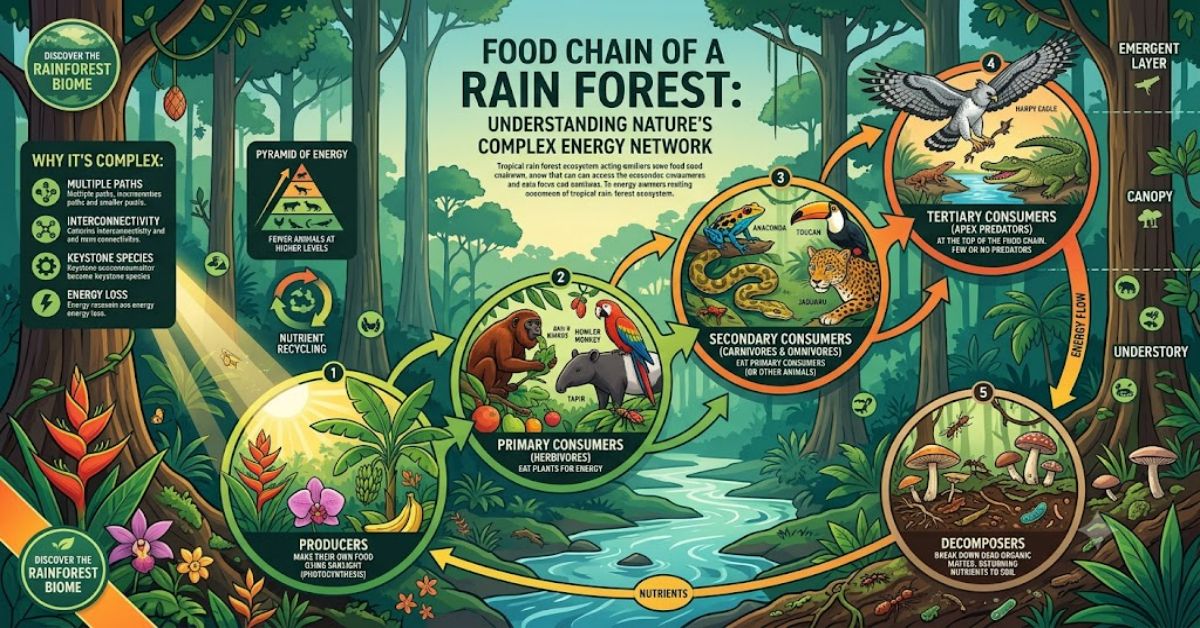
The food chain of a rain forest explains how energy moves through one of the world’s most biodiverse ecosystems. It begins with primary producers such as towering trees, vines, ferns, and other green plants that convert sunlight into food through photosynthesis. These plants are eaten by primary consumers, which are then hunted by larger predators. At the top of the chain are apex predators, while decomposers recycle nutrients back into the soil, allowing the cycle to continue.
Although a food chain is often shown as a straight line, tropical rainforests are far more complicated. Thousands of plant and animal species interact in overlapping relationships, creating intricate food webs rather than isolated chains. Every organism, from tiny fungi to powerful jaguars, contributes to maintaining ecological balance. Understanding these relationships helps explain why rainforest conservation is so important and why the loss of even one species can affect many others.
What Is a Rainforest Food Chain?
A food chain is a sequence showing how organisms obtain energy by eating other organisms.
In tropical rainforests, the sequence usually follows this pattern:
Sun → Plants → Herbivores → Carnivores → Apex Predators → Decomposers
Unlike deserts or grasslands, rainforests support an enormous variety of species. This biodiversity means that many animals have several food sources, causing numerous food chains to overlap into complex food webs.
The Main Levels of the Food Chain
Producers
Producers form the foundation of the rainforest ecosystem.
Examples include:
- Kapok trees
- Rubber trees
- Orchids
- Ferns
- Mosses
- Tropical shrubs
Using sunlight, water, and carbon dioxide, these plants produce the energy that supports every other organism.
Primary Consumers
Primary consumers feed directly on plants.
Examples include:
- Leafcutter ants
- Caterpillars
- Sloths
- Tapirs
- Fruit bats
- Parrots
These animals transfer plant energy to higher levels of the food chain.
Secondary Consumers
Secondary consumers feed on herbivores and insects.
Examples include:
- Frogs
- Snakes
- Tree frogs
- Small wild cats
- Lizards
Many rainforest reptiles and amphibians occupy this important middle level.
Tertiary Consumers and Apex Predators
These predators sit near the top of the ecosystem.
Examples include:
- Jaguars
- Harpy eagles
- Green anacondas
- Ocelots
- Caimans
Apex predators regulate prey populations and help maintain ecological balance.
Example Food Chains in a Tropical Rainforest
| Food Chain | Energy Flow |
| Chain 1 | Sun → Tree Leaves → Caterpillar → Frog → Snake → Harpy Eagle |
| Chain 2 | Sun → Fruit Tree → Monkey → Jaguar |
| Chain 3 | Sun → Grass → Tapir → Jaguar |
| Chain 4 | Sun → Flower → Butterfly → Bird → Boa Constrictor |
These examples demonstrate that the same predator may appear in several different food chains.
Why Food Webs Are More Accurate
The food chain of a rain forest is often simplified for learning purposes, but real ecosystems operate as food webs.
For example:
- Monkeys eat fruit, leaves, flowers, and insects.
- Jaguars hunt monkeys, deer, capybaras, and reptiles.
- Birds consume seeds, insects, nectar, and fruit.
- Snakes prey on frogs, birds, rodents, and eggs.
These multiple feeding relationships make rainforests highly resilient, but they also mean disturbances can spread quickly through the ecosystem.
The Essential Role of Decomposers
Dead plants and animals do not simply disappear.
Decomposers—including fungi, bacteria, termites, and earthworms—break down organic material and return nutrients to the soil.
Without decomposers:
- Soil fertility declines.
- Plant growth slows.
- Nutrient cycling stops.
- Entire ecosystems weaken.
Their work completes the energy cycle and supports new plant growth.
Structured Insight: Rainforest Organisms by Trophic Level
| Trophic Level | Examples | Primary Role |
| Producers | Trees, vines, ferns | Produce food through photosynthesis |
| Primary Consumers | Sloths, insects, parrots | Eat plants |
| Secondary Consumers | Frogs, snakes, lizards | Consume herbivores |
| Tertiary Consumers | Jaguars, eagles | Control prey populations |
| Decomposers | Fungi, bacteria | Recycle nutrients |
Why Rainforest Food Chains Matter
Studying rainforest food chains helps scientists understand ecosystem health.
Healthy food chains:
- Maintain biodiversity.
- Control species populations.
- Support nutrient recycling.
- Protect water quality.
- Stabilise climate through healthy forests.
When one species disappears because of habitat destruction or climate change, many connected species may also be affected.
Human Impact on Rainforest Food Chains
Several human activities threaten rainforest ecosystems:
- Deforestation.
- Illegal wildlife trade.
- Mining.
- Agricultural expansion.
- Climate change.
Habitat loss reduces available food, disrupts breeding patterns, and fragments animal populations. Protecting forests preserves entire ecological networks rather than individual species alone.
The Future of the Food Chain of a Rain Forest in 2027
By 2027, conservation efforts are expected to rely increasingly on satellite monitoring, biodiversity mapping, and artificial intelligence to identify ecological changes earlier. Protected areas and restoration projects may improve habitat connectivity for many species, although ongoing pressures from land-use change and climate change remain significant challenges.
Scientists also expect improved ecological modelling to strengthen understanding of rainforest food webs, helping governments and conservation organisations make better decisions about protecting vulnerable ecosystems.
Key Takeaways
- Every rainforest food chain begins with producers.
- Multiple food chains connect to create complex food webs.
- Apex predators help regulate ecosystems.
- Decomposers recycle nutrients essential for plant growth.
- Biodiversity increases ecosystem stability.
- Conservation protects every level of the food chain.
Conclusion
The food chain of a rain forest illustrates one of nature’s most remarkable systems of energy transfer. From towering tropical trees to insects, birds, reptiles, mammals, and decomposers, every organism contributes to maintaining ecological balance. Although diagrams often present a simple sequence, real rainforests consist of thousands of interconnected feeding relationships that form highly complex food webs.
Understanding these relationships highlights why rainforest conservation matters. Protecting producers, herbivores, predators, and decomposers ensures the long-term health of these ecosystems while preserving biodiversity that benefits the entire planet. As scientific knowledge and conservation technology continue advancing, maintaining healthy rainforest food webs will remain a global environmental priority.
FAQ
What is the food chain of a rain forest?
It is the sequence through which energy moves from plants to herbivores, carnivores, apex predators, and finally decomposers within a tropical rainforest ecosystem.
Why is a rainforest food web more accurate than a food chain?
Most rainforest animals eat multiple food sources and are prey for several predators, creating interconnected food webs instead of single linear chains.
Who are the producers in a tropical rainforest?
Trees, vines, shrubs, ferns, mosses, and other green plants are the primary producers because they make food through photosynthesis.
Which animals are apex predators in rainforests?
Jaguars, harpy eagles, green anacondas, and caimans are among the best-known apex predators in tropical rainforests.
Why are decomposers important?
They recycle nutrients from dead plants and animals back into the soil, allowing new vegetation to grow and sustaining the entire ecosystem.
Methodology
This article is based on established ecological principles regarding trophic levels, rainforest biodiversity, and nutrient cycling. Information has been synthesised from recognised educational and conservation sources while presenting rainforest food chains as simplified teaching models that exist within much larger food webs.
Editorial Disclosure: This article was drafted with AI assistance and should be reviewed and fact-checked by a human editor before publication.
References
- Encyclopaedia Britannica. (2024). Tropical Rainforest.
- World Wildlife Fund. (2024). Tropical Forests.
- National Geographic Society. (2023). Food Webs and Ecosystems.
- Royal Botanic Gardens, Kew. (2024). Rainforest Plants and Biodiversity.