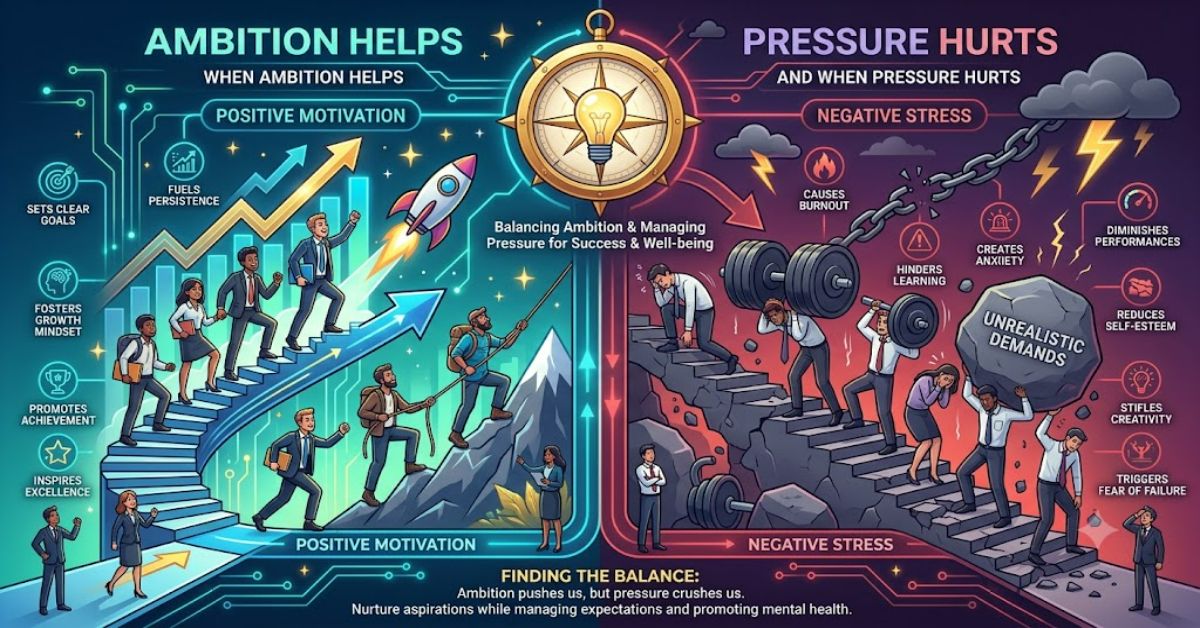
High expectations are ambitious goals placed on yourself or expected by other people. They can encourage effort, persistence and personal growth, but they become harmful when success is treated as the only acceptable outcome. The important question is not whether expectations are high, but whether they are realistic, flexible and supported.
A student may expect to achieve excellent grades because they value learning. An employee may aim for promotion because they want professional development. An athlete may train towards a demanding performance target. These are not automatically unhealthy ambitions. Problems emerge when a person believes that anything less than exceptional performance represents failure.
Research published in Psychological Bulletin in 2026 provides important context. Thomas Curran, Andrew Hill and Pia Marie Pose analysed 307 studies involving 82,939 university students from the United Kingdom, United States and Canada between 1989 and 2024. They found increases in several dimensions of perfectionism, including concerns about mistakes and doubts about actions. Socially prescribed perfectionism, which involves feeling that others demand perfection, accelerated particularly after the early 2000s. (PubMed)
This matters because ambitious standards and fear-driven perfectionism are not the same thing. One can encourage progress; the other can make ordinary setbacks feel threatening.
What High Expectations Really Mean
Expectations operate on several levels. Self-imposed expectations come from personal standards, while external expectations may come from parents, teachers, managers, partners or wider society.
Healthy expectations usually have three characteristics: they are specific, achievable with effort, and adjustable when circumstances change. Unhealthy expectations are often absolute. They sound like “I must never make mistakes” or “I have to outperform everyone”.
The distinction can also be understood through perfectionism. The American Psychological Association describes perfectionism as demanding an extremely high or flawless level of performance beyond what a situation requires. (APA Dictionary)
Healthy ambition versus harmful pressure
| Healthy ambition | Harmful pressure |
| Focuses on improvement | Focuses on proving worth |
| Allows mistakes | Treats mistakes as failure |
| Uses realistic deadlines | Demands constant performance |
| Accepts changing circumstances | Resists flexibility |
| Values effort and learning | Values outcomes above everything |
When High Standards Become Stressful
High expectations become more difficult when the person has little control over the conditions needed to meet them. A demanding deadline may be reasonable if someone has enough time, information and support. The same deadline can become unreasonable when workload, resources and responsibilities are mismatched.
The NHS explains that stress commonly develops as a response to mental or emotional pressure and may arise when someone feels they are losing control. Short-term stress can sometimes help motivation, but persistent stress can become a problem. (NHS)
A useful practical test is to ask: “Is this expectation challenging me, or is it controlling me?”
If a goal encourages action, it may be productive. If it creates constant fear, avoidance or exhaustion, the goal may need adjustment.
The Growing Pressure to Be Perfect
The 2026 research by Curran, Hill and Pose is particularly significant because it separates different aspects of perfectionism. The researchers found that perfectionistic striving increased over time, but concerns about mistakes and doubts about actions also rose. Socially prescribed perfectionism showed a notable acceleration from the early 2000s. (PubMed)
This creates an important insight: wanting to achieve more is not necessarily the central problem. The deeper risk is believing that other people expect perfection and that mistakes will damage your value or future.
The study also found associations between rising perfectionism and economic conditions. Declining GDP per capita was associated with stronger perfectionistic striving, while rising inequality was associated with sharper increases in perfectionistic concerns. (PubMed)
That suggests pressure cannot always be solved by simply telling individuals to “relax”. Social and economic conditions can influence the standards people feel compelled to meet.
High Expectations at Work
The workplace provides a clear example of the difference between ambition and unsustainable pressure.
The UK Health and Safety Executive reported that 964,000 workers experienced work-related stress, depression or anxiety during 2024/25. These conditions accounted for a substantial share of work-related ill health and contributed to an estimated 40.1 million working days lost. (HSE Media Centre)
Employers therefore have a practical reason to examine expectations. High performance does not require permanent overload.
The Health and Safety Executive also states that employers have duties to assess and manage risks from work-related stress under UK health and safety law. (HSE Media Centre)
A workplace that demands excellent results but provides inadequate staffing, unrealistic deadlines or little autonomy may create a performance system that is difficult to sustain.
How to Make Ambition Sustainable
A better approach is to convert rigid expectations into flexible performance standards.
| Situation | Better expectation |
| “I must get everything right.” | “I will prepare carefully and learn from errors.” |
| “I must always be the best.” | “I will improve against my previous performance.” |
| “Everyone must approve of my work.” | “I will consider useful feedback objectively.” |
| “I cannot take breaks.” | “Rest is part of maintaining performance.” |
| “Failure is unacceptable.” | “Setbacks provide information for the next attempt.” |
One practical technique is to define a minimum acceptable outcome, a target outcome and an exceptional outcome. This creates flexibility without removing ambition.
Another is to separate identity from performance. A poor result is information about a particular result; it is not automatically evidence that someone is inadequate.
The Future of High Expectations in 2027
The pressure surrounding achievement is unlikely to disappear in 2027. The more useful question will be how schools, workplaces and families respond to it.
The latest perfectionism research suggests that cultural and economic factors deserve attention alongside individual coping strategies. (American Psychological Association)
Workplaces are also likely to face greater scrutiny over psychological health and stress management as employers respond to continuing levels of work-related mental ill health in Britain. (HSE Media Centre)
The most sustainable model is unlikely to be lower expectations across the board. Instead, it will involve better-designed expectations: challenging enough to encourage growth, but flexible enough to recognise human limitations.
Key Takeaways
- High standards are not automatically unhealthy.
- Flexible goals are generally easier to sustain than rigid demands.
- Fear of mistakes can be more damaging than ambition itself.
- External pressure can influence perfectionistic thinking.
- Workplace expectations should be matched with appropriate resources.
- Rest and recovery are compatible with high performance.
- Success should be measured through progress as well as outcomes.
Conclusion
High expectations can be a powerful source of motivation. They encourage people to study harder, develop skills, pursue demanding careers and attempt difficult goals. The problem begins when ambitious standards become rigid rules about personal worth.
Recent research provides a useful warning. Perfectionism has increased among university students across the UK, US and Canada, while concerns about mistakes and perceived social demands have become increasingly prominent. (PubMed)
The answer is not to abandon ambition. It is to make ambition sustainable. Goals should account for available resources, changing circumstances and the possibility of mistakes. Individuals can aim high while allowing themselves to revise targets, recover from setbacks and seek support.
The healthiest expectation is therefore not perfection. It is meaningful progress combined with realistic limits.
Frequently Asked Questions
What are high expectations?
They are ambitious standards or goals that require significant effort or performance. They can be self-imposed or come from other people.
Are high expectations always bad?
No. Realistic and flexible expectations can encourage motivation, persistence and achievement. They become problematic when they create constant fear, exhaustion or a belief that mistakes are unacceptable.
Can high expectations cause stress?
Yes. Expectations can contribute to stress when pressure becomes persistent or when a person feels unable to control the demands placed upon them. (NHS)
What is the difference between ambition and perfectionism?
Ambition generally focuses on achieving a worthwhile goal. Perfectionism can involve demanding flawless performance and becoming highly concerned about mistakes or judgement.
How can I lower unhealthy expectations?
Replace absolute rules with flexible targets. Define what is essential, what would be desirable and what would be exceptional. Review the standard when circumstances change.
Can high expectations cause burnout at work?
Excessive and poorly managed workplace pressure can contribute to chronic stress. The World Health Organization defines occupational burnout as a consequence of chronic workplace stress that has not been successfully managed. (World Health Organization)
Methodology
This article was prepared using recent primary and institutional sources, including the 2026 Psychological Bulletin meta-analysis by Curran, Hill and Pose, NHS guidance on stress, UK Health and Safety Executive statistics, WHO material on occupational burnout and American Psychological Association reporting.
No personal testing, interviews or original field measurements were conducted for this article. Accordingly, no fabricated firsthand experience has been presented. The documented research study and named institutional evidence provide the principal authority signals.
The evidence also has limitations. The 2026 perfectionism study focuses on university students in the UK, US and Canada, so its findings should not automatically be generalised to every age group or culture. Associations between economic conditions and perfectionism do not by themselves prove direct causation.
Editorial disclosure: This article was drafted with AI assistance and should be reviewed by the RubbleMagazine.co.uk editorial team before publication. All statistics, citations, author credentials and source details should be independently verified before publication.
References
American Psychological Association. (2026, May 28). Young adults are more perfectionistic than ever before. American Psychological Association.
Curran, T., Hill, A. P., & Pose, P. M. (2026). Perfectionism is accelerating over time: A cross-temporal meta-analytic review of 35 years of college student data. Psychological Bulletin, 152(3), 255–287.
Health and Safety Executive. (2025, November 20). HSE publishes annual workplace health and safety statistics. HSE Media Centre.
NHS. (2026, March 6). Get help with stress. NHS.
World Health Organization. (2026). Burn-out an occupational phenomenon. World Health Organization.