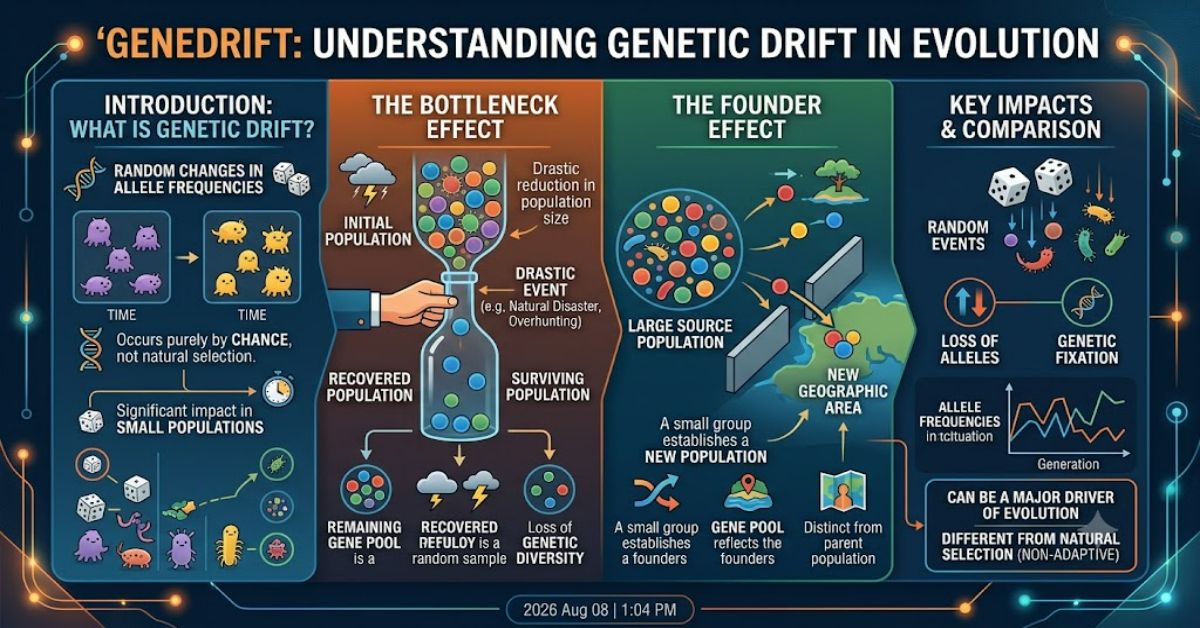
Genedrift is most commonly understood as genetic drift, a fundamental mechanism of evolution in which random events change the frequency of alleles within a population. An allele is a particular version of a gene. When some alleles become more common while others become less common simply because of chance, the genetic composition of the population changes. The US National Human Genome Research Institute describes genetic drift as random fluctuations in allele frequency and notes that its effects can be especially strong in small, isolated populations.
This distinction matters because evolution is often associated only with natural selection. Selection favours inherited characteristics that improve survival or reproduction under particular conditions. Genetic drift works differently. A genetic variant can become common even when it offers no advantage, while a useful variant can disappear by chance.
The process is easiest to understand through a simple example. Imagine a small population containing equal numbers of organisms carrying two versions of a gene. If a storm, disease outbreak or random reproductive event leaves only a few individuals to produce the next generation, the surviving group may not represent the original genetic proportions. By chance, one allele could become much more common.
Over many generations, these changes can accumulate. An allele may eventually disappear completely or become fixed, meaning that it is the only version of that gene remaining at a particular location in the population. This makes genetic drift important not only in evolutionary theory but also in conservation, population genetics and the interpretation of genomic data.
How Genetic Drift Works
Genetic drift occurs because populations are finite. Each generation represents a form of genetic sampling: only some individuals reproduce, and their genetic variants are passed forward.
In a very large population, random differences may have relatively little effect on overall allele frequencies. In a small population, however, chance can produce much larger shifts.
For example, suppose a population has 100 individuals and two alleles occur at similar frequencies. If reproduction were perfectly representative, the proportions might remain stable. Real populations do not reproduce with mathematical precision. Some individuals leave more offspring than others for reasons unrelated to genetic advantage. Random events can therefore alter the genetic balance.
The smaller the effective population size, the greater the potential influence of drift. Importantly, effective population size is not necessarily the same as the number of individuals physically present. Population structure, unequal reproductive success and demographic history can all affect how strongly random sampling influences genetic variation.
| Factor | Effect on genetic drift |
| Large population | Random changes tend to have a smaller effect |
| Small population | Random allele-frequency changes can be substantial |
| Population bottleneck | Genetic diversity may be rapidly lost |
| Founder event | A small founding group can carry an unusual sample of alleles |
| Isolation | Allows random changes to accumulate independently |
Founder Effects and Population Bottlenecks
Two important forms of genetic drift are the founder effect and the population bottleneck.
A founder effect occurs when a new population is established by a relatively small number of individuals. The founders carry only part of the genetic diversity found in the original population. As their descendants multiply, variants that happened to be present among the founders can become disproportionately common.
A population bottleneck works in the opposite demographic direction. Instead of a few individuals leaving a larger population to establish a new one, an existing population is drastically reduced. The surviving individuals represent only a fraction of the original gene pool.
Research on population bottlenecks shows why these events matter. A 2021 review in Nature Reviews Microbiology explains that bottlenecks can reduce genetic diversity and increase the influence of random drift, while founder effects can also alter the genetic composition of emerging populations.
These processes are not limited to textbook examples. They can influence wildlife conservation, infectious disease evolution and human population history.
Genetic Drift vs Natural Selection
Genetic drift and natural selection can both change allele frequencies, but the underlying mechanisms are different.
| Feature | Genetic Drift | Natural Selection |
| Main driver | Chance | Differences in reproductive success |
| Requires an advantage? | No | Usually involves a fitness difference |
| Strongest influence | Small populations | Can operate in populations of many sizes |
| Can remove useful variants? | Yes, by chance | Usually less likely if the variant is beneficial |
| Can increase harmful variants? | Yes | Possible under some circumstances, but selection generally acts against them |
The distinction becomes especially important when researchers study genomic data. A population may show a high frequency of a variant without that frequency being evidence that the variant was favoured by natural selection.
Research published in 2021 on human genomic variation demonstrated that historical genetic drift can influence estimates of genetic architecture and the apparent relationship between allele frequency and selection. The authors used data from the 1000 Genomes Project to show how demographic history can complicate interpretation.
That is one of the less obvious implications of genetic drift: a genetic pattern can look adaptive even when demographic history has contributed substantially to producing it.
Why Genetic Diversity Matters
Genetic diversity provides populations with a broader collection of inherited variants. When drift removes alleles, diversity can decline.
This creates an important trade-off. Genetic drift is a natural part of evolution, but repeated drift in small populations can leave populations with fewer genetic options when environments change.
Conservation biology therefore pays close attention to population size and connectivity. Isolated populations may experience stronger drift because genetic material is less frequently introduced from elsewhere.
The same principle can matter in laboratory research. Experimental populations deliberately subjected to repeated bottlenecks can experience strong random changes, allowing researchers to investigate how mutation, drift and selection interact.
Three Important Insights About Genedrift
1. Drift does not mean random mutation.
Mutation creates new genetic variants. Genetic drift changes the frequency of variants that already exist in a population.
2. Population size matters more than headcount alone.
The effective population size can differ substantially from the census population, so simply counting individuals may not accurately predict the strength of drift.
3. Drift can complicate genetic research.
When researchers compare populations, differences in allele frequencies may reflect demographic history rather than adaptation. This is particularly important when interpreting genome-wide association and population studies.
The Future of Genedrift in 2027
By 2027, genetic drift is likely to remain an important consideration as genomic datasets become larger and increasingly diverse. More extensive population sampling can help researchers separate demographic effects from natural selection.
This matters because genetic databases do not automatically represent the world’s full genetic diversity. Research has already shown that historical bottlenecks can influence how genetic associations are interpreted.
The practical direction is therefore not simply to collect more genomes, but to include more geographically and historically diverse populations and combine genomic evidence with demographic modelling.
Key Takeaways
- Genetic drift changes allele frequencies through chance.
- Small populations are particularly vulnerable to strong drift.
- Founder effects and bottlenecks are major situations in which drift becomes powerful.
- Drift can reduce genetic diversity and cause alleles to disappear.
- Genetic differences between populations are not automatically evidence of natural selection.
- Effective population size is often more informative than simple population count.
Conclusion
Genedrift, when used to describe genetic drift, refers to one of the core mechanisms through which populations evolve. Its defining feature is randomness: allele frequencies can change because of chance rather than because a particular trait improves survival or reproduction.
Its influence becomes especially important when populations are small, isolated or reduced through demographic bottlenecks. Founder events can also carry a limited genetic sample into a new population, allowing particular variants to become common for reasons unrelated to biological advantage.
Understanding genetic drift is therefore essential when interpreting evolution and modern genomic research. It helps explain why populations can become genetically different, why diversity can disappear and why demographic history must be considered alongside natural selection. As genomic datasets expand, accounting for drift will remain central to distinguishing genuine adaptation from patterns produced by population history.
Frequently Asked Questions
What is genedrift?
Genedrift most commonly refers to genetic drift, an evolutionary process in which allele frequencies change randomly from one generation to another. It is particularly influential in small populations.
Is Genedrift the same as natural selection?
No. Genedrift is driven by chance, while natural selection results from differences in reproductive success associated with inherited characteristics.
What is a founder effect?
A founder effect occurs when a new population begins with a relatively small number of individuals. Because the founders carry only part of the original population’s genetic variation, certain alleles can become unusually common.
What is a genetic bottleneck?
A genetic bottleneck occurs when a population experiences a major reduction in size. The surviving population may contain only a fraction of the original genetic diversity, increasing the influence of genetic drift.
Can genetic drift cause extinction?
Genetic drift does not directly mean extinction, but prolonged drift in very small populations can reduce genetic diversity and may contribute to vulnerability when populations face environmental change or other pressures.
Why is genetic drift important in human genetics?
Genetic drift can influence allele frequencies in human populations and complicate interpretation of genomic studies. Historical population bottlenecks, migration and founder events can all affect observed genetic patterns.
Methodology
This article treats “genedrift” primarily as a reference to genetic drift rather than the similarly named life-sciences consultancy. The scientific explanation was checked against the National Human Genome Research Institute and peer-reviewed literature from Nature publications. No original laboratory testing or firsthand biological observation was conducted for this article, so no such experience has been presented as original reporting.
The analysis has a practical limitation: genetic drift interacts with mutation, migration, recombination and natural selection, meaning simplified examples cannot represent every real population. The discussion therefore uses population-genetic principles rather than presenting drift as an isolated evolutionary force.
Editorial disclosure: This article was drafted with AI assistance and should be reviewed by a human editor before publication. Scientific claims, references and any author credentials should be independently verified by the RubbleMagazine.co.uk editorial team.
References
Ashraf, B., & Lawson, D. J. (2021). Genetic drift from the out-of-Africa bottleneck leads to biased estimation of genetic architecture and selection. European Journal of Human Genetics, 29, 1549–1556.
National Human Genome Research Institute. (2026). Genetic drift. National Institutes of Health.
Weaver, S. C., Forrester, N. L., Liu, J., & Vasilakis, N. (2021). Population bottlenecks and founder effects: Implications for mosquito-borne arboviral emergence. Nature Reviews Microbiology, 19, 184–195.
Charlesworth, B. (2009). Effective population size and patterns of molecular evolution and variation. Nature Reviews Genetics, 10, 195–205.