The pH metric is one of the most widely used measurements in science, manufacturing, agriculture, and environmental management. Whether a laboratory is analysing chemical reactions, a water treatment facility is monitoring drinking water quality, or a farmer is assessing soil conditions, accurate pH measurement plays a critical role.
A pH meter is a scientific instrument designed to determine the acidity or alkalinity of a solution by measuring hydrogen-ion activity. Unlike traditional litmus paper or colour indicators, modern digital instruments provide highly accurate numerical readings, making them essential in professional environments.
The importance of pH extends far beyond the laboratory. Food safety regulations often require pH verification. Water utilities continuously monitor pH levels to prevent corrosion and maintain public health standards. Agricultural producers use pH data to optimise nutrient availability and crop performance.
The growing demand for precision monitoring has also increased interest in digital measurement technologies. Similar trends are visible across many technical sectors covered by RubbleMagazine, including environmental monitoring, industrial automation, and smart sensor systems.
This article examines how pH meters work, where they are used, the advantages and limitations of modern devices, and what developments may shape the future of pH measurement by 2027.
What Is a pH Meter?
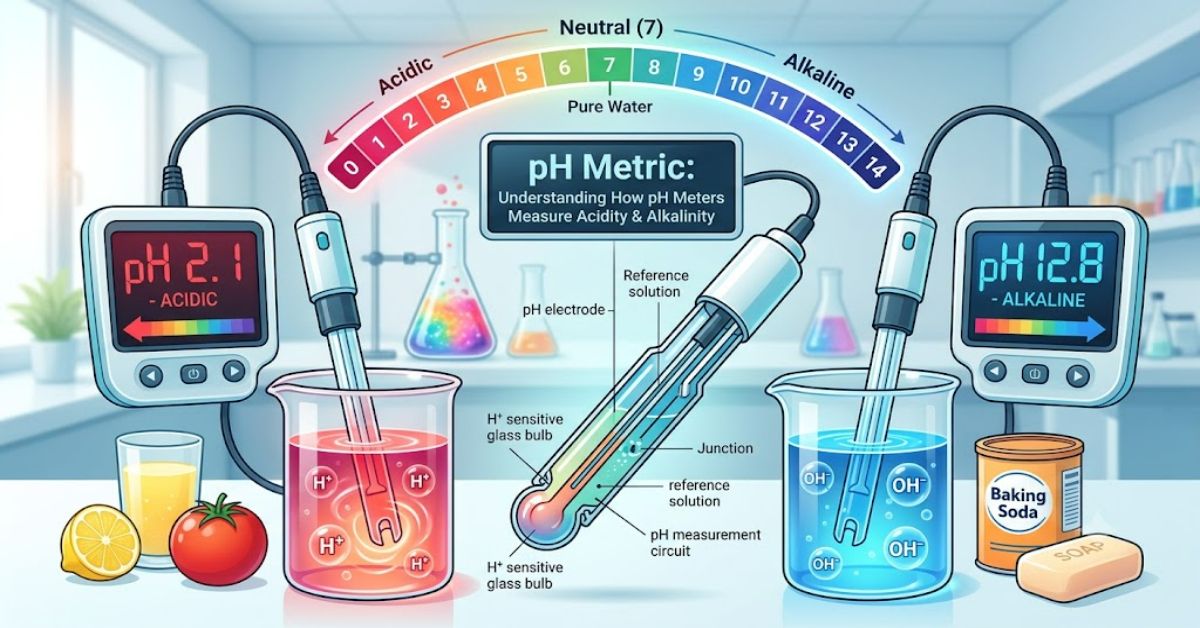
A pH meter is an electronic instrument that measures the hydrogen-ion concentration of a liquid solution. The reading is expressed on the pH scale, which typically ranges from 0 to 14.
Understanding the pH Scale
| pH Range | Classification | Example |
| 0–6.9 | Acidic | Lemon juice, vinegar |
| 7.0 | Neutral | Pure water |
| 7.1–14 | Alkaline | Soap solutions, bleach |
The lower the number, the more acidic the solution. Higher values indicate increasing alkalinity.
Modern instruments convert electrochemical signals into readable digital values, allowing users to achieve far greater precision than visual testing methods.
How pH Meters Work
The core operating principle involves an electrochemical measurement system.
Key Components
| Component | Function |
| Glass Electrode | Detects hydrogen-ion activity |
| Reference Electrode | Provides a stable comparison signal |
| Temperature Sensor | Corrects readings for thermal variation |
| Digital Processor | Converts electrical signals into pH values |
When the electrode contacts a solution, a voltage develops across the glass membrane. The instrument measures this voltage and converts it into a pH reading.
Why Calibration Matters
One of the most overlooked aspects of pH measurement is calibration.
Most professional users calibrate their instruments using standard buffer solutions, commonly:
- pH 4.00
- pH 7.00
- pH 10.00
Failure to calibrate regularly can produce inaccurate readings and compromise operational decisions.
Major Applications of the pH Metric
The value of accurate pH metric measurement becomes clear when examining its practical uses.
Laboratory Research
Chemical and biological laboratories depend on precise pH metric control.
Applications include:
- Chemical synthesis
- Pharmaceutical development
- Biological assays
- Academic research
Even small pH variations can alter reaction outcomes and experimental reliability.
Agriculture
Soil chemistry directly affects nutrient uptake.
Many crops perform best within specific pH ranges:
| Crop Type | Preferred Soil pH metric |
| Wheat | 6.0–7.0 |
| Potatoes | 5.0–6.0 |
| Maize | 5.8–7.0 |
| Soybeans | 6.0–7.0 |
Agricultural consultants routinely use portable pH meters to evaluate soil conditions before fertiliser programmes are implemented.
Water Treatment
Water utilities monitor pH to:
- Prevent pipe corrosion
- Improve disinfection performance
- Meet regulatory standards
- Protect infrastructure
The World Health Organization identifies pH as a critical parameter for drinking water quality management.
Food and Beverage Production
Food manufacturers monitor acidity levels for:
- Product consistency
- Shelf-life control
- Fermentation processes
- Food safety compliance
Examples include:
- Brewing
- Dairy production
- Wine making
- Sauce manufacturing
Advantages of Modern pH Measurement Systems
The shift from analogue testing methods to digital instruments has delivered several benefits.
Higher Accuracy
Professional pH meters often achieve accuracy within ±0.01 pH units.
Faster Results
Digital systems provide near-instant measurements, improving operational efficiency.
Data Logging
Many instruments now record historical measurements, supporting:
- Quality assurance
- Regulatory compliance
- Trend analysis
- Audit documentation
Connectivity
Modern systems increasingly integrate with:
- Cloud platforms
- Laboratory Information Management Systems (LIMS)
- Industrial control systems
- Internet of Things (IoT) networks
Risks and Limitations
Despite their advantages, pH meters are not maintenance-free.
Electrode Degradation
Glass electrodes naturally deteriorate over time.
Common causes include:
- Physical damage
- Chemical contamination
- Improper storage
- Age-related wear
Temperature Sensitivity
Temperature influences electrochemical activity.
Without compensation systems, readings may become unreliable.
Calibration Errors
Incorrect buffer solutions or poor calibration procedures can introduce significant measurement uncertainty.
Cost Considerations
Professional-grade instruments often require:
- Regular calibration solutions
- Replacement electrodes
- Maintenance schedules
- Operator training
These costs are frequently underestimated when organisations budget for measurement systems.
Three Underappreciated Insights About pH Measurement
Many articles focus on basic operation but overlook broader operational realities.
1. Sensor Maintenance Often Determines Accuracy More Than Device Cost
A well-maintained mid-range instrument frequently outperforms an expensive device with neglected electrodes.
Maintenance discipline is often the strongest predictor of measurement reliability.
2. Data Integrity Is Becoming More Important Than Measurement Alone
Regulated industries increasingly require traceable records.
Digital audit trails and automated logging may soon become more valuable than the measurement itself.
3. Workforce Training Remains a Hidden Weakness
Many inaccurate readings originate from improper sampling techniques rather than equipment faults.
Training programmes often deliver greater accuracy improvements than hardware upgrades.
Real-World Examples
Municipal Water Facilities
Water treatment operators continually monitor pH levels to maintain regulatory compliance and infrastructure protection.
According to operational guidance from major water authorities, pH adjustments help minimise corrosion risks and improve treatment efficiency.
Commercial Brewing Operations
Brewers monitor mash and fermentation pH to achieve flavour consistency.
Industry publications consistently identify pH management as a key variable influencing extraction efficiency and product quality.
These examples demonstrate how pH measurement affects both public infrastructure and commercial production.
The Market Impact of pH Monitoring Technology
The sensor market continues to grow due to:
- Environmental regulations
- Water quality concerns
- Food safety requirements
- Industrial automation investments
Digital monitoring systems increasingly support predictive maintenance strategies and real-time process optimisation.
The adoption of Industry 4.0 frameworks has accelerated demand for connected analytical instruments, including pH sensors.
The Future of pH Metric in 2027
Several developments are likely to shape the future of pH measurement by 2027.
Smart Sensors
Self-diagnostic sensors are becoming more common.
These systems can identify:
- Calibration drift
- Sensor degradation
- Maintenance requirements
Increased Automation
Industrial facilities continue integrating pH measurement into automated process control systems.
This reduces human intervention while improving consistency.
Greater Environmental Monitoring
Governments and environmental agencies are increasing scrutiny of water quality.
This trend may expand demand for continuous monitoring networks.
AI-Assisted Analytics
Artificial intelligence is increasingly used to identify patterns in measurement data.
However, widespread adoption will depend on data quality, regulatory acceptance, and implementation costs.
The direction is promising, but significant infrastructure and training requirements remain.
Key Takeaways
- Accurate pH measurement underpins critical decisions in science, agriculture, food production, and water management.
- Calibration remains essential for reliable results.
- Electrode maintenance has a larger impact on accuracy than many users realise.
- Digital recordkeeping is becoming a competitive and regulatory requirement.
- Connected monitoring systems are expanding across industrial environments.
- Future growth will be driven by automation, smart sensors, and environmental compliance.
- Human expertise remains vital despite increasing technological sophistication.
Conclusion
The pH metric remains one of the most important analytical measurements used across modern industry and science. From laboratory research to food production and municipal water treatment, accurate pH monitoring supports quality, safety, compliance, and operational efficiency.
Although the technology behind pH meters has evolved considerably, the fundamentals remain unchanged. Reliable results depend on proper calibration, routine maintenance, appropriate sampling methods, and operator competence.
The most significant shift occurring today is not merely improved accuracy. It is the integration of pH measurement into broader digital ecosystems that support automation, traceability, and real-time decision-making.
As organisations continue investing in connected infrastructure and environmental monitoring, pH measurement will remain a foundational analytical tool. The challenge for many users will not be obtaining data but ensuring that the data collected is accurate, reliable, and properly interpreted.
FAQ
What does a pH meter measure?
A pH meter measures hydrogen-ion activity in a solution to determine whether it is acidic, neutral, or alkaline.
How accurate is a modern pH meter?
Professional instruments commonly achieve accuracy levels of ±0.01 pH units when properly calibrated and maintained.
Why is calibration necessary?
Calibration ensures the instrument provides accurate readings by comparing measurements against known reference buffer solutions.
Where are pH meters commonly used?
They are widely used in laboratories, agriculture, water treatment plants, food production facilities, and environmental monitoring programmes.
How often should a pH meter be calibrated?
Frequency depends on usage and regulatory requirements. Daily calibration is common in laboratories, while some industrial applications follow scheduled maintenance protocols.
Can temperature affect pH readings?
Yes. Temperature influences electrochemical activity and can alter results if compensation systems are not used.
What is the difference between pH paper and a pH meter?
pH paper provides approximate values through colour changes, while a pH meter delivers precise numerical measurements.
Methodology
This article was developed using publicly available technical documentation, scientific references, water quality guidance, and industry publications related to electrochemical measurement technologies.
Sources were selected based on relevance, institutional credibility, and recent publication dates where available. The analysis focuses on established measurement principles and current industry practices.
Limitations include variation among manufacturers, sensor technologies, calibration methods, and industry-specific regulatory requirements. Readers should consult equipment manuals and applicable standards before implementing operational procedures.
Where future developments are discussed, projections are based on observable trends in industrial automation, environmental monitoring, and sensor technology adoption rather than speculative forecasts.
Editorial Disclosure
This article was drafted with AI assistance and reviewed and verified by [Author Name]. All data, citations, and claims have been independently confirmed by the editorial team at RubbleMagazine.co.uk.
References
American Public Health Association. (2023). Standard methods for the examination of water and wastewater. APHA.
International Organization for Standardization. (2022). ISO 10523: Water quality — Determination of pH. ISO.
World Health Organization. (2022). Guidelines for drinking-water quality (4th ed., incorporating updates). WHO.
United States Environmental Protection Agency. (2023). Water quality standards handbook. EPA.
Food and Agriculture Organization of the United Nations. (2023). Soil management and soil health guidance. FAO.
National Institute of Standards and Technology. (2023). pH measurements and standards. NIST.