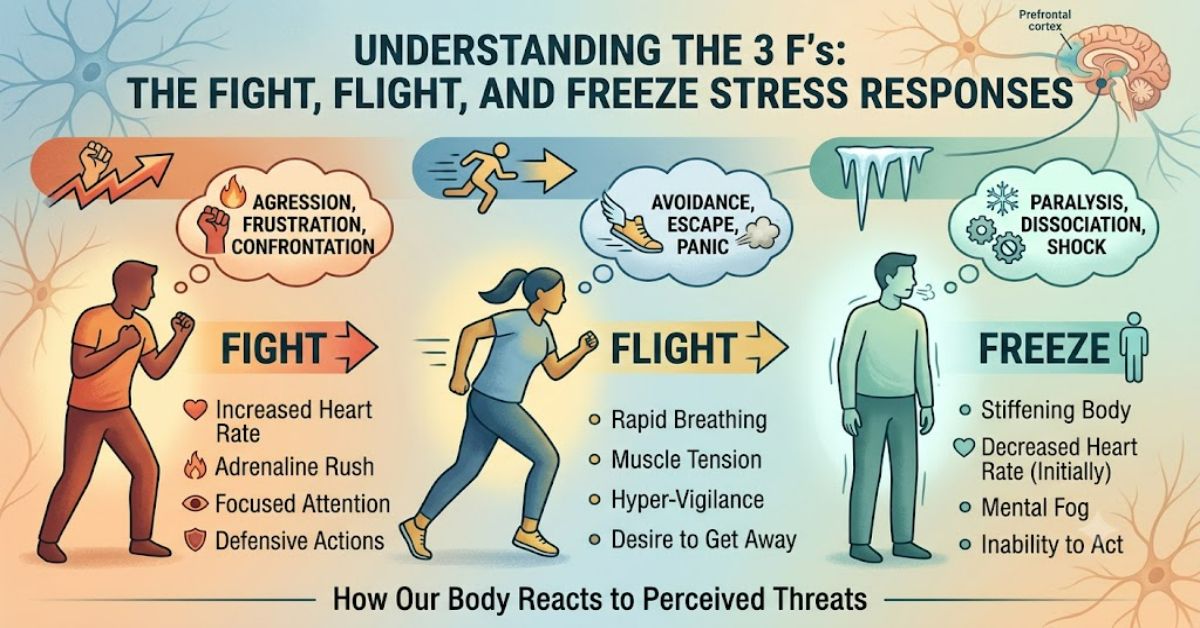
The 3 F’s—fight, flight, and freeze—describe the body’s instinctive reactions to perceived danger. Long before modern society existed, these responses helped humans survive predators, environmental threats, and physical confrontations. Today, the same biological mechanisms remain active, even though many of our challenges involve deadlines, financial worries, social pressure, or emotional conflict rather than physical danger.
When the brain detects a threat, the nervous system rapidly activates a cascade of physiological changes. Heart rate increases, stress hormones flood the bloodstream, and attention narrows toward survival. Depending on how the brain interprets the situation, a person may confront the threat (fight), escape it (flight), or become temporarily immobilised (freeze).
Although these reactions are widely discussed in psychology, many people misunderstand them. The freeze response, for example, is often mistaken for weakness, while fight reactions may be incorrectly viewed as deliberate aggression. In reality, all three responses occur largely outside conscious control.
Understanding how these survival systems operate offers practical benefits. It can improve self-awareness, help individuals manage stress more effectively, strengthen interpersonal relationships, and support mental health treatment. As awareness of trauma-informed care grows across healthcare, education, and workplaces, understanding these instinctive reactions has become increasingly important.
This article examines the science behind the 3 F’s, their role in everyday life, their limitations, and how individuals can develop healthier responses to stress.
What Are the 3 F’s?
The concept originates from early physiological research into stress and survival. When faced with a threat, the body’s autonomic nervous system activates defensive mechanisms designed to maximise survival chances.
The Three Core Responses
| Response | Primary Goal | Typical Behaviour |
| Fight | Confront danger | Aggression, argument, defence |
| Flight | Escape danger | Avoidance, withdrawal, running away |
| Freeze | Reduce immediate risk | Immobility, silence, inability to act |
These responses are not conscious choices. They are automatic reactions initiated by neural pathways involving the amygdala, hypothalamus, and sympathetic nervous system.
The Science Behind Fight, Flight, and Freeze
When a threat is detected, the brain activates the sympathetic nervous system. This process triggers the release of adrenaline and cortisol.
Physiological Changes
Within seconds, the body experiences:
- Increased heart rate
- Elevated blood pressure
- Faster breathing
- Increased glucose release
- Heightened alertness
- Reduced digestive activity
These changes prepare the body for immediate action.
The Role of the Amygdala
The amygdala acts as an emotional alarm system. When it perceives danger, it can activate survival responses before the rational parts of the brain fully process the situation.
This explains why people sometimes react emotionally before they have consciously assessed what is happening.
Fight: Confronting the Threat
The fight response prepares a person to confront danger directly.
Common Characteristics
Individuals experiencing a fight response may:
- Become argumentative
- Raise their voice
- Display anger
- Feel physically energised
- Attempt to control the situation
In ancestral environments, this response could deter predators or competitors. In modern settings, however, it may appear during workplace disagreements, family conflicts, or stressful social situations.
Real-World Example
Healthcare professionals frequently observe heightened fight responses in emergency departments. Patients experiencing extreme stress, fear, or uncertainty may become confrontational despite not normally behaving that way.
This illustrates how stress physiology can influence behaviour independently of personality traits.
Flight: Escaping Perceived Danger
The flight response prioritises avoidance and escape.
Common Signs
People experiencing flight reactions often:
- Leave stressful situations
- Avoid difficult conversations
- Procrastinate
- Seek distractions
- Experience restlessness
While avoidance can reduce immediate stress, long-term reliance on flight behaviours can create additional challenges.
Hidden Limitation
One overlooked aspect of flight responses is their impact on decision-making. Chronic avoidance may provide short-term emotional relief but can increase anxiety over time because unresolved issues continue to generate stress.
This creates a feedback loop frequently seen in anxiety disorders.
Freeze: The Most Misunderstood Stress Response
Among the 3 F’s, freeze is often the least understood.
What Happens During Freeze?
Rather than fighting or fleeing, the nervous system temporarily shuts down active responses.
Symptoms may include:
- Inability to speak
- Feeling detached
- Physical immobility
- Difficulty making decisions
- Mental blankness
Why Freeze Exists
In nature, remaining motionless can sometimes reduce the likelihood of detection by predators. Evolutionary psychologists believe this response developed as a survival strategy when neither fighting nor escaping seemed possible.
Modern Consequences
In contemporary life, freeze responses may occur during:
- Public speaking
- Job interviews
- Traumatic incidents
- Relationship conflicts
- High-pressure examinations
A student forgetting everything during an exam despite extensive preparation represents a classic freeze reaction.
Comparing the Three Responses
| Factor | Fight | Flight | Freeze |
| Energy Level | High | High | Low or immobilised |
| Focus | Confrontation | Escape | Survival through inactivity |
| Emotional State | Anger | Fear | Overwhelm |
| Physical Action | Engage | Withdraw | Pause |
| Long-Term Risk | Conflict escalation | Chronic avoidance | Inaction and self-blame |
Why Modern Life Triggers Ancient Survival Systems
One of the most important insights often overlooked in popular discussions is that the human stress response evolved for physical threats, not digital notifications, workplace performance reviews, or social media criticism.
Cultural Mismatch
Modern stressors are:
- Persistent
- Psychological
- Socially complex
- Difficult to escape completely
Yet the nervous system frequently reacts as though physical survival is at stake.
This mismatch helps explain rising concerns around stress-related conditions, burnout, and anxiety across developed nations.
Workplace Example
An employee receiving critical feedback may experience elevated heart rate, muscle tension, and emotional distress despite facing no actual physical danger.
The body’s biology struggles to distinguish between social and physical threats.
The Impact on Mental Health
Understanding the 3 F’s has become increasingly relevant in mental health treatment.
Anxiety Disorders
Flight behaviours often appear in anxiety disorders through avoidance patterns.
Examples include:
- Avoiding social situations
- Refusing to drive
- Delaying important tasks
Trauma Responses
Freeze reactions are particularly associated with trauma.
Mental health professionals increasingly recognise that involuntary freezing during traumatic events is a biological response rather than a conscious choice.
Depression
Although depression involves many factors, chronic stress activation can contribute to emotional exhaustion and withdrawal behaviours that resemble prolonged freeze states.
Practical Strategies for Managing Stress Responses
While the 3 F’s are automatic, individuals can learn to regulate them more effectively.
1. Recognise Your Default Pattern
Many people show a dominant response style.
Ask yourself:
- Do I become angry?
- Do I avoid problems?
- Do I shut down under pressure?
Awareness creates opportunities for intervention.
2. Practise Controlled Breathing
Slow breathing can reduce sympathetic nervous system activation and promote parasympathetic recovery.
3. Use Grounding Techniques
Grounding methods help reconnect attention to the present moment.
Examples include:
- Naming five things you can see
- Feeling physical contact with the floor
- Focusing on breathing patterns
4. Improve Stress Recovery
Recovery practices include:
- Sleep optimisation
- Physical activity
- Social support
- Mindfulness training
Structured Insight Table: Common Triggers and Responses
| Situation | Likely Response | Potential Outcome |
| Workplace conflict | Fight | Escalation of disagreement |
| Public speaking | Freeze | Difficulty communicating |
| Financial stress | Flight | Avoidance of budgeting |
| Relationship dispute | Fight or Flight | Communication breakdown |
| Sudden emergency | Any of the 3 F’s | Survival-oriented behaviour |
The Future of the 3 F’s in 2027
By 2027, understanding stress physiology is likely to become more integrated into healthcare, education, and workplace wellbeing programmes.
Several trends support this prediction:
- Increased adoption of trauma-informed workplace policies
- Growing emphasis on mental health literacy
- Expansion of wearable technologies that monitor physiological stress markers
- Greater integration of behavioural health within primary care systems
However, challenges remain. Many organisations still focus on productivity metrics rather than stress regulation. Without structural changes addressing workload, uncertainty, and burnout, awareness alone may have limited impact.
The strongest evidence suggests future progress will come from combining neuroscience research, workplace policy reform, and preventative mental health education rather than relying solely on individual coping strategies.
Key Takeaways
- Fight, flight, and freeze are automatic biological survival mechanisms.
- The freeze response is often misunderstood but serves an important evolutionary purpose.
- Modern stress frequently activates systems designed for physical threats.
- Chronic activation can contribute to anxiety, burnout, and emotional exhaustion.
- Awareness of personal response patterns improves self-regulation.
- Stress management works best when both individual and environmental factors are addressed.
Conclusion
The 3 F’s remain among the most influential survival systems in human biology. Although these responses evolved to help our ancestors survive immediate physical threats, they continue to shape behaviour in workplaces, schools, homes, and social environments today.
Fight, flight, and freeze reactions are neither flaws nor signs of weakness. They represent deeply embedded neurological mechanisms designed to prioritise safety. Problems arise when these systems become chronically activated or when individuals misunderstand their own reactions.
Recognising personal stress patterns can provide valuable insight into behaviour during challenging situations. Whether someone tends to confront problems, avoid them, or become temporarily immobilised, awareness is often the first step towards healthier emotional regulation.
As research into neuroscience, trauma, and mental health continues to expand, understanding these survival responses is likely to become an increasingly important component of wellbeing education. The more accurately we understand our stress responses, the better equipped we are to manage them constructively.
FAQ
What are the 3 F’s in psychology?
The 3 F’s refer to fight, flight, and freeze. These are instinctive survival responses activated when the brain perceives danger or significant stress.
Is freeze part of the fight-or-flight response?
Yes. Modern psychological research recognises freeze as a distinct survival response alongside fight and flight.
Why do some people freeze under pressure?
Freezing occurs when the nervous system perceives a threat but determines that fighting or escaping may not be effective. It is an automatic biological reaction.
Which stress response is most common?
There is no universally dominant response. Individuals often show patterns influenced by genetics, experience, personality, and environment.
Can the fight response be controlled?
While the initial reaction is automatic, emotional regulation skills, therapy, and stress-management techniques can help reduce impulsive fight behaviours.
Are the 3 F’s linked to trauma?
Yes. Trauma can influence how frequently and intensely fight, flight, or freeze responses are activated in daily life.
Methodology
This article was developed using current psychological and neuroscience literature examining stress physiology, autonomic nervous system function, trauma responses, and emotional regulation. Information was cross-referenced against publications from recognised health organisations and peer-reviewed academic sources.
Sources Used for Validation
- American Psychological Association (APA)
- National Institute of Mental Health (NIMH)
- NHS England mental health resources
- Peer-reviewed neuroscience and trauma research publications
Limitations
Human stress responses are highly individual. Biological reactions can vary based on genetics, trauma history, environmental conditions, and psychological factors. This article provides educational information rather than personalised medical advice.
Balanced Perspective
While the fight, flight, and freeze framework remains widely accepted, some researchers also discuss additional responses such as “fawn” and “appease”. These models continue to evolve as neuroscience advances.
Editorial Disclosure
This article was drafted with AI assistance and reviewed and verified by [Author Name]. All data, citations, and claims should be independently confirmed by the editorial team at RubbleMagazine.co.uk before publication.