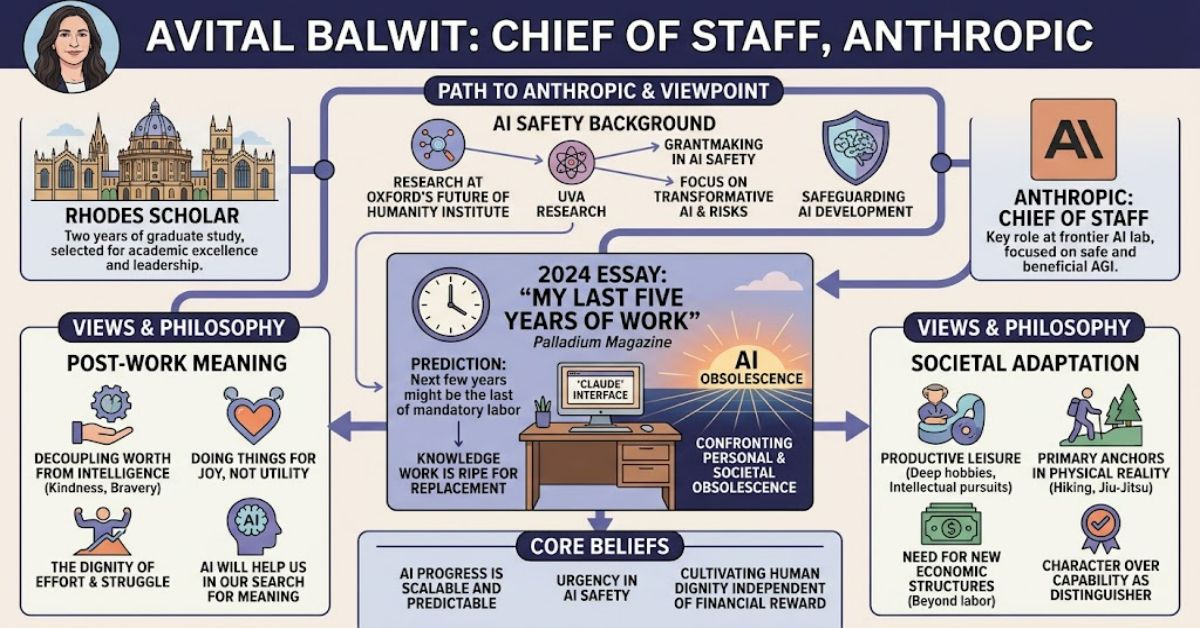
Avital Balwit is an American writer and AI-policy thinker who serves as Chief of Staff to Dario Amodei, CEO of Anthropic. Her route into the technology industry is unusual: rather than beginning as an engineer or computer scientist, she developed expertise across political thought, cognitive science, philosophy, existential risk and AI safety.
That background helps explain why Balwit has attracted attention beyond Anthropic’s organisational structure. Her public writing focuses less on model architecture and more on what increasingly capable artificial intelligence could mean for employment, human purpose and society.
Her best-known essay, My Last Five Years of Work, was published by Palladium on 17 May 2024. Written when she was 25, it considered the possibility that advances in AI could make much of traditional knowledge work economically unnecessary. Importantly, the essay was explicitly written in her personal capacity and did not represent Anthropic’s official position.
Balwit’s background also includes a Rhodes Scholarship and study at the University of Oxford’s Future of Humanity Institute. Before moving into the AI industry, she had already been examining existential risk and questions surrounding the long-term future of humanity.
Her career therefore provides a useful case study in how AI leadership increasingly involves disciplines beyond engineering.
Who Is Avital Balwit?
Balwit’s academic background began at the University of Virginia, where she studied Political and Social Thought and Cognitive Science. In November 2020, UVA announced that she had become the university’s 55th Rhodes Scholar. She planned to study philosophy at Oxford while working around the Future of Humanity Institute and Global Priorities Institute.
Her stated interests at the time were already closely connected to the questions that later became central to her writing: existential risk, global priorities and how societies could respond to potentially catastrophic technological developments.
| Career stage | Documented focus |
| University of Virginia | Political and Social Thought, Cognitive Science |
| Rhodes Scholarship | Philosophy and long-term global risks |
| Oxford | Future of Humanity Institute and related research |
| Pre-Anthropic work | AI safety, biosecurity and policy-related activity |
| Anthropic | Chief of Staff to CEO Dario Amodei |
| Public writing | AI, employment, human purpose and technological change |
This progression is significant because it shows that Balwit’s AI career did not begin with model engineering. Her expertise developed around the social and philosophical questions created by increasingly capable AI.
The Role of Anthropic Chief of Staff
At Anthropic, Balwit works directly with CEO Dario Amodei. Her own website identifies her as Chief of Staff to Amodei, while a 2026 report described her as his only direct report.
A chief-of-staff position at a frontier AI company can involve considerably more than administrative coordination. The role can connect executive priorities, research, policy, communications and organisational decision-making.
The distinction is particularly relevant at Anthropic because the company positions itself around developing AI systems that are reliable, interpretable and steerable.
Balwit’s non-engineering background does not mean she is outside technical strategy. Instead, it places her in a complementary part of the organisation: translating complex technological developments into questions about policy, priorities, people and long-term consequences.
Why Her 2024 Essay Became Important
Balwit’s most influential public contribution so far is My Last Five Years of Work.
Published on 17 May 2024, the essay began with a striking personal premise: she questioned whether she might have only a few years of conventional employment remaining because of AI. Her argument was not simply that machines would eliminate jobs. She examined what happens to human wellbeing when employment stops being the main structure through which people receive income, status, routine and social connection.
The essay mattered because Balwit was writing from inside a frontier AI company while simultaneously questioning the economic assumptions surrounding AI development.
| Question | Balwit’s perspective |
| Will AI affect knowledge work? | Increasingly capable systems could automate many cognitive tasks |
| Does job automation equal human misery? | Not necessarily |
| Why does work matter? | It provides income, identity, structure and social connection |
| What happens after employment? | Society may need new ways to provide purpose and security |
| Is technical progress enough? | No; institutions and social norms must adapt |
One of the strongest aspects of the essay is that it separates technological capability from social outcomes. Even if AI can perform economically valuable tasks, the consequences depend on how societies distribute resources and redesign institutions.
AI Safety and Existential Risk
Balwit’s interest in AI safety predates her work at Anthropic.
In 2020, UVA described her goal as studying existential risks and ways of preventing catastrophes capable of causing human extinction. Her academic plans placed her within Oxford’s emerging research ecosystem around existential risk and global priorities.
That perspective later appeared in collaborative academic work. In 2022, Balwit and economist Anton Korinek published a Brookings working paper distinguishing between direct AI alignment and what they called social alignment. The latter concerns how AI systems affect wider groups and create externalities beyond the individual or organisation operating them.
This distinction offers an important insight: an AI system can perform exactly as its user requests while still producing harmful effects elsewhere.
For policymakers, that changes the question from “Does the system follow instructions?” to “What happens to everyone affected by the system?”
Three Insights From Balwit’s Career
1. AI governance needs interdisciplinary expertise.
AI systems are technical products, but their deployment affects labour markets, law, economics and social institutions. Balwit’s career demonstrates why those disciplines increasingly overlap.
2. The employment question is larger than job replacement.
Her 2024 essay focuses on what employment provides beyond wages. If automation substantially changes labour demand, governments and employers may eventually need to address identity, social participation and purpose as well as income.
3. Insider status can create a distinctive perspective.
Balwit has written about AI’s potential disruption while working inside a frontier AI company. Her essay was personal rather than an official Anthropic statement, making the distinction between individual analysis and corporate policy particularly important.
Risks and Limitations
Balwit’s predictions should not be treated as established forecasts.
Her 2024 argument about the future of work depends on assumptions about AI capability, deployment speed, economics and institutional adaptation. A model being technically capable of performing a task does not automatically mean organisations will replace workers performing it.
Regulation, liability, consumer preferences, reliability requirements and implementation costs can all slow adoption.
There is also a difference between task automation and occupational elimination. Many jobs combine routine cognitive work with judgement, interpersonal interaction and accountability. AI may therefore change job composition without immediately eliminating entire professions.
That distinction is essential when evaluating Balwit’s arguments fairly.
The Future of Avital Balwit in 2027
By 2027, Balwit’s relevance is likely to depend increasingly on whether the questions raised in her writing translate into practical debates around AI deployment.
The technology industry is moving towards increasingly capable models and autonomous AI agents, while governments are considering stronger oversight. At the same time, Anthropic CEO Dario Amodei has recently argued that frontier AI development needs stronger safety measures and external evaluation as capabilities accelerate.
That environment creates a larger role for people who can connect technical progress with organisational and social consequences.
Balwit’s own career suggests that the future of AI leadership will not belong exclusively to engineers. Philosophers, economists, policy specialists, security researchers and organisational strategists may all become increasingly important as AI moves from research laboratories into institutions and everyday work.
Key Takeaways
- Balwit combines academic training in political thought and cognitive science with AI-safety research.
- Her Rhodes Scholarship took her to Oxford and into the study of existential risk.
- She became Chief of Staff to Anthropic CEO Dario Amodei.
- Her 2024 essay made employment and human purpose central to her public profile.
- Her research interests extend beyond technical alignment into social consequences.
- Her career demonstrates the growing importance of interdisciplinary AI expertise.
Conclusion
Avital Balwit’s career offers a different way of understanding the people shaping the AI industry. She is not primarily known for developing neural-network architectures or publishing machine-learning benchmarks. Instead, her work sits closer to the questions that arise when advanced technology interacts with institutions and human lives.
Her academic path through political thought, cognitive science, Oxford philosophy and existential-risk research created a foundation for thinking about AI as more than a technical system. Her position as Chief of Staff to Dario Amodei places those questions close to the leadership of one of the world’s most prominent AI companies.
Her 2024 essay remains particularly useful because it focuses attention on an often-overlooked issue: what happens to human purpose when employment changes dramatically. That question is uncertain, but it is likely to become more important as AI systems perform increasingly sophisticated cognitive tasks.
Balwit’s significance therefore lies not only in her job title, but in the bridge she represents between AI capability, safety, economics and human meaning.
FAQ
Who is Avital Balwit?
Avital Balwit is an American writer and AI-policy thinker who serves as Chief of Staff to Anthropic CEO Dario Amodei. She is also a Rhodes Scholar and has researched existential risk and AI safety.
What does Avital Balwit do at Anthropic?
She serves as Chief of Staff to CEO Dario Amodei. Public reporting has described her as his only direct report, placing her close to the company’s senior leadership structure.
What is Avital Balwit known for writing?
She is best known for My Last Five Years of Work, a 2024 Palladium essay examining how advanced AI could affect employment, identity and human purpose.
Is Avital Balwit an AI engineer?
Her documented academic background is in Political and Social Thought and Cognitive Science, followed by philosophy and existential-risk research. Her career is therefore interdisciplinary rather than centred on conventional AI engineering.
What does Avital Balwit say about AI and jobs?
Her 2024 essay argues that increasingly capable AI could make substantial amounts of knowledge work economically unnecessary. She also examines whether people could maintain wellbeing and purpose without traditional employment.
What is Avital Balwit’s connection to AI safety?
Her interest predates Anthropic. As a Rhodes Scholar, she planned research around existential risk at Oxford, and she later co-authored work examining direct and social AI alignment.
Methodology
This article was researched using Balwit’s personal website, University of Virginia records, Palladium’s original publication of her 2024 essay, Brookings research and current reporting on Anthropic’s leadership structure and AI-safety position.
Primary and institutional sources were prioritised for biographical and career claims. Balwit’s own essay was treated as evidence of her personal views rather than Anthropic’s official position. Claims about her current role were cross-checked against her personal website and recent reporting.
No firsthand interview, personal correspondence or independent testing was conducted for this article. Predictions about AI and employment are presented as arguments or possibilities rather than established outcomes.
Human editorial disclosure: This article was drafted with AI assistance and should be reviewed and independently verified by a human editor before publication.
References
Anthropic. (2026). Leadership at Anthropic. Anthropic.
Balwit, A. (2024, 17 May). My last five years of work. Palladium.
Brookings Institution. (2022, 10 May). Aligned with whom? Direct and social goals for AI systems. Brookings.
University of Virginia. (2020, 30 November). Avital Balwit, UVA’s 55th Rhodes Scholar, seeks to prevent ‘existential risk’. University Communications.