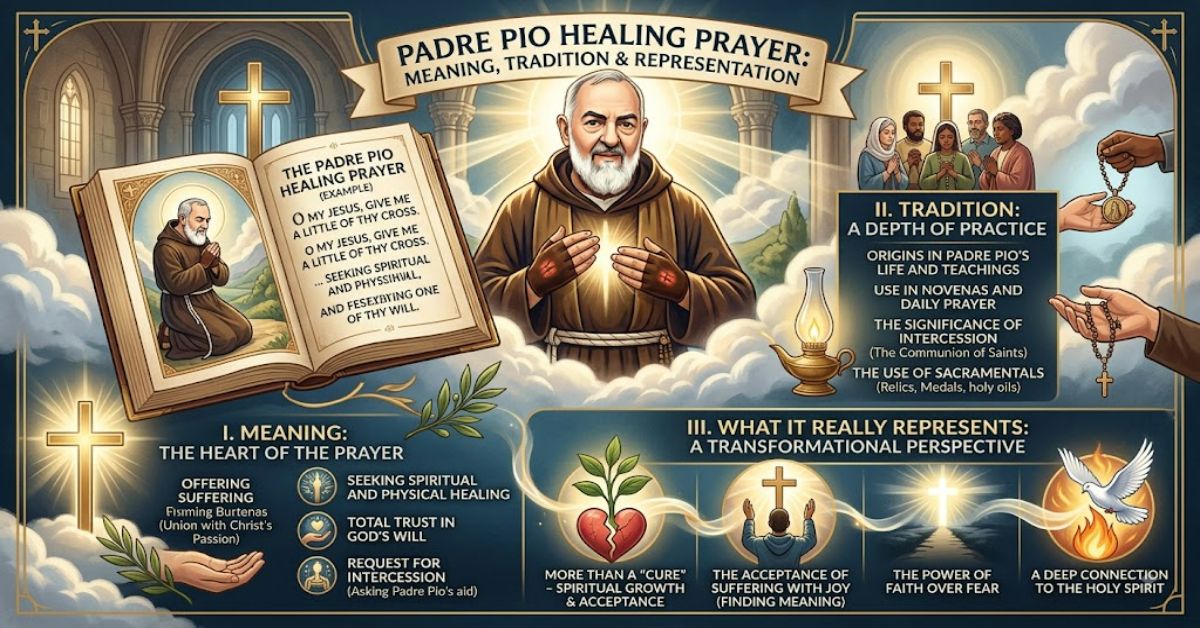
The Padre Pio healing prayer is a modern prayer associated online with St Pio of Pietrelcina, the Italian Capuchin friar canonised by Pope John Paul II on 16 June 2002. It asks God for healing of the body, mind and spirit and includes petitions concerning illness, damaged areas of the body, inflammation and abnormal cells. The prayer is particularly popular among people facing serious illness or supporting someone through a difficult period.
However, there is an important distinction between a prayer being associated with Padre Pio and a prayer being historically documented as something he personally wrote or recited. The Padre Pio Foundation of America publishes prayers asking for Padre Pio’s intercession, including a prayer that asks God to grant a particular grace through the saint’s intercession.
The Vatican’s official record confirms Padre Pio’s importance within Catholic tradition. He was born Francesco Forgione in 1887, died in 1968, was beatified on 2 May 1999 and canonised on 16 June 2002.
That context matters because the prayer is ultimately about faith, petition and trust in God rather than a guaranteed medical outcome.
What Is the Padre Pio Healing Prayer?
The phrase generally refers to a prayer circulated online under titles such as “The Most Powerful Healing Prayer” or “Padre Pio Healing Prayer”. One widely circulated version asks God to touch the person with healing, remove unhealthy or abnormal cells, restore damaged areas and bring the body back towards healthy functioning. A version published online by The Catholic Crusade uses this wording and explicitly identifies the prayer with Padre Pio.
The important editorial point is that this online attribution is not the same as documentary evidence that Padre Pio himself composed the prayer.
By contrast, the Padre Pio Foundation of America provides clearly identified prayers connected with his spirituality, including a prayer asking for his intercession and a prayer attributed to Padre Pio addressed directly to Jesus.
This creates a useful distinction:
| Type of prayer | Purpose | Attribution |
| Prayer for Padre Pio’s intercession | Asking God for a grace through St Pio | Documented by Padre Pio Foundation |
| Padre Pio’s Prayer to Jesus | Reflection on suffering, strength and faith | Published by Padre Pio Foundation |
| Widely circulated healing prayer | Petition for physical, emotional and spiritual restoration | Commonly attributed online to Padre Pio |
Why People Turn to It During Illness
Prayer often becomes especially important when people experience uncertainty. A diagnosis, operation, chronic condition or long recovery can create fear that ordinary routines cannot easily resolve.
The appeal of this prayer lies partly in its comprehensive language. It does not focus solely on physical symptoms. It also asks for peace, emotional restoration and spiritual strength.
That broader focus reflects the way many believers understand healing. Recovery is not always viewed simply as the disappearance of disease. It may also involve courage, acceptance, reconciliation, hope and the ability to endure suffering.
The Vatican’s account of Padre Pio’s life places considerable emphasis on his relationship with suffering. During his canonisation homily on 16 June 2002, Pope John Paul II presented suffering accepted with faithful love as an important part of Padre Pio’s spiritual example.
Padre Pio and the Catholic Understanding of Healing
Padre Pio’s reputation is closely connected with spiritual direction, confession, the Eucharist and accounts of miraculous events. His canonisation process included examination of the healing of Matteo Pio Colella, a child from San Giovanni Rotondo. The Vatican records that the case underwent a canonical process beginning in 2000, followed by medical examination in November 2001 and theological assessment before the miracle decree was promulgated in December 2001.
This is one of the strongest documented connections between Padre Pio and healing within the Catholic tradition.
It should not, however, be interpreted as evidence that reciting a particular prayer guarantees recovery from disease. Catholic devotion and clinical medicine answer different questions.
What Does Science Say About Prayer and Healing?
Scientific research has examined intercessory prayer, although the results remain difficult to interpret.
A Cochrane review examining randomised trials of intercessory prayer found no clear overall effect on major health outcomes. The review included 10 studies involving 7,646 participants and concluded that the available evidence did not support either a clear beneficial or harmful clinical effect.
More recent research has examined prayer in relation to pain. A 2023 systematic review and meta-analysis of randomised controlled trials reported potentially beneficial effects in several comparisons involving private or communal prayer, while also highlighting the limited number and differing designs of studies available.
The evidence therefore does not justify claiming that a prayer can remove disease or repair damaged cells through a scientifically established mechanism.
| Question | Evidence-based position |
| Can prayer provide spiritual comfort? | Yes, this is a recognised purpose of religious practice |
| Does science prove that prayer cures disease? | No |
| Can prayer be used alongside medical care? | Generally, yes |
| Should prayer replace diagnosis or treatment? | No |
| Are reported miraculous healings part of Catholic tradition? | Yes, including cases examined through formal Church processes |
Three Important Insights About the Prayer
1. Attribution matters.
A prayer appearing thousands of times online does not automatically mean Padre Pio wrote it. Readers should distinguish documented prayers from later devotional material associated with his name.
2. Spiritual healing and clinical healing are different concepts.
A person may experience greater peace, hope or resilience through prayer without there being measurable evidence that a disease has been medically reversed.
3. Prayer does not have to compete with medicine.
The most responsible approach is to allow religious devotion and professional healthcare to occupy different roles. Prayer can accompany treatment without being presented as a substitute for it.
The Future of Padre Pio Healing Prayer in 2027
By 2027, the prayer is likely to remain widely available through websites, social media, video platforms and digital prayer communities. Its online popularity also makes source verification increasingly important.
The central challenge will not be whether people continue praying. It will be whether devotional websites clearly distinguish traditional Padre Pio prayers from modern compositions attributed to him without strong documentary evidence.
For readers, this means provenance will matter more. A prayer connected to a saint should ideally be accompanied by information explaining where the text originated and how the attribution was established.
Key Takeaways
- Padre Pio remains one of the best-known Catholic figures associated with healing and spiritual consolation.
- His canonisation took place on 16 June 2002.
- The widely shared modern healing prayer should not automatically be treated as a prayer personally written by Padre Pio.
- The Vatican documents a formally examined healing associated with his canonisation process.
- Scientific research has not established prayer as a replacement for medical treatment.
- Prayer can nevertheless hold significant personal and religious meaning for believers.
Conclusion
The Padre Pio healing prayer occupies an interesting space between Catholic devotion, online religious culture and modern conversations about wellbeing. Its popularity reflects the enduring desire for hope when illness creates uncertainty.
St Pio’s documented spiritual legacy is firmly rooted in Catholic practice, and the Vatican records both his canonisation and the formal investigation of a healing associated with his cause.
At the same time, careful readers should distinguish documented prayers from modern texts circulating under his name. The widely shared healing prayer can be meaningful as a devotional petition, but its wording should not be presented as proven medical treatment or as a guaranteed route to recovery.
For believers, its value may lie in expressing trust, asking for strength and placing suffering within a religious framework. Medical care remains essential when illness is present.
Frequently Asked Questions
What is the Padre Pio healing prayer?
It is a prayer circulated online that asks God for physical, emotional and spiritual healing, often through language associated with St Padre Pio.
Is the healing prayer actually written by Padre Pio?
Its popular online version is commonly attributed to Padre Pio, but that attribution should be treated cautiously. The Padre Pio Foundation publishes other prayers with clearer descriptions of their provenance.
Can I pray to Padre Pio for healing?
Yes. Catholic devotion includes asking saints to intercede with God. The Padre Pio Foundation publishes a specific prayer requesting God’s grace through Padre Pio’s intercession.
Does the prayer cure illness?
There is no established scientific evidence that this specific prayer cures disease. Prayer may have spiritual importance, but it should not replace appropriate medical assessment or treatment.
What healing miracle is associated with Padre Pio?
The Vatican records the healing of Matteo Pio Colella as the miracle examined during Padre Pio’s canonisation process.
When was Padre Pio canonised?
Padre Pio was canonised by Pope John Paul II on 16 June 2002.
Methodology
This article separates documented Catholic information from claims made by contemporary websites and social-media sources. Vatican material was used to verify Padre Pio’s biography, canonisation and the healing examined during his canonisation process. The Padre Pio Foundation of America was consulted for documented devotional prayers. Scientific claims were checked against systematic reviews indexed by PubMed.
A key limitation is that online attribution of the widely circulated healing prayer is inconsistent. It is therefore described as commonly associated with Padre Pio rather than definitively presented as his original composition.
Editorial disclosure: This article was drafted with AI assistance and requires human editorial verification of all citations, attribution claims and final publication details.
References
Catholic Crusade. (2021, February 15). The Most Powerful Healing Prayer – Padre Pio [Video]. YouTube.
Jarego, M., Ferreira-Valente, A., Queiroz-Garcia, I., Day, M. A., Pais-Ribeiro, J., Costa, R. M., Pimenta, F., & Jensen, M. P. (2023). Are prayer-based interventions effective pain management options? A systematic review and meta-analysis of randomized controlled trials. Journal of Religion and Health, 62(3), 1780–1809.
Padre Pio Foundation of America. (2020). Padre Pio prayers for healing and miracles.
Roberts, L., Ahmed, I., & Hall, S. (2007). Intercessory prayer for the alleviation of ill health. Cochrane Database of Systematic Reviews, (1), CD000368.
Vatican. (2002, 16 June). Padre Pio da Pietrelcina (1887–1968): Canonisation.
Vatican. (2002, 16 June). 16 June 2002, Canonization of St Pio of Pietrelcina.