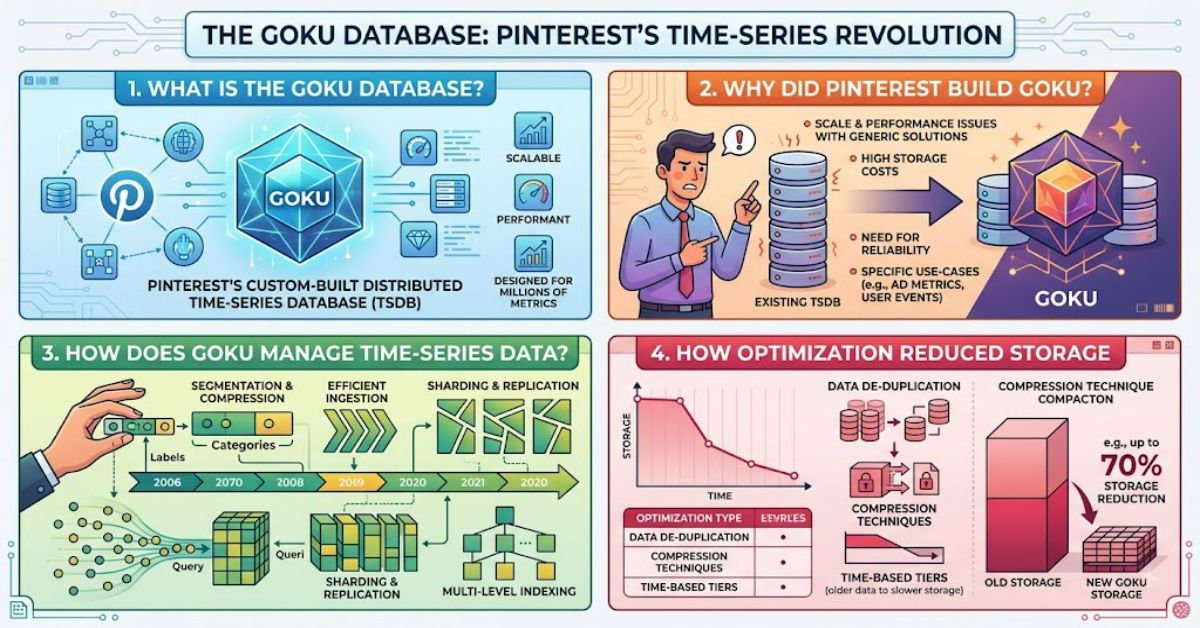
The goku database is Pinterest’s in-house time-series database, developed to store and manage metrics used by its observability infrastructure. The name can easily cause confusion because Goku is also the famous protagonist of the Dragon Ball franchise. In a technology context, however, the term refers to Pinterest’s database system.
Pinterest Engineering described Goku as a collection of sub-service components rather than simply one database cluster. Its role is closely connected to monitoring services, storing metrics and supporting alerting for engineering teams. The system was created partly because Pinterest needed infrastructure suited to its own observability requirements and had encountered limitations with OpenTSDB.
The project is particularly interesting because Pinterest has publicly documented several optimisation efforts. These were not simply about making queries faster. Engineers worked on storage, memory allocation, indexing, metric management and hardware efficiency.
That makes Goku a useful case study in modern database engineering. At large scale, even apparently small inefficiencies can become expensive when multiplied across hosts, metrics and continuously collected time-series data.
Why Pinterest Built Goku
Time-series databases are designed for information where observations are associated with timestamps. Monitoring systems are a classic example. A service may generate measurements for CPU usage, request rates, latency, errors or other operational indicators.
Pinterest needed a system capable of handling this kind of workload within its observability stack. According to Pinterest Engineering, Goku was developed in-house to provide cost-efficient and low-latency storage for metrics. The company identified limitations in OpenTSDB as one of the motivations for building its own database engine.
The important point is that Goku was not created simply because Pinterest wanted a proprietary database. Its architecture reflects a particular operational problem: how to store a large amount of continuously generated monitoring data without allowing infrastructure costs and resource consumption to grow unnecessarily.
That is a recurring challenge in observability engineering.
What Kind of Data Does Goku Handle?
Goku is designed around time-series metrics. Unlike a conventional transactional database, where a business might store customer records or financial transactions, a metrics database is concerned with measurements changing over time.
A simplified example might look like this:
| Metric | Timestamp | Value | Typical Use |
| Request latency | 12:00:01 | 42 ms | Performance monitoring |
| CPU utilisation | 12:00:01 | 68% | Infrastructure monitoring |
| Error rate | 12:00:01 | 0.8% | Reliability monitoring |
| Request count | 12:00:01 | 14,500 | Traffic analysis |
The value of this information comes from its sequence. Engineers can compare measurements over time, identify unusual behaviour and establish whether a service is operating within expected conditions.
This makes storage efficiency particularly important. Monitoring data can accumulate continuously, creating a substantial infrastructure burden.
Goku Database vs a Conventional Database
The differences become clearer when Goku is compared with more general database categories.
| Characteristic | Goku | Traditional Transactional Database | Primary Difference |
| Main workload | Time-series metrics | Business transactions | Data model |
| Typical data | Timestamped measurements | Records and relationships | Temporal focus |
| Primary users | Observability and engineering teams | Applications and business systems | Operational purpose |
| Key concern | Metrics storage and query efficiency | Transactions and consistency | Workload priorities |
| Data growth | Continuous metric ingestion | Application-dependent | Monitoring can be constant |
| Optimisation focus | Compression, indexing, memory and storage | Transactions, indexing and concurrency | Infrastructure profile |
This comparison highlights why simply using a general-purpose database may not always be the most efficient solution for observability workloads.
How Pinterest Improved the Goku Database
Pinterest publicly documented a series of changes intended to make Goku more efficient.
One major development involved metrics namespaces. These organise metric configurations and provide a mechanism for controlling how metrics are managed. Pinterest also introduced a system for identifying top write-heavy metrics, helping the Observability team identify data that could be blocked rather than stored unnecessarily.
InfoQ reported that these changes reduced stored time series by 37%.
Another improvement involved indexing. Pinterest reported reducing memory used for metric-name indexing from 12 GB to 3 GB per host. Dictionary encoding in the Goku Compactor also helped eliminate out-of-memory problems and allowed the system to operate with less expensive hardware.
These are significant because they demonstrate an important principle in infrastructure engineering: improving the data that enters a system can be as valuable as optimising the system that stores it.
The Numbers Behind the Optimisation
Pinterest’s published results provide a useful structured view of the engineering work.
| Optimisation Area | Reported Result |
| Time-series storage | 40% reduction |
| Infrastructure costs | 70% reduction |
| Metric-name indexing memory per host | 12 GB to 3 GB |
| Storage growth accommodated | 30% increase |
| Time series reduced through metric controls | 37% |
| Memory reduction from IOBuf changes | 8–11 GB per host |
Pinterest Engineering reported that the overall work reduced time-series storage by 40% and costs by 70%, while allowing the infrastructure to accommodate a 30% increase in organic storage growth without additional capacity.
These figures are particularly valuable because they show that database optimisation is not limited to query latency. Storage footprint, memory pressure and hardware selection can have equally important financial consequences.
The Hidden Lesson: Not Every Metric Needs to Be Stored
One of the strongest insights from Pinterest’s work is that database optimisation can begin before data reaches long-term storage.
If a monitoring system collects metrics that provide little operational value, engineers may spend resources ingesting, indexing and storing information that does not materially improve observability.
Pinterest’s namespace and write-heavy metric work illustrates this principle. Reducing unnecessary time-series data can lower storage requirements without necessarily reducing the quality of monitoring that engineers actually depend upon.
This creates a practical distinction between data volume and useful data volume. A larger observability dataset is not automatically a better observability dataset.
Compression and Memory Efficiency
Time-series systems often rely heavily on compression because consecutive measurements frequently contain patterns that can be represented efficiently.
Pinterest’s wider optimisation work included dictionary encoding and memory-management changes. The reported reduction in memory consumption demonstrates why resource efficiency matters at host level. Small savings per machine can become substantial across a large distributed infrastructure.
Pinterest also described changes to the folly::IOBuf structure that reduced memory usage by 8–11 GB per host.
The broader engineering lesson is clear: infrastructure cost is often shaped by many small resource decisions rather than one dramatic architectural change.
Risks and Trade-Offs
Building an in-house database can provide strong control, but it also creates engineering responsibility.
A proprietary system requires specialist knowledge for maintenance, debugging, capacity planning and future development. An organisation cannot simply rely on the broader open-source community for every component.
There is also a risk that optimisation becomes too narrowly focused on infrastructure costs. Metrics that appear unnecessary today may become useful during a future incident. Removing data therefore requires a careful understanding of operational requirements.
The most sensible approach is not “store everything” or “delete everything”. It is to establish which metrics have meaningful diagnostic value and then design retention and storage policies around those needs.
Goku Database and the Dragon Ball Character
The word “Goku” has an entirely different meaning outside database engineering.
Son Goku is the central character of the Dragon Ball franchise created by Akira Toriyama. The official Dragon Ball website continues to publish Goku-related news, merchandise and character material, demonstrating the character’s ongoing place within the franchise.
| Goku Reference | Field | Meaning |
| Pinterest Goku | Technology | In-house time-series database |
| Son Goku | Entertainment | Dragon Ball protagonist |
| Search context | Technology | Metrics, observability, storage |
| Search context | Anime | Saiyan, transformations, battles |
The surrounding vocabulary usually makes the intended meaning obvious. Terms such as “metrics”, “OpenTSDB”, “storage” and “observability” point towards Pinterest’s technology. Words such as “Saiyan”, “Super Saiyan” and “Dragon Ball” point towards the fictional character.
The Future of Goku Database in 2027
The future of Pinterest’s Goku system is likely to remain connected to the same pressures that drove its optimisation: increasing metric volume, infrastructure cost and the need for efficient observability.
The broader technology trend is towards more disciplined observability rather than simply collecting every possible metric. Storage efficiency, metric cardinality, compression and intelligent retention are likely to remain important engineering concerns.
Pinterest’s own work provides a practical example of why. The company reported that optimisation allowed it to handle a 30% increase in organic storage growth without additional capacity.
Whether Goku remains Pinterest’s preferred internal architecture in exactly its current form cannot be predicted. Large technology organisations regularly replace or redesign internal systems. The more durable lesson is architectural: specialised infrastructure can produce major efficiency gains when its design closely matches the workload.
Key Takeaways
- Goku has two major meanings: Pinterest’s database and the Dragon Ball character.
- Pinterest Goku is a time-series database built for metrics and observability.
- OpenTSDB limitations helped motivate Pinterest to develop its own solution.
- Metric management matters: reducing unnecessary stored data can be as important as improving database code.
- Memory optimisation can have direct financial effects when applied across large infrastructure fleets.
- Pinterest reported 40% lower time-series storage and 70% lower costs following its optimisation work.
Conclusion
The goku database is an interesting example of how large technology organisations can build specialised infrastructure around a specific operational workload. Pinterest created Goku as an in-house time-series database for metrics and observability, with a focus on efficient storage and low-latency access.
Its later optimisation work is perhaps more revealing than the original architecture. Pinterest tackled metric selection, indexing, memory allocation, dictionary encoding and storage efficiency rather than treating database performance as a single problem. The reported results — including a 40% reduction in time-series storage and a 70% reduction in costs — show the potential impact of that approach.
For readers encountering the phrase through search, distinguishing Pinterest’s Goku from the Dragon Ball character is essential. In a technology discussion, Goku belongs to the world of observability and time-series data, not anime. That distinction makes the surrounding terminology the quickest way to identify the intended meaning.
FAQ
What is the Goku database?
Goku is Pinterest’s in-house time-series database used to store metrics for its observability infrastructure. Pinterest developed it to address specific requirements around metrics storage, performance and cost efficiency.
Is Goku a database made by Pinterest?
Yes. Pinterest Engineering describes Goku as an in-house database engine and part of the company’s observability infrastructure.
What does Goku database have to do with OpenTSDB?
Pinterest developed Goku partly because it encountered limitations with OpenTSDB. Goku was designed around Pinterest’s particular time-series and observability requirements.
Is the Goku database related to Dragon Ball?
No. Pinterest’s Goku and Son Goku from Dragon Ball are unrelated. They simply share the same name.
How much did Pinterest reduce Goku’s costs?
Pinterest reported a 70% reduction in costs and a 40% reduction in time-series storage following its optimisation work.
What kind of data does Goku store?
Goku stores time-series metrics used by Pinterest’s observability systems. These can represent measurements collected continuously from services and infrastructure.
Why is time-series database efficiency important?
Monitoring systems can generate large amounts of timestamped data continuously. Efficient indexing, compression, memory management and metric selection can therefore reduce infrastructure requirements while preserving useful operational visibility.
Methodology
This article was researched using Pinterest Engineering’s published material on Goku, including its documented optimisation work, alongside independent technical reporting from InfoQ. The official Dragon Ball website was used to distinguish the technology reference from the fictional character.
The reported performance figures are attributed to Pinterest rather than independently reproduced. No firsthand testing of Pinterest’s private infrastructure was conducted, and the article does not claim direct access to Goku’s production environment. The main limitation is that Goku is an internal Pinterest system, so some architectural details are necessarily unavailable publicly.
Editorial disclosure: This article was drafted with AI assistance and should be independently reviewed and verified by the editorial team before publication.
References
Pinterest Engineering. (2023, 22 November). Improving efficiency of Goku Time Series Database at Pinterest (Part 1). Pinterest Engineering.
Pinterest Engineering. (2024). Improving efficiency of Goku Time Series Database at Pinterest (Part 2). Pinterest Engineering.
Pinterest Engineering. (2024). Improving efficiency of Goku Time Series Database at Pinterest (Part 3). Pinterest Engineering.
Palriwal, M. (2024, 6 November). Improving the efficiency of Goku Time-Series Database at Pinterest. InfoQ.
Dragon Ball Official Site. (2026). Son Goku. Dragon Ball Official Site.