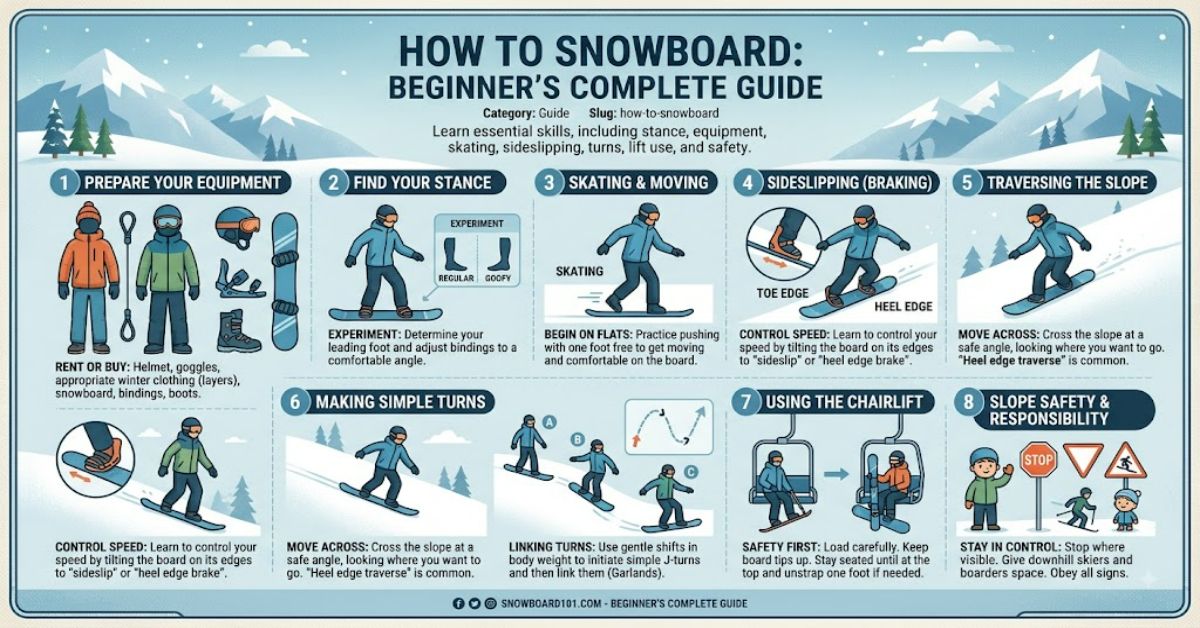
Stance, Turns and Safe Progression
If you are wondering how to snowboard for the first time, the basic process is straightforward: identify your natural stance, learn how the board responds to your weight, practise controlling an edge, and gradually progress from stopping to turning. Most beginners should not start by trying to ride quickly. The first objective is to become comfortable standing on the board and controlling its movement.
Snowboarding feels unusual at first because both feet are fixed to a single board. Unlike skiing, you cannot independently move your legs to maintain balance. Your body position, edge pressure and weight distribution all influence the board’s direction. That makes the first few sessions a mixture of balance practice, repeated small falls and gradual improvements in coordination.
A beginner normally rides with either the left foot forward, known as regular stance, or the right foot forward, known as goofy stance. Neither stance is inherently better. The correct choice is the one that feels more natural and allows you to balance comfortably. Snowboarding terminology also distinguishes heelside and toeside edges, which become important as soon as you begin controlling speed.
The safest route is to learn on a gentle, designated beginner slope, ideally with a qualified instructor. Your early goals should be simple: stand up, move across flat snow, stop deliberately, control a sideslip and eventually connect turns. Once those skills become automatic, steeper terrain becomes much easier to manage.
Choosing Your Snowboard Stance
The first practical question is which foot should face forwards.
A regular rider places the left foot towards the nose of the board, while a goofy rider places the right foot forwards. There is no universal test that guarantees your stance, so beginners can experiment with several simple balance movements.
One common approach is to imagine sliding across a smooth floor. Another is to notice which foot you naturally put forward when regaining balance. The important point is not to overthink the choice. Try both positions during a lesson or on a safe, flat surface.
| Stance | Front Foot | Rear Foot | Common Description |
| Regular | Left | Right | Left foot leads |
| Goofy | Right | Left | Right foot leads |
| Switch | Opposite to normal | Opposite to normal | Riding the non-natural stance |
Once your stance is established, avoid changing it repeatedly. Consistency helps your brain build the movement patterns needed for balance and edge control.
Equipment You Need Before You Ride
Good technique cannot compensate for unsuitable equipment. Beginners do not need an expensive technical setup, but the essentials should fit correctly.
A snowboard should be appropriate for your weight, boot size and ability. Rental shops can normally help select a beginner-friendly board and bindings. Boots should feel secure without causing painful pressure points.
A properly fitted snowboard helmet is particularly important. Snow helmets commonly use recognised standards such as ASTM F2040 and CE EN1077, while correct fit requires the helmet to sit securely without excessive movement.
Useful beginner equipment includes:
- Snowboard and bindings
- Properly fitted snowboard boots
- Certified snow helmet
- Goggles
- Waterproof jacket and trousers
- Insulating layers
- Snowboard gloves or mittens
- Snowboard socks
- Wrist protection if preferred
- Impact shorts for additional comfort during repeated falls
Do not assume protective equipment makes aggressive riding safe. Helmets reduce some risks but cannot prevent every head injury, and good slope behaviour remains essential.
Learn to Skate Before You Ride
One of the most useful early skills is skating.
When one foot is attached to the binding and the other remains free, you can push yourself across relatively flat terrain. This is how snowboarders move around areas such as lift queues and loading zones.
Keep the strapped-in foot centred over the board and use the free foot to push gently. Small movements are better than large ones. Practise stopping your movement and maintaining balance without staring constantly at your feet.
This seemingly basic exercise has a practical purpose. It teaches you how the board moves while reducing your dependence on both feet being attached.
Learn How to Fall Safely
Falling is part of learning to snowboard. The objective is not to eliminate falls immediately but to make them controlled and predictable.
Avoid instinctively throwing your hands backwards to catch yourself. Instead, keep your arms close to your body where possible and focus on reducing the force of the impact.
A beginner lesson is valuable here because an instructor can demonstrate falling technique and correct unsafe habits before they become automatic.
This is also where fatigue becomes an overlooked problem. A rider who has enough energy to make controlled turns at the start of a session may struggle to maintain posture after several hours. Stopping for regular breaks is therefore part of technical progression rather than wasted riding time.
Master Sideslipping
Sideslipping is one of the most important skills in beginner snowboarding.
Stand across the slope with your board roughly perpendicular to the fall line. By adjusting pressure on the uphill edge, you can prevent the board from sliding. Reducing that pressure allows the board to move downhill gradually.
You can learn this on both edges:
- Heelside sideslip: Your heels control pressure against the snow.
- Toeside sideslip: Your toes and lower-leg pressure control the board.
The skill matters because it teaches you the relationship between edge angle and speed. If the board is flat and pointed downhill, gravity can accelerate you quickly. An engaged edge provides a way to regulate that movement.
A useful beginner target is not simply travelling down the slope. It is being able to start sliding, slow down and stop when you decide.
Learn to Traverse Across the Slope
Once you can sideslip, the next step is traversing.
A traverse means travelling across the slope rather than directly downhill. Your board remains angled across the fall line, allowing the edge to control speed while you move sideways across the run.
This is where beginners begin to understand that snowboarding is largely about managing three things:
- Edge angle
- Weight distribution
- Direction of travel
A strong traverse should feel deliberate rather than accidental. You should be able to slow down, stop and change direction without losing balance.
The FIS code of conduct places strong emphasis on staying in control, adapting speed to ability and conditions, and choosing a route that does not endanger people ahead.
How to Link Your First Turns
Once both heelside and toeside control are developing, you can begin linking turns.
A basic turn involves moving from one edge to the other while allowing the board to rotate across the slope.
Start on a gentle beginner run. From a traverse, gradually release the existing edge and allow the snowboard to point more towards the fall line. As the board changes direction, transfer pressure towards the opposite edge.
Do not force the board around by twisting your shoulders violently. Your lower body and edge control should progressively guide the board.
Your first turns may be large and slow. That is acceptable. Smaller turns can come later.
The basic progression
| Stage | Main Skill | Goal |
| 1 | Stance | Establish regular or goofy position |
| 2 | Flat-ground balance | Become comfortable standing on the board |
| 3 | Skating | Move safely with one foot detached |
| 4 | Falling | Reduce uncontrolled impacts |
| 5 | Sideslipping | Control speed with an edge |
| 6 | Traversing | Move across the slope deliberately |
| 7 | Single turns | Change direction with edge control |
| 8 | Linked turns | Connect turns continuously |
| 9 | Beginner runs | Apply skills in changing conditions |
This sequence is more useful than trying to measure progress by the number of days spent riding. Snowboarders develop at different rates.
Common Beginner Mistakes
Several mistakes repeatedly make learning harder.
Looking directly at the board: Your body tends to follow your head. Looking towards the intended direction of travel encourages better posture and awareness.
Leaning too far backwards: Beginners often become frightened when the board accelerates and sit back. This can reduce effective control and make falls more likely.
Using only the upper body: Turning the shoulders aggressively does not replace proper edge control.
Trying steeper terrain too soon: A slope that appears manageable from the bottom can feel dramatically faster once you are standing on it.
Ignoring fatigue: Tired legs make precise edge movements harder. A break can improve technique more than another ten attempts.
These points reveal an important practical insight: beginner progression is not simply about learning new manoeuvres. It is also about removing unnecessary variables.
Slope Safety and Lift Etiquette
Learning how to snowboard also means learning how to share the mountain.
Always remain in control and adapt your speed to your ability, terrain, snow and traffic. Riders entering a run or restarting after stopping should look uphill first. Avoid stopping in narrow areas or places where other riders cannot see you clearly.
Lift use deserves separate attention. Beginners should tell the lift operator if they need assistance. Before loading, understand whether you are using a chairlift, surface lift or conveyor system. Follow the resort’s instructions rather than copying experienced riders.
A basic safety framework includes:
| Situation | Safer Beginner Approach |
| Starting a run | Look uphill before moving |
| Stopping | Choose a visible, wider area |
| Crossing the slope | Maintain edge control |
| Passing | Leave adequate space |
| Falling | Move clear of traffic when possible |
| Lift loading | Follow operator instructions |
| Poor visibility | Reduce speed and reassess |
| Closed terrain | Do not enter |
The underlying principle is simple: your ability determines the speed and terrain you should use, not the confidence of the moment.
Real-World Progression: Why Lessons Matter
Snowboarding has a substantial participation base despite the UK’s limited natural mountain environment. Snowsport England operates programmes designed to increase participation and develop riders through clubs, coaching and facilities. Its 2025 Futures Championships included 79 young skiers and snowboarders across events including board cross and slopestyle.
The UK also demonstrates that snowboard development does not depend entirely on having mountains nearby. Dry slopes and indoor facilities can help riders develop balance, edge awareness and freestyle skills before travelling to snow.
However, there is a limit to what artificial surfaces can reproduce. Real snow introduces changing texture, gradient, visibility and weather. That makes the transition to mountain riding an important stage rather than a simple continuation of dry-slope practice.
This is a useful distinction for beginners: training infrastructure can build technique, but mountain experience develops environmental judgement.
The Future of How to Snowboard in 2027
By 2027, beginner snowboarding instruction is likely to continue combining traditional coaching with video analysis, indoor facilities and dry-slope training. The direction is already visible in British participation programmes and the wider development structure around skiing and snowboarding.
The more significant change may be accessibility rather than technology. Indoor snow centres and dry slopes allow beginners to practise without travelling immediately to the Alps. That can reduce the barrier created by geography and cost.
At elite level, Britain’s recent snowboarding results have also increased visibility for the sport. At the 2026 Winter Olympics, Charlotte Bankes and Huw Nightingale won the mixed team snowboard cross event, giving Great Britain its first Olympic gold medal on snow.
That achievement does not change the fundamentals of learning, but it may contribute to greater interest in participation and youth development.
Key Takeaways
- Stance comes first: Find the foot position that feels natural and stick with it while learning.
- Edge control matters more than speed: Sideslipping and traversing create the foundation for reliable turns.
- Falling is a skill: Learning how to fall reduces the tendency to react with uncontrolled movements.
- Beginner terrain is useful: Gentle slopes give you room to practise without excessive speed.
- Equipment should fit: Boots, bindings and helmets need to work as a system rather than simply being available.
- Fatigue affects technique: Breaks can preserve control and reduce avoidable mistakes.
- Mountain awareness is part of riding: Snow conditions, traffic, signs and slope etiquette all affect how safely you can apply your technique.
Conclusion
Learning how to snowboard is less about mastering impressive tricks and more about building reliable control. The strongest progression begins with stance and balance, followed by skating, safe falling, sideslipping, traversing and basic linked turns. Each stage gives you a skill that makes the next one easier.
For beginners, patience is particularly valuable. Snowboarding can feel frustrating during the first few sessions because small changes in balance have obvious consequences. That experience is normal. Repetition gradually turns unfamiliar movements into automatic responses.
Safety should remain part of the learning process rather than an afterthought. A properly fitted helmet, suitable equipment, appropriate terrain and awareness of other slope users all contribute to a better experience. The FIS principles of control, awareness and respect provide a useful framework for riding responsibly.
The goal of early snowboarding is therefore simple: become comfortable enough to control where you go, how quickly you travel and when you stop. Once those abilities become dependable, the mountain becomes considerably more enjoyable.
Frequently Asked Questions
What is the easiest way to learn how to snowboard?
The easiest route is usually a beginner lesson on gentle terrain. Start with stance, balance and skating, then learn falling, sideslipping, traversing and basic turns. This progression builds control before introducing greater speed.
How do I know whether I should snowboard regular or goofy?
Regular means your left foot leads; goofy means your right foot leads. Try both positions on a safe, flat surface and identify which feels more natural for balance and movement.
How long does it take to learn basic snowboarding?
It varies considerably. Some beginners can make controlled turns during their first few sessions, while others need longer to develop reliable edge control. Consistent practice matters more than a fixed number of days.
Is snowboarding difficult for beginners?
The first sessions can be challenging because both feet are attached to one board. However, learning becomes more manageable when skills are introduced progressively rather than attempting full runs immediately.
What equipment do I need for my first snowboard lesson?
You normally need a snowboard, bindings, boots, helmet, goggles, waterproof clothing and suitable gloves. Rental centres can often supply the board, bindings and boots, while helmets may also be available for hire.
Should beginners wear a helmet while snowboarding?
Yes. A properly fitted snow-sports helmet is an important safety measure. It should fit securely, remain stable during movement and meet an appropriate recognised standard. A helmet does not remove the need for controlled riding.
Methodology
This guide was prepared using established snowboarding terminology and safety guidance, with particular attention to stance terminology, edge control, slope etiquette and equipment requirements. REI’s snowboarding glossary was used to validate terminology, while published slope-safety guidance was used to cross-check principles concerning control, route choice, stopping and lift behaviour.
Current British context was checked against Snowsport England’s participation and development information, including its 2025 Futures Championships.
No firsthand snowboard lesson, equipment test or field measurement was conducted for this article. Accordingly, no personal testing claims have been presented as firsthand experience. The guide is instructional rather than a substitute for professional coaching, resort-specific rules or local safety advice.
Editorial disclosure: This article was drafted with AI assistance and requires human editorial review before publication. Claims, references, dates and safety guidance should be independently verified by the RubbleMagazine.co.uk editorial team.
References
International Ski Federation. (n.d.). FIS rules of conduct for skiers and snowboarders. FIS.
REI Co-op. (n.d.). How to choose a ski/snowboard helmet. REI Expert Advice.
REI Co-op. (n.d.). Snowboarding terms glossary. REI Expert Advice.
Snowsport England. (2025). 2025 Futures Championships. Snowsport England.
Snowsport England. (n.d.). Get to know Snowsport England. Snowsport England.