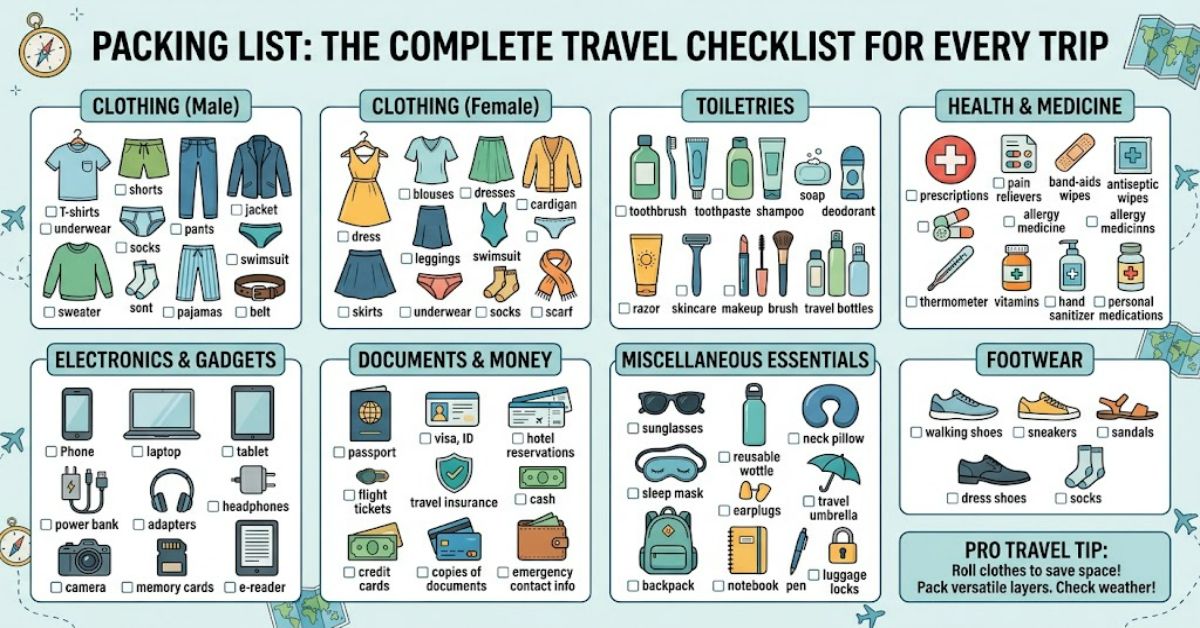
A good packing list does more than remind you to take enough clothes. It creates a simple system for checking the things that can cause the biggest problems if forgotten: passports, visas, insurance details, medication, payment cards, chargers and destination-specific documents.
For international travel, the Foreign, Commonwealth & Development Office recommends checking entry requirements, travel warnings, passport validity, visas, insurance and health requirements before departure. Its foreign travel checklist was updated on 5 June 2026, reinforcing the importance of checking requirements close to the date of travel rather than relying on old information.
The most practical approach is to divide a packing list into categories. Documents and money come first, followed by clothing, toiletries, technology, health supplies and useful extras. This makes the final check faster and reduces the temptation to pack items simply because there is spare space in the suitcase.
What Should Be on a Basic Packing List?
| Category | Essential items | Check before departure |
| Documents | Passport, visa, tickets, insurance details | Validity and entry rules |
| Money | Cards, cash, backup payment method | International usage |
| Clothing | Underwear, tops, trousers, sleepwear | Weather and activities |
| Toiletries | Toothbrush, toothpaste, skincare, hygiene items | Airport liquid restrictions |
| Technology | Phone, charger, power bank, adapters | Destination plug type |
| Health | Prescription medicines, basic first aid | Medicine and vaccination rules |
| Extras | Sunglasses, reusable bottle, day bag | Destination needs |
This structure works for a weekend city break as well as a longer international holiday. The difference is quantity, not the basic logic.
Documents, Money and Travel Security
Documents should be packed before anything else because replacing clothing is inconvenient, while replacing a missing passport or resolving an entry problem can disrupt an entire trip.
Keep your passport, visa or electronic travel authorisation, booking information, insurance details and important contact numbers accessible. The FCDO also recommends taking additional photo identification and maintaining a backup of important travel information in case your phone is lost or inaccessible.
A useful packing system has two layers: physical documents and secure digital backups. Do not rely exclusively on a phone. A printed copy of important insurance information, for example, can be useful when a device is lost or its battery is flat.
Money should receive similar treatment. Carry your main payment method separately from a backup card or alternative means of accessing funds. This is particularly useful if a bank card is lost or a payment method fails abroad.
Clothing: Pack for the Itinerary, Not the Fantasy
Clothing is where packing lists become unnecessarily large. Instead of packing for every possible scenario, start with the actual itinerary.
A three-day city break might require comfortable walking shoes, several interchangeable outfits and one weatherproof layer. A beach holiday needs swimwear and sun protection, while a hiking trip requires technical footwear and activity-specific clothing.
A simple rule is to choose items that can perform more than one function. Neutral colours, interchangeable layers and lightweight fabrics can reduce the total number of garments without reducing outfit options.
| Trip type | Clothing priority | Common mistake |
| City break | Comfortable shoes and layers | Too many formal outfits |
| Beach holiday | Swimwear and sun protection | Forgetting a light evening layer |
| Business trip | Versatile smart clothing | Packing unnecessary duplicates |
| Hiking trip | Technical layers and footwear | Prioritising appearance over function |
| Cold-weather trip | Insulating layers and waterproof outerwear | Underestimating bulk |
Toiletries, Liquids and Airport Rules
Toiletries should be organised separately so they can be removed quickly if airport security requires inspection.
UK airport liquid rules are not completely uniform. GOV.UK states that at most airports, liquids in containers larger than 100ml cannot pass through security, while some airports may permit containers holding up to two litres. Travellers should therefore check the specific airport rules for both departure and connecting airports.
Liquids include more than drinks. Shampoo, toothpaste, creams, gels, perfume and contact-lens solution can all fall under liquid restrictions.
Medication is treated differently in important circumstances. Essential liquid medicines over 100ml can be carried in hand luggage, although proof may be required depending on the medication and container size.
Electronics and Health Essentials
Technology should be packed around actual requirements. A phone, charging cable, power bank and destination-compatible plug adapter will cover many trips. Travellers working remotely may also need a laptop, headphones and additional storage.
Do not forget that electronic equipment is only useful when its power requirements are considered. Check the destination’s socket type and voltage before travelling with appliances such as hairdryers or styling tools.
Health items deserve priority because replacements may be difficult to obtain overseas. Prescription medicines should remain in their original packaging where practical, with supporting documentation when appropriate. Destination countries can have their own restrictions on medicines, so checking those requirements before travel is important.
Travel vaccinations can also form part of pre-trip preparation. The NHS advises travellers to seek travel-health advice around four to six weeks before departure because some vaccinations require multiple doses or time to provide protection.
Three Packing Problems People Often Miss
The airport problem: Packing liquids without checking the departure airport’s current rules can create delays at security. The solution is to check the airport rather than assuming every UK airport operates identically.
The backup problem: Keeping every important document only on a phone creates a single point of failure. A secure digital backup plus selected printed documents provides greater resilience.
The itinerary problem: Packing for an imagined holiday rather than the actual schedule creates excess baggage. Reviewing each day’s activities before packing exposes unnecessary duplicates.
These are practical gaps that a conventional clothes-focused checklist can overlook.
Travel Insurance and Unexpected Costs
Insurance belongs on the packing list even though it is not physically packed into a suitcase. The FCDO recommends obtaining appropriate travel insurance before travelling and checking coverage for the destination, duration and planned activities.
The policy details and emergency assistance number should be accessible during the trip. Insurance also needs to be considered alongside activities: a standard policy may not automatically cover every sport, adventure activity or special circumstance.
The Future of Packing Lists in 2027
By 2027, travel packing is likely to become increasingly digital, particularly through airline apps, electronic documents and automated itinerary planning. However, digital convenience will not remove the need for physical resilience.
Travel requirements can change by airport, destination and passenger circumstances. The continuing importance of official government guidance means travellers will still need to verify entry, health and security requirements close to departure.
The practical direction is therefore not “pack everything digitally”, but use digital tools while maintaining sensible offline backups.
Key Insights
- Documents should be checked before clothing because entry problems can disrupt an entire journey.
- Packing around the itinerary is more efficient than packing for hypothetical situations.
- Airport liquid rules should be checked for every relevant airport, including connections.
- Medicines require more planning than ordinary toiletries.
- Travel insurance details belong in the essential information category.
- A backup payment method can reduce the consequences of losing a card or phone.
- A packing list is most effective when it is treated as a risk-management tool rather than a shopping list.
Conclusion
A well-designed packing list is less about owning the perfect travel accessories and more about preventing avoidable problems. The essentials are straightforward: valid documents, appropriate clothing, necessary medication, reliable payment methods, useful technology and destination-specific equipment.
The strongest approach is to work backwards from the trip. Check the destination, review the itinerary, confirm airport requirements and identify anything that would be difficult or expensive to replace. Only then decide what clothing and extras are necessary.
For international travellers, official guidance should remain the final reference point because passport, visa, health and security requirements can change. A thoughtful packing system cannot eliminate every travel problem, but it can remove many of the preventable ones before the journey begins.
Frequently Asked Questions
What should be included in a basic packing list?
Start with documents, money, medication, clothing, toiletries, electronics and destination-specific essentials. Adjust quantities according to the length and purpose of the trip.
How do I make a packing list for international travel?
Begin with passport and entry requirements, then add insurance, health requirements, clothing, technology and toiletries. Check official destination and airport guidance before departure.
How many clothes should I pack for a week?
There is no universal number. Base clothing on the weather, planned activities, laundry access and whether garments can be combined into multiple outfits.
Can I take toiletries in hand luggage?
Yes, but liquid restrictions apply and rules can vary between airports. At most UK airports, containers over 100ml are generally restricted, so check the relevant airport before flying.
Should medicines go in hand luggage?
Essential medicines should generally be kept accessible during travel. Special rules apply to liquid medicines and controlled drugs, so check airline, airport and destination requirements.
Do I need travel insurance?
The FCDO recommends appropriate travel insurance for overseas trips. Coverage should match the destination, duration and activities planned.
Methodology
This article was developed using official UK travel and health guidance, particularly Foreign, Commonwealth & Development Office guidance on foreign travel, insurance and preparation, GOV.UK airport security information, and NHS travel vaccination guidance. These sources provide current operational information, including updates published during 2026.
The main limitation is that packing requirements vary by destination, airline, airport, season and traveller. This article therefore provides a general framework rather than a substitute for destination-specific requirements.
References
Foreign, Commonwealth & Development Office. (2026). Foreign travel checklist. GOV.UK.
Foreign, Commonwealth & Development Office. (2024). Foreign travel insurance. GOV.UK.
GOV.UK. (2026). Hand luggage restrictions at UK airports: Liquids. UK Government.
GOV.UK. (2026). Hand luggage restrictions at UK airports: Medicines, medical equipment and dietary requirements. UK Government.
NHS. (2026). Travel vaccinations. NHS.