The simplest explanation is also the most useful: “guess what chicken butt” is a deliberately silly response to the question “Guess what?” One person creates the expectation that an interesting piece of information is coming. Instead, the other person delivers an absurd rhyme.
The familiar exchange is:
“Guess what?”
“What?”
“Chicken butt!”
The joke works because the answer is unexpected and has no logical relationship to the question. It is a classic non-sequitur, with the sound of “what” creating the setup for the punchline “butt”.
The expression has no established serious meaning. It belongs to the tradition of playground humour, teasing and nonsense rhymes, where the objective is participation and laughter rather than information.
There is also evidence that “chicken butt” once had a slightly different conversational function. Malachi Andrews and Paul T. Owens’ 1973 book Black Language records it as a rhyming response when somebody says “What?” because they did not hear something, explaining that it could mean the speaker would not repeat what had been said (Andrews & Owens, 1973).
Where Did the Chicken Butt Joke Come From?
The exact origin cannot be established with certainty. That matters because many online explanations present one theory as fact.
Documented evidence provides a more cautious picture. Charles G. Bell’s 1962 novel The Married Land contains an example of boys using “chicken butt” in a playful exchange. Research compiled by etymologist Barry Popik also identifies an earlier example in John Oliver Killens’ 1954 novel Youngblood, as well as a related appearance in Charles Greenleaf Bell’s 1956 Delta Return.
| Period | Documented development | Significance |
| 1950s | “Chicken butt” appears in published American literature | Shows the expression predates the internet |
| 1962 | Charles G. Bell uses the phrase in The Married Land | Evidence of informal playground-style usage |
| 1973 | Black Language defines the rhyming response | Provides unusually clear evidence of its social use |
| 1980s–1990s | The expression becomes familiar childhood humour | Oral transmission helps it cross generations |
| 2000s onward | Memes, videos and social platforms circulate variants | Digital culture gives the joke another outlet |
This evidence does not prove that any one author invented the phrase. Playground expressions are usually transmitted orally, meaning their first spoken appearance can disappear long before somebody records them.
The Popular Rhyme Variations
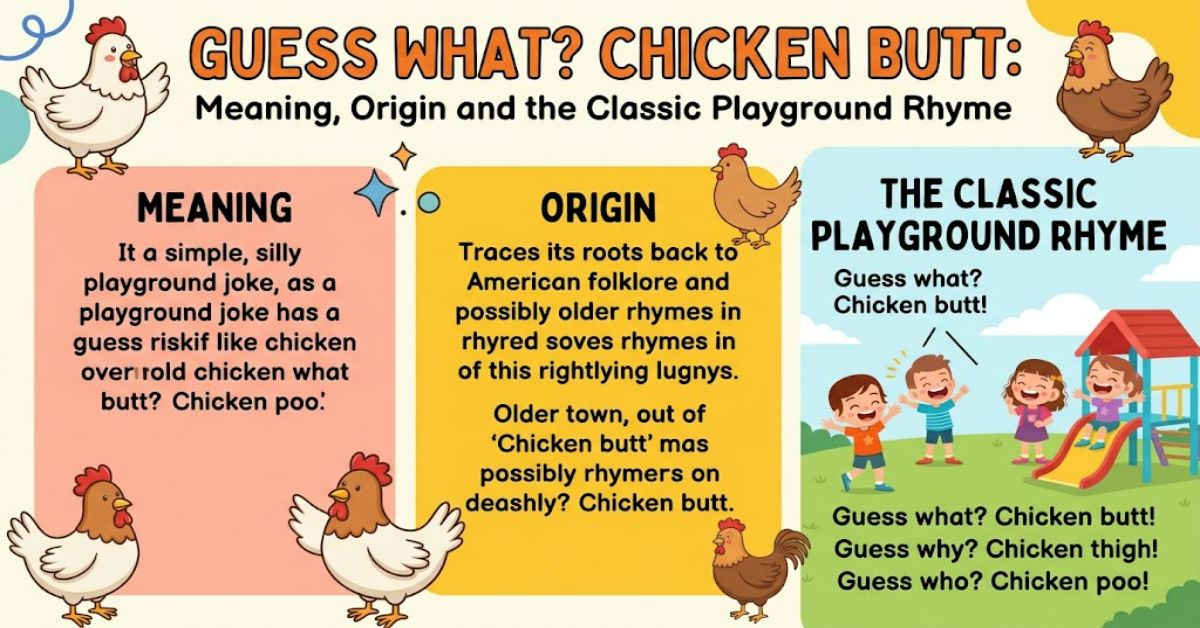
The basic joke eventually developed into longer call-and-response versions. One commonly circulated form expands the pattern with questions that produce deliberately ridiculous chicken-related answers:
- Guess what? Chicken butt!
- Guess why? Chicken thigh!
- Guess where? Chicken hair!
- Guess when? Chicken hen!
- Guess who? Chicken poo!
The exact wording varies. Some versions use “Guess how?” or substitute different body parts, animals or deliberately childish words.
The important feature is the pattern rather than a fixed canonical text. Each line follows a simple question-and-answer structure, making it easy for children to remember, alter and pass on.
That flexibility is one reason the rhyme has survived. A child does not need to memorise a complete poem. They only need to understand the mechanism.
Why Is the Joke So Funny?
There are three practical ingredients behind its durability.
Expectation: “Guess what?” normally signals that useful or exciting information is coming.
Disruption: “Chicken butt!” abruptly destroys that expectation.
Participation: The listener has to answer “What?” before the punchline works.
That final element is particularly important. This is not simply a joke that someone tells to an audience. It is a miniature social game.
The phrase also benefits from sound. “What” and “butt” create a loose comic rhyme, while the unexpected image of a chicken’s rear end makes the answer inherently childish. The humour therefore works without requiring cultural knowledge or a complicated story.
Is the Chicken Butt Origin Connected to Butchers?
One popular explanation connects the expression with historical meat terminology. Some accounts claim that “butt” referred to a type of barrel or a less desirable cut of meat, eventually producing a marketplace expression involving cheap chicken.
Another frequently repeated theory connects the phrase with George Gershwin’s Porgy and Bess, which premiered in 1935 and contains the words “fi’ cent butts” in its dialogue or lyrics.
These connections are interesting, but they should not be presented as proven origins of the playground joke. The documented evidence for the later expression is stronger than the evidence establishing a direct chain from historical butchery terminology or Porgy and Bess to the children’s rhyme.
That distinction is one of the most useful facts about the phrase: its history is documented in pieces, but its ultimate invention remains uncertain.
Cultural Impact and Everyday Use
“Guess what? Chicken butt!” has lasted because it requires almost nothing. No props, technology or special setting are needed.
It can appear between siblings, classmates, parents and children, particularly when someone wants to provoke an eye-roll or create a deliberately childish moment. The phrase is also easily adapted for memes, short videos and social posts because its structure is immediately recognisable.
| Feature | Effect on longevity |
| Short format | Easy to remember |
| Call-and-response | Encourages participation |
| Rhyme | Makes the punchline predictable but amusing |
| Nonsense | Requires little background knowledge |
| Adaptability | Supports countless variations |
| Oral transmission | Allows regional and generational changes |
The deeper cultural point is that children’s folklore often survives without an identifiable author. Unlike a published poem or song, a playground rhyme can evolve every time somebody repeats it.
The Future of Guess What Chicken Butt in 2027
There is little reason to expect the phrase itself to disappear in 2027. Its continued relevance does not depend on a commercial franchise or a particular social platform.
Instead, its strength comes from a reusable format. Children can modify the rhyme, adults can use it nostalgically, and digital creators can turn it into short-form humour.
The likely change is not the disappearance of the phrase but the growth of new variants. Social platforms make it easier for regional jokes to travel internationally, while older playground expressions can be rediscovered by new generations.
Key Takeaways
- The phrase is fundamentally a nonsense joke and call-and-response game.
- Its documented history reaches back at least to the mid-20th century.
- Black Language provides particularly valuable evidence about how “chicken butt” was used in informal speech.
- The familiar “Guess what?” format is only one version of the expression.
- Claims about a definitive butcher-market origin remain uncertain.
- The rhyme survives because it is short, participatory and easy to adapt.
Conclusion
“Guess what chicken butt” looks like an almost content-free joke, but its history reveals something interesting about how language travels. Playground humour rarely has a clear author or publication date. Instead, expressions are repeated, modified and remembered until somebody eventually writes them down.
The surviving evidence shows that “chicken butt” was already part of American informal language by the middle of the 20th century. Charles G. Bell’s 1962 work and the 1973 Black Language reference provide particularly useful documentary evidence, while earlier literary examples suggest an even older spoken tradition.
What makes the expression durable is its simplicity. The listener expects information and receives nonsense. That small reversal creates the joke, while the rhyme makes it easy to repeat. Whether heard on a playground, at home or through modern digital culture, the phrase remains a compact example of how childish humour can become part of shared language.
FAQ
What does “guess what chicken butt” mean?
It is a playful nonsense response to “Guess what?” It has no established serious meaning and is mainly used as a silly joke.
Where did “Guess what? Chicken butt!” originate?
Its ultimate origin is uncertain. Published evidence places related uses of “chicken butt” in American literature and language by the 1950s and 1960s.
Is “chicken butt” an old playground rhyme?
Yes, in its modern form it has been used as childhood and playground humour for decades, although the exact date when the full rhyme emerged is unclear.
What comes after “Guess where?”
A commonly circulated version answers “Chicken hair!” However, variations exist and there is no single authoritative version.
What are other chicken butt rhymes?
Common variants include “Guess why? Chicken thigh!”, “Guess when? Chicken hen!” and “Guess who? Chicken poo!”
Did the phrase come from Porgy and Bess?
Porgy and Bess contains a reference to “fi’ cent butts”, but this does not establish that the opera created the later playground expression. The connection remains a theory rather than a confirmed origin.
Methodology
This article separates documented appearances from theories about the expression’s origin. Sources were checked for publication dates, quoted usage and bibliographic details, with particular attention to the 1954, 1962 and 1973 records identified in published etymological research. The principal limitation is that an orally transmitted playground expression cannot be assigned a definitive invention date from surviving written evidence. Claims about the phrase’s ultimate origin are therefore presented cautiously.
Editorial disclosure: This article was drafted with AI assistance and requires human editorial verification of quotations, bibliographic details and historical claims before publication.
References
Andrews, M., & Owens, P. T. (1973). Black Language. Seymour-Smith.
Bell, C. G. (1956). Delta Return. Indiana University Press.
Bell, C. G. (1962). The Married Land. Houghton Mifflin Company.
Gershwin, G., Heyward, D., & Heyward, D. (1935). Porgy and Bess. Theatre production and libretto.
Killens, J. O. (1954). Youngblood. Dial Press.
Popik, B. (2017). “Guess what?”/“Chicken butt.” Barry Popik: The Big Apple.