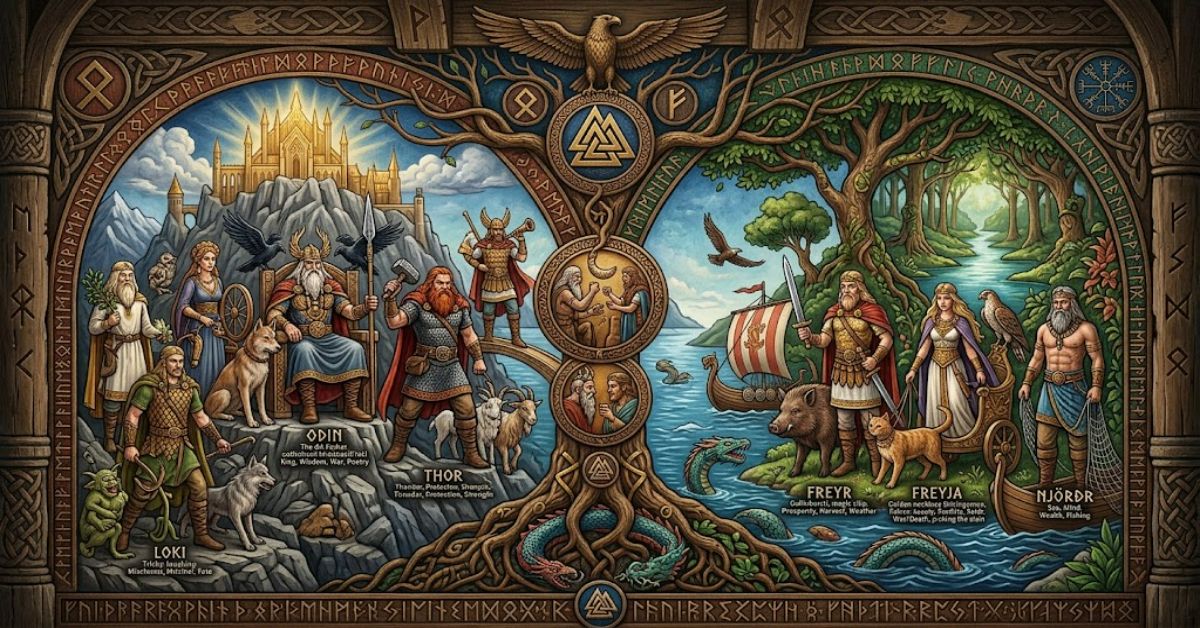
The Norse gods are the powerful deities of ancient Scandinavian mythology, with the surviving tradition commonly distinguishing between two major groups: the Æsir and the Vanir. Odin, Thor, Frigg, Tyr, Baldr and Heimdall are among the best-known figures associated with the Æsir, while Njörðr, Freyr and Freyja are central Vanir deities.
These gods were not simply characters with fixed powers in a modern superhero sense. They formed part of a religious and mythological system concerned with kinship, fate, warfare, fertility, death, hospitality, wisdom and the unstable relationship between divine and human communities.
Our knowledge also has important limitations. The Viking Age ended in the 11th century, while some of the most important surviving literary sources were written down in Iceland during the 13th century. The Poetic Edda and Snorri Sturluson’s Prose Edda are therefore medieval witnesses to traditions that originated earlier.
Archaeological evidence, place names, runic inscriptions and earlier continental references provide additional context, but they do not create a single complete Norse mythology. Some stories survive in several forms, some figures are obscure, and some relationships remain debated.
Understanding that evidence helps explain why different modern lists of Norse gods can look surprisingly different. The surviving mythology is a layered body of traditions rather than one canonical religious text.
Who Were the Norse Gods?
The divine world of Norse mythology included gods, goddesses and other supernatural beings whose roles sometimes overlap.
The Æsir are generally associated with figures such as Odin and Thor, while the Vanir include gods connected particularly with fertility, prosperity and the natural world. The distinction, however, is not absolute.
The two groups famously fought a war before reaching a settlement. As part of that settlement, hostages moved between the groups. Njörðr and his children Freyr and Freyja became connected with the Æsir community.
This mythological conflict is significant because it presents different divine traditions being incorporated into one larger system.
| Deity | Group or association | Major themes | Notable relationships |
| Odin | Æsir | Wisdom, kingship, war, poetry | Father of several gods |
| Thor | Æsir | Thunder, protection, strength | Son of Odin |
| Frigg | Æsir | Marriage, motherhood, foresight | Wife of Odin |
| Tyr | Æsir | Law, courage, warfare | Associated with the binding of Fenrir |
| Heimdall | Æsir | Watchfulness, protection | Guardian of Bifröst |
| Baldr | Æsir | Beauty, innocence, tragedy | Son of Odin and Frigg |
| Njörðr | Vanir | Seafaring, wealth, prosperity | Father of Freyr and Freyja |
| Freyr | Vanir | Fertility, peace, prosperity | Brother of Freyja |
| Freyja | Vanir | Love, fertility, magic, war | Sister of Freyr |
| Loki | Complex/giant ancestry | Trickery, transformation, disruption | Parent of several significant beings |
Odin: Wisdom, Kingship and Sacrifice
Odin is one of the most complex figures in the mythology. He is associated with wisdom, poetry, magic, warfare, death and rulership.
His pursuit of knowledge frequently involves sacrifice. One famous story describes Odin hanging from Yggdrasil, wounded by a spear, for nine nights to gain knowledge of the runes. Another account links his sacrifice of an eye to gaining access to Mímir’s well of wisdom.
This makes Odin different from a simple war deity. Knowledge is central to his character, but knowledge comes at a price.
He is also associated with Valhalla, where selected warriors slain in battle are received by the einherjar. Yet the relationship between Odin and the dead is broader than Valhalla alone. His associations include battle, prophecy and the mysterious selection of those who die.
Thor: Thunder and Protection
Thor is perhaps the most recognisable of the Norse gods. His principal weapon is Mjölnir, the hammer that gives him formidable power and represents protection against hostile forces.
Thor’s mythology repeatedly places him in conflict with giants and other supernatural threats. His strength is important, but his stories also contain humour, deception and moments where physical power alone is insufficient.
Thor’s role as a protector is particularly significant. The god is connected to the defence of the divine and human worlds, making him an important figure in a society where storms, warfare and environmental uncertainty were tangible realities.
Archaeological finds of Mjölnir-shaped pendants demonstrate that the hammer had significance beyond surviving literary stories. Such objects do not prove precisely how every worshipper understood Thor, but they provide material evidence for the cultural importance of the symbol.
Frigg, Freyja and the Role of Norse Goddesses
Modern summaries sometimes focus heavily on male deities, but goddesses occupy important positions in Norse mythology.
Frigg is Odin’s wife and is associated with marriage, motherhood and foreknowledge. Some aspects of her mythology overlap or have been compared with traditions surrounding Freyja, although the precise relationship between the two figures remains a subject of scholarly discussion.
Freyja is one of the most important Vanir goddesses. She is associated with fertility, sexuality, wealth, magic and warfare. The mythology therefore resists a narrow division in which male gods represent battle and female gods represent domestic life.
Freyja’s association with seiðr, a form of magic or sorcery, is particularly important. In Ynglinga saga, the practice is associated with Freyja and subsequently with Odin.
| Theme | Key deity or deities | What the surviving sources associate with it |
| Wisdom | Odin | Sacrifice, knowledge and poetry |
| Thunder | Thor | Protection and Mjölnir |
| Fertility | Freyr, Freyja | Prosperity, fertility and abundance |
| Marriage | Frigg | Family and household relationships |
| Magic | Freyja, Odin | Seiðr and supernatural knowledge |
| Law and courage | Tyr | Oaths, bravery and sacrifice |
| Death and fate | Odin, Hel and others | Different traditions surrounding the dead |
The Vanir and the Æsir
The distinction between the Æsir and Vanir is one of the most useful ways to understand the structure of Norse mythology.
The Æsir are generally connected with Odin, Thor and other prominent gods of the divine community centred around Asgard. The Vanir are represented by Njörðr, Freyr and Freyja and are particularly associated with prosperity, fertility and natural abundance.
Yet the groups cannot be reduced to two completely separate categories.
The Æsir–Vanir war ends with reconciliation. Njörðr and his children become integrated into the Æsir’s world. The story can therefore be read as a mythological explanation for the coexistence of different religious traditions within a wider Scandinavian cultural environment.
That interpretation should remain cautious. The mythology does not provide a straightforward historical account of how Scandinavian religion developed. It is better understood as evidence of how medieval Icelandic authors preserved and organised older traditions.
Loki and the Problem of Categories
Loki complicates almost every simple classification.
He is closely connected with the Æsir and appears alongside them in many stories, but his ancestry is associated with the jötnar, often translated as giants. He can assist the gods and cause enormous problems for them.
His children include Fenrir, Jörmungandr and Hel, three figures central to the events surrounding Ragnarök.
Loki’s importance illustrates another limitation of modern lists of Norse gods. Not every major supernatural figure fits neatly into the categories of “god”, “giant” or “monster”. The mythology contains overlapping relationships between different supernatural groups.
Ragnarök and the Fate of the Gods
Ragnarök is the great catastrophe and transformation at the end of the mythological cycle.
The surviving sources describe a series of events involving cosmic conflict, the death of major gods and the destruction of the established order. Odin is killed by Fenrir. Thor defeats Jörmungandr but dies from its venom. Freyr faces Surtr without his usual weapon and is killed.
The world is then consumed by fire before a renewed world emerges.
Importantly, Ragnarök is not simply a story about destruction. Renewal follows catastrophe. The surviving texts describe a world in which some gods survive or return and a new generation emerges.
This cyclical structure contributes to one of the mythology’s most enduring themes: even divine power is constrained by fate.
What the Sources Tell Us
Most modern understanding rests on a relatively small number of surviving sources.
The Poetic Edda, preserved principally in the medieval Icelandic manuscript known as the Codex Regius, contains mythological and heroic poems. The manuscript dates to the 13th century, although many of its poems are considered substantially older.
Snorri Sturluson’s Prose Edda, composed in the 13th century, provides another major source. It explains mythological material partly to preserve the poetic traditions necessary for understanding skaldic verse.
Earlier evidence also matters. Roman-era writers, runic inscriptions, archaeological finds and place names can provide clues about pre-Christian Scandinavian religion.
| Evidence type | Example | Main value | Main limitation |
| Mythological poetry | Poetic Edda | Preserves narrative traditions | Recorded in medieval manuscripts |
| Prose literature | Prose Edda | Organises and explains myths | Written after Christianisation |
| Archaeology | Mjölnir pendants | Material evidence of religious symbols | Meaning is not always certain |
| Runic inscriptions | Scandinavian runestones | Contemporary written evidence | Often brief |
| Place names | Theophoric place names | Evidence of deity associations | Interpretation can be disputed |
Why Modern Lists Can Be Misleading
One of the most useful insights when researching Norse mythology is that there was no surviving equivalent of a single official list of gods.
Different communities across Scandinavia may have emphasised different deities. Local worship, political structures and regional traditions could influence which gods were important.
Another issue is terminology. Modern English descriptions often translate æsir and vanir as straightforward divine “tribes” or “groups”, but these translations can conceal nuances in Old Norse terminology and medieval literary context.
A third limitation is chronology. A story recorded in Iceland in the 13th century should not automatically be treated as an unchanged account of Scandinavian religious practice in the 8th or 9th century.
These distinctions make the evidence more complicated, but they also make it more useful. Instead of treating mythology as a fixed catalogue, readers can examine how stories were preserved, transformed and interpreted.
The Cultural Impact of Norse Gods
The Norse gods have remained prominent long after the decline of pre-Christian Scandinavian religion.
Their names appear in modern literature, films, television, comics, games, music and popular culture. Thursday, for example, derives from Old English Þūnresdæg, “Thor’s day”, while Wednesday derives from a Germanic name associated with Woden, the English counterpart of Odin.
Modern adaptations frequently simplify the mythology. Thor may be presented primarily as a superhero, while Loki can become a sympathetic antihero. These portrayals are modern interpretations rather than direct representations of medieval Scandinavian religion.
That distinction matters because popular culture can introduce people to Norse mythology while simultaneously changing its characters, relationships and themes.
The Future of Norse Gods in 2027
Interest in Norse mythology is likely to remain strong through 2027 because the material continues to provide adaptable characters and stories for entertainment, games, education and cultural analysis.
The more significant development may be greater attention to source context. Digital editions, museum collections and academic resources make manuscripts, artefacts and archaeological discoveries increasingly accessible to wider audiences.
There is also likely to be continued discussion about how modern entertainment represents pre-Christian Scandinavian culture. Scholars and museums increasingly distinguish between historical evidence, medieval literary interpretation and modern reconstruction.
That distinction is particularly relevant when visual media presents fictionalised versions of Odin, Thor or Loki as though they were historically documented personalities.
Key Takeaways
- The Æsir and Vanir are the two principal divine groups in surviving Norse mythology.
- Odin combines associations with wisdom, poetry, magic, kingship, war and death.
- Thor’s hammer, Mjölnir, is both a literary object and an archaeological symbol.
- Freyja demonstrates that Norse goddesses could be associated with fertility, magic, wealth and warfare.
- Loki’s ancestry and relationships show why Norse supernatural categories are not always straightforward.
- The Poetic Edda and Prose Edda are medieval sources preserving older traditions rather than contemporary records of the Viking Age.
- Modern portrayals should be distinguished from the evidence contained in medieval and archaeological sources.
Conclusion
The Norse gods form a complex mythological system rather than a simple hierarchy of supernatural characters. Odin, Thor, Frigg, Freyja, Freyr, Tyr, Baldr and Loki each occupy distinctive positions within stories about knowledge, protection, fertility, sacrifice, family and fate.
The division between the Æsir and Vanir provides an important framework, particularly because their conflict and eventual integration suggest a mythology comfortable with combining different divine traditions. At the same time, figures such as Loki demonstrate how difficult it can be to impose rigid categories on the surviving material.
The evidence also needs careful handling. The most substantial literary sources were recorded in medieval Iceland, centuries after many of the traditions they preserve had developed. Archaeology, inscriptions and place names can add context but rarely provide a complete narrative.
That combination of rich storytelling and incomplete evidence is central to understanding Norse mythology. It allows the gods to be studied not only as legendary figures, but also as evidence of how Scandinavian communities imagined power, nature, society and the limits imposed by fate.
FAQ
Who are the main Norse gods?
The best-known Norse deities include Odin, Thor, Frigg, Freyja, Freyr, Tyr, Heimdall and Baldr. Loki is also central to many surviving myths, although his classification is more complicated because of his giant ancestry and unusual relationships with the gods.
What are the two groups of Norse gods?
The two principal groups are the Æsir and the Vanir. Odin and Thor are associated with the Æsir, while Njörðr, Freyr and Freyja are prominent Vanir. The mythology describes a war between the groups followed by reconciliation.
Is Loki an Æsir or a Vanir?
Loki is closely involved with the Æsir but is not normally classified as a Vanir deity. His ancestry is associated with the jötnar, and his relationships with the gods make him difficult to place within a simple divine classification.
Who is the strongest Norse god?
The surviving mythology does not provide a reliable universal ranking of divine strength. Thor is portrayed as exceptionally powerful, while Odin possesses different forms of authority, knowledge and magical ability.
Who is the Norse god of thunder?
Thor is the principal Norse god associated with thunder. His hammer, Mjölnir, is one of the most recognisable symbols associated with him.
Are Norse gods real historical figures?
They are religious and mythological figures rather than historically documented human rulers. Archaeological evidence demonstrates aspects of pre-Christian Scandinavian religious practice, but it does not establish the gods as historical people.
Methodology
This article was prepared using established primary and scholarly reference material concerning Old Norse mythology, medieval Icelandic literature and archaeological evidence. The Poetic Edda and Prose Edda were treated as medieval sources that preserve older traditions rather than as direct contemporary records of Viking Age religion.
Archaeological evidence, including Mjölnir pendants, was considered separately from literary evidence because material objects can demonstrate symbolic or religious activity without establishing precisely how individual communities interpreted the symbols.
The article does not claim firsthand archaeological or field experience. No original testing, excavation or interview was conducted. Where interpretation remains debated, the wording reflects that uncertainty rather than presenting one reconstruction as definitive.
Editorial disclosure: This article was drafted with AI assistance and should be reviewed and verified by the responsible RubbleMagazine.co.uk editor before publication. All dates, translations, source details and historical claims should be checked against the original sources.
References
Lindow, J. (2001). Norse mythology: A guide to the gods, heroes, rituals, and beliefs. Oxford University Press.
Price, N. (2020). The children of Ash and Elm: A history of the Vikings. Basic Books.
Simek, R. (2007). Dictionary of Northern mythology. D. S. Brewer.
Sturluson, S. (2018). The Prose Edda: Tales from Norse mythology (A. Faulkes, Trans.). Everyman’s Library. (Original work composed in the 13th century.)
The British Museum. (n.d.). Viking and Scandinavian collections. British Museum.
The National Museum of Denmark. (n.d.). The Viking Age. National Museum of Denmark.
World History Encyclopedia. (2021). Norse mythology. World History Encyclopedia.