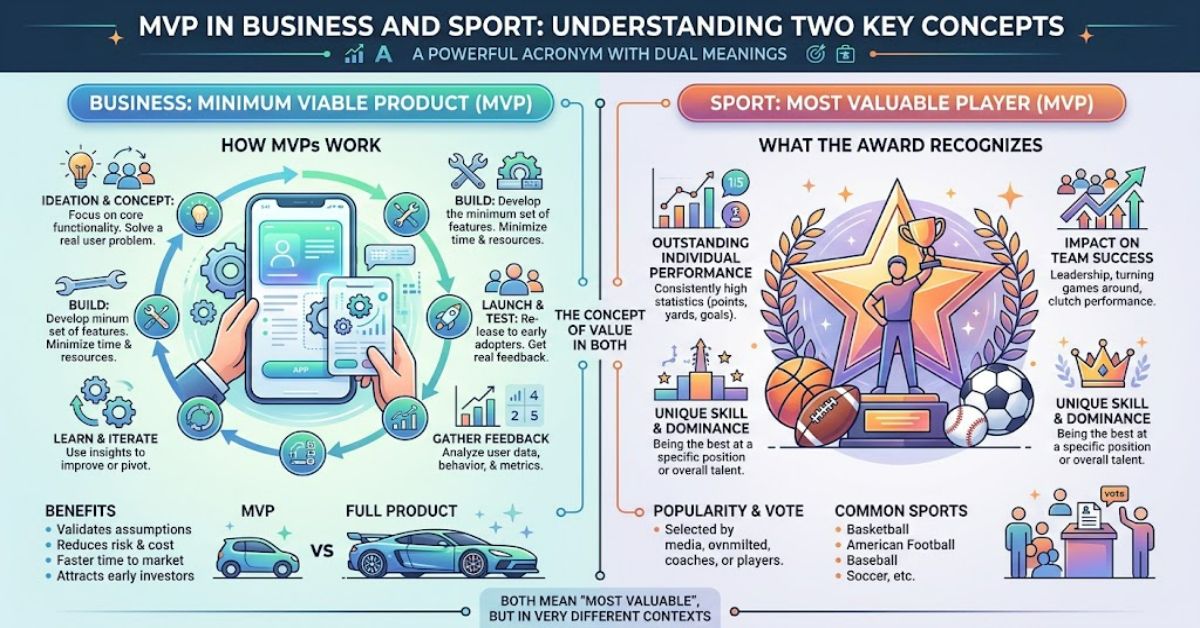
MVP has two widely used meanings. In business, technology and product development, it stands for minimum viable product — a basic version of a product that helps a team test its assumptions with real customers. In sport, MVP means most valuable player, a title awarded to an athlete judged to have made an outstanding contribution to a team or competition.
The correct meaning depends on the context. A startup discussing an MVP before launching an app is probably planning a product experiment. A basketball commentator announcing an MVP is referring to an individual player’s performance and value.
Although the abbreviations are identical, the ideas behind them are different. A minimum viable product is a method for reducing uncertainty before investing heavily in development. A most valuable player award is a form of recognition based on performance, influence and, depending on the competition, voting or formal selection criteria.
Understanding both definitions is useful because MVP appears across business plans, software development discussions, sports coverage, marketing material and online conversations. Misreading the abbreviation can create confusion, particularly when the surrounding discussion does not make its meaning immediately obvious.
This guide explains both definitions, compares their uses, examines their practical implications and outlines common misunderstandings. It also considers how the minimum viable product approach may develop through 2027 as organisations adopt faster development cycles, artificial intelligence tools and more evidence-driven product decisions.
What Does MVP Mean in Business?
A minimum viable product is an early, usable version of a product that allows a business to test important assumptions before committing to full-scale development.
The concept is closely associated with Eric Ries and the lean startup approach. In his 2011 book The Lean Startup, Ries described the objective as learning about customers through the smallest practical investment of effort.
An MVP is not simply an unfinished product. It should provide enough value for a specific group of users to try it and give meaningful feedback.
For example, someone planning a meal-planning app might initially build a simple website where users select dietary preferences and receive weekly meal plans. Features such as social sharing, automated shopping lists and advanced nutrition analytics could come later.
The first version tests whether customers actually want the central service.
How a minimum viable product works
The process usually follows four stages:
- Identify a problem: Establish a specific customer need rather than starting with a long feature list.
- Build the smallest useful solution: Include only the functionality needed to test the main assumption.
- Measure behaviour: Collect evidence through usage, interviews, retention, conversion or willingness to pay.
- Decide what comes next: Improve the product, change direction or stop development if the evidence does not support the idea.
The UK Government’s business guidance similarly recommends testing customer demand, gathering feedback and evaluating whether people would pay for a proposed product. This makes experimentation a commercial decision, not merely a software development technique.
What Does MVP Mean in Sport?
In sport, MVP stands for most valuable player. It describes an athlete recognised for making an exceptional contribution to a team, season or competition.
The award is common in basketball and other professional sports, although its precise meaning varies between leagues and tournaments. Some awards recognise regular-season performance, while others focus on a final, championship or individual event.
An MVP decision may consider statistics, consistency, leadership, influence on team results and performance under pressure. The exact criteria depend on the competition and its voting system.
In basketball, for example, scoring totals alone do not necessarily determine value. Playmaking, defensive contributions, efficiency and the effect a player has on teammates may also influence assessments.
The award is therefore not always identical to the title of highest scorer or best athlete in a single match. It reflects a judgement about overall contribution within a defined competition.
MVP Compared: Business vs Sport
| Feature | Minimum viable product | Most valuable player |
| Field | Business and technology | Sport |
| Main purpose | Test a product idea | Recognise exceptional performance |
| What is evaluated? | Customer need, usability and demand | Individual performance and influence |
| Evidence | User feedback, engagement and commercial results | Statistics, results and award voting |
| Typical outcome | Improve, expand, pivot or stop | Recognition or an award |
| Example | A basic online booking service | A basketball player recognised for a season’s performance |
The key distinction is that one meaning describes a development method, while the other describes an award or recognition.
Why the Business Meaning Matters
The minimum viable product approach can reduce wasted expenditure, but its value depends on what the team learns.
1. It limits early investment
Developing every proposed feature before speaking to customers can consume time and money without proving that a market exists. A focused first release allows a company to test demand before increasing its commitment.
2. It turns assumptions into measurable questions
A team might believe customers want a subscription service. Rather than treating that belief as fact, it can test sign-up rates, trial usage and willingness to pay.
An important distinction is that interest is not the same as demand. People may praise an idea without using it regularly or paying for it.
3. It helps prioritise development
An MVP creates evidence for deciding which features deserve further investment. This can prevent teams from spending months refining functions that users rarely need.
However, results must be interpreted carefully. A weak response may indicate poor product design, unsuitable pricing, an ineffective distribution channel or a product that does not solve a meaningful problem.
MVP and Other Early Product Approaches
| Approach | Main purpose | Best use |
| Prototype | Explore design and functionality | Testing concepts before building a working product |
| Minimum viable product | Test assumptions with real users | Learning whether a solution has practical value |
| Proof of concept | Test whether an idea is technically feasible | Assessing difficult engineering or technical risks |
| Beta release | Identify issues and improve a more developed product | Testing reliability and usability before wider release |
| Full product | Deliver the intended complete experience | Serving established user needs at broader scale |
These approaches can overlap, but they answer different questions. A prototype may test whether people understand a design, while a minimum viable product can test whether they will use a working service.
The most useful choice depends on the uncertainty a team needs to resolve.
Risks and Common Misunderstandings
The term can be misused when businesses treat “minimum” as permission to release something unreliable.
Poor quality: A product can have few features and still need secure data handling, accessible interfaces and dependable core functionality. Minimal scope should not mean careless execution.
Weak measurement: Downloads and registrations can look encouraging without demonstrating sustained use. Teams should define success measures before launch and examine actual behaviour.
Unrepresentative feedback: Testing with friends, colleagues or a narrow group of users may produce misleading results. The UK Government’s usability guidance highlights the importance of recruiting appropriate participants and recognising the limitations of controlled tests.
Endless experimentation: An MVP should inform a decision. Repeatedly collecting feedback without changing priorities or setting decision criteria wastes the time and money the approach is meant to save.
A further practical risk concerns privacy and compliance. Even a small product may handle personal data, payments or sensitive information. The minimum release still needs safeguards appropriate to its intended use.
The Future of MVP in 2027
By 2027, the minimum viable product approach is likely to remain relevant as software teams use AI-assisted development, automated testing and low-code tools to create early versions more quickly.
Faster development can reduce the cost of experimentation, but it does not remove the need for customer research. Generating a working interface is easier than proving that it solves a genuine problem or supports a sustainable business model.
UK public-sector guidance on prototyping and testing also supports a staged approach: start with a proportionate experiment, observe how people use it and improve the service using evidence. This principle applies beyond startups.
Three developments deserve attention:
- AI-assisted prototyping: Teams may produce testable concepts faster, although generated code and content still require security, accuracy and usability checks.
- More behavioural measurement: Product teams can combine interviews with retention, conversion and task-completion data to assess whether a solution delivers value.
- Greater responsibility from the outset: Privacy, accessibility, security and regulatory requirements may shape the smallest viable release rather than being postponed until later.
These are reasonable directions rather than guaranteed outcomes. The effect of AI tools will vary by product complexity, user expectations and the risks associated with the service.
Key Takeaways
- Context determines whether MVP means minimum viable product or most valuable player.
- A minimum viable product should test a clear assumption with a defined group of users.
- A prototype, proof of concept and beta release serve related but different purposes.
- Early feedback is valuable only when it comes from relevant users and supports a decision.
- Businesses should measure meaningful behaviour rather than relying on downloads or compliments alone.
- The smallest viable release must still meet appropriate standards for reliability, accessibility, security and privacy.
Frequently Asked Questions
What does MVP stand for?
MVP most commonly means minimum viable product in business and technology, or most valuable player in sport. The surrounding topic usually makes the intended definition clear.
What is an MVP in business?
It is an early version of a product that provides enough functionality to test a business idea with real users and gather evidence before investing in wider development.
What is an MVP in software development?
It is a limited but usable release designed to test key assumptions about a software product. Its scope focuses on essential user needs rather than every planned feature.
What does MVP mean in basketball?
It means most valuable player, an award recognising an athlete’s contribution within a season, tournament or other competition. Selection criteria vary.
Is an MVP the same as a prototype?
No. A prototype helps explore or test a concept, while a minimum viable product is generally intended to provide a usable solution and generate evidence from real-world use.
Can an MVP be low quality?
It can be limited in scope, but it should still work reliably and meet essential user, security and accessibility requirements. Minimal functionality is not an excuse for unsafe or unusable design.
How do businesses know whether an MVP has succeeded?
They set measurable criteria before launch. Depending on the product, these may include task completion, repeat usage, customer retention, conversion rates or willingness to pay.
Conclusion
MVP has two distinct meanings, and recognising the context is the simplest way to interpret it correctly. In sport, the abbreviation refers to a most valuable player whose contribution earns recognition within a competition. In business and technology, it describes a minimum viable product that helps teams test assumptions before making larger investments.
The business definition is particularly important because it encourages evidence-based decisions. A carefully scoped first release can reveal whether a proposed solution meets a real need, but only if the team gathers relevant feedback and measures meaningful outcomes. It must also maintain appropriate standards for safety, reliability and user privacy.
An MVP is therefore neither a shortcut to success nor simply an incomplete product. It is a structured way to learn. Its effectiveness depends on asking a useful question, testing it with suitable users and responding honestly to the evidence. In either context, the underlying idea of value remains central, even though the way that value is assessed differs.
References
- Government Digital Service. (n.d.). Using moderated usability testing. GOV.UK.
- Government Digital Service. (n.d.). Growing your business: Develop new products and services. GOV.UK.
- Lean Enterprise Institute. (n.d.). Lean startup.
- Ries, E. (2011). The Lean Startup: How Today’s Entrepreneurs Use Continuous Innovation to Create Radically Successful Businesses. Crown Business.
- Stevenson, R., Burnell, D., & Fisher, G. (2024). The minimum viable product (MVP): Theory and practice. Entrepreneurship Theory and Practice.
- National Basketball Association. (2017). What criteria matters most in making your MVP decision? NBA.com.
Methodology
This article was prepared using established product-development literature, UK Government guidance on product testing and customer validation, and published material about sports awards. The sources support the distinction between product experimentation and athletic recognition. No original product testing, interviews or firsthand sports reporting were conducted for this article, and no such experience is claimed. The business examples are illustrative rather than measured case studies. Sports awards use different selection systems, so the article avoids presenting one league’s criteria as universal. Editors should confirm bibliographic details and any award-specific rules against the original publisher before publication.
Editorial disclosure: This article was drafted with AI assistance and should be reviewed by a human editor. Claims, references, author credentials and publication details should be independently verified before publication.