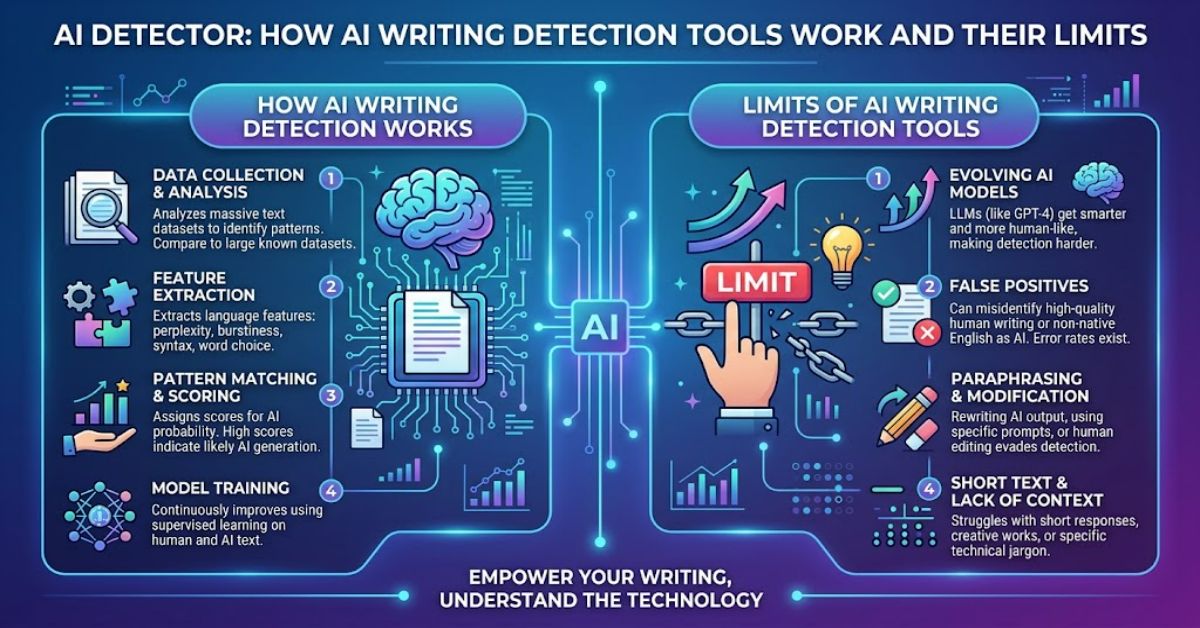
An AI detector is a tool that analyses written content and estimates whether it may have been generated by artificial intelligence. These tools are used by educators, publishers, businesses and website owners who want to understand how text was produced. They often examine patterns such as predictability, repetition, sentence structure and other statistical features associated with machine-generated language.
However, an AI detector does not directly see how a document was written. It examines the finished text and produces a classification, score or probability estimate. That distinction matters: a high score is not conclusive evidence that someone used AI, just as a low score does not guarantee that every sentence was written by a person.
The technology has become more relevant as tools such as ChatGPT have made AI-assisted writing accessible to a broad audience. Yet detection remains a difficult technical problem. Large language models can produce fluent, varied prose, while human writers may use formal, repetitive or highly predictable language. Editing, translation, short passages and specialist terminology can further complicate classification.
For anyone choosing or using a detection tool, the most important question is not simply whether it can label text as AI-generated. It is how reliable that label is for the intended purpose, what errors it makes and what consequences follow from the result.
This guide explains how AI writing detection works, compares common approaches, examines practical limitations and outlines responsible use in education, publishing and business. It also considers how detection may change by 2027 as generative systems and assessment practices continue to develop.
How AI Writing Detectors Work
Most detection systems look for statistical or linguistic features that differ, on average, between human-written and machine-generated text. They do not all use the same methods, and their internal models are often proprietary.
Predictability and language patterns
Large language models generate text by predicting likely continuations from context. Some detectors assess how predictable a passage appears, sometimes using measures related to perplexity — a statistical estimate of how surprising a sequence of words is to a language model.
Text with highly predictable word choices and regular sentence structures may receive a higher AI-likelihood score from certain systems. Others use classifiers trained on examples of human-written and AI-generated material.
These signals are not exclusive to AI. A well-edited report, a student writing in a second language or a writer following a strict style guide may also use predictable language. Conversely, AI-generated text can be edited until its patterns differ from those in a detector’s training data.
Sentence variation and repetition
Some systems examine how sentence lengths, vocabulary and phrasing vary throughout a passage. Repeated transitions, uniform paragraph structures and recurring expressions may contribute to a classification.
Yet these features are clues rather than proof. Many professional writers deliberately use consistent sentence structures for clarity. The absence of repetition also does not establish human authorship.
Machine-learning classifiers
A classifier learns statistical differences from labelled examples. After training, it applies those patterns to new text and produces an output, such as a score or category.
Its performance depends on the examples used to train and evaluate it. If a detector is tested on text that closely resembles its training material, it may perform better than it does on unfamiliar writing, newer models or heavily edited passages.
A study published in Acta Neurochirurgica on 07 August 2025 assessed 1,000 academic texts using three detection tools. The researchers found that performance varied and none of the tools was perfectly reliable. Its findings also have limits: the sample focused on neurosurgical academic writing and specific ChatGPT versions, so it cannot establish universal accuracy across every genre or detector (Erol et al., 2025).
AI Detector Tools Compared
Detection products differ in their intended users, reporting features, language coverage and access requirements. Features and policies can change, so buyers should verify current specifications before relying on a particular service.
| Tool or approach | Typical purpose | Important consideration |
| Turnitin AI writing detection | Academic writing review | Intended for institutional workflows; results require human interpretation |
| GPTZero | Reviewing text for possible AI generation | A classification is not definitive proof of authorship |
| ZeroGPT | Checking whether text may be AI-generated | Results should be treated as estimates, not verdicts |
| General-purpose AI classifiers | Research and text analysis | Performance depends on the model, language and evaluation data |
| Provenance and watermarking methods | Identifying origin information where available | Require compatible systems and may not cover all generated content |
Turnitin’s own guidance states that its system can misidentify human-written and AI-generated material and should not be the sole basis for adverse action against a student. It also explains that low scores have a higher incidence of false positives, which is why its reporting approach treats that range cautiously (Turnitin, n.d.).
This is an important point for anyone comparing tools: a polished dashboard or precise-looking percentage does not automatically mean the underlying conclusion is certain.
What the Evidence Tells Us
The following table summarises established issues that affect the interpretation of detector results. It does not represent a new benchmark or a direct test of commercial products.
| Factor | Why it matters | Practical response |
| False positives | Human writing may be incorrectly classified as AI-generated | Never make a serious decision from one score |
| False negatives | AI-generated text may not be identified | A low score does not prove human authorship |
| Editing and paraphrasing | Changes to wording can alter detectable patterns | Consider drafting history and supporting evidence |
| Short passages | There may be too little text for stable analysis | Avoid strong conclusions from brief samples |
| Language and genre | Performance may differ across languages and writing styles | Check whether the tool has been evaluated for the intended use |
| Model changes | New generation systems can change the patterns detectors encounter | Reassess reliability over time |
Three broader insights follow from this evidence.
First, accuracy must be judged against the cost of an error. A detector used to sort a large batch of low-risk material may be useful as a preliminary filter. The same output should not automatically determine a student’s grade, employment decision or allegation of misconduct.
Second, the source of the writing matters as much as its surface style. Drafts, revision history, notes and references can provide context that the final text alone cannot reveal. These records do not guarantee authorship, but they can help reviewers reach a more informed decision.
Third, a score is only meaningful when its limits are understood. A percentage shown by a detector should not be interpreted as the probability that a particular person used AI unless the provider explicitly defines it that way and supplies appropriate validation. Different systems may calculate and label scores differently.
Where AI Detection Is Used
Education and academic integrity
Schools, colleges and universities may use detection tools to identify work that merits further review. However, an institution should first define what students are permitted to do with AI.
Using a tool to brainstorm ideas, checking grammar and submitting a generated essay as independent work are different activities. A detector cannot reliably determine which activity took place from the final text alone.
The UK Department for Education’s guidance, updated on 12 August 2025, advises education settings to consider the benefits and risks of generative AI, including safety, data protection and intellectual property. It also stresses the continuing importance of professional judgement (Department for Education, 2025).
A fair review process should therefore consider the assignment requirements, the student’s explanation, relevant drafts and the institution’s published policy.
Publishing and content marketing
Publishers may use detection tools to flag articles for editorial review, particularly where accuracy, originality and transparent sourcing are essential.
However, AI detection is not a substitute for fact-checking. Human-written material can contain fabricated claims, while AI-generated content can contain accurate information. Editors should check sources, quotations, originality, factual accuracy and whether the article provides genuine value to readers.
A detector score alone cannot establish whether an article is trustworthy or suitable for publication.
Business and recruitment
Businesses may use text analysis as one part of a broader workflow, but decisions about employees, applicants or contractors require particular care. AI assistance may be permitted in one role and restricted in another.
Organisations should define acceptable use before introducing detection software. They should also consider whether submitted text contains personal, confidential or commercially sensitive information before uploading it to an external service.
How to Interpret a Detection Result
A sensible review process separates an initial signal from a final decision.
- Check the tool’s scope. Confirm that it supports the language, length and type of text being examined.
- Read the report carefully. Understand whether it identifies particular passages, assigns a score or offers a broad classification.
- Look for independent evidence. Where appropriate, examine drafts, document history, source notes and the writer’s explanation.
- Consider alternative explanations. Formal language, editing, translation and template-driven writing may influence results.
- Apply a consistent policy. Give the person concerned a fair opportunity to respond before reaching a consequential conclusion.
This approach does not mean dismissing detection technology. It means using it in proportion to its reliability and the consequences of a mistake.
The Future of AI Detection in 2027
AI detection is likely to remain part of discussions about academic integrity, publishing standards and digital trust in 2027. However, detection based solely on writing style faces a continuing challenge: language models and human editing practices both change.
The National Institute of Standards and Technology’s November 2024 report on synthetic-content transparency examined several approaches, including detection, watermarking and provenance tracking. These approaches address different parts of the problem. Detection analyses content for signals, while provenance systems aim to provide information about where content originated or how it was handled (Chandra et al., 2024).
Three developments merit attention.
- Better evaluation: More representative testing across languages, genres and writing styles could help organisations understand where a detector performs well and where it fails.
- Provenance methods: Watermarks and origin records may provide useful evidence when supported by the systems involved, although they will not cover every piece of generated text.
- Clearer institutional rules: Schools, publishers and employers may place greater emphasis on disclosure, process evidence and transparent policies rather than treating a detector score as a verdict.
These developments are not guaranteed to produce universally reliable identification. Technical limits, privacy considerations, implementation costs and compatibility will continue to shape adoption. The most defensible approach is likely to combine technical signals with evidence about how the work was created.
Key Takeaways
- An AI detector estimates the likelihood that text resembles machine-generated writing; it does not directly establish who wrote it.
- Predictability, repetition and sentence variation are possible signals, not unique signatures of AI.
- False positives and false negatives can occur, so scores should be interpreted in context.
- Research results from one academic field or language should not automatically be applied to every writing situation.
- Educators and employers should establish clear AI-use policies before using detection tools.
- Provenance information may complement detection, but it has its own coverage and compatibility limits.
- Human review, transparent procedures and independent evidence remain essential when a result could affect someone’s reputation or opportunities.
Frequently Asked Questions
What is an AI detector?
An AI detector is software that analyses text and estimates whether it may have been generated by an AI system. It may use statistical patterns, machine-learning classifiers or other language features.
How accurate are AI writing detectors?
Accuracy varies by tool, text type, language and evaluation method. Research has found that detectors can distinguish some human-written and AI-generated material, but no result should be treated as infallible.
Can an AI detector identify ChatGPT writing?
Some tools are designed to identify patterns associated with text generated by large language models, including ChatGPT. They cannot guarantee that a specific passage came from ChatGPT or identify its author with certainty.
Can human-written text be flagged as AI-generated?
Yes. Formal writing, repetitive phrasing and predictable sentence structures may trigger a detector even when a person wrote the text. This is known as a false positive.
Can an AI detector check a short paragraph?
Some tools accept short passages, but limited text can make the result less dependable. Check the provider’s minimum text requirements and avoid treating a brief sample as conclusive evidence.
Should schools rely on AI detection scores?
No. A score can prompt further review, but schools should also consider their AI-use policy, supporting evidence and the student’s explanation. Serious decisions require a fair and consistent process.
Does AI detection prove plagiarism?
No. AI detection and plagiarism checking address different questions. A passage may be AI-generated without matching a published source, while copied human-written material may not be flagged as AI-generated.
Conclusion
AI writing detection can offer a useful signal when an organisation needs to review text, but its output must be interpreted carefully. These systems analyse patterns and produce estimates; they do not provide a complete record of how a document was created. Predictable human writing can be misclassified, and generated text may go undetected.
The practical value of a detector depends on its intended purpose, the quality of its evaluation and the consequences attached to its result. A low-risk editorial check is different from an allegation that could affect a student’s education or a person’s employment. The higher the stakes, the stronger the need for independent evidence and human judgement.
Developments in provenance and watermarking may improve transparency where compatible systems are available. They will not remove every uncertainty. For now, the most responsible approach combines careful technical assessment with clear rules, factual verification and a fair review process. Detection tools are best treated as supporting instruments, not final authorities on authorship.
References
Chandra, B., Dunietz, J., Roberts, K., Lee, Y., Fontana, P., & Awad, G. (2024). Reducing risks posed by synthetic content: An overview of technical approaches to digital content transparency. National Institute of Standards and Technology.
Department for Education. (2025, 12 August). Generative artificial intelligence (AI) in education. GOV.UK.
Erol, G., Ergen, A., Erol, B. G., Ergen, Ş. K., Bora, T. S., Çölgeçen, A. D., Araz, B., Şahin, C., Bostancı, G., Kılıç, İ., Macit, Z. B., Sevgi, U. T., et al. (2025). Can we trust academic AI detective? Accuracy and limitations of AI-output detectors. Acta Neurochirurgica, 167, Article 214.
Turnitin. (n.d.). Using the AI writing report. Turnitin Guides.
Methodology
This article AI detector draws on published research into AI-text detection, guidance from the UK Department for Education, a National Institute of Standards and Technology report on synthetic-content transparency, and Turnitin’s documentation about interpreting detection reports. The material was synthesised to explain common methods, practical uses and limitations. No independent benchmark or hands-on product test was conducted, and no testing results are claimed. Tool features and policies may change, and findings from a single research sample cannot establish the accuracy of every detector across all languages and genres. References should be checked against their original publications before the article goes live.
Editorial disclosure: This article was drafted with AI assistance and requires human editorial review. References, claims and publication details should be independently verified before publication.