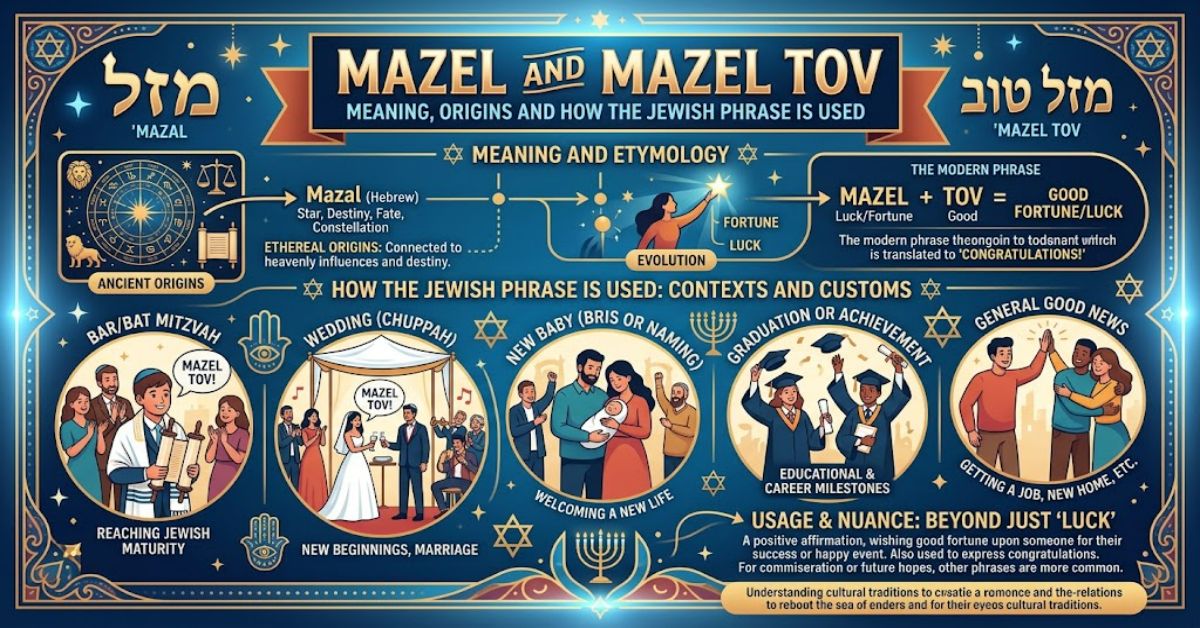
The phrase “mazel tov” is widely recognised as a Jewish expression of congratulations. It is commonly heard at weddings, bar and bat mitzvahs, births, graduations and other important milestones. The related spelling “mazal tov” is closer to modern Hebrew pronunciation, while “mazel tov” reflects the Yiddish-influenced form familiar to many English speakers. Cambridge Dictionary defines the expression as a Jewish way of conveying good wishes or approval, while dictionaries trace its origin to Hebrew, often through Yiddish.
The supplied keyword detail describes “Mazel tov” or “mazal tov” as meaning “good fortune” or “good stars”, while its practical English meaning is “congratulations”. That distinction is important because the phrase does not simply function as an equivalent of “good luck”. In Jewish usage, it commonly recognises that something fortunate has already happened.
The history behind the expression is equally interesting. The word mazal is associated with a constellation or celestial sign, while tov means good. The resulting expression can therefore be understood literally as “good constellation” or “good fortune”.
Understanding this background explains why the phrase carries a meaning that is richer than its everyday translation.
What Does Mazel Tov Mean?
In ordinary conversation, mazel tov means “congratulations”. Someone might say it after hearing about an engagement, a new job, a graduation, a wedding or another achievement.
The important nuance is that it generally acknowledges good fortune rather than predicting it.
For example, if a friend announces that they have graduated, saying “mazel tov” recognises the achievement. It is closer to “congratulations on this happy occasion” than to “I hope you get lucky”.
My Jewish Learning explains that the expression literally refers to a favourable constellation and that its modern congratulatory meaning developed over time.
| Expression | Common meaning | Literal or historical association |
| Mazel tov | Congratulations | Good fortune / good constellation |
| Mazal tov | Congratulations | Good fortune / good constellation |
| Mazal | Fortune or luck | Constellation or celestial sign |
| Tov | Good | Goodness or something favourable |
Mazel or Mazal: Which Spelling Is Correct?
Both forms are used.
“Mazal tov” reflects modern Hebrew pronunciation more closely. “Mazel tov” is particularly familiar in English and reflects the Yiddish and Ashkenazi pronunciation traditionally encountered in Jewish communities outside Israel.
Chabad explains that the modern Hebrew pronunciation places the emphasis on the second syllable, while the traditional Yiddish-influenced pronunciation places greater emphasis on the first.
Neither spelling should automatically be treated as incorrect. Language changes when words move between communities, alphabets and languages. The variation is therefore part of the phrase’s linguistic history.
For English-language writing, “mazel tov” is probably the most familiar spelling. “Mazal tov” is also widely understood and is especially useful when discussing the Hebrew form.
Where Does the Word Mazal Come From?
The deeper history begins with mazal.
The word is associated with constellations, zodiacal signs and fortune. Chabad describes mazal as literally relating to a constellation of stars, while explaining how the term came to be associated with luck and destiny.
This celestial background is significant because ancient and medieval Jewish thought included discussions about whether heavenly bodies influenced human affairs. That does not mean modern Jewish use of mazel tov is an endorsement of astrology. Instead, the expression preserves an older linguistic association that survived after its everyday meaning changed.
The phrase therefore provides an unusual example of how vocabulary can retain traces of older ideas even when speakers no longer interpret the words literally.
When Do People Say Mazel Tov?
Mazel tov is suitable for many forms of good news.
Common occasions include:
- Weddings: It is traditionally shouted or spoken after significant moments of the ceremony, including the breaking of the glass.
- Bar and bat mitzvahs: The phrase can mark a young person’s religious milestone.
- Births: It may be used to congratulate parents after the safe arrival of a child.
- Engagements: Announcing an engagement is a classic occasion for congratulations.
- Graduations: The phrase can recognise educational achievement.
- New jobs: It may be used when someone begins a new professional chapter.
- Homes and achievements: Buying a home, completing an important project or reaching another milestone can also prompt the expression.
Chabad lists weddings, births, bar and bat mitzvahs, new jobs and other milestones among occasions where the phrase is traditionally appropriate.
Is Mazel Tov the Same as Good Luck?
Not exactly.
This is one of the most common points of confusion. Although dictionaries may translate the phrase literally as “good luck” or “good fortune”, its everyday function is usually congratulatory.
Merriam-Webster defines mazel tov as an interjection used to express congratulations and records its first known English use in 1862.
That history helps explain why translating the phrase word for word can be misleading. “Good luck” in English often means a hope for something that has not happened yet. Mazel tov generally responds to favourable news that has already occurred.
That distinction is small in wording but important in social context.
A Cultural Example: Jewish Weddings
Jewish weddings provide one of the most recognisable settings for mazel tov.
At the conclusion of many Jewish wedding ceremonies, a glass is broken underfoot. Guests traditionally respond with a collective “Mazel tov!” The phrase therefore becomes part of the ceremony’s emotional rhythm rather than simply an individual greeting.
The expression’s role here demonstrates how language can become embedded in ritual. It does not merely communicate information. It helps a community mark an important transition.
The same principle applies to bar and bat mitzvah celebrations, births and other occasions. Saying mazel tov signals recognition that the event matters.
An Important Usage Distinction
There are circumstances in which Jewish speakers may choose another expression rather than mazel tov.
My Jewish Learning notes that some people avoid saying mazel tov to a pregnant woman because of traditional concerns about tempting fate. Instead, b’sha’ah tovah, meaning approximately “at a good time”, may be used while waiting for the birth. After a healthy birth, mazel tov becomes appropriate.
This example shows why cultural phrases should not always be treated as simple vocabulary equivalents. Their use can depend on timing, tradition and community practice.
How the Phrase Entered English
Mazel tov became established in English through contact with Jewish communities and Yiddish-speaking culture.
The Online Etymology Dictionary dates its English use to 1862 and describes its route through Yiddish from Hebrew mazzāl tōb, meaning good luck or good fortune.
Its survival in English is partly explained by the growing cultural visibility of Jewish celebrations and by the influence of Yiddish on English vocabulary.
Today, the phrase is familiar far beyond communities where Hebrew or Yiddish is spoken. It appears in newspapers, entertainment, popular culture and everyday conversation.
The Future of Mazel Tov in 2027
There is little reason to expect the phrase to disappear from everyday language by 2027. Its continued use is supported by two different strengths: it remains culturally important within Jewish communities while also being widely recognised in English.
The more interesting development is likely to be increased awareness of pronunciation and context. Digital communication makes it easier for people to encounter Hebrew and Yiddish expressions outside their original communities, but it can also flatten cultural distinctions.
Mazel tov is a useful example. A person may know that it means “congratulations” without knowing that mazal has a much older association with constellations and fortune.
Future cultural writing should therefore preserve both meanings: the phrase’s everyday function and its historical background.
Key Insights
- Mazel tov is best understood as congratulations rather than a simple wish for future luck.
- Mazel and mazal represent pronunciation and transliteration differences rather than completely different expressions.
- The word mazal has a historical association with constellations, fortune and celestial signs.
- The phrase entered English usage through Jewish and Yiddish cultural influence.
- Its meaning is shaped by context, especially during religious and family milestones.
- Jewish communities may use different expressions depending on the occasion and timing.
- The phrase demonstrates how older linguistic meanings can survive inside modern everyday speech.
Conclusion
“Mazel tov” is a short phrase with a surprisingly long history. Today, most people understand it as “congratulations”, and that is the meaning that matters in ordinary conversation. Yet its literal connection with good fortune and constellations reveals how language can preserve cultural ideas long after their original context has changed.
The difference between mazel and mazal is also useful to understand. Both forms refer to the same expression, with pronunciation and transliteration shaped by Hebrew, Yiddish and English usage.
From weddings and bar mitzvahs to graduations, births and professional achievements, mazel tov provides more than a translation of “congratulations”. It marks a moment as fortunate and worthy of recognition.
That combination of linguistic history, cultural tradition and everyday usefulness explains why the expression has remained familiar across generations and well beyond the communities in which it originated.
FAQ
What does mazel tov mean?
Mazel to’v means “congratulations” in everyday use. Its literal meaning is connected with good fortune or a good constellation.
Is mazel tov Hebrew or Yiddish?
The phrase originates in Hebrew, but the familiar English form was strongly influenced by Yiddish usage. “Mazal tov” more closely reflects modern Hebrew pronunciation.
What does mazel mean?
Mazel or mazal is historically associated with a constellation, celestial sign, fortune or luck. In the phrase mazel to’v, it is combined with tov, meaning good.
When should you say mazel to’v?
It can be used when congratulating someone on significant good news, including a wedding, engagement, birth, bar or bat mitzvah, graduation, new job or another important achievement.
Does mazel to’v mean good luck?
Literally, it can be translated as “good luck” or “good fortune”, but its usual conversational meaning is “congratulations”. It generally acknowledges good fortune that has already occurred.
How do you pronounce mazel to’v?
The Yiddish-influenced pronunciation is commonly rendered approximately as “MAH-zel tov”, while modern Hebrew uses “mah-ZAHL tov”.
Methodology
This article was developed from the RubbleMagazine keyword brief, which defines “mazel to’v” or “mazal tov” as a Jewish phrase literally associated with good fortune or good stars and commonly used to mean congratulations.
Linguistic and cultural claims were checked against My Jewish Learning, Chabad, Cambridge Dictionary, Merriam-Webster and the Online Etymology Dictionary. These sources were used to cross-check meaning, pronunciation, historical usage and common contexts.
The article does not claim firsthand attendance at Jewish ceremonies or personal experience with the phrase. Instead, documented cultural examples, including wedding and lifecycle contexts described by established Jewish educational sources, are used as the authority signals.
A limitation is that Jewish customs can differ between communities, denominations and family traditions. The article therefore avoids presenting every usage convention as universal.
References
Cambridge University Press. (2026). Mazel to’v. Cambridge Dictionary.
Harper, D. (n.d.). Mazel to’v. Online Etymology Dictionary.
Merriam-Webster. (2026). Mazel to’v. Merriam-Webster Dictionary.
My Jewish Learning. (n.d.). What does mazel to’v mean? My Jewish Learning.
Posner, M. (n.d.). What does “Mazel To’v” mean? Chabad.org.