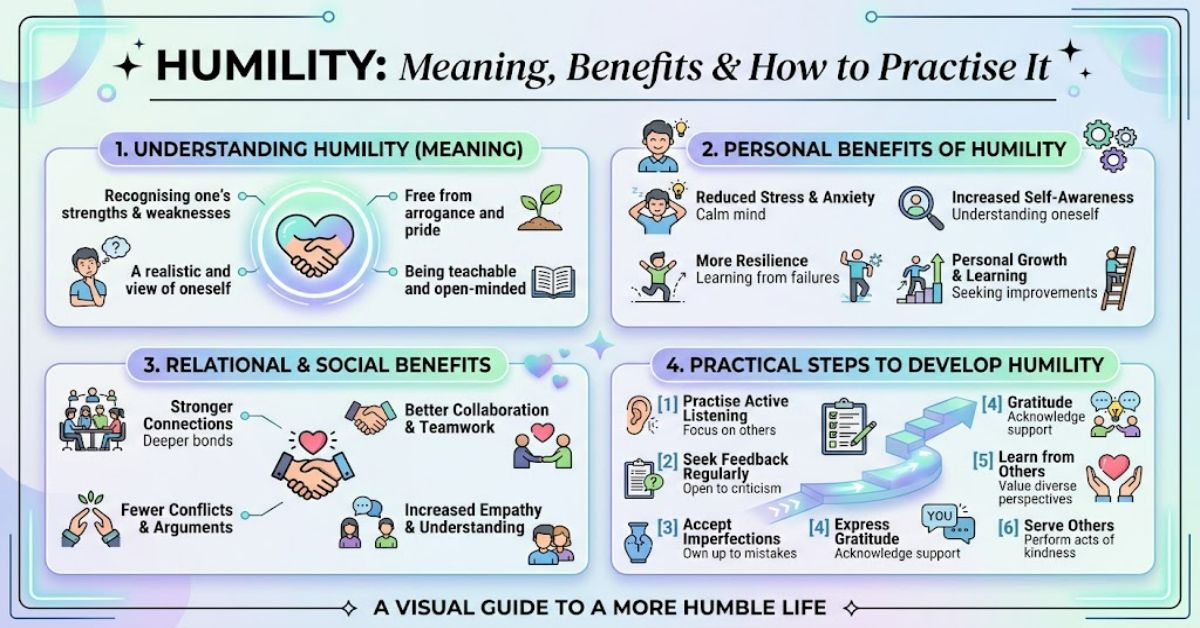
Humility is often described as modesty, but its meaning goes deeper. Humility is the quality of having an accurate, modest and grounded estimate of your own importance without arrogance or false pride. It allows people to recognise their achievements without believing those achievements make them superior to everyone else.
A humble person can be confident while still admitting mistakes. They can accept praise without needing constant attention. They can acknowledge their knowledge while recognising that there is always more to learn.
This balance makes humilit’y valuable in everyday life. It influences how people respond to criticism, deal with disagreements, approach education and work with others. It can also affect leadership because people are more likely to contribute when they feel that their ideas will be heard.
Humilit’y should not be confused with weakness. Someone does not need to hide their abilities or refuse recognition to be humble. Instead, the goal is an accurate understanding of both strengths and limitations.
Research into intellectual humilit’y has also expanded the discussion. Studies have examined whether recognising personal fallibility makes people more willing to investigate information that challenges their existing beliefs. Research into humble leadership has similarly explored connections between humilit’y, employee engagement, trust and workplace behaviour.
The result is a practical definition: humilit’y is not thinking less of yourself. It is thinking about yourself more accurately.
What Is Humility?
Humilit’y involves keeping your sense of personal importance in proportion.
A humble person can recognise genuine achievements without allowing those achievements to define their entire identity. They can say, “I did this well,” while also saying, “There are areas where I need to improve.”
This separates humilit’y from low self-esteem.
| Humility | Low Self-Esteem |
| Recognises strengths and weaknesses | Focuses heavily on weaknesses |
| Accepts praise comfortably | May reject or distrust praise |
| Admits mistakes | May see mistakes as personal failure |
| Respects other people’s abilities | May assume others are always better |
| Accepts constructive criticism | May feel personally threatened by criticism |
| Has realistic confidence | Often involves reduced confidence |
Humilit’y therefore does not require a negative view of yourself. In fact, people with healthy confidence may find it easier to practise genuine humilit’y because they do not need to constantly prove their worth.
Humility Is Not Weakness
A common misconception is that humble people are passive.
That is not necessarily true.
A humble manager can make difficult decisions. A successful professional can acknowledge their achievements. A talented student can be proud of good results. A business owner can confidently promote a successful product.
The difference is how achievement is interpreted.
Arrogance turns achievement into superiority. Humilit’y recognises achievement without using it as permission to diminish others.
Confidence and humilit’y can therefore exist together. Confidence asks, “Can I do this?” Humilit’y asks, “What might I be missing?”
Those questions complement one another.
Intellectual Humility and Learning
Intellectual humilit’y is the recognition that personal knowledge and beliefs can be incomplete or mistaken.
This is particularly important when people encounter information that conflicts with their existing opinions. Instead of immediately dismissing an opposing argument, an intellectually humble person considers whether there is evidence worth examining.
Research published in 2023 examined intellectual humilit’y and people’s willingness to investigate political misinformation. The findings suggested that recognising human fallibility could encourage people to investigate information that challenged their existing views.
A 2024 study on belief revision also found that people with higher intellectual humilit’y were more likely to explore information opposing false beliefs. However, the researchers did not conclude that humilit’y automatically produces belief change.
That distinction matters. Humilit’y does not mean believing every new claim. Critical thinking is still necessary.
A useful approach is to ask:
- What evidence supports my position?
- What evidence challenges it?
- What would make me change my mind?
- Am I rejecting this information because it is weak or because I dislike its conclusion?
- How confident should I actually be?
These questions turn humilit’y into a practical thinking habit.
Humility in Leadership
Leadership is one area where humilit’y can have a particularly visible effect.
A leader who admits mistakes, listens to employees and recognises the contributions of others can create a different workplace atmosphere from one where authority is constantly reinforced.
Research published in recent years has associated humble leadership with outcomes such as employee engagement, trust, job satisfaction, creativity and employee voice.
| Humble Leadership Behaviour | Possible Workplace Benefit |
| Admitting mistakes | Encourages accountability |
| Asking employees for ideas | Improves participation |
| Giving credit to others | Builds trust |
| Listening before deciding | Improves information flow |
| Accepting criticism | Supports learning |
| Revising decisions | Demonstrates adaptability |
However, humble leadership should not mean avoiding responsibility. Leaders still need to make decisions and provide direction.
The value comes from creating enough openness for useful information to reach the decision-maker.
The Risk of Too Much Humility
Humilit’y also has limits.
If humilit’y becomes constant self-doubt, it can stop being useful. A person who automatically assumes they are wrong is not necessarily more rational than someone who assumes they are always right.
Recent philosophical research has raised concerns about excessive intellectual humilit’y because extreme uncertainty may cause people to lose confidence in beliefs that are actually justified.
The goal should therefore be calibration.
If the evidence is weak, confidence should be limited. If the evidence is strong, confidence can reasonably be higher. Humilit’y means being willing to adjust that confidence when circumstances change.
This creates a healthier middle ground between arrogance and insecurity.
How to Practise Humility
Humilit’y can be developed through simple behaviours.
Listen before responding. Give people enough space to finish explaining their ideas before preparing your reply.
Admit mistakes. A quick acknowledgement is usually more constructive than a complicated excuse.
Ask questions. If someone knows more about a subject, use the opportunity to learn rather than pretending to understand.
Give specific credit. Recognise exactly what another person contributed instead of offering vague praise.
Accept useful criticism. Not every criticism is correct, but even an imperfect criticism may reveal something worth considering.
Separate confidence from certainty. You can believe that a decision is correct without claiming that it can never be wrong.
These habits make humilit’y visible through behaviour rather than words.
The Future of Humility in 2027
Humilit’y is likely to become increasingly relevant as artificial intelligence, misinformation and data-driven decision-making continue to influence everyday life.
AI systems can produce highly confident-sounding responses even when information is incomplete or incorrect. Users therefore need intellectual humilit’y when assessing automated information. Checking important claims and recognising uncertainty can help prevent misplaced confidence.
The same issue applies to workplaces. Having access to more information does not automatically produce better judgement. Leaders still need to recognise uncertainty, invite disagreement and remain willing to revise decisions.
By 2027, humilit’y may therefore be discussed less as a traditional personality virtue and more as a practical information skill. The strongest applications are likely to involve evidence checking, critical thinking, listening and responsible decision-making.
The exact impact remains uncertain. Humilit’y training may improve some behaviours, but measuring genuine internal change is more difficult than measuring whether someone simply uses modest language.
Key Takeaways
- Humilit’y is realistic self-awareness rather than self-criticism.
- It allows people to recognise achievements without becoming arrogant.
- Intellectual humilit’y encourages openness to information that challenges existing beliefs.
- Humilit’y should not become excessive self-doubt.
- Humble leadership can support trust, engagement and employee participation.
- Confidence and humilit’y can coexist.
- In an AI-driven information environment, intellectual humilit’y can help people question confident-sounding claims.
Conclusion
Humility is ultimately about proportion.
It allows people to recognise what they do well without exaggerating their importance and to acknowledge what they do not know without feeling ashamed. That balance can improve learning, relationships, leadership and personal decision-making.
Research into intellectual humility suggests that recognising personal fallibility may encourage people to investigate information that challenges existing beliefs. Research into humble leadership has also connected humble behaviour with several positive workplace outcomes.
Yet humility should not be taken to mean permanent uncertainty. Excessive humility can become self-doubt and may prevent people from trusting conclusions supported by strong evidence.
The healthiest approach is therefore balanced confidence. Know your strengths, acknowledge your limitations and remain open to correction.
A genuinely humble person does not need to become smaller. They simply understand their place more accurately and leave enough room to recognise the abilities, knowledge and experiences of other people.
FAQ
What is humility in simple terms?
Humility means having a realistic view of yourself. It involves recognising your strengths and achievements while accepting your limitations and remaining aware that you can make mistakes.
Is humility the same as low self-esteem?
No. Low self-esteem involves a negative evaluation of yourself, while humility involves realistic self-assessment. A humble person can have strong confidence and still recognise areas where they need to improve.
What is intellectual humility?
Intellectual humility is recognising that your knowledge and beliefs may be incomplete or incorrect. It encourages people to examine evidence, consider alternative viewpoints and revise conclusions when stronger evidence becomes available.
Why is humility important in leadership?
Humility can help leaders listen to employees, acknowledge mistakes, encourage participation and accept useful criticism. Research has associated humble leadership with outcomes including trust, engagement, job satisfaction and employee voice.
How can someone practise humility?
Start by listening carefully, asking questions, admitting mistakes, giving credit to others and accepting constructive feedback. It is also useful to distinguish confidence from absolute certainty.
Can a person be too humble?
Yes. Excessive humility can become self-doubt. Healthy humility aims for accuracy rather than automatically assuming that other people are better or that your own judgement is wrong.
Is humility useful when using artificial intelligence?
Yes. AI-generated information can sound convincing even when it contains errors. Intellectual humility encourages users to verify important claims, recognise uncertainty and remain open to correcting their conclusions.
Methodology
This article draws on psychological, philosophical and organisational research concerning humility, intellectual humility and humble leadership. Recent peer-reviewed studies and established psychological frameworks were prioritised.
The analysis distinguishes between general humility, intellectual humility and leadership humility because these concepts are related but not identical. Claims about research findings should be checked against the original publications before publication.
No fabricated personal testing, interviews or firsthand observations have been presented. The discussion of research is based on documented studies and published findings.
The evidence also has limitations. Humility is measured in different ways across academic disciplines, and associations between humility and positive outcomes do not automatically establish causation. Excessive humility may also produce negative effects in some circumstances.
Editorial Disclosure: This article was drafted with AI assistance and should receive human editorial review before publication. Statistics, research claims and references should be independently verified by the editorial team before publication.
References
American Psychological Association. (2018). Humility. APA Dictionary of Psychology.
Gollwitzer, A., Bao, E., & Oettingen, G. (2024). Intellectual humility as a tool to combat false beliefs: An individual-based approach to belief revision. British Journal of Social Psychology, 63, 1450–1478.
Hendy, N. T. (2024). Intellectual humility in the workplace. Encyclopedia, 4(4), 1857–1864.
Koetke, J., Schumann, K., Porter, T., & Smilo-Morgan, I. (2023). Fallibility salience increases intellectual humility: Implications for people’s willingness to investigate political misinformation. Personality and Social Psychology Bulletin, 49(5), 806–820.
Levy, N. (2023). Too humble for words. Philosophical Studies, 180, 3141–3160.
VIA Institute on Character. (2026). Humility character strength. VIA Institute on Character.
Zhong, J., Ma, C., Chen, G. X., Zhang, L., & Zhang, X. (2024). Humble leader, successful follower: Linking leader humility with follower career outcomes via leader competence from an implicit leadership theory perspective. Journal of Vocational Behavior, 155, 104060.