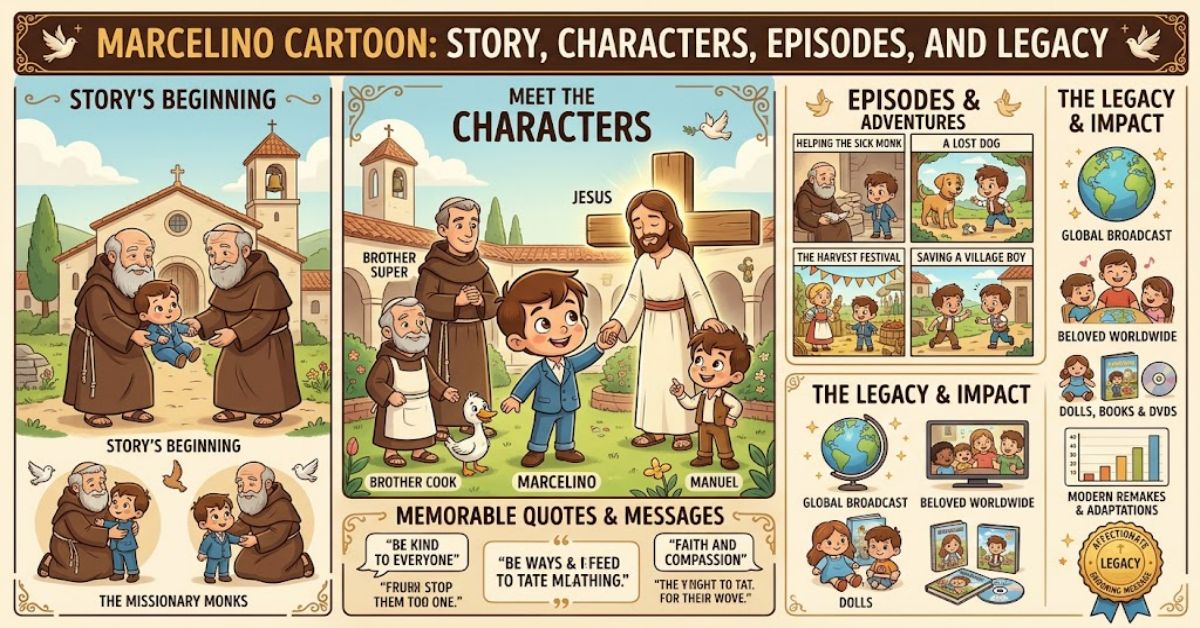
The Marcelino cartoon is the animated television adaptation of Marcelino Pan y Vino, the story created by Spanish writer José María Sánchez-Silva. First produced around 2000, the series reworked the familiar tale of a young abandoned boy who grows up in a monastery under the care of friars. It combines family entertainment with adventure, fantasy, comedy and moments of genuine emotional weight.
The television adaptation is particularly interesting because it was not the work of one country alone. Production involved companies and broadcasters from France, Spain and Japan, with additional international participation. Nippon Animation lists the programme as a 2000 family series with 26 episodes in its first production, while contemporary Spanish reporting documented its production involving VIP Toons, PMMP and Nippon Animation alongside TF1, TVE, RAI and Televisa.
The animated version also belongs to a much longer cultural history. Sánchez-Silva’s original Marcelino Pan y Vino was published in 1953 and had already become internationally recognised before the television series appeared. A famous 1955 film adaptation had also established Marcelino as a screen character decades earlier.
For viewers discovering the series today, that background explains why the cartoon can feel different from many conventional children’s programmes. Its central character comes from Spanish literature, its visual production reflects several animation traditions, and its stories mix childhood adventure with questions about family, faith, compassion and belonging.
What Is the Marcelino Cartoon?
Marcelino Pan y Vino is an animated television series based on José María Sánchez-Silva’s 1953 work. The first animated production was created around 2000 and was presented internationally under the title Marcelino Pan y Vino, with the shorter title Marcelino also used in some markets.
Nippon Animation identifies the programme as a family production from 2000 consisting of 26 episodes, each approximately 26 minutes long. Contemporary Spanish reporting similarly described the original television project as a 26-episode animated series.
The production is therefore best understood as an international animated adaptation, rather than simply a French cartoon. French companies and broadcasters played an important role, but Spanish and Japanese production partners were also central to the project.
That distinction matters because online descriptions sometimes reduce the series to a single national origin. Available production records show a more complicated structure.
Basic Series Information
| Element | Information |
| Original story | Marcelino Pan y Vino |
| Original author | José María Sánchez-Silva |
| Original literary work | 1953 |
| Animated production | 2000 |
| Primary genre | Family, adventure, fantasy |
| First production | 26 episodes |
| Main production partners | Nippon Animation, VIP Toons, PMMP and TF1 |
| Key directors | Santiago Moro and Xavier Picard |
| Character design | José Luis Moro |
| Original music | Josep Maria Bardagi and other contributors |
| Languages | Multiple international versions |
The Story Behind Marcelino
At the centre of the series is Marcelino, a young boy who is abandoned as a baby outside a monastery. The friars take responsibility for him and raise him within their community.
This premise gives the series its unusual emotional foundation. Marcelino is surrounded by adults who care for him, yet he remains curious about his origins and the identity of his mother.
Nippon Animation’s official programme description emphasises Marcelino’s relationship with animals, plants and the natural world. He can communicate with animals, and his curiosity repeatedly leads him into unexpected situations.
The animated series expands that basic premise into a wider adventure format. Rather than keeping Marcelino inside the monastery throughout the story, individual episodes take him into forests, villages and fantastical situations.
That expansion was an important adaptation choice. A short literary story can depend on atmosphere and symbolism, while a television series needs recurring characters, conflicts and episodic plots. The cartoon therefore turns Marcelino into an active young protagonist whose curiosity drives the narrative.
From Spanish Literature to International Animation
José María Sánchez-Silva’s original story appeared in 1953. According to contemporary reporting from El País, the work had been translated into more than 30 languages and received Spain’s National Literature Prize in 1957.
The character had already crossed into cinema before the animated series was developed. The best-known early screen adaptation was the 1955 film Marcelino Pan y Vino, directed by Ladislao Vajda.
That history gives the cartoon a useful place in adaptation studies. Marcelino was not invented for television. He moved through several media:
Novel → film → animated television series
Each transition changed the way the character could be presented.
The 2000 television version had to make Marcelino suitable for repeated episodic storytelling. Contemporary Spanish reporting said the animation project had been developing for years, with José Luis Moro involved from the earlier stages of development.
This long production period also illustrates one of the less obvious features of the series: traditional hand-drawn animation required considerable labour.
A report published by elDiario.es in October 2000 stated that each episode involved approximately 44,000 drawings and described the production as full animation. That figure helps explain why the series represented a substantial production undertaking for its period.
Who Created the Animated Series?
The series brought together several creative figures.
Santiago Moro and Xavier Picard were credited as directors, while Jaime de Armiñán was responsible for the scripts, with Gregorio Muro contributing to the early episodes. José Luis Moro handled character design.
This combination produced a distinctive European-Japanese production model.
Nippon Animation’s involvement is especially significant because the company had extensive experience in family animation. Its official programme page describes Marcelino as a cheerful and mischievous boy whose ability to communicate with animals shapes his adventures.
The production therefore combined a Spanish literary source with European development and Japanese animation expertise.
Production Structure
| Area | Main contribution |
| Literary foundation | José María Sánchez-Silva |
| Spanish production | VIP Toons and Spanish television partners |
| French participation | PMMP and TF1 |
| Japanese animation | Nippon Animation |
| Direction | Santiago Moro and Xavier Picard |
| Scriptwriting | Jaime de Armiñán |
| Character design | José Luis Moro |
| International broadcasting | Europe and other overseas markets |
This structure is one of the strongest reasons the series remains interesting from an animation-history perspective.
Marcelino’s Main Characters
Marcelino
Marcelino is the emotional centre of the series. He is curious, energetic and frequently mischievous, but his behaviour is generally driven by innocence rather than malice.
His questions about his origins also give the character a deeper dimension than a conventional cartoon protagonist.
Candela
Candela is one of the recurring figures connected to Marcelino’s wider world. Her presence helps introduce information about Marcelino’s history and adds another human dimension to the narrative.
The Friars
The monks are central to Marcelino’s upbringing. Rather than presenting the monastery simply as a backdrop, the series uses it as Marcelino’s home and social environment.
The friars provide discipline, affection and guidance while also becoming part of the comedy and everyday adventure.
Leo and the Animals
Animals are unusually important to the series because Marcelino can communicate with them.
This device allows the programme to move naturally between human and animal characters. It also makes nature part of Marcelino’s social world rather than merely scenery.
Duke Arthur Mostro and Other Antagonists
The series also introduces antagonists and recurring threats, including Duke Arthur Mostro and other figures who create conflict.
Their function is straightforward but important: they give the television adaptation an episodic adventure structure that differs from the quieter emotional core of the original story.
How Many Episodes Does Marcelino Have?
The safest way to understand the episode count is to distinguish between the original production and later material.
The first animated production consisted of 26 episodes. Nippon Animation’s official catalogue confirms this first production.
Later production expanded the television property. Anime Guides records 78 episodes across production years associated with 2000, 2004 and 2010, while other databases describe the programme as having three seasons.
This means references claiming 26, 52 or 78 episodes can appear contradictory when they are actually describing different stages of the series.
Marcelino Episode Structure
| Production period | Episode count | Context |
| 2000 | 26 | Original animated production |
| 2004 | 26 | Later production |
| 2010 | 26 | Additional production |
| Total commonly listed | 78 | Three 26-episode production blocks |
The distinction is useful for anyone trying to locate a particular episode. A search based only on “season one” may not correspond neatly with the way different broadcasters or databases catalogue the programme.
Why the Series Looks Different From Modern Cartoons
The visual language of the Marcelino cartoon reflects the period in which it was produced.
It belongs to the era of traditional television animation when hand-drawn production remained important. Contemporary Spanish reporting described the first series as full animation and cited tens of thousands of drawings per episode.
That helps explain its visual rhythm.
Modern children’s animation often relies heavily on digital pipelines, simplified shapes and efficient asset reuse. Marcelino’s early production belongs to a different production environment, where character movement and backgrounds could require extensive manual work.
The result is not necessarily “better” or “worse”. It is simply different.
For viewers returning to the series after many years, this difference can be part of its nostalgic appeal. The slightly softer visual movement and illustrated environments contribute to its identity as an early-2000s animated production.
Themes That Make Marcelino Stand Out
Family and Belonging
Marcelino’s abandonment is central to the story, but the series does not define family solely through biological relationships.
The friars become Marcelino’s caregivers, teachers and community. That creates an important distinction between biological origin and lived family experience.
Curiosity
Marcelino constantly asks questions. His curiosity is not treated simply as troublesome behaviour; it becomes the engine of discovery.
This makes the character particularly suitable for children’s television.
Compassion
Kindness is another recurring idea. The series frequently places Marcelino in situations where empathy becomes more important than strength.
Nature and Animals
Marcelino’s relationship with animals gives the series a strong ecological and imaginative dimension. Nature becomes a place of communication and discovery rather than a passive background.
Why the Marcelino Cartoon Still Attracts Interest
One reason the series continues to appear in searches is that it sits at the intersection of nostalgia and adaptation history.
Someone searching for the show may remember only a few details: a young boy, monks, a monastery, animals or a mysterious religious figure. Those fragments can make the programme difficult to identify because its title is less prominent in today’s mainstream animation catalogues.
There is also a language factor.
The first 26-episode run was adapted into several languages, including English, French, Spanish, Portuguese, Italian and Tagalog. This international distribution gave Marcelino a broader cultural footprint than the show’s current visibility might suggest.
Three Useful Insights for Viewers
| Insight | Why it matters |
| The show is internationally produced | Calling it only a French cartoon misses its Spanish and Japanese production history |
| Episode totals vary by source | Different totals usually reflect later production blocks rather than simple factual disagreement |
| Marcelino predates the cartoon | The television character belongs to a literary and cinematic tradition beginning in 1953 |
These points also explain why basic searches can produce inconsistent information.
The Cultural Impact of an International Children’s Series
The Marcelino cartoon demonstrates how stories can travel between countries without losing their central identity.
The original character came from Spanish literature. The television adaptation involved France, Spain and Japan. It was then distributed in multiple languages and broadcast through different national television systems.
That model was particularly valuable before today’s streaming-first environment.
A children’s programme could be developed across borders, localised into several languages and distributed through established broadcasters. The production itself therefore reflected the increasingly international nature of television animation at the turn of the millennium.
At the same time, the series retained specifically Spanish cultural foundations. The monastery setting, the source novel and the character’s history remained connected to Sánchez-Silva’s original work.
The Future of Marcelino in 2027
There is no strong evidence that a major new Marcelino animated revival is scheduled for 2027. It would therefore be misleading to predict a confirmed reboot, remake or new season.
The more realistic future is archival and digital discovery.
Older children’s programmes increasingly benefit from online databases, streaming catalogues and fan communities that help audiences identify shows remembered from childhood. Marcelino is well suited to this kind of rediscovery because its production history crosses several countries and languages.
The broader animation market also continues to value established intellectual property, but that does not mean every older property will receive a revival. A future Marcelino project would need to balance the emotional identity of the original with contemporary expectations around children’s programming.
The strongest realistic opportunity may therefore be improved preservation, legal availability and accurate metadata rather than an assumed remake.
Key Takeaways
- The Marcelino cartoon is based on José María Sánchez-Silva’s 1953 literary work.
- The first animated television production appeared around 2000.
- France, Spain and Japan were central to its production history.
- The first production contained 26 episodes.
- Later production expanded the series to a commonly listed total of 78 episodes.
- Marcelino’s relationship with the friars and animals forms the emotional and imaginative centre of the programme.
- Its continuing interest comes partly from nostalgia and partly from its unusual international adaptation history.
Conclusion
The Marcelino cartoon occupies an unusual place in children’s animation. It is neither simply a French production nor merely a Japanese-style animated series. Its identity was shaped by a Spanish literary source, European television partners and Japanese animation expertise.
The character’s story began with José María Sánchez-Silva’s 1953 work and had already reached cinema before television animation introduced Marcelino to another generation. The 2000 series expanded the original premise into an episodic world filled with adventure, fantasy, animals and recurring characters while retaining the central themes of family, curiosity and compassion.
Its production history is also important. The first 26 episodes required substantial animation work and were prepared for international distribution across multiple languages. Later production blocks expanded the programme further.
For viewers remembering Marcelino today, that combination of childhood nostalgia and genuine animation history explains why the series remains worth identifying and understanding.
Frequently Asked Questions
What is the Marcelino cartoon about?
The Marcelino cartoon follows an orphaned boy who is abandoned outside a monastery and raised by Franciscan friars. His curiosity leads him into adventures involving animals, nature, magic and other characters while he continues to wonder about his mother and origins.
Is Marcelino Pan y Vino a French cartoon?
It is more accurate to describe it as an international animated production. French companies and TF1 were important partners, but Spanish and Japanese organisations, including VIP Toons and Nippon Animation, also played major roles.
When was the Marcelino cartoon made?
The first animated production dates to 2000. Nippon Animation officially lists the programme as a 2000 family animation consisting of 26 episodes.
How many episodes does Marcelino have?
The first production had 26 episodes. Later production blocks were made in 2004 and 2010, bringing the commonly listed total to 78 episodes.
Who created Marcelino?
Marcelino originated in the 1953 story by Spanish writer José María Sánchez-Silva. The animated adaptation was directed by Santiago Moro and Xavier Picard, with scripts associated with Jaime de Armiñán and character design by José Luis Moro.
Is Marcelino based on a true story?
No. Marcelino is a fictional character from Sánchez-Silva’s literary work. The story has religious and cultural elements, but the character and his adventures are fictional.
Why do some sources list different Marcelino episode counts?
Different sources may describe different production periods or catalogue the programme differently. The original series had 26 episodes, while later production blocks increased the overall number commonly associated with the television franchise.
Methodology
This article was prepared by comparing official programme information from Nippon Animation with contemporary reporting from Spanish media and additional animation reference material. Production details, episode counts, broadcast history and the series’ literary origins were cross-checked where possible.
The primary production source was Nippon Animation’s official programme record. Contemporary reports from El País, Servimedia and elDiario.es were used to establish the historical context of the 2000 production, including its creators, broadcasters and production scale. Additional episode and international-production details were checked against animation reference databases.
A limitation is that international television catalogues do not always use identical season and episode numbering. For that reason, the article distinguishes the original 26-episode production from later blocks rather than treating every database’s total as identical.
No firsthand testing, interviews or field reporting were conducted, so none are presented as personal experience. The article relies on documented production records and historical reporting.
Editorial disclosure: This article was drafted with AI assistance and should be independently reviewed and verified by the RubbleMagazine.co.uk editorial team before publication.
References
El País. (2000, 12 October). Marcelino pan y vino, convertido en serie de dibujos con guiones de Armiñán.
Nippon Animation Co., Ltd. (n.d.). Marcelino Pan y Vino. Nippon Animation programme catalogue.
Servimedia. (2000, 11 October). TVE emitirá Marcelino, pan y vino en dibujos animados.
Servimedia. (2000, 14 October). TVE estrenará mañana la serie de dibujos animados “Marcelino, pan y vino”.
elDiario.es. (2000, 15 October). TVE estrena la serie de dibujos “Marcelino pan y vino”.
Anime Guides. (n.d.). Marcelino Pan y Vino. Animation reference database.
Sánchez-Silva, J. M. (1953). Marcelino Pan y Vino. Editorial Juventud.
Quality Control
- Single consistent author voice
- Entertainment category selected
- Core keyword used naturally
- Keyword included in H1, opening and metadata
- Comparison/structured tables included
- Evidence-backed analytical insights included
- Future of Marcelino in 2027 included
- Methodology included
- FAQ includes seven questions
- UK English conventions used
- No fabricated firsthand testing or interviews
- AI disclosure included
- Human editor verification required before publication
- APA references require final manual verification
- Author bio and credentials require editorial verification
- Internal links require final site-editor verification before publication