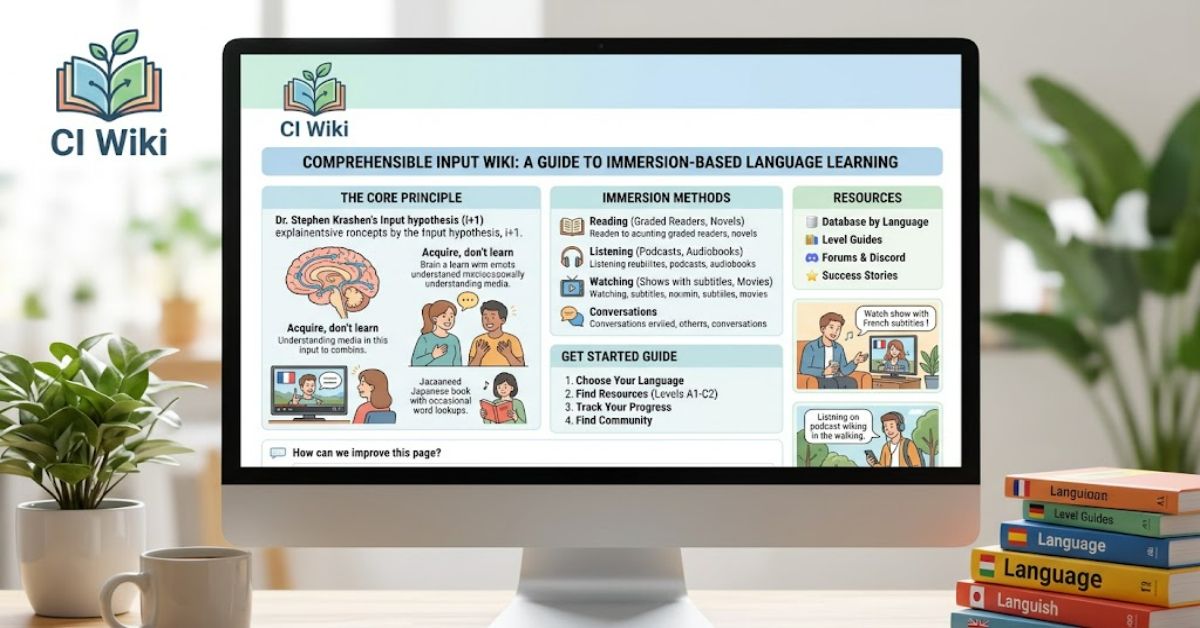
The Comprehensible Input Wiki is a community-driven database that helps language learners organise and discover immersion-based resources. Its central idea is straightforward: learners need access to material they can understand well enough to follow, while still encountering new vocabulary, structures and expressions.
The approach is closely associated with linguist Dr Stephen Krashen and his Comprehension Hypothesis. Krashen argued that language acquisition develops through understanding meaningful messages, with the well-known concept of i+1 describing input that extends slightly beyond a learner’s current level.
For modern learners, this creates a practical problem. The internet contains enormous quantities of language content, but abundance does not automatically make learning easier. A beginner who opens a native-level podcast may understand almost nothing. An advanced learner using only elementary materials may stop encountering enough new language to progress.
This is where curated resource systems become useful. Rather than treating immersion as simply consuming as much foreign-language content as possible, the Comprehensible Input Wiki approach centres on finding material that matches the learner’s current comprehension level.
That distinction matters. Comprehensible input is not the same as passive exposure. A film playing in the background may provide exposure, but if the learner cannot follow the message, its practical value may be limited. Equally, content does not need to be understood word for word to be useful. Context, images, prior knowledge and repetition can all help learners understand messages containing unfamiliar language.
What Is the Comprehensible Input Wiki?
The wiki functions as a community-organised reference point for immersion-based language learning resources. Its purpose is to make the search for suitable content more manageable.
Depending on the language and available entries, learners may encounter resources such as:
- Videos and video channels
- Podcasts and audio content
- Graded or level-appropriate reading
- Learner-focused immersion material
- Other resources organised around comprehension and accessibility
The important feature is the organisation principle. The value does not come simply from listing popular language-learning websites. The system is built around the question: Can the learner understand enough of this material for it to be useful?
That makes the resource particularly relevant for independent learners who want alternatives to a traditional textbook-led curriculum.
The Comprehension Hypothesis and i+1
Krashen’s Comprehension Hypothesis distinguishes between conscious learning and language acquisition. In his framework, acquisition develops when learners understand messages in the target language.
The concept often summarised as i+1 describes material that is slightly beyond a learner’s present linguistic competence. The “i” represents the learner’s current state, while the “+1” represents new language that can become understandable through context.
| Input Type | Likely Learning Experience |
| Far below current level | Comfortable but potentially limited new challenge |
| Around current level | High comprehension and consolidation |
| Slightly above current level | New language supported by context |
| Far above current level | Comprehension may break down |
The table is best treated as a practical model rather than a precise measurement system. There is no universal device that can calculate exactly what counts as one step above a learner’s level.
That is one of the first limitations learners encounter when applying i+1 in real life.
How Learners Can Use the Wiki Effectively
The best strategy is not to consume every available resource. Instead, learners can create a progression based on comprehension.
Start with understanding, not difficulty
A resource should not be selected simply because it is labelled “advanced” or “authentic”. If the learner cannot follow the main message, the material may create more frustration than useful engagement.
Use context as a learning tool
Visuals, familiar topics, recurring speakers and predictable formats all reduce the cognitive burden of understanding new language.
A cooking video, for example, may be easier to follow than an abstract discussion because actions and objects provide contextual support.
Revisit familiar material
One useful but often overlooked insight is that progression does not always require constantly finding new content. Returning to familiar material can reduce the effort needed to understand the overall message, allowing attention to shift towards vocabulary and grammar.
Track comprehension, not just hours
A learner can spend hundreds of hours with target-language media without knowing whether the material is appropriately challenging.
A simple question can be more useful than counting hours: Can I explain the main idea of what I just watched or read?
Comprehensible Input Wiki Compared with Traditional Study
| Approach | Main Strength | Main Limitation |
| Comprehensible input | Builds understanding through meaningful exposure | Progress can be difficult to measure |
| Grammar-led study | Provides clear explanations and structure | May not create enough meaningful exposure |
| Vocabulary memorisation | Efficient for targeted word learning | Isolated words may lack context |
| Full native immersion | Provides authentic language | Can overwhelm beginners |
| Blended approach | Combines exposure with targeted support | Requires more planning |
This comparison highlights an important practical point: comprehensible input does not have to compete with every other learning method.
Recent research provides evidence that explicit instruction can support second-language development. A meta-analysis covering 28 primary reports and 67 unique samples found significant positive effects from explicit instruction, although results varied according to factors such as instruction type, practice and treatment intensity.
For learners, this suggests that an either-or debate may be less useful than asking which tool solves a particular problem.
Three Important Insights Often Missed
1. Resource discovery is a real learning bottleneck
Language learners often spend substantial time searching for suitable material. A community database can reduce this friction by helping learners move more quickly from searching to actual exposure.
The challenge, however, is that community-maintained directories require regular updating. A resource that was useful when added may later disappear, change format or become less suitable.
2. “Authentic” does not automatically mean “better”
Authentic native-level content is valuable, but it is not always the best starting point.
A recent network meta-analysis of 34 eligible studies involving 4,742 participants found that both simplified and elaborated texts were significantly more comprehensible than authentic texts for L2 reading, with simplified texts marginally more comprehensible than elaborated versions.
The practical implication is clear: simplified material should not automatically be treated as inferior. For learners below advanced level, accessibility can be a strength.
3. Comprehension and acquisition are not identical measurements
Understanding a video today does not guarantee that every new word or grammatical pattern will become permanently available for future use.
This creates a useful workflow: combine understandable input with repetition, targeted review and opportunities to notice recurring language. The input remains central, but the learner also builds a system for retaining what repeatedly appears.
Risks and Trade-Offs
The main risk of the comprehensible-input approach is misjudging difficulty.
Material that feels comfortable may eventually become too easy. On the other hand, constantly choosing highly difficult material can make immersion feel like decoding rather than understanding.
There is also a quality-control issue with community-driven databases. Categories, level labels and recommendations may reflect contributor judgement rather than standardised proficiency testing.
That does not make community curation unreliable by definition. It means learners should treat recommendations as starting points and evaluate their own comprehension.
Another trade-off concerns explicit instruction. Learners who rely exclusively on immersion may struggle with particular features they need to understand for examinations, professional writing or formal accuracy. Research on explicit instruction indicates that direct teaching can make a meaningful contribution to L2 development.
Real-World Impact on Independent Language Learning
The growth of online video, podcasts and digital reading has changed the practical meaning of immersion.
Previously, many learners had limited access to target-language media outside classrooms, libraries or physical broadcasts. Today, the challenge is often the opposite: filtering an overwhelming supply of content.
Community-organised databases can therefore act as navigation systems.
The Comprehensible Input Wiki represents a broader shift towards learner-built infrastructure. Instead of depending entirely on a single course provider, independent learners can combine resources from multiple creators and formats.
This flexibility is powerful, but it transfers responsibility to the learner. There may be no teacher automatically adjusting the level, correcting misunderstandings or deciding when it is time to progress.
The Future of Comprehensible Input Wiki in 2027
By 2027, the need for organised language-learning resources is likely to remain strong. Digital content continues to expand, while immersive technologies are also attracting research interest in language education. A 2024 systematic review examined the effectiveness of immersive learning technologies in K–12 English as a second language learning, reflecting continued interest in technology-supported immersion.
The most likely development is not that one method replaces every other method. Instead, learners may increasingly combine curated input with adaptive technology, progress tracking and targeted instruction.
The limitation will remain quality control. As resource libraries grow, maintaining accurate categorisation and checking whether materials remain available becomes a significant organisational task.
Community-driven projects can be highly useful, but their long-term value depends on active maintenance and transparent recommendations.
Key Takeaways
- The Comprehensible Input Wiki is designed to organise immersion-based language resources around learner comprehension.
- Its educational philosophy is closely linked to Stephen Krashen’s Comprehension Hypothesis and the idea of i+1.
- The best material is not necessarily the hardest or the most “authentic”; it must remain understandable.
- Simplified and elaborated texts can improve comprehension compared with unaided authentic texts.
- Explicit instruction also has evidence supporting its role in second-language development.
- A blended learning system may help learners combine meaningful exposure with targeted support.
Conclusion
The Comprehensible Input Wiki addresses a practical problem at the centre of independent language learning: finding enough material that is interesting, accessible and appropriate for the learner’s current level.
Its connection to the Comprehension Hypothesis gives the project a clear educational framework. The aim is not simply to expose learners to more language, but to help them find messages they can understand while continuing to encounter new linguistic material.
The strongest practical lesson is that comprehensible input should not be confused with effortless learning. Learners still need to make choices about level, repetition, attention and progression. They may also benefit from explicit instruction when accuracy or specific language features require focused attention.
For that reason, the most sustainable approach is often flexible rather than ideological. Immersion can provide the language environment, while other methods can address gaps that exposure alone does not immediately solve.
FAQ
What is the Comprehensible Input Wiki?
The Comprehensible Input Wiki is a community-driven database that organises immersion-based resources for language learners. Its purpose is to help learners find listening, viewing and reading material that they can understand at their current stage of development.
What does comprehensible input mean?
Comprehensible input is spoken or written language that a learner can understand even when some words or structures are unfamiliar. Context, images, prior knowledge and repeated exposure can help make new language understandable.
What does i+1 mean in language learning?
The term i+1 is associated with Stephen Krashen’s Input Hypothesis. It describes language input that is slightly beyond a learner’s current level but remains understandable through context and existing knowledge.
Is comprehensible input enough to learn a language?
Comprehensible input can be an important part of language acquisition, but research also supports explicit instruction as an effective contributor to L2 development. A learner may benefit from combining meaningful exposure with targeted teaching and practice.
Is the Comprehensible Input Wiki suitable for beginners?
It can be useful for beginners if resources are available at an appropriate level. Beginners should prioritise material with strong contextual support, such as visuals, predictable topics and repeated vocabulary.
Are simplified texts useful for language learners?
Yes. Research synthesising controlled studies found that simplified and elaborated texts were significantly more comprehensible than authentic texts for L2 reading, with simplified texts showing a small advantage over elaborated versions.
Methodology
This article was developed from the supplied topic description and then checked against published material on comprehensible input, Krashen’s Comprehension Hypothesis and recent research on second-language instruction. Krashen’s own published discussion of the Comprehension Hypothesis was used for theoretical context, while recent meta-analytic and systematic-review evidence was used to test where a pure input-focused approach may have limitations.
The analysis does not claim personal testing of the Comprehensible Input Wiki or present invented user experiences. A key limitation is that community-driven resources can change over time, including their categorisation and availability. The article therefore treats the wiki as a discovery framework rather than a guarantee of learning outcomes.
References
Kim, H. S., Lee, J. H., & Lee, H. (2024). The relative effects of L1 and L2 glosses on L2 learning: A meta-analysis. Language Teaching Research, 28(1), 7–28.
Krashen, S. (2008). Language education: Past, present and future. Language Teaching, 39(2). Sage Publications.
Li, F., & Sun, Y. (2024). Effects of different forms of explicit instruction on L2 development: A meta-analysis. Foreign Language Annals.
Murphy, A., & Arciuli, J. (2024). Digital reading comprehension instruction in English for children with English as an additional language: A systematic review. Journal of Research in Reading.
Weng, Y., Schmidt, M., Huang, W., & Hao, Y. (2024). The effectiveness of immersive learning technologies in K–12 English as second language learning: A systematic review. ReCALL.