If you are preparing a university application or applying for a job, you may wonder what is a personal statement example and what makes one effective. A personal statement is a short, focused essay that introduces your background, skills, interests and goals to an admissions committee or hiring manager. Its purpose is to give the reader a clearer picture of you beyond grades, qualifications or employment history.
A good personal statement does not need to tell your entire life story. Instead, it selects the experiences and qualities that are most relevant to the opportunity. For a university application, this could mean discussing academic interests, relevant experiences and reasons for choosing a subject. For employment, the emphasis may be on professional strengths, achievements and career ambitions.
The strongest statements are usually specific, organised and authentic. They show rather than simply claim qualities. Instead of writing, “I am hardworking”, an applicant might describe a project that required sustained effort and explain what they learned from completing it.
The exact requirements vary depending on the institution, course, employer or application system. However, the basic principle remains consistent: the statement should explain who you are, what you can offer and why the opportunity matters to you.
What Is a Personal Statement?
A personal statement is a written introduction designed to provide context about an applicant.
It is normally more personal than a CV but more focused than a general autobiography. The writer chooses relevant experiences and uses them to demonstrate qualities, motivation and suitability.
| Purpose | What to Discuss |
| University application | Academic interests, relevant experience and subject motivation |
| Job application | Skills, achievements, experience and career objectives |
| Scholarship | Achievement, motivation, contribution and future plans |
| Internship | Relevant skills, learning goals and practical experience |
| Course application | Interest in the subject and preparation for study |
The central question should always be: Why should the reader believe that this applicant is a good fit?
A personal statement works best when each paragraph contributes something useful towards answering that question.
What Does a Good Personal Statement Example Include?
Although formats differ, most effective statements contain several common elements.
A Clear Opening
The opening should establish the applicant’s motivation without relying on clichés.
For example, rather than beginning with “I have always wanted to study business”, an applicant could explain how managing a small school project introduced them to budgeting, planning and decision-making.
The second approach gives the reader something concrete.
Relevant Experience
Experience does not have to come from formal employment.
It may include:
- School or university projects
- Volunteering
- Part-time employment
- Internships
- Competitions
- Clubs and societies
- Independent research
- Community activities
The important factor is relevance. The writer should explain what the experience demonstrates rather than simply naming it.
Skills and Evidence
A statement becomes more convincing when skills are supported by examples.
| Skill | Weak Approach | Stronger Approach |
| Leadership | “I am a good leader.” | Explain how you organised a team project. |
| Communication | “I communicate well.” | Describe presenting research to an audience. |
| Organisation | “I am organised.” | Explain how you managed competing deadlines. |
| Problem-solving | “I solve problems effectively.” | Describe a specific challenge and your solution. |
| Teamwork | “I work well with others.” | Show how you contributed to a group outcome. |
This evidence-based approach makes the statement more credible.
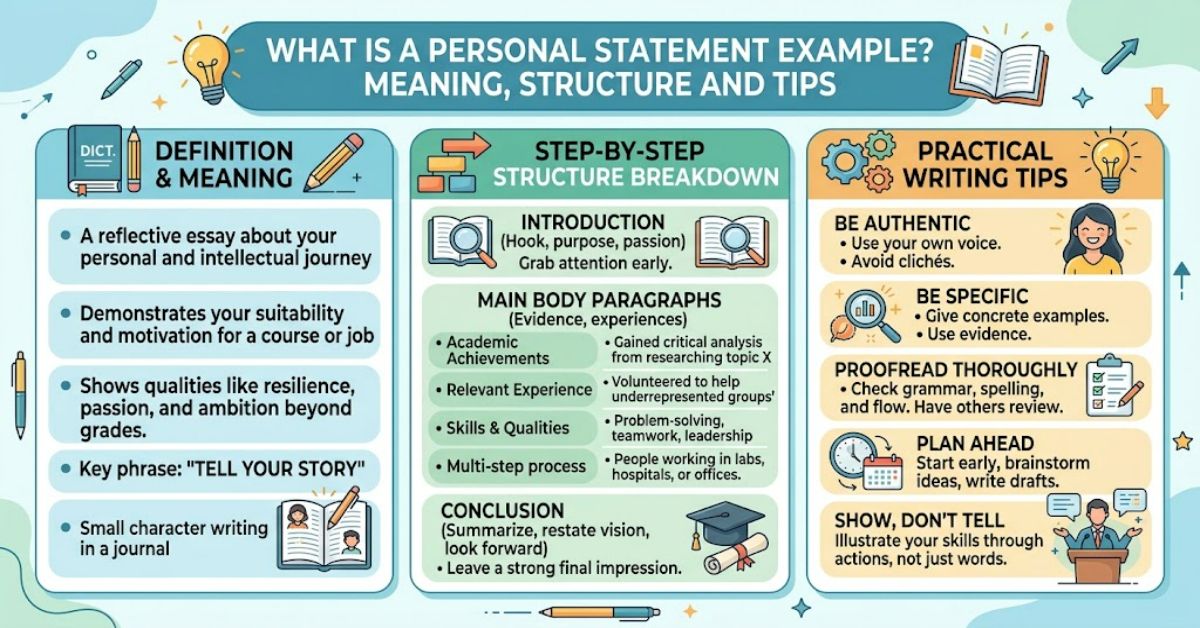
How to Structure a Personal Statement
A simple five-part structure can make drafting easier.
1. Introduction
Explain what interests you about the course, role or opportunity.
2. Background
Discuss relevant academic, professional or personal experiences that helped develop your interest.
3. Skills
Identify two or three important strengths and support them with evidence.
4. Future Goals
Explain what you hope to achieve and how the opportunity fits into those plans.
5. Closing
Finish by reinforcing your motivation and suitability without repeating the entire statement.
This structure is flexible. Some applications require a specific format, so applicants should always follow the instructions provided by the university or employer.
A Short Personal Statement Example
Consider an applicant applying for a business management course:
My interest in business developed through organising fundraising activities at college, where I became interested in budgeting, promotion and customer behaviour. Managing these activities taught me that successful projects require more than a good idea; they depend on planning, communication and careful use of resources. I have since developed my interest by reading about marketing and completing a research project on changing consumer habits. These experiences have strengthened my analytical and organisational skills and confirmed my desire to study business management. I hope to develop a stronger understanding of strategy, finance and marketing while gaining the knowledge needed for a future career in business.
This example is effective because it connects experience, learning, skills and future goals. It does not simply claim that the applicant is motivated or hardworking.
Common Mistakes to Avoid
Understanding what is a personal statement example also means recognising what makes a statement ineffective.
Using clichés: Phrases such as “I have always dreamed of…” can sound generic when they are not supported by evidence.
Repeating the CV: A statement should add context rather than copy employment dates and qualifications.
Writing too broadly: Trying to discuss every achievement can make the statement unfocused.
Making unsupported claims: Saying you are creative, organised or determined is less convincing than showing these qualities through examples.
Ignoring the audience: A university admissions team and a hiring manager are looking for different forms of evidence.
Failing to proofread: Spelling, grammar and punctuation errors can distract from otherwise strong content.
Why Specific Examples Matter
One of the most important lessons for applicants is that evidence is stronger than description.
Suppose two applicants both write that they have excellent communication skills.
The first writes:
“I have excellent communication skills and enjoy working with people.”
The second writes:
“During a college presentation, I translated complex research into a short briefing for an audience unfamiliar with the subject.”
The second example provides evidence. The reader can see how the skill was used rather than simply being asked to accept the claim.
This principle applies across applications. Whenever possible, connect a quality to an action, situation or result.
Personal Statements for University and Employment
The emphasis changes according to the purpose of the application.
For university, academic curiosity and subject-specific motivation are usually important. Applicants should demonstrate that they understand what they are applying to study.
For employment, professional relevance becomes more important. The applicant should show how previous experience, transferable skills and achievements relate to the position.
| Application Type | Main Focus |
| University | Academic motivation and preparation |
| Graduate role | Education, transferable skills and career direction |
| Experienced role | Professional achievements and specialist skills |
| Internship | Potential, relevant experience and learning goals |
| Scholarship | Achievement, motivation and future contribution |
A strong statement therefore cannot simply be copied from one application to another.
How to Improve Your Draft
After writing the first version, review every paragraph and ask three questions:
- Does this information help explain my suitability?
- Have I provided evidence for important claims?
- Does this paragraph add something that the previous paragraph did not?
Remove anything that does not serve a clear purpose.
It is also useful to read the statement aloud. Awkward sentences, unnecessary repetition and overly complicated wording often become easier to identify when heard rather than silently read.
Finally, check the application’s exact requirements. Word limits, formatting rules and questions vary, and failing to follow instructions can weaken an otherwise strong application.
The Future of Personal Statements in 2027
Personal statements are likely to continue changing as universities and employers place greater emphasis on skills, evidence and authenticity.
Digital application systems may increasingly use structured questions alongside traditional free-text statements. This could make applications easier to compare while reducing the space available for generic personal writing.
Artificial intelligence is another important consideration. Applicants may use AI tools to brainstorm, edit or organise their ideas. However, a statement that does not accurately represent the applicant’s own experiences can create problems, particularly where institutions have rules concerning originality and acceptable assistance.
The most valuable personal statements in 2027 are therefore likely to remain those grounded in genuine experience. Technology can help improve clarity, but it cannot replace the applicant’s own evidence, motivation and perspective.
Key Takeaways
- A personal statement introduces an applicant beyond basic qualifications or employment history.
- Strong statements use specific examples rather than unsupported descriptions.
- Experiences should be connected to skills, lessons and future goals.
- University and employment statements require different emphasis.
- Generic clichés can make an application less distinctive.
- Editing and proofreading are essential before submission.
- Authenticity remains more valuable than unnecessarily complicated language.
Conclusion
A personal statement is an opportunity to explain the person behind an application. The best examples are focused, evidence-based and tailored to the audience. They do not attempt to impress through complicated vocabulary or exaggerated claims.
Instead, they show how experiences have shaped interests, developed skills and influenced future ambitions.
Whether the application is for university, employment, an internship or a scholarship, the same principle applies: relevance matters. Choose experiences that support your argument, explain what you learned and connect those lessons to the opportunity.
If you are still wondering what is a personal statement example, think of it as a concise argument for your suitability. It should answer three basic questions: who are you, what have you learned or achieved, and why are you prepared for the next opportunity?
A clear answer to those questions can turn a collection of experiences into a persuasive and memorable application.
FAQ
What is a personal statement example?
A personal statement example is a sample of the type of focused writing used to introduce an applicant’s background, skills, interests and goals. It demonstrates how relevant experiences can be connected to an application.
What should a personal statement include?
It should normally include relevant experience, skills, motivation and future goals. The exact content depends on whether the statement is being used for university, employment, a scholarship or another application.
How long should a personal statement be?
There is no universal length. Requirements vary between universities, employers and application systems. Always follow the specific word or character limit given in the application instructions.
How do I start a personal statement?
Begin with a specific reason for your interest in the subject, role or opportunity. Avoid generic openings and introduce an experience, question or motivation that genuinely connects to your application.
Can I use the same personal statement for different applications?
You can reuse useful ideas, but copying the entire statement is usually ineffective. Different courses and employers have different requirements, so each application should be tailored to its audience.
What makes a personal statement strong?
A strong statement is specific, relevant and authentic. It supports claims with real examples, explains what the applicant learned and connects previous experiences with future goals.
Methodology
This article was prepared as an educational explainer focused on the structure, purpose and practical use of personal statements. The guidance distinguishes between university, employment, scholarship and internship applications because requirements differ between contexts.
No fabricated applicant experience, admissions outcome or employer assessment has been presented as firsthand evidence. The sample statement is an original illustrative example created to demonstrate structure and writing technique.
Application requirements can change between institutions and recruitment systems. Readers should therefore check the current instructions provided by the specific university, employer or organisation before submitting a statement.
Editorial Disclosure: This article was drafted with AI assistance and should be reviewed by a human editor before publication. Any institution-specific requirements should be checked against the relevant organisation’s current guidance.