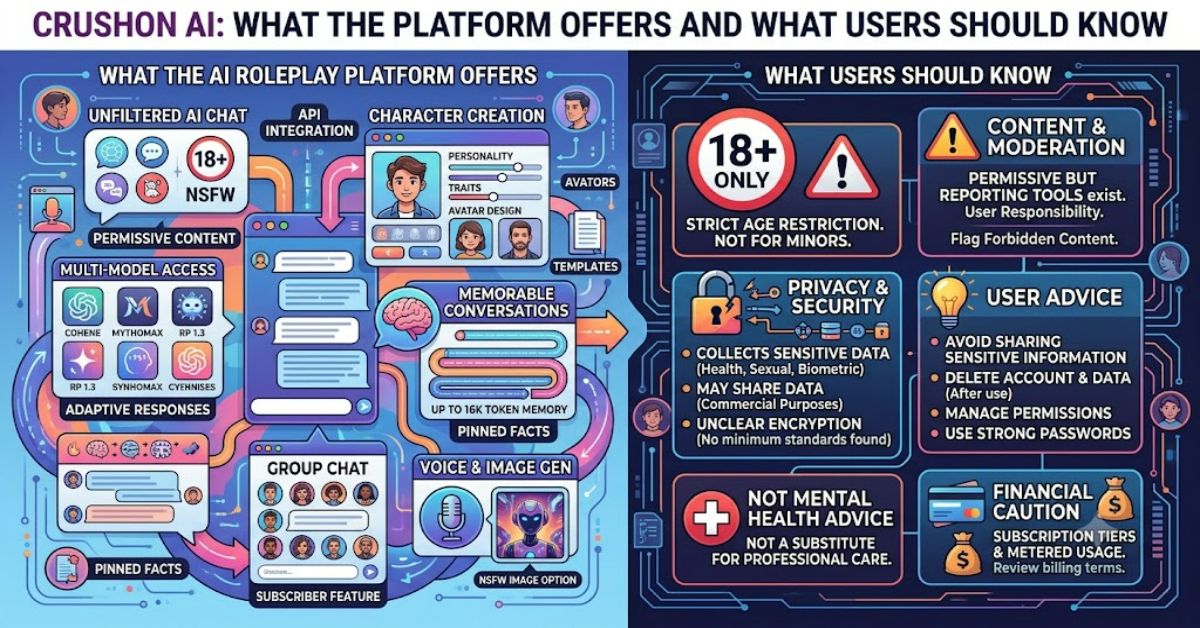
CrushOnAI is an AI companion and roleplay platform designed around conversations with fictional and user-created characters. Instead of treating an AI chatbot mainly as a productivity assistant, the service focuses on character simulation, storytelling and immersive dialogue. Users can select existing personalities or create their own, making the experience closer to interactive fiction than a conventional question-and-answer chatbot.
The platform has become particularly associated with its relatively permissive approach to adult roleplay. However, describing it simply as a “no-filter” chatbot misses an important distinction: CrushOn still has community rules and prohibits illegal activities and certain harmful uses. Its published rules state that the service is available only to users aged 18 or older.
That positioning places CrushOnAI within a wider category of role-playing language agents. Academic research describes these systems as AI designed to simulate assigned personas, ranging from fictional characters to personalised companions. Their growing popularity reflects a broader shift from generic chatbot interactions towards character-based experiences.
For prospective users, therefore, the interesting question is not simply whether CrushOnAI is unrestricted. It is how its character library, customisation, conversational models and content policies combine to create a particular type of AI experience.
What Is CrushOnAI?
CrushOnAI is built around AI characters rather than a single general-purpose assistant. A user can browse available personalities, begin a conversation and guide the interaction through prompts and roleplay scenarios.
The platform’s strongest differentiator is its emphasis on creative freedom. Users looking for fantasy, anime-inspired characters, fictional personalities or relationship-oriented scenarios may find the format more suitable than mainstream assistants with stricter conversational boundaries.
Research into role-playing AI helps explain why this model works. Large language models can reproduce particular speech patterns, personality traits and behavioural instructions, creating the impression that the user is interacting with a distinct persona rather than an anonymous chatbot.
That distinction matters. The value of a roleplay platform depends less on simply generating grammatically correct text and more on maintaining character identity, context and narrative continuity.
How the Platform Differs From Conventional AI Chatbots
A conventional AI assistant is usually judged by accuracy, productivity and factual usefulness. A roleplay platform has different performance criteria.
| Area | Conventional AI Assistant | CrushOnAI-Style Roleplay |
| Main purpose | Information and productivity | Character interaction and roleplay |
| Conversation style | Task-oriented | Persona-driven |
| Customisation | Usually moderate | Character and scenario focused |
| Content boundaries | Often restrictive | More permissive, while still subject to rules |
| Success measure | Accuracy and usefulness | Immersion and character consistency |
| Typical use | Research, writing, planning | Storytelling, simulation and companionship |
This difference explains why users may prefer a specialist platform even when general-purpose AI systems are technically more capable.
Character Creation and Personalisation
Character customisation is one of the most important parts of the experience.
A well-designed character can have a defined personality, background, speaking style and behavioural pattern. The user can then construct a scenario around those traits. This makes the interaction more participatory: rather than receiving a fixed chatbot response, the user helps shape the fictional environment.
The underlying technology is not unique to CrushOnAI. Research into role-playing language agents shows that persona information can influence generated behaviour, although current systems still have significant limitations in maintaining consistent character decisions.
That limitation becomes particularly noticeable during long conversations. An AI may remember the broad scenario while losing smaller details, changing its personality or producing responses that feel repetitive.
Why the Less Restrictive Model Appeals to Users
Many users are attracted to CrushOnAI because mainstream AI services often place firm boundaries around romantic, violent or adult-oriented conversations.
A less restrictive environment gives users more room for fictional storytelling. Independent reviews published in 2026 commonly identify content freedom and character variety as major strengths, while also reporting concerns about memory, consistency and pricing structures.
There is a wider cultural reason for this demand. Research published in 2026 examining intimate AI roleplay found that users are interested in immersive fantasy and defined interpersonal scenarios, while also highlighting the difficulty of designing appropriate safety features for these interactions.
The lesson is straightforward: openness is attractive, but openness does not remove the need for boundaries.
Risks and Trade-Offs
The biggest mistake a user can make is assuming that an AI companion is equivalent to a private human conversation.
Privacy deserves particular attention. Users may disclose personal preferences, relationship details, emotional experiences or other information while interacting with an AI character. That makes sensible digital hygiene important.
Another issue is content exposure. Because community-created characters can cover a wide range of subjects, users need to understand that not every character or scenario will suit every audience.
CrushOn’s own rules prohibit illegal activities and state that the service is restricted to adults.
There is also a quality trade-off. Reviews in 2026 have pointed to inconsistent memory and character continuity. A platform can offer thousands of scenarios, but quantity does not guarantee narrative quality.
Structured Insight Table
| Factor | Potential Advantage | Potential Limitation |
| Character variety | More choice | Quality can vary |
| Flexible roleplay | Greater creative freedom | Greater exposure to unsuitable material |
| Personalisation | More immersive scenarios | Requires careful prompting |
| Long conversations | Stronger sense of continuity | Memory may weaken over time |
| Adult orientation | Clear audience positioning | Not appropriate for minors |
The Practical Meaning of “AI Companion”
The phrase “AI companion” can create unrealistic expectations. These systems generate responses based on models, prompts and available conversational context. They can simulate empathy and personality, but simulation is not the same as human understanding.
That distinction becomes especially important when conversations become emotionally significant.
The most productive way to approach CrushOnAI is therefore as an interactive digital experience. It can support fictional storytelling, experimentation with characters and recreational conversation. It should not be treated as a substitute for professional support, genuine relationships or human judgement.
The Future of CrushOnAI in 2027
The future of CrushOnAI will depend on how the wider AI companion market balances freedom with safety.
Regulation and public scrutiny are already pushing AI companies towards stronger age controls and more structured experiences. Competing platforms have introduced additional restrictions around younger users as concerns about chatbot interactions have intensified.
At the same time, research suggests that role-playing agents will continue improving through better persona modelling, memory retrieval and contextual reasoning.
For CrushOnAI, the likely challenge is maintaining its appeal for users seeking creative freedom without allowing openness to undermine user safety. Better memory, stronger character consistency and clearer privacy controls could matter as much as larger character libraries.
Key Takeaways
- CrushOnAI is primarily a character-interaction platform rather than a general productivity assistant.
- Its adult-only positioning is an important part of its current identity.
- User-created characters provide substantial creative flexibility.
- More permissive moderation creates both opportunities and safety responsibilities.
- Memory and character consistency remain important technical limitations across roleplay AI.
- Users should avoid sharing sensitive personal information simply because a conversation feels private.
- The next stage of competition is likely to centre on quality, personalisation, safety and long-term memory.
Conclusion
CrushOnAI represents a distinct branch of the AI market: one where the central product is not factual assistance but simulated interaction. Its character-based design, customisation and permissive approach make it attractive to users interested in roleplay and fictional conversation.
That freedom also creates responsibilities. The platform remains an adult service with published community rules, and users should understand that AI conversations are generated interactions rather than human relationships. Privacy, content boundaries and the possibility of inconsistent character behaviour all deserve consideration.
The broader technology is developing quickly. Research into role-playing language agents shows genuine progress in persona simulation, but also confirms that consistency and decision-making remain imperfect.
Ultimately, CrushOnAI is best understood as an entertainment and creative roleplay environment. Its appeal comes from giving users greater control over the characters and scenarios they explore, while its long-term success will depend on how effectively it balances that freedom with reliability and responsible platform design.
FAQ
What is CrushOnAI?
CrushOnAI is an AI character and roleplay platform where adults can interact with fictional and user-created AI personalities. Its focus is immersive conversation rather than general productivity.
Is CrushOnAI an AI companion platform?
Yes. It fits within the broader AI companion and role-playing language agent category, allowing users to have personalised conversations with simulated characters.
Is CrushOnAI suitable for children?
No. CrushOnAI’s published community rules state that the service is available only to users aged 18 and older.
Why is CrushOnAI popular for roleplay?
Its appeal comes from character variety, customisation and a comparatively permissive approach to roleplay. Users can explore fictional scenarios that may be restricted on more tightly moderated platforms.
Does CrushOnAI always remember previous conversations?
Not necessarily. Independent 2026 reviews have identified memory and contextual consistency as limitations that can affect longer roleplay sessions.
Is CrushOnAI completely without rules?
No. Although it is known for a permissive content approach, the platform has community rules and prohibits certain illegal or harmful activities.
Methodology
This article was prepared using publicly available information about CrushOnAI, its published community rules, current 2026 third-party assessments and academic research into role-playing language agents and AI-mediated relationships. The analysis separates documented platform characteristics from broader observations about conversational AI.
A key limitation is that third-party reviews can differ in their assessment of features, pricing and performance, while platform functionality may change over time. Claims about personal testing have not been presented as firsthand testing by the author.
This article was drafted with AI assistance and requires human editorial review before publication. Named claims, dates and source details should be independently checked against the original sources.
References
Chen, J., Wang, X., Xu, R., Yuan, Y., Shi, W., Jiao, J., Chen, A., Li, N., et al. (2024). From persona to personalization: A survey on role-playing language agents. arXiv.
Kieserman, J., Mai, C., Lignell, S., Qin, L., Andreou, A., McCoy, D., & Bellini, R. (2026). Caught in a Mafia romance: How users explore intimate role-play and narrative exploration with chatbots. arXiv.
Xu, R., Wang, X., Yuan, X., Dong, X., & others. (2024). Character is destiny: Can role-playing language agents make persona-driven decisions? arXiv.
CrushOn.AI. (2025). Rules & prohibited content. CrushOn.AI.
Companion Scout. (2026). CrushOn AI review 2026: Unfiltered variety.
DreamGen. (2026). CrushOn AI review: Hands-on testing, limitations & verdict.
Editorial note: Human verification of references, platform claims, current features and the publication’s author credentials should be completed before publication.